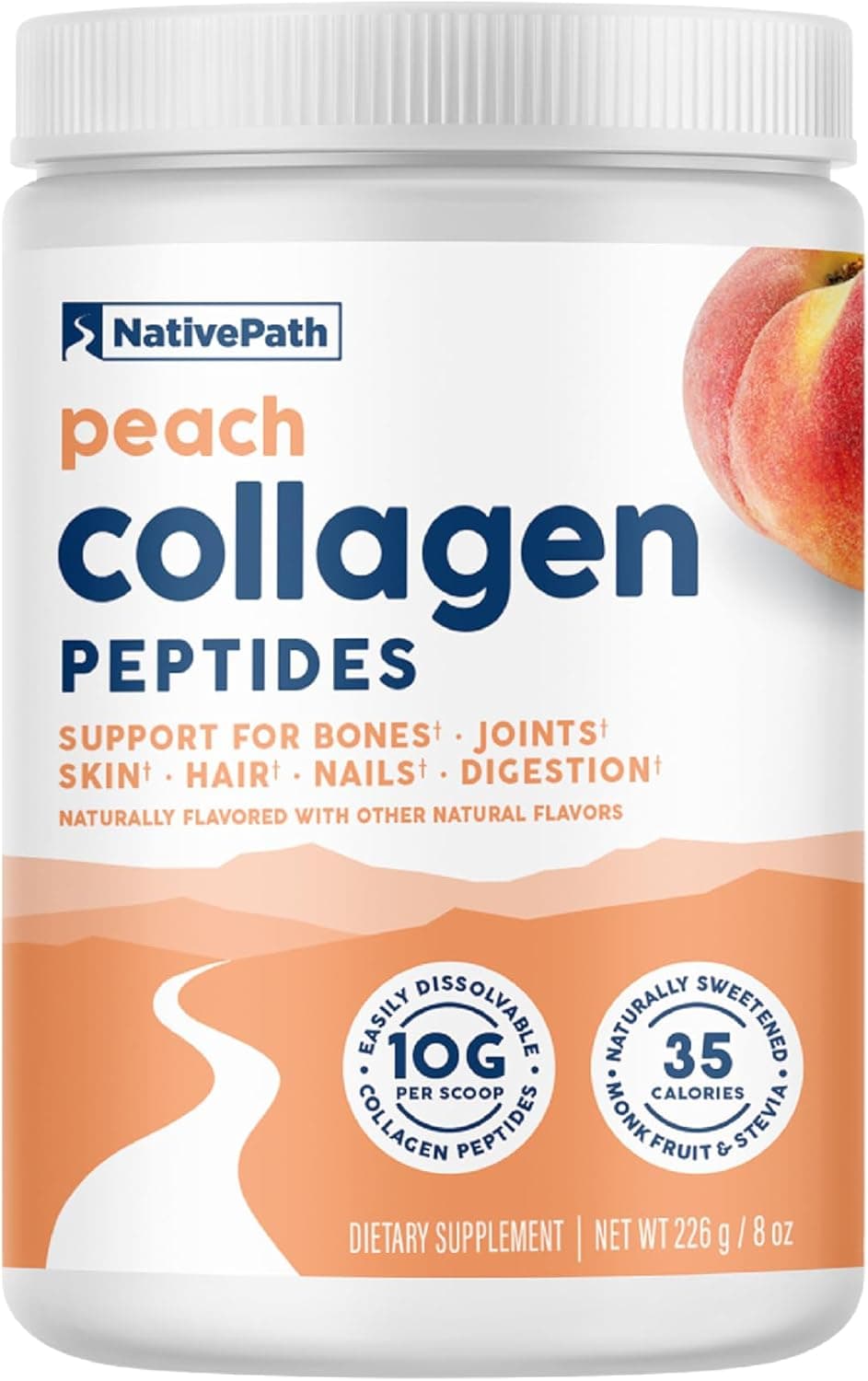
Collagen (Type I & III).
Supports skin elasticity and joint comfort, but results are subtle. Provides the building blocks for your skin, hair, nails, and joints. The idea is to give your body extra raw material to work with.
Reviewed March 2026
- Category
- Amino acid
- Also filed under
- Skin HealthJoint HealthConnective Tissue Support
What Collagen (Type I & III) is, and what it does.
- Does it work
- Maybe. The evidence for skin is decent, but the results are modest. For joints, it's mixed. It's one of the most overhyped supplements out there.
- How much to take
- 10 grams daily. Less than 5g is probably a waste. Mix the powder in coffee or a shake. Consistency is key.
- Time to feel it
- About 12 weeks of daily use.
- The first dose
- Absolutely nothing. This isn't a stimulant. Your body needs months to slowly incorporate these building blocks.
- With regular use
- After 8-12 weeks of daily use, you might notice slightly better skin hydration or less joint achiness. The effect is subtle.
- How well tolerated
- Generally well tolerated. It's basically a protein. The main issue is potential allergies to the source (bovine, marine, etc.). Check the label.
- How it feels
- You don't 'feel' it. It's not a mood or energy supplement. Any benefits are slow, gradual changes to your tissues over months.
- The overlooked benefit
- Hydrolysis is why it stirs into cold coffee instead of setting like jelly, and the short peptides it creates cross the gut wall intact through the PEPT1 transporter.
2.5 to 15g a day is where Collagen (Type I & III) works.
Source: Choi 2019 meta-analysis + Zague 2011 skin studies
In a randomised double blind placebo controlled trial, 77 healthy women took 5,000 mg a day of bioactive collagen peptides or placebo for 12 weeks with measurements at weeks 8, 12 and 16. Dermal density and hydration rose and transepidermal water loss fell against placebo at week 12, and those changes were still present after a 4 week washout rather than returning toward baseline. A second trial in 72 women separated from placebo at 8 weeks on hydration, elasticity and density, and retained the change 2 weeks after stopping. Both trials were run by or with the peptide manufacturers. A 2025 meta analysis of 23 randomised trials and 1,474 participants found these skin effects present in industry funded trials and absent in trials without industry funding, which is why the grade here is D.
The proof, claim by claim.
These words describe the research, not the molecule's worth. Research strength is how much work stands behind one claim, and it is never a product score.
While research supports collagen's role in skin and joint health, the magnitude of benefit from supplementation is debated. Some studies show statistically significant improvements, but the clinical relevance (real-world impact) is often modest.
- PromisingImproves skin elasticity and hydrationMeta-analysis26 trials, Pu et al., 2023 (Nutrients)PMID 37432180
- Reduces activity-related joint pain and osteoarthritis symptomsMeta-analysis of 5 RCTs
- Supports wound healing and connective tissue repairSeveral small RCTs
Questions people ask about Collagen (Type I & III).
- Does it actually work for wrinkles?
- It helps with skin hydration and elasticity, which can make fine lines look a bit better. Don't expect it to erase deep wrinkles. That's not how biology works.
- Which type of collagen is best?
- Types I & III are for skin, hair, and bones. Type II is for joints. Most powders are I & III. Go with that unless you have a specific joint issue.
- Can't I just drink bone broth?
- You can, but the collagen content varies wildly. A supplement powder gives you a consistent, known dose. You'd need a lot of high-quality broth.
- Does it matter what time I take it?
- Nope. Morning, noon, night. With food, without food. Just take it daily and be consistent.
- Do I need to take it with Vitamin C?
- Your body needs Vitamin C to make its own collagen, but you don't have to take them at the exact same time. Just make sure you get enough Vit C in your diet.
- Is vegan collagen a thing?
- Not really. True collagen comes from animals. 'Vegan collagen builders' are just a mix of amino acids and vitamins. It's a different product.
Why these belong in the same formula. Each row says what the basis is, from settled biochemistry through to a trial that measured the pair.
Vitamin C is the cofactor prolyl and lysyl hydroxylase depend on to add hydroxyl groups to proline and lysine while new collagen is assembled, and that hydroxylation is what lets the triple helix fold and stay stable. Collagen supplies the amino acid building blocks while vitamin C supports the body's own step of turning them into finished fibers, which is why the two are a standard pairing.
Copper sits at the active site of lysyl oxidase, the enzyme that forms the covalent cross-links between collagen strands that give mature fibers their tensile strength. With enough copper present, newly made collagen can complete this cross-linking step into stable connective tissue.
Zinc is required by several of the enzymes that build and remodel the collagen matrix and by the general protein-synthesis machinery cells use to lay down new fibers. It works alongside collagen's amino acids as a mineral the body draws on while forming and maintaining connective tissue.
Hyaluronic acid and collagen are the two main structural materials of the skin's dermal layer, where water-holding hyaluronic acid fills the space around the collagen scaffold and keeps the tissue hydrated and firm. Because they play complementary roles in the same matrix, the two have a long history of being formulated together for skin support.
Glycine fills roughly one position in three along the type I and III helix, so it is the largest amino acid demand of new collagen synthesis.
Lysine residues are hydroxylated and then cross-linked by copper-dependent lysyl oxidase, the step that gives type I fibrils their tensile strength.
Prolyl and lysyl hydroxylase are iron-dependent dioxygenases, so ferrous iron works with ascorbate at the active site for every hydroxyproline formed.
Silicon concentrates in connective tissue and has been reported to support prolyl hydroxylase activity and fibril cross-linking, which is why orthosilicic acid is paired with type I and III peptides.
Manganese is the cofactor for the glycosyltransferases that build the glycosaminoglycan matrix in which type I and III fibrils are embedded.
MSM contributes sulfur for the sulfated glycosaminoglycans and disulfide bonds of connective tissue, a block the peptides themselves do not supply.
Retinoids raise procollagen I expression in dermal fibroblasts, acting on the synthesis instruction while type I and III peptides supply the residues.
Grape seed proanthocyanidins bind collagen and elastin fibres and moderate the metalloproteinases that degrade them, so they act on the loss side while peptides act on the build side.
Catechins bind non-heme iron and copper in the gut, the same two metals that hydroxylate and cross-link collagen, so a shared dose window lowers mineral uptake. Separate the doses by a couple of hours.
A large calcium dose competes with non-heme iron at DMT1, and iron is the metal centre of the collagen hydroxylases, so combining them in one serving reduces iron uptake.
Collagen's repeating Gly-X-Y motif is dominated by proline and hydroxyproline, and hydroxyproline is made by hydroxylating proline already built into the chain. Supplying proline supports the amino acid pool that new collagen is assembled from. Whether extra dietary proline changes collagen output in a well-fed adult has not been shown, so the mechanism is settled while the effect is not.
Collagen hydrolysates lack tryptophan altogether, which is why collagen is not counted as a complete protein for dietary purposes. If collagen peptides displace a meaningful share of daily protein intake, tryptophan and the other limiting essential amino acids have to come from elsewhere in the diet. This is a composition fact, not a claim that either one enhances the other.
Collagen is rich in glycine, proline and hydroxyproline and poor in the branched-chain and sulphur amino acids. Whey is the opposite pattern. Used together the amino acid supply is broader than either alone. They are not interchangeable on a protein label and should be counted separately.
Leucine is the amino acid that triggers the muscle protein synthesis signal, and collagen peptides carry very little of it. Where collagen is being taken around resistance training, leucine has to be supplied by the wider diet for that signalling step. This clarifies a limit of collagen rather than promising a combined effect.
Chondroitin chains and collagen fibrils sit side by side in cartilage matrix, and the two are routinely formulated together for joint comfort and mobility during activity. They are absorbed and handled by completely separate routes, so any combined benefit would be additive. No trial in the candidate set tested the pair.
Glucosamine feeds glycosaminoglycan synthesis while collagen peptides supply the amino acid and peptide side of matrix turnover. Products aimed at joint comfort during activity commonly carry both. The grounding is each ingredient's own literature plus shared physiology, not a combination study.
Bone is roughly type I collagen plus hydroxyapatite, so the mineral phase needs both a collagen scaffold and calcium delivered to it. Vitamin D supports the calcium absorption side of that equation. Several candidate papers measure collagen-derived bone turnover markers alongside vitamin D, which is marker data rather than an outcome.
Vitamin K dependent carboxylation of osteocalcin is what lets that protein bind calcium in the bone matrix that type I collagen frames. The collagen scaffold and the carboxylation step are separate requirements, both needed for normal mineralisation. No combination trial of collagen peptides with MK-7 appears in the candidate set.
Collagen peptides and creatine are frequently taken by the same people during a training block, and one candidate trial reports collagen type I content in skeletal muscle after 12 weeks of loading. Creatine acts on phosphocreatine availability, collagen on matrix amino acid supply, so the routes do not overlap. Nothing here tested the two together.
Ceramides belong to the lipid barrier of the epidermis. Collagen types I and III form the dermal matrix underneath it. Skin formulas often carry both because they address different layers. No combination evidence exists in the candidate set, so this is an additive formulation pairing.
Photodamage shifts dermal collagen quality, and carotenoid antioxidants are studied for the oxidative side of that process while collagen peptides address substrate supply. One candidate paper is an animal study of a botanical antioxidant and UV-induced collagen change, which supports the mechanism direction only. Astaxanthin itself was not the tested agent.
Vitamin E sits in membranes and limits lipid peroxidation, a process that accompanies oxidative matrix damage. Collagen supply and lipid antioxidant defence are separate contributions to connective tissue maintenance. No trial of the pair exists, so this is mechanism-level and page-only.
Boron partitions into bone mineral while type I collagen forms the organic scaffold of the same tissue. Products for normal bone maintenance often carry both. The pairing rests on shared tissue rather than any measured interaction.
Talk to a doctor before taking Collagen (Type I & III) if any of these apply to you: Pregnancy, Breastfeeding, Allergies (fish, bovine, etc.). These are flags to check first, not effects Collagen (Type I & III) is known to cause.
Not medical advice. Show the label to your pharmacist.What Collagen (Type I & III) actually does.
Collagen's building blocks repeat in a pattern where about one in three amino acids is glycine, and that specific pattern is what lets three strands twist together into collagen's signature helix.
Two enzymes need vitamin C and iron to finish building the collagen chain, and that finishing step is what stabilizes the helix shape.
One enzyme involved in building collagen's cross-links needs copper, so having enough copper is necessary for the strength of the finished collagen fibers.
Breaking gelatin down into short pieces lets specific small units get absorbed intact through a gut transporter and show up in blood, which is why hydrolyzed collagen behaves differently in the gut than whole gelatin does.
Where Collagen (Type I & III) comes from.
It is made from animal hides, bones or fish skin left over from food processing. Those are cleaned, simmered to pull out gelatin, then broken down with enzymes into small pieces that mix into a cold drink without setting like jelly. Testing checks the piece size and confirms it really is collagen.
Made from an animal material. Species and tissue are the things worth knowing, and both belong on a label.
Bovine or porcine hide and bone, or fish skin and scales, arrive as by-products of meat and fish processing.
Hides are treated with alkali or acid to swell the tissue and strip non-collagen protein and fat. Bone is additionally demineralised with acid to leave the collagen matrix.
Controlled heating in water breaks the cross-links holding the triple helices together, releasing soluble gelatin.
Proteases cut the gelatin chains into shorter peptides, which is the step that gives a cold-water-soluble, non-gelling powder.
The hydrolysate is filtered, ion-exchanged and carbon-treated to remove ash, colour and odour, then concentrated.
Batches are characterised by average molecular weight distribution, protein content and hydroxyproline, which is the analytical fingerprint of collagen.
The concentrate is spray-dried to a free-flowing powder for sticks, tubs, capsules or gummies.
Getting Collagen (Type I & III) from food.
The whole-food sources on file. A supplement closes the gap, it does not replace dinner.
A gram-for-gram figure (how much of each you would eat to match a dose) will appear here once it is sourced and reviewed. This page will not print a number it cannot cite.
The forms it comes in.
The essence, in one line each.
- Pooling 19 randomized trials in 1,125 people, oral hydrolyzed collagen improved skin hydration and elasticity and reduced wrinkles versus placebo, with effects seen by about 90 days.Systematic review and meta-analysis. de Miranda et al., 2021 (International Journal of Dermatology). PMID 33742704 ↗
- Postmenopausal women taking 5 g of collagen peptides daily for 12 months gained bone mineral density at the spine and femoral neck, where the spine T-score rose about 0.1 while it edged down on placebo.Randomised trial. König et al., 2018 (Nutrients). PMID 29337906 ↗
- In 147 physically active athletes with healthy joints, 10 g of collagen hydrolysate daily for 24 weeks lowered joint pain when walking by about 1.1 points on a visual analogue scale versus 0.5 on placebo.Randomised trial. Clark et al., 2008 (Current Medical Research and Opinion). PMID 18416885 ↗
- Pooling randomised trials of oral and topical peptides, collagen peptides among them, found measurable improvement in skin elasticity and wrinkle depth against placebo.Meta-analysis. Nukaly et al., 2026 (Frontiers in Medicine). PMID 41924746 ↗
- Bioactive collagen peptides improved skin health measures during supplementation, and part of the improvement was still measurable after supplementation stopped.Randomised trial. Wang et al., 2025 (Journal of Cosmetic Dermatology). PMID 41311286 ↗
- Specific collagen peptides taken across 12 weeks of a hypertrophy-oriented training programme were reported to increase collagen type I content in skeletal muscle. A tissue composition measure, not a performance outcome.Randomised trial. Jerger S et al., 2026 (Frontiers in Physiology). PMID 42376607 ↗
- A randomised controlled evaluation of recombinant humanised type III collagen used for facial skin appearance. The material was applied clinically rather than swallowed, so it does not transfer to an oral peptide dose.Randomised trial. Huang Z et al., 2025 (Journal of Cosmetic Dermatology). PMID 41208340 ↗
- Injected recombinant humanised type III collagen solution combined with a type III collagen product was assessed for skin outcomes and tolerability. An injectable route, which is not comparable to an oral collagen peptide.Randomised trial. Qin X et al., 2026 (Journal of Cosmetic Dermatology). PMID 42087486 ↗
- Oral whole-leaf matcha partly reduced ultraviolet-induced disruption at the dermoepidermal junction and shifted collagen phenotype. An animal model showing that dietary intake can alter collagen phenotype, with matcha and not collagen as the tested agent.Animal study. Zorlu O et al., 2026 (Frontiers in Medicine). PMID 42359064 ↗
- Pooled randomised trials of exercise report movement in bone turnover markers, several of which are collagen fragments released during matrix remodelling. Collagen is named as the marker source and the endpoints are markers, not fractures or density outcomes.Meta-analysis. Zhang W et al., 2025 (Frontiers in Endocrinology). PMID 41030850 ↗
- A single high vitamin D dose altered ultramarathon-associated changes in serum bone turnover markers, which include collagen-derived fragments. The ingredient is named as marker chemistry and the measures are biomarkers.Randomised trial. Stankiewicz B et al., 2025 (Journal of the International Society of Sports Nutrition). PMID 40963202 ↗
- Vitamin D3, omega-3 fatty acids and exercise were tested against serum sclerostin and bone turnover markers, the latter comprising collagen breakdown and formation fragments. Marker-level results.Randomised trial. Tsourdi E et al., 2025 (Journal of Clinical Endocrinology and Metabolism). PMID 39657964 ↗
- Biglycan restored a neonatal extracellular matrix signalling environment that supported stem cell driven tendon regeneration, describing how matrix collagen context governs repair. Laboratory work naming collagen inside the matrix, not a supplement test.In vitro study. Li WT et al., 2026 (International Journal of Molecular Sciences). PMID 42196359 ↗
- Ergothioneine reduced cardiac collagen deposition in rats fed a high-fat diet, illustrating that dietary compounds can alter collagen accumulation in tissue. An animal study of a different compound, useful for the collagen turnover mechanism only.Animal study. Zeman M et al., 2026 (Journal of Nutritional Biochemistry). PMID 42457094 ↗
- A review of targeted supplementation for healthy ageing that names collagen among the physiological and molecular strategies discussed. A review summarising the field, not new measurement.Narrative review. Kurtz JA et al., 2026 (Current Nutrition Reports). PMID 42234350 ↗
These are the studies our verdict leans on, chosen from the 1,205 we read for Collagen (Type I & III). The full linked list is below.
FDA Disclaimer: These statements have not been evaluated by the Food and Drug Administration. This information is for educational purposes only and is not intended to diagnose, treat, cure, or prevent any disease. Consult your healthcare provider before starting any supplement regimen.