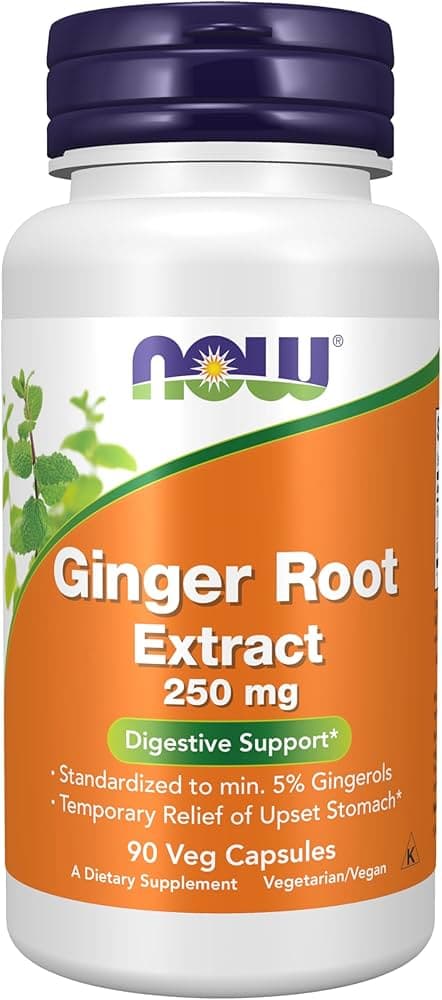
Ginger Extract.
May ease nausea and support digestion. Calms nausea, eases indigestion, and may reduce minor inflammation. Think of it as a natural settle-down for your gut.
Reviewed March 2026
- Category
- Herb
- Also filed under
- Nausea ReliefDigestive SupportAnti inflammatory
What Ginger Extract is, and what it does.
- Does it work
- Yes. Especially for motion sickness or morning sickness, where the evidence is solid. For general inflammation, other things work better.
- How much to take
- Look for an extract standardized for gingerols. 20-50mg of gingerols per day is the sweet spot. This usually means taking 250-500mg of the total extract.
- Time to feel it
- About eleven days of daily use.
- The first dose
- For nausea, you can feel it working in 1-2 hours. For general digestive support, the effects are more subtle and build over a few days.
- With regular use
- Less frequent indigestion. Some studies suggest it helps with menstrual cramps or minor joint aches due to its mild anti-inflammatory effect. A nice background support.
- How well tolerated
- Generally well tolerated. The main issue is potential stomach upset if you take a lot on an empty stomach. Talk to a doc if you have gallstones or take blood thinners.
- How it feels
- A mild, warming calm in your stomach. It takes the edge off of feeling queasy or bloated. Not a stimulant, not a sedative.
- The overlooked benefit
- Processing sets the chemistry. Drying converts gingerol into shogaol, so two extracts from the same root can carry quite different pungent profiles depending on how they were dried.
20 to 50mg a day is where Ginger Extract works.
Source: Bodagh et al. 2019 Food Sci Nutr meta-analysis; Viljoen et al. 2014 Nutr J
Two double blind, placebo controlled, randomised experiments with 34 and 40 volunteers gave 2 g of raw or heat treated ginger daily for 11 consecutive days, then induced muscle pain with 18 eccentric elbow flexor actions. Pain 24 hours after the exercise was 25 percent lower with raw ginger and 23 percent lower with heat treated ginger than with placebo, a modest difference, and effects on arm volume, range of motion and strength were smaller. A separate 5 day protocol in 32 recreational distance runners at 1.425 g a day reported a smaller rise in soreness while jogging after a downhill run, with unclear effects on most other outcomes.
The proof, claim by claim.
These words describe the research, not the molecule's worth. Research strength is how much work stands behind one claim, and it is never a product score.
There is a good body of evidence supporting ginger's anti-nausea and digestive benefits. While more research is always welcome, the existing data is fairly consistent.
- Occasional nausea and queasinessMeta-analysis
- Gastric emptying and upper gut motilityRandomised trial
- Comfort across the monthly cycleMeta-analysis
- Joint comfort and everyday stiffnessMeta-analysis
- Cyclooxygenase and lipoxygenase mediated eicosanoid formationIn vitro study
- TRPV1 vanilloid receptor activationIn vitro study
Questions people ask about Ginger Extract.
- Can I just eat ginger candy instead?
- Not the same. Most candy is just sugar with a hint of flavor. You need a standardized extract to get a reliable dose of the active compounds, gingerols.
- Is it good for motion sickness?
- Yes. This is one of its best-studied uses. Take it 30-60 minutes before you travel.
- Will it give me heartburn?
- Unlikely at normal doses, but it can happen if you take a lot. Always take it with food to be safe.
- Can I take it every day?
- Yes. It's well tolerated in daily use as a digestive aid.
- Fresh ginger vs. extract?
- Fresh ginger is great in food, but the dose is inconsistent. Extracts guarantee you're getting the active gingerols that do the real work.
Why these belong in the same formula. Each row says what the basis is, from settled biochemistry through to a trial that measured the pair.
Gingerols and curcumin act on the same eicosanoid machinery, both lowering cyclooxygenase activity and the prostaglandin output the body uses to run a normal inflammatory response. That overlapping mechanism, along with their shared rhizome chemistry, is the long-standing reason the two are formulated side by side.
Gingerols lower thromboxane output while EPA and DHA shift the same eicosanoid pool toward less sticky signaling, so both influence how platelets clump during normal clotting. Their effects run in the same direction and can add together, which is the usual reason to account for the pairing at higher intakes.
Ginkgolides block platelet-activating factor while gingerols cut thromboxane synthesis, two separate levers on the same normal clotting process. Since both nudge platelet aggregation in the same direction, the effects can stack, which is the well-recognized caution about taking them together.
Piperine inhibits intestinal glucuronidation and CYP metabolism, which raises circulating levels of co-dosed phytochemicals including gingerols. This is the standard reason a pepper extract sits in a botanical formula.
Ginger speeds gastric emptying while menthol relaxes intestinal smooth muscle by blocking calcium entry. The two mechanisms sit at different levels of the tract.
Cynarin from artichoke raises bile secretion for normal fat handling while ginger moves gastric contents onward. The mechanisms sit in sequence along normal digestion.
Boswellic acids act on 5-lipoxygenase and leukotriene formation while gingerols act on cyclooxygenase and lipoxygenase both. The two cover different arms of arachidonic acid handling.
Gingerols inhibit thromboxane synthesis while garlic organosulfur compounds lower platelet aggregation separately. Independent mechanisms on normal clotting stack.
Salicin converts to salicylate and inhibits platelet cyclooxygenase, and gingerols suppress thromboxane as well. Together the effect on normal clotting is larger than either alone.
Generous tocopherol doses reduce platelet adhesion and thromboxane release, the same normal function gingerols act on. The two are additive rather than complementary here.
Concentrated ginger polyphenols bind ferric iron in the gut into complexes the intestine absorbs poorly. Co-dosing an extract with iron lowers iron uptake.
A randomised trial combined green tea extract with ginger supplementation and reported changes in endurance performance measures and in how participants rated thermal sensation. Both materials are polyphenol and terpene rich and both act on thermogenic and antioxidant pathways, which is the stated rationale for pairing them. The trial measured performance and perception endpoints, so read the result as specific to that protocol rather than as a general claim.
Rosemary and ginger extracts were assessed together in a laboratory model of oxidative stress, with DNA integrity and vascular endothelial measures as the readouts. Carnosic acid from rosemary and gingerols from ginger both act on the same Nrf2-linked antioxidant response, which explains why the two are studied as a pair. These are laboratory markers, not outcomes in people.
Bromelain is a proteolytic enzyme from pineapple stem and ginger contributes gingerols and shogaols, and the two appear together in blends aimed at post-exercise comfort. Both act on eicosanoid signalling by different entry points, which is the mechanistic argument for the pairing. No trial of the specific combination establishes an additive size.
Gingerols inhibit thromboxane synthesis and platelet aggregation in laboratory work, and nattokinase acts on fibrin and clot dynamics. Stacking two agents that both push platelet and clot behaviour in the same direction is a compatibility flag, not a benefit. Anyone on medication that affects clotting should raise the combination with their clinician before using it.
Garlic organosulfur compounds and ginger phenolics each inhibit platelet aggregation through separate routes, so the effects on that measure add rather than cancel. This matters most when other agents acting the same way are already in the stack. Flag it as an interaction to check, not as a reason to combine.
Gymnemic acids act on intestinal sugar uptake and sweet-taste signalling, while ginger phenolics have been studied for effects on glucose and insulin markers. The two occupy different steps, which is the argument for combining them. The additive size in people has not been measured for this pair.
Ginger has a long record as a carminative and prokinetic aid taken with meals, and enzyme blends act on macronutrient breakdown in the same window. The two support normal digestive comfort by different routes, one on motility and one on hydrolysis. The pairing is convention with a mechanistic rationale rather than a trialled combination.
Betaine hydrochloride supplies gastric acidity for pepsin activation while ginger supports normal gastric emptying. Products aimed at post-meal comfort commonly carry both. There is no combination trial, so the basis is formulation convention plus separate mechanisms.
Ginger and licorice appear together in a large number of traditional formulas, where licorice is used as a harmonising herb and ginger as a warming carminative. Deglycyrrhizinated licorice is the form usually chosen in supplements because whole licorice affects mineralocorticoid signalling at sustained doses. The pairing is historical convention with a mechanistic story, not a measured combination result.
Chamomile contributes apigenin and bisabolol and ginger contributes gingerols, and the two are combined in teas aimed at post-meal comfort. The routes differ, with chamomile acting on smooth muscle and receptor signalling and ginger on motility. Take this as long-standing practice rather than trial evidence.
Glutamine is the preferred fuel of enterocytes and ginger supports normal gastric motility, so blends aimed at digestive comfort often carry both. They act at different points, one on cell metabolism and one on motility. No combination trial defines the joint effect.
MSM contributes bioavailable sulfur and ginger contributes gingerols and shogaols, and both are used in formulas for joint comfort and mobility during activity. The mechanisms sit in different places, which is why they are stacked. The combined effect has not been measured directly.
Magnesium relaxes smooth muscle and draws water into the bowel lumen at higher doses, while ginger acts on gastric motility. Products aimed at normal digestive rhythm sometimes carry both. The interaction is mechanistic and dose-dependent rather than trial-defined.
Zinc has an established role in normal immune function as a cofactor across hundreds of enzymes, while ginger is used as a warming carminative in the same category of products. The two do not share a pathway. The pairing is a category convention. Nothing here says the combination performs better than either alone.
Talk to a doctor before taking Ginger Extract if any of these apply to you: Blood Thinners, Pregnancy, Gallstones. These are flags to check first, not effects Ginger Extract is known to cause.
Not medical advice. Show the label to your pharmacist.What Ginger Extract actually does.
The bite in ginger comes from a family of compounds called gingerols.
Drying and heating turns gingerols into shogaols, so a dried extract has a different profile from fresh root.
They switch on the same nerve receptor that responds to heat, which is why ginger feels warming.
It helps the stomach empty at a normal pace after a meal.
Where Ginger Extract comes from.
The root is washed, sliced and dried, then the active compounds are pulled out with alcohol or pressurised carbon dioxide. The solvent is removed, the strength is measured, and what is left is dried into a concentrated powder or kept as a thick oil.
Made from a plant. What ends up in the capsule tracks the harvest, so batch testing and a stated marker matter more here than with a made molecule.
Cultivated ginger rhizome, most supplement-grade material from India, China, Nigeria or Peru, harvested at maturity for higher pungent-principle content.
Rhizomes are washed, sliced and dried, a step that also converts part of the gingerol content to shogaol through dehydration.
The milled root is extracted with ethanol and water, or with supercritical carbon dioxide, which selects the lipophilic pungent principles and essential oil.
Ethanol is stripped under vacuum, or carbon dioxide is simply depressurised off, leaving an oleoresin or a dried concentrate.
HPLC quantifies 6-gingerol and related pungent compounds and the concentrate is diluted onto a carrier to hit the declared percentage.
The standardised material is spray dried onto a carrier for capsules and tablets, or kept as an oleoresin for softgels and liquids.
Getting Ginger Extract from food.
The whole-food sources on file. A supplement closes the gap, it does not replace dinner.
A gram-for-gram figure (how much of each you would eat to match a dose) will appear here once it is sourced and reviewed. This page will not print a number it cannot cite.
The forms it comes in.
The essence, in one line each.
- Across 13 trials in 1,174 pregnant women, ginger eased nausea more than placebo (standardised difference 0.82) while the reduction in vomiting was not statistically significant.Meta-analysis. Hu et al., 2020 (Journal of Maternal-Fetal & Neonatal Medicine). PMID 31937153 ↗
- Pooling 16 randomised trials in 1,010 adults, ginger supplementation lowered circulating C-reactive protein and TNF-alpha, with no detectable change in interleukin-6 or sICAM.Meta-analysis. Morvaridzadeh et al., 2020 (Cytokine). PMID 32763761 ↗
- Across six trials in 345 adults, ginger lowered systolic blood pressure by about 6.4 mmHg and diastolic by about 2.1 mmHg, with the shift seen only in the subsets taking 3 g a day or more, aged 50 or under, and studied for eight weeks or less.Meta-analysis. Hasani et al., 2019 (Phytotherapy Research). PMID 30972845 ↗
- In 14 trials in 473 adults carrying excess body weight, ginger lowered body weight, waist-to-hip ratio, fasting glucose and insulin resistance and raised HDL cholesterol, with no detectable change in BMI, insulin, triglycerides or LDL cholesterol.Meta-analysis. Maharlouei et al., 2019 (Critical Reviews in Food Science and Nutrition). PMID 29393665 ↗
- Pooling trials of interventions derived from the Zingiberaceae family, which includes ginger, the review reports small improvements on memory-related and other cognitive outcomes in adults, with the size of the effect varying widely between studies.Systematic review. Victoria-Montesinos et al., 2026 (Frontiers in nutrition). PMID 42199754 ↗
- Across randomised trials, intake of species from the Zingiberaceae family, which includes ginger, was associated with modest reductions in fasting blood sugar and related glycemic markers in adults with raised blood sugar.Meta-analysis. Victoria-Montesinos et al., 2025 (International journal of molecular sciences). PMID 40565030 ↗
- An overview of the existing meta-analyses on ginger finds the most consistent human signals for nausea, inflammatory markers and glycemic and lipid measures, with much of the underlying evidence graded low certainty.Systematic review. Paudel et al., 2025 (Frontiers in pharmacology). PMID 40808693 ↗
- In adults carrying excess body weight, steamed ginger extract produced small reductions in body weight and body fat compared with placebo over the trial period, with no safety signal reported.Randomised trial. Kwon et al., 2026 (Nutrients). PMID 41599979 ↗
- Ginger supplementation shifted markers of inflammation and measures of functional capacity modestly compared with placebo, with several outcomes showing no detectable difference between groups.Randomised trial. Broeckel et al., 2025 (Nutrients). PMID 40732990 ↗
- Combined green tea extract and ginger supplementation was reported to influence endurance performance measures and thermal perception relative to control.Randomised trial. Demirli et al., 2025 (Nutrients). PMID 41010475 ↗
- A published protocol describing a randomised study of ginger root extract and microbiota-gut-brain axis measures. It sets out methods and reports no results.Randomised trial. Shen et al., 2026 (Clinical Nutrition ESPEN). PMID 41831719 ↗
- A review of ginger bioactives mapping their multi-target mechanisms, delivery approaches and the state of the human literature.Narrative review. Simeone et al., 2026 (Nutrients). PMID 41978129 ↗
- Rosemary and ginger extracts were reported to preserve DNA integrity and endothelial function measures in a laboratory oxidative stress model.In vitro study. Park et al., 2026 (Food Science and Biotechnology). PMID 41909864 ↗
- Ginger liquid extract in the diet was associated with changes in growth, immune response and antioxidant defence markers in the animals studied.Animal study. Ozkaya et al., 2024 (Tropical Animal Health and Production). PMID 38602560 ↗
- Red ginger extract combined with a cooling perch was reported to improve thermoregulatory and performance measures under tropical heat conditions.Animal study. Syafwan et al., 2026 (Poultry Science). PMID 42308737 ↗
- Scallion white and ginger extracts reduced stress-related deterioration in muscle quality measures during transport.Animal study. Peng et al., 2026 (Foods). PMID 42195849 ↗
- Graded levels of a ginger-derived liquid protease were associated with differences in growth performance, nutrient digestibility and immune markers.Animal study. Ali et al., 2025 (Journal of Animal Physiology and Animal Nutrition). PMID 40387503 ↗
These are the studies our verdict leans on, chosen from the 7,390 we read for Ginger Extract. The full linked list is below.
The studies, linked.
2 sources behind our Ginger Extract verdict: peer-reviewed studies and registered clinical trials. Every one links straight to PubMed, the journal, or ClinicalTrials.gov. Read them yourself.
- Clinical trialMulticenter, Randomized, Double-blind, Placebo Controlled, Study to Evaluate the Activity of a Ginger (Zingiber Officinale) Food Supplement in the Management of Nausea in Patients Receiving Highly Emetogenic Treatments and Standard Anti-emetogenic Therapy.ClinicalTrials.gov ↗250 participants, Completed
- Clinical trialEffect of Ginger Extract on Postprandial Glycemia of Healthy Adults and Its Antioxidant Properties: a Randomized Controlled TrialClinicalTrials.gov ↗30 participants, Completed
Evidence surfaced via Semantic Scholar (Allen Institute for AI) and ClinicalTrials.gov. Ranked by study type and citation weight, not cherry-picked.
Problems people have reported.
Read this carefully. These are 41 voluntary, unverified reactions reported to the FDA (openFDA). The number mostly reflects how popular Ginger Extract is, not how risky it is. A report is not proof Ginger Extract caused anything. It is a signal of what to watch for, nothing more.
Source: openFDA adverse-event reports. Voluntary reporting, not an incidence rate.
FDA Disclaimer: These statements have not been evaluated by the Food and Drug Administration. This information is for educational purposes only and is not intended to diagnose, treat, cure, or prevent any disease. Consult your healthcare provider before starting any supplement regimen.