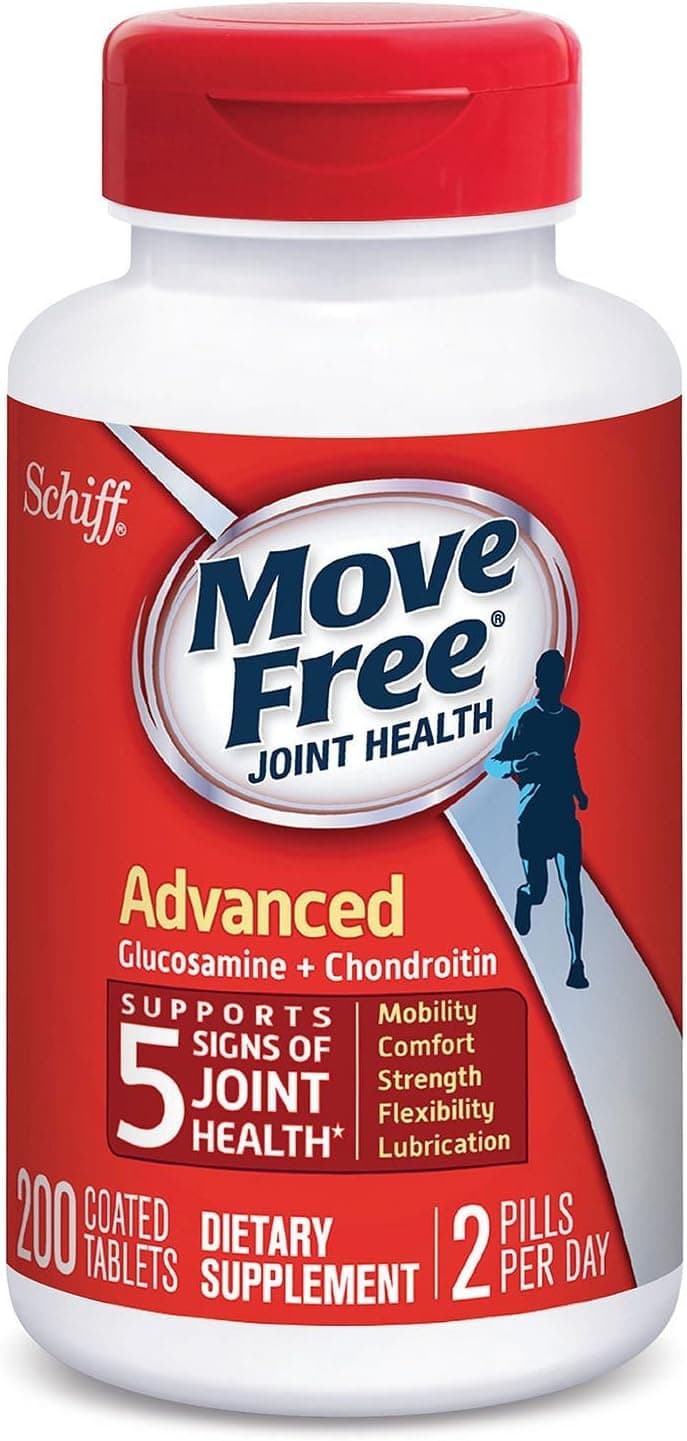
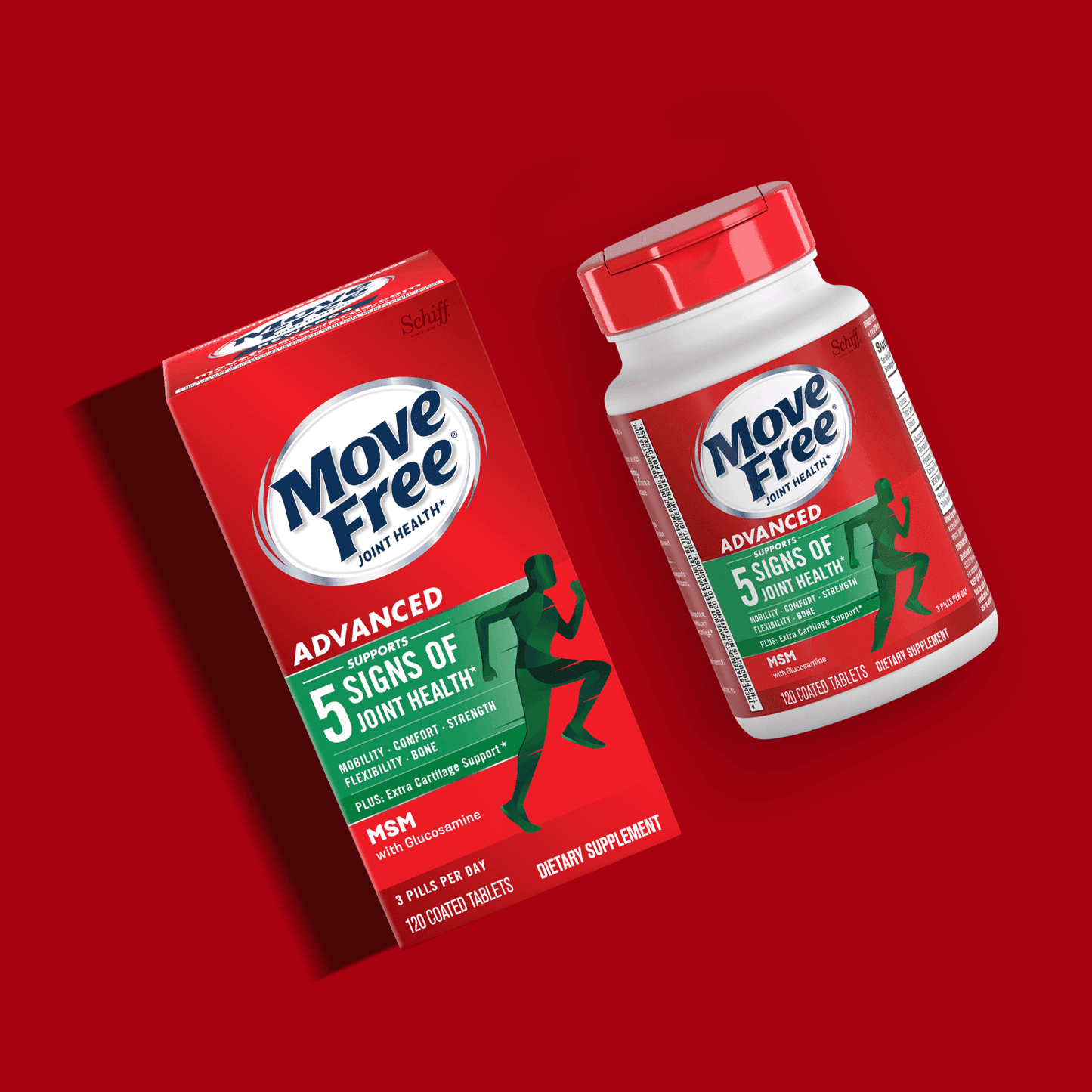
Glucosamine.
May help with joint comfort and flexibility. It's an amino sugar your body uses to build the cushioning matrix inside cartilage. Taken daily, it supports joint comfort and easy movement.
Reviewed March 2026
- Category
- Amino acid
- Also filed under
- Joint healthReduced joint painImproved joint flexibility
What Glucosamine is, and what it does.
- Does it work
- Suits people whose knees, hips or hands feel stiff, and anyone who has loaded the same joints for years. A fermented version covers people avoiding shellfish.
- How much to take
- Start with 1,500mg a day, taken with food. One dose or three smaller ones land the same daily total, so pick whichever you'll actually keep up with.
- Time to feel it
- Within about 6 to 8 hours of a single dose.
- The first dose
- Day one is quiet work. The sugar is absorbed within hours and routed into cartilage building pathways, and that shows up over weeks.
- With regular use
- Give it four to eight weeks, with three months the honest window. Daily use keeps supplying the amino sugar your cartilage matrix is built from, and the change is gradual.
- How well tolerated
- Well tolerated, with mild digestive upset the usual complaint. Shell-derived versions carry crustacean material. Check with your doctor if you take a blood thinner.
- How it feels
- There's no kick to it. What shifts is background stiffness, noticed when stairs or a jar lid stop registering as an effort.
- The overlooked benefit
- The same sugar feeds hyaluronan production and O-GlcNAc protein signalling, so it supports the fluid side of a joint and not only the cartilage itself.
1,500mg a day is where Glucosamine works.
Source: Wandel 2010 meta + GAIT study 2006
After a single 1500 mg oral dose of glucosamine sulfate in a randomized crossover study of 10 healthy adults, glucosamine was followed in blood over 24 hours, and its metabolite glucosamine-6-sulfate peaked at 6 to 8 hours with a longer half-life.
The proof, claim by claim.
These words describe the research, not the molecule's worth. Research strength is how much work stands behind one claim, and it is never a product score.
Research on glucosamine is mixed, with some studies showing benefit for joint pain and osteoarthritis, while others show no significant effect. Effectiveness may vary depending on the individual and the specific formulation of glucosamine used. Many trials use pharmaceutical grade glucosamine, so supplement grade versions may have less reliable effects. However, it does have a long history of use with a relatively good safety profile.
- Joint comfort with daily useMeta-analysis
- Joint mobility and stiffnessRandomised trial
- Supply of the amino sugar used to build cartilage matrixNarrative review
- Cartilage cell glycosaminoglycan productionIn vitro study
- Joint space and structural markers over years of useRandomised trial
- Long-term use and general health outcomesCohort study
Questions people ask about Glucosamine.
- When should I take it?
- Timing matters less than consistency. Pick a time that works for you and take it daily.
- Can I take it with other supplements?
- Usually fine. The main thing to watch is not doubling up on the same ingredient from different products. If you're on prescription meds, check with your pharmacist first.
- Any side effects to watch for?
- Most people tolerate it well at recommended doses. GI upset is the most common complaint with any supplement. Start with a lower dose and work up. If something feels off, stop and reassess.
- Who benefits most from this?
- People with a specific, evidence-backed need. Glucosamine has strong research. If your situation matches the studied use case, it's one of the more reliable supplements you can take.
What the trials show about these together.
Outcomes the engine found studied for these actives as a combination, not one at a time. Each is a finding a named trial measured, cited and dated, never written by the brand.
- PromisingGlucosamine + ChondroitinJoint
In a meta-analysis of eight randomized trials, glucosamine taken together with chondroitin lowered total WOMAC osteoarthritis scores versus placebo, while pain-specific scores did not reach significance.
Meng et al., 2022 (Arch Orthop Trauma Surg)PMID 35024906
Research strength. Research strength says how much work stands behind the combination. It is never a product score.
Fail closed. Where actives were studied on their own rather than together, each shows on its own evidence, never a combined effect no trial measured.
Independent record. Every finding is cited to a named trial, dated, and never written by the brand.
Findings from trials that studied these actives as a combination. Context for how the actives were tested together, not a statement about any individual and not a claim about this product.
Why these belong in the same formula. Each row says what the basis is, from settled biochemistry through to a trial that measured the pair.
Glucosamine supplies the amino sugar backbone unit and chondroitin the sulphated chain. They are the two halves of the same cartilage matrix chemistry and have been formulated together for decades.
The sulfate salt delivers the same amino sugar plus a sulphate counter ion. A formula carrying both is stacking one molecule in two salt forms.
Hyaluronan chains are built from alternating glucuronic acid and N-acetylglucosamine, and glucosamine feeds the UDP-N-acetylglucosamine pool. One supplies the building block, the other the finished polymer.
The glycosyltransferases that extend glycosaminoglycan chains are manganese dependent. Manganese ascorbate joint formulas were built on that cofactor logic.
Ascorbate is required by the prolyl and lysyl hydroxylases that mature collagen in the same tissue glucosamine feeds. It also appears as the counter ion in glucosamine ascorbate raw material.
MSM supplies bioavailable sulphur used in sulphated matrix components while glucosamine supplies the amino sugar unit. The two have been paired in joint products on that basis.
Collagen peptides supply the protein fibre substrate while glucosamine supplies the amino sugar side of the matrix. They feed different components of the same tissue.
Boswellic acids act on the 5-lipoxygenase arm of normal inflammatory signalling while glucosamine acts as a matrix substrate. The mechanisms do not overlap, which is why they are combined.
Curcumin modulates NF-kB driven signalling while glucosamine supplies matrix substrate. The two act on separate parts of normal joint comfort.
EPA shifts eicosanoid production toward less inflammatory series while glucosamine feeds the matrix. Neither covers the other's mechanism.
Eggshell membrane naturally contains glycosaminoglycans and collagen. Pairing it with glucosamine adds the same matrix chemistry from a whole material source.
Both are hexosamines that feed the same endpoint, UDP-N-acetylglucosamine, the activated sugar donor cells use to build glycosaminoglycans and to glycosylate proteins. Glucosamine has to be acetylated first. N-acetylglucosamine enters one step further along. Formulas that carry both are supplying the same pathway at two entry points rather than doing two different things.
The body makes its own glucosamine-6-phosphate by transferring the amide nitrogen of glutamine onto fructose-6-phosphate, a reaction run by glutamine-fructose-6-phosphate amidotransferase. Glutamine is therefore the nitrogen donor for endogenous hexosamine synthesis. Supplemental glucosamine enters downstream of that step, so the two sit on the same route at different points.
Cartilage is a composite: a collagen scaffold with proteoglycans packed into it. Glycine occupies every third position in the collagen triple helix, while glucosamine supplies the amino-sugar backbone of the proteoglycan side. Pairing them supports two different structural components of the same tissue rather than duplicating one.
Proline and its hydroxylated form are the other repeating residues of collagen, and hydroxyproline is what stabilises the triple helix. Glucosamine contributes to the proteoglycan fraction of connective tissue, not the collagen fraction. The two cover complementary halves of normal matrix turnover.
Lysyl oxidase, the enzyme that cross-links collagen and elastin fibres, is copper-dependent and does nothing without it. Glucosamine has no role in that cross-linking step. In a connective-tissue formula copper covers the enzymatic finishing of the scaffold while glucosamine covers substrate supply for the ground substance.
Orthosilicic acid is described in connective-tissue literature as taking part in early collagen matrix formation, and silicon shows up bound to glycosaminoglycan fractions of tissue. The human data is thinner than the biochemistry, so this sits at a mechanistic level rather than an outcome level. Glucosamine supplies the amino sugar. Silicon is associated with the matrix that sugar ends up in.
Ginger gingerols act on eicosanoid signalling and appear in joint-comfort blends alongside glucosamine. The two do unrelated things: one modulates inflammatory mediators, the other feeds matrix synthesis. Ginger also has a mild effect on platelet function, worth noting when several such ingredients stack.
Proanthocyanidins bind and stabilise collagen fibres in vitro and quench reactive oxygen species that degrade matrix components. Glucosamine does neither. The pairing is mechanistically sensible and thinly studied together, so it belongs at an early confidence.
A share of an oral glucosamine dose is not absorbed in the small intestine and reaches the colon, where resident bacteria act on it as an amino-sugar substrate. A 2021 review of glucosamine and gut health describes shifts in microbial composition and metabolite output on that basis. What the colonic fraction does downstream is not settled, so this is a modulating relationship rather than an additive one.
Inulin is a fermentable fructan that reaches the colon intact and shifts which bacterial groups dominate. Any unabsorbed glucosamine arrives in the same compartment. The interaction is plausible and has not been characterised in a dedicated combination study, so it stays early.
The hexosamine pathway that glucosamine feeds is a nutrient-sensing branch of glucose metabolism, and berberine acts on AMPK-linked glucose handling. Anyone combining them is touching normal glucose regulation from two directions. Human combination data does not exist, and the direction of the net effect has not been measured, so this is flagged for awareness rather than recommended.
Chromium is used in formulas aimed at normal glucose handling, the same physiology the hexosamine pathway reports on. Glucosamine at supplemental doses is a small flux into that pathway. The combination has not been studied directly. The note exists so a formulator sees the overlap rather than assuming independence.
Case-level reports describe changes in anticoagulant response in people taking glucosamine, and nattokinase has its own fibrinolytic activity. Stacking two ingredients that touch clotting deserves attention even where neither effect is large on its own. No combination study exists, so the pairing is flagged, not quantified.
Glucosamine is a building block of the glycosaminoglycans in cartilage, and chondroitin sulfate is one of those glycosaminoglycans itself. Formulas have paired the two for decades on that shared role in the cartilage matrix, and most of the trial record studies them together rather than apart.
Talk to a doctor before taking Glucosamine if any of these apply to you: Shellfish allergy (if derived from shellfish), May affect blood sugar levels, Those on blood thinners should consult a doctor. These are flags to check first, not effects Glucosamine is known to cause.
Not medical advice. Show the label to your pharmacist.What Glucosamine actually does.
The body turns glucosamine into the building block it uses to make cartilage cushioning and to decorate proteins with sugars.
Your body already makes glucosamine-6-phosphate from fructose-6-phosphate and the amide nitrogen of glutamine, in a rate-limiting step run by one control enzyme. Supplemental glucosamine enters after that step, so it bypasses the control point.
Cartilage cushioning is made of long sugar chains, and glucosamine is one of the sugars in those chains.
Glucosamine is taken into gut and tissue cells largely through glucose transporters, so when concentrations run high, glucose and glucosamine compete for the same carriers.
Where Glucosamine comes from.
Most glucosamine starts as shrimp or crab shell that is broken down with acid. Some is grown instead by fermenting corn sugar, which never touches shellfish. The molecule at the end is identical. The difference is what else might be left over.
The same molecule is reached more than one way. Which route a given product used is a manufacturing choice, and the finished compound is the same either way.
Two independent starting materials are in commercial use: chitin recovered from shrimp and crab shell, a seafood-processing by-product, and plant glucose from corn or wheat starch used as the carbon source for microbial fermentation.
The shell route deacetylates and depolymerises chitin with concentrated hydrochloric acid at heat, giving glucosamine hydrochloride directly. The fermentation route uses Aspergillus niger or an engineered bacterium to build the amino sugar from glucose, giving a product with no shellfish contact.
On the shell route the raw shell is first stripped of calcium carbonate with acid and of residual protein with alkali before hydrolysis, since both would otherwise carry through.
The hydrolysate is filtered, treated with activated carbon to remove colour, then crystallised and recrystallised. Residual protein is the analyte that matters most for anyone avoiding shellfish material.
Where a sulfate presentation is wanted, the hydrochloride is converted and co-crystallised with potassium or sodium chloride to give a stable solid. Assay is set on glucosamine base.
Dried, milled to a defined particle size and blended for tablet, capsule or drink powder use.
Getting Glucosamine from food.
The whole-food sources on file. A supplement closes the gap, it does not replace dinner.
A gram-for-gram figure (how much of each you would eat to match a dose) will appear here once it is sourced and reviewed. This page will not print a number it cannot cite.
The forms it comes in.
The essence, in one line each.
- The authors conclude that oral glucosamine reaches the colon in part and is associated with shifts in microbial composition and gut barrier markers, and that human outcome data remains limited.Narrative review. Moon et al., 2021 (Nutrients). PMID 34202877 ↗
- This pilot crossover compared plasma pharmacokinetics of two glucosamine presentations and reported the measured exposure profile for each. A pharmacokinetic marker, not a clinical outcome, and the sample was a pilot.Randomised trial. Chang et al., 2025 (Nutrients). PMID 40806074 ↗
- In athletes recovering from knee ligament reconstruction, the authors reported their measured cartilage turnover and functional endpoints between glucosamine and placebo arms. A single small trial in a narrow population.Randomised trial. Eraslan et al., 2015 (Research in Sports Medicine). PMID 25630243 ↗
- A double-blind trial compared a multi-nutrient supplement plus exercise against exercise alone in older adults with age-related knee joint wear. Glucosamine was one component of the blend, so its individual contribution cannot be separated.Randomised trial. Liu et al., 2025 (Age and Ageing). PMID 39982001 ↗
- In a propensity-score-matched cohort, regular glucosamine use was associated with lower incidence of several age-related chronic conditions. An association in observational data, not a demonstrated cause.Cohort study. He et al., 2025 (Aging Clinical and Experimental Research). PMID 40879960 ↗
- The authors report an association between habitual glucosamine supplementation and the incidence of a major cardiovascular endpoint in cohort data. Observational association only, with residual confounding by healthy-user behaviour acknowledged.Cohort study. Barillas-Lara et al., 2023 (Mayo Clinic Proceedings). PMID 37536800 ↗
- No association was detected between glucosamine supplementation and later neurological diagnoses in this prospective cohort. A failure to detect a relationship, which is not evidence that none exists.Cohort study. Ai et al., 2024 (Journals of Gerontology Series A). PMID 37158699 ↗
- A Mendelian randomisation analysis using genetic instruments for glucosamine use reported an inverse association with high blood sugar risk. Genetic association analysis, not a supplementation trial and not a measured outcome of taking a product.Cohort study. Zhou et al., 2025 (Journal of International Medical Research). PMID 40300556 ↗
- Mendelian randomisation reported associations between genetically proxied glucosamine use and cognitive and muscle-mass traits. The instruments are genetic proxies, so this is association from inherited variation rather than an effect of supplementation.Cohort study. Kang et al., 2024 (Frontiers in Endocrinology). PMID 39764251 ↗
- Reported glucosamine use was associated with slower progression of elevated liver fat and related endpoints in this analysis. An observational association, with the usual healthy-user confounding.Cohort study. Ryu et al., 2025 (Clinical Nutrition). PMID 40020645 ↗
These are the studies our verdict leans on, chosen from the 10 we read for Glucosamine. The full linked list is below.
The studies, linked.
11 sources behind our Glucosamine verdict: peer-reviewed studies and registered clinical trials. Every one links straight to PubMed, the journal, or ClinicalTrials.gov. Read them yourself.
- Clinical trialEfficacy and Safety of Xinfeng Capsule in the Treatment of Knee Osteoarthritis (KOA) :A Randomized, Double-blind, Double-dummy, Multi-center TrialClinicalTrials.gov ↗268 participants, Completed
- Clinical trialA Randomised, Double-blind, Placebo-controlled Study to Evaluate the Efficacy and Safety of Collavant n2 in Individuals With Osteoarthritis of the KneeClinicalTrials.gov ↗236 participants, Completed
- Clinical trialDevelopment of Biomarker and Functional Assessment Tools to Evaluate the Effect of Glucosamine on Joint Structure and Quality of LifeClinicalTrials.gov ↗201 participants, Completed
- Clinical trialEfficacy of Bioactive Collagen Peptide Versus Glucosamine and Chondroitin Sulphate in Grade I-III Knee Osteoarthritis: A Randomized Controlled TrialClinicalTrials.gov ↗150 participants, Completed
- Clinical trialSymptomatic Effects of Long-term Crystalline Glucosamine Sulfate Therapy in Hand Osteoarthritis: a Comparative Retrospective StudyClinicalTrials.gov ↗108 participants, Completed
- Clinical trialAn Exploratory Study of the Effects of Oral Glucosamine Administration on Insulin Sensitivity and Capillary Recruitment in Normal and Obese SubjectsClinicalTrials.gov ↗Phase 1, 60 participants, Completed
- Clinical trialEffects of Glucosamine and Chondroitin Supplementation in Women With Knee Osteoarthritis Participating in an Exercise and Weight Loss Program: a Randomized Placebo Controlled Clinical TrialClinicalTrials.gov ↗Phase 4, 36 participants, Completed
- ClinicalTrials.gov ↗
- Clinical trialGLANCE2.1 - Glucosamine and Chondroitin (G&C) Effects StudyClinicalTrials.gov ↗Phase 1, 9 participants, Completed
- Clinical trialRandomized Evaluation Of Not Less Medical Association Chondroitin Sulfate Plus Glucosamine Sulfate (In Powder Dosage Forms And Oral Capsule), Manufactured By The Geolab Pharmaceutical Industry Ltd, Compared To The Drug Condroflex® (Powder And Oral Capsule), Manufactured In The Laboratory Zodiac, The Treatment Of Osteoarthritis.ClinicalTrials.gov ↗Phase 3, 320 participants, Unknown
- Clinical trialChitosan Versus Glucosamine Phonophoresis in the Management of Knee Osteoarthritis: A Randomized Controlled TrialClinicalTrials.gov ↗60 participants, Unknown
Evidence surfaced via Semantic Scholar (Allen Institute for AI) and ClinicalTrials.gov. Ranked by study type and citation weight, not cherry-picked.
Problems people have reported.
Read this carefully. These are 162,233 voluntary, unverified reactions reported to the FDA (openFDA). The number mostly reflects how popular Glucosamine is, not how risky it is. A report is not proof Glucosamine caused anything. It is a signal of what to watch for, nothing more.
Source: openFDA adverse-event reports. Voluntary reporting, not an incidence rate.
FDA Disclaimer: These statements have not been evaluated by the Food and Drug Administration. This information is for educational purposes only and is not intended to diagnose, treat, cure, or prevent any disease. Consult your healthcare provider before starting any supplement regimen.