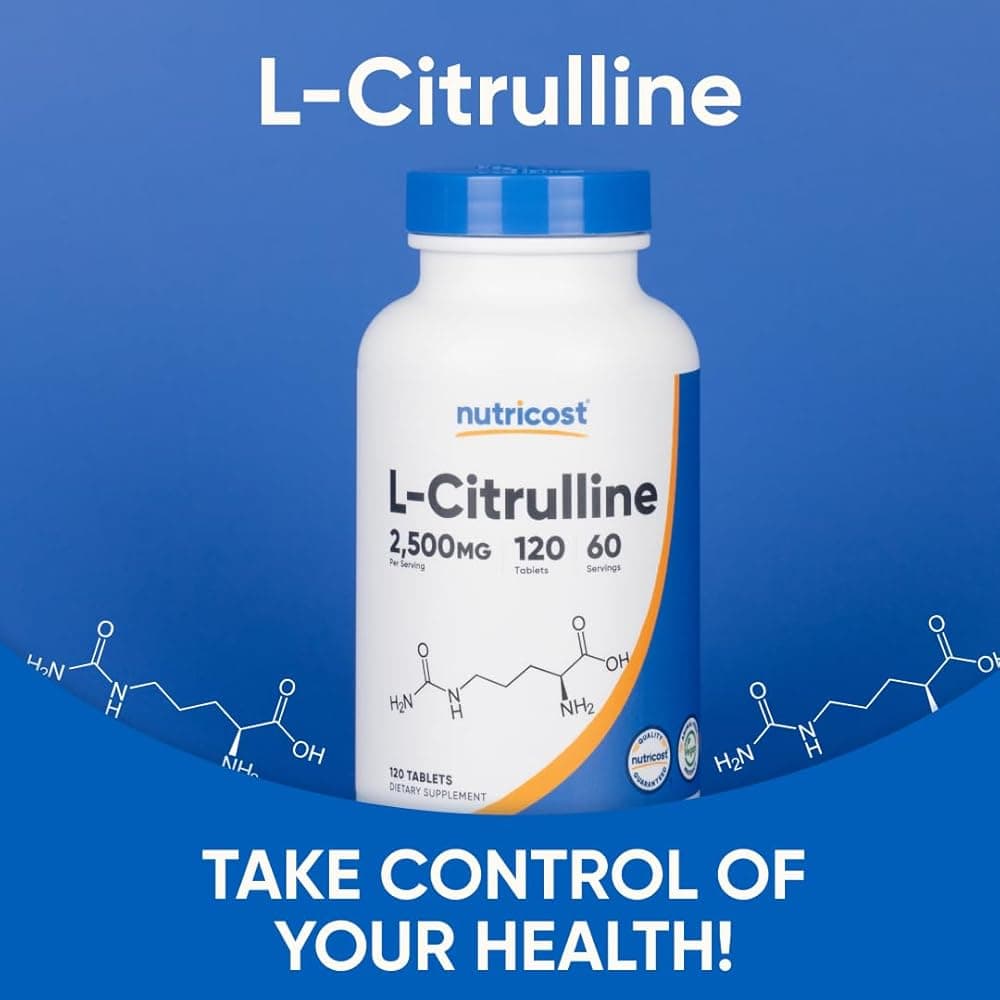
L-Citrulline.
The pump primer. Boosts nitric oxide for better blood flow. This means more oxygen and nutrients to your muscles during exercise. Your body converts it to arginine way more effectively than taking arginine itself.
Reviewed March 2026
- Category
- Other
- Also filed under
- PumpCirculationPerformancePre Workout
What L-Citrulline is, and what it does.
- Does it work
- Yes. One of the few pre-workout ingredients with rock-solid human data for performance and pump. The evidence is clear.
- How much to take
- Start with 6g to 10g a day, taken about an hour before you train. That's the band where plasma arginine rises enough to change blood flow.
- Time to feel it
- Within about 1 hour of a single dose.
- The first dose
- You'll feel it the first time you train with it. A noticeably better pump within an hour of taking it.
- With regular use
- Consistent use leads to better workout performance, faster recovery between sets, and reduced muscle soreness. Some studies show a modest benefit for blood pressure over time.
- How well tolerated
- Well tolerated for most people. Your body makes it. The main thing is the blood pressure effect, which is usually a benefit unless yours is already low.
- How it feels
- A physical feeling of fullness in the muscles you're working. Not a mental buzz or energy kick. Just a better connection to the muscle.
- The overlooked benefit
- Plasma citrulline is used in clinics as a marker of small intestine cell mass, because the gut makes most of it. It's a urea cycle intermediate, not only a nitric oxide precursor.
6 to 10g a day is where L-Citrulline works.
Source: Perez-Guisado 2010 + Bailey 2015 exercise study
In a randomised double-blind crossover trial in 19 recreationally active women, a single 8 g dose of citrulline malate taken 60 minutes before testing raised total work in a 5-repetition isokinetic leg extension protocol compared with placebo, with no difference in peak torque and no difference in the 50-repetition protocol. A separate crossover trial in 10 well-trained men using 12 g 60 minutes before high-intensity cycling found no change in time to exhaustion or power.
The proof, claim by claim.
These words describe the research, not the molecule's worth. Research strength is how much work stands behind one claim, and it is never a product score.
Superior to L-Arginine for blood flow.
- Enhances high-intensity strength performance and rep volumeMeta-analysis of 12 RCTs
- Reduces resting blood pressureMeta-analysis of 15 RCTs
- EarlyDecreases post-exercise muscle soreness (DOMS)Meta-analysis13 trials, Rhim et al., 2020 (J Sport Health Sci)PMID 33308806
Questions people ask about L-Citrulline.
- Should I take this instead of L-Arginine?
- Yes. Citrulline bypasses the gut breakdown that hammers arginine, so more of it actually gets used by your body to make nitric oxide.
- Is this the same as Citrulline Malate?
- Almost. Citrulline Malate is L-Citrulline bonded to malic acid. To get 6g of pure citrulline, you need about 9g of Citrulline Malate (2:1 ratio).
- Can I take it on non-training days?
- You can, especially if you're using it for general circulation or blood pressure. For pump, just take it before workouts.
- Does it taste bad?
- On its own, it's quite sour and slightly bitter. Most people mix it into a flavored drink to mask it.
- Will it keep me awake?
- Nope. It's not a stimulant. Won't interfere with sleep at all.
- Do I need to cycle it?
- No evidence suggests you need to cycle L-Citrulline. It's well tolerated in continuous use.
What the trials show about these together.
Outcomes the engine found studied for these actives as a combination, not one at a time. Each is a finding a named trial measured, cited and dated, never written by the brand.
- EarlyL-Citrulline + BeetrootEndurance
In a nine-week randomized placebo-controlled trial in 32 trained triathletes, citrulline taken together with nitrate-rich beetroot extract improved a test of aerobic power compared with either supplement alone, while the strength tests showed no significant difference between the groups.
Burgos et al., 2021 (Nutrients)PMID 35010917
Research strength. Research strength says how much work stands behind the combination. It is never a product score.
Fail closed. Where actives were studied on their own rather than together, each shows on its own evidence, never a combined effect no trial measured.
Independent record. Every finding is cited to a named trial, dated, and never written by the brand.
Findings from trials that studied these actives as a combination. Context for how the actives were tested together, not a statement about any individual and not a claim about this product.
Why these belong in the same formula. Each row says what the basis is, from settled biochemistry through to a trial that measured the pair.
The body turns L-citrulline into L-arginine in the kidneys, and because citrulline slips past the gut and liver breakdown that limits swallowed arginine, it raises blood arginine steadily to feed the same nitric oxide pathway that widens blood vessels. Taken together they lift arginine and nitric oxide availability more than either amino acid on its own.
Beta-alanine is the limiting building block for carnosine, which buffers the hydrogen ions that accumulate inside muscle during hard effort, while L-citrulline supports blood flow through the arginine and nitric oxide route. The two ease different limits on sustained muscular work, which is why pre-workout formulas have long combined them.
L-citrulline supplies the arginine that nitric oxide synthase uses to make nitric oxide, and vitamin C keeps that enzyme's cofactor, tetrahydrobiopterin, in its active form so it keeps producing nitric oxide efficiently. The two support the same blood vessel signaling from different points.
Ornithine plus carbamoyl phosphate yields citrulline, so the pair are neighbours in the urea cycle and both support normal ammonia handling under exertion.
The gut makes citrulline from glutamine, so glutamine is the physiological precursor of the same molecule and enters the arginine pool by the same route.
L-citrulline feeds the oxygen-dependent NOS route through arginine while nitrate feeds the oxygen-independent nitrate to nitrite route, covering different tissue oxygen states.
Folate supports tetrahydrobiopterin regeneration, and that cofactor keeps nitric oxide synthase coupled rather than leaking superoxide from the arginine supplied.
Norvaline inhibits arginase, so less of the arginine generated from L-citrulline is diverted to urea and more stays available to nitric oxide synthase.
Agmatine is arginine minus its carboxyl group and modulates nitric oxide synthase activity and arginine transport at the node L-citrulline feeds.
Pine bark procyanidins raise endothelial nitric oxide synthase expression and activity while L-citrulline supplies the substrate that enzyme uses.
Creatine supports immediate phosphate-driven ATP resynthesis while L-citrulline acts on delivery and ammonia handling, so they address different limits in one session.
Glutathione holds nitric oxide as S-nitrosoglutathione and limits its loss to superoxide, extending the working life of what the citrulline route produces.
Lysine and arginine move on the same cationic amino acid transporter, so a large lysine dose alongside competes with the arginine L-citrulline generates for tissue uptake.
Citrulline works by being converted to arginine, the substrate nitric oxide synthase uses. That enzyme is a flavoprotein: it needs FAD and FMN, both built from riboflavin, to shuttle electrons from NADPH to its heme. Riboflavin status is therefore an input to the pathway a citrulline dose is aiming at.
Each nitric oxide synthase subunit holds a heme group, and heme synthesis depends on iron. Without adequate iron the enzyme cannot be assembled in functional form, whatever the arginine supply. This is cofactor dependence rather than a tested combination.
Nitric oxide synthase functions as a dimer, and a tetrathiolate zinc site at the dimer interface stabilises that arrangement. The monomer does not catalyse the reaction. Zinc is therefore structurally required upstream of anything citrulline contributes as substrate.
Rising intracellular calcium loads calmodulin, and calmodulin binding is what allows electron flow between the reductase and oxygenase domains of endothelial NOS. That gate sits between a citrulline dose and any nitric oxide produced. The dependence is textbook. It is not an argument for taking extra calcium.
Tetrahydrobiopterin is the cofactor that keeps nitric oxide synthase coupled, and it is readily oxidised. Tocopherol in the membrane and ascorbate in the cytosol form a recycling pair that limits that oxidation. The mechanism is well described. Effects on any vascular endpoint from adding vitamin E alongside citrulline have not been measured.
Lipoic acid participates in regenerating other antioxidants, which is relevant because oxidised cofactor uncouples nitric oxide synthase. The connection to a citrulline dose runs entirely through that cofactor redox state. No combination has been studied, so this stays early.
Taurine and citrulline are both used in formulations aimed at supporting normal blood flow, and each has separate human work on vascular markers. They do not share a synthetic pathway. Any combined effect is untested and should be described as such.
Bicarbonate works by raising extracellular buffering capacity, citrulline by feeding arginine and nitric oxide production. Because the mechanisms do not overlap, stacking them in a pre-workout is common practice rather than duplication. Whether the effects add in a measured way has not been established for this specific pair.
A large protein dose floods the neutral amino acid transporters that also carry citrulline across the intestinal wall, so co-ingestion can slow citrulline appearance in plasma. Against that, the protein supplies the substrate for any anabolic response. Timing the two apart is the practical way to keep the plasma citrulline rise clean.
Potassium influences vascular tone and sodium handling, and citrulline supplementation has been associated in a meta-analysis with lower resting pressure. Combined, the two act on pressure through separate mechanisms and the effects can add. Anyone already tracking blood pressure should account for both rather than one.
Garlic preparations and citrulline have each been studied for effects on resting blood pressure through different routes, garlic partly through hydrogen sulfide signalling. Stacked, the pressure-lowering directions point the same way, so the combined effect could be larger than either alone. That is worth flagging in a formula rather than assumed, since no trial has given the two together.
Melatonin has been associated with lower nighttime blood pressure and citrulline with lower resting pressure. Taken together the directions align, so the combined effect on an evening reading could be larger than either alone. This is a flag from separate literatures, not a tested combination.
Free thiols react with nitric oxide to form S-nitrosothiols, which act as a transport and storage form rather than destroying the signal. Adding a thiol donor alongside a nitric oxide precursor therefore changes how the molecule is held rather than how much is made. The net effect in people has not been quantified.
Proanthocyanidin-rich extracts have their own literature on endothelial function markers, distinct from the arginine substrate route. Combined with citrulline the two would act at different points on the same physiology. No shared trial exists, and the readouts on both sides are markers rather than outcomes.
Cationic amino acids share the CAT-1 family carrier, while citrulline is neutral and travels mainly on the B0 and neutral carriers. That difference is exactly why citrulline raises plasma arginine more reliably than arginine itself does. A large dose of another amino acid competing on the neutral carriers can still slow citrulline uptake.
The body makes nitric oxide by two routes. Citrulline is converted to arginine, the substrate the nitric oxide synthase enzymes use, and beetroot's nitrate is reduced to nitrite and then to nitric oxide without those enzymes at all. A formula that carries both feeds the same molecule from two directions.
Talk to a doctor before taking L-Citrulline if any of these apply to you: Low blood pressure. These are flags to check first, not effects L-Citrulline is known to cause.
Not medical advice. Show the label to your pharmacist.What L-Citrulline actually does.
Your body converts citrulline into arginine in two enzyme steps, mostly in the kidneys, and arginine is what the nitric oxide enzyme uses to make nitric oxide, which hands citrulline back again.
Your gut and liver break down a big share of any arginine you swallow before it reaches your bloodstream. Citrulline slips past that step, which is why an equivalent citrulline dose raises blood arginine more.
Citrulline is a neutral amino acid that rides on different carriers than the ones arginine, lysine and ornithine use, so it doesn't compete with them for uptake in the same way.
The enzyme that makes nitric oxide needs a whole crew of helpers: tetrahydrobiopterin, FAD, FMN, NADPH, an iron centre, a structural zinc site and calcium-loaded calmodulin. When the tetrahydrobiopterin gets oxidised, the enzyme makes superoxide instead of nitric oxide.
Where L-Citrulline comes from.
Bacteria fed plant sugar make it. The broth is filtered, the amino acid is pulled out on a resin, crystallised and dried. Some of it is then combined with malic acid, which is where the malate version comes from.
Built by fermentation, the same way vitamin B12 and many amino acids are made at scale. Controlled conditions, consistent output.
Glucose or sucrose from starch crops such as corn, cassava or sugar cane supplies the carbon, with an ammonium or urea nitrogen source added to the broth.
Amino-acid producing bacterial strains with the arginine pathway interrupted after citrulline accumulate it in the broth and excrete it, the same class of industrial process used for other fermented amino acids.
Biomass is removed by centrifugation and filtration, leaving citrulline in an aqueous solution with residual salts and other amino acids.
Citrulline is captured on ion-exchange resin, eluted, decolourised over carbon, concentrated and crystallised, which is the step that separates it from related amino acids.
Content and optical purity are set by chromatography and specific rotation, with related amino acids, residual solvent and heavy metals tested against specification.
The dried crystals are milled to a target mesh, or wet-blended and co-dried with DL-malic acid at a declared ratio to give the malate form.
The production strain, the malate ratio when it is not on the label, and whether the malic acid is the DL racemate or the L form are the usual gaps, and the ratio is the one that changes the delivered citrulline dose.
Getting L-Citrulline from food.
The whole-food sources on file. A supplement closes the gap, it does not replace dinner.
A gram-for-gram figure (how much of each you would eat to match a dose) will appear here once it is sourced and reviewed. This page will not print a number it cannot cite.
The forms it comes in.
The essence, in one line each.
- Pooled across 8 trials, L-citrulline lowered systolic blood pressure by about 4.1 mmHg, with a diastolic drop of about 2.8 mmHg seen only at doses of 6 grams a day or more.Systematic review and meta-analysis. Barkhidarian et al., 2019 (Avicenna Journal of Phytomedicine). PMID 30788274 ↗
- Across 8 studies, taking 6 to 8 grams of citrulline malate 40 to 60 minutes before strength training raised repetitions completed before muscular failure by about 6.4 percent.Systematic review and meta-analysis. Varvik et al., 2021 (International Journal of Sport Nutrition and Exercise Metabolism). PMID 34010809 ↗
- Across 15 randomised trials in middle-aged and older adults, l-citrulline or watermelon intake lowered systolic blood pressure by about 4.0 mmHg and diastolic by about 2.5 mmHg.Meta-analysis. Luo et al., 2025 (Clinical Nutrition ESPEN). PMID 40789388 ↗
- Pooling 8 randomised trials in 176 middle-aged and older adults, l-citrulline improved flow-mediated dilation, a measure of blood vessel widening, by about 1.8 percentage points, while pulse wave velocity showed no clear change.Meta-analysis. Luo et al., 2025 (Frontiers in Nutrition). PMID 41323997 ↗
- In 22 older women with elevated blood pressure, 10 g of l-citrulline daily for 4 weeks raised forearm blood flow during handgrip exercise by about 48 mL/min and improved muscle oxygen saturation, alongside a small fall in aortic systolic pressure.Randomised trial. Kang et al., 2024 (Nutrients). PMID 38931289 ↗
- Across 21 randomised trials, l-citrulline showed no overall effect on body weight, fat mass or fat-free mass, with reductions in fat mass only in exploratory subgroups over age 40 or above 6 g a day.Meta-analysis. Ashtary-Larky et al., 2025 (Nutrients). PMID 41097202 ↗
- In 13 endurance runners in the heat while mildly under-hydrated, 6 g of l-citrulline a day for 7 days did not produce a detectable change in 3 km time trial performance, core temperature or heart rate.Randomised trial. Cable et al., 2025 (European Journal of Applied Physiology). PMID 39699639 ↗
- The review of citrulline supplementation in postmenopausal women reports vascular measures as the most consistently affected domain, with muscular and metabolic findings less consistent across the included studies.Systematic review. Bahari H et al., 2026 (BMC Women's Health). PMID 41588439 ↗
- In postmenopausal women, L-citrulline attenuated the rise in aortic pressure and pressure wave measures during a metaboreflex challenge. These are haemodynamic measures taken during a provocation test, not everyday endpoints.Randomised trial. Dillon KN et al., 2024 (British Journal of Nutrition). PMID 37664994 ↗
- Among healthy adults, the vascular response to L-citrulline was reported to depend largely on where participants started on the blood pressure range, with the larger changes in those at the higher end. A subgroup pattern rather than a uniform effect.Randomised trial. Nogimura D et al., 2026 (Nutrition Research). PMID 42142423 ↗
- The trial reported changes in endothelial function, arterial stiffness and fasting blood glucose measures with L-citrulline supplementation. All three are markers, and the trial's population descriptor is truncated in the retrieval record.Randomised trial. Kang Y et al., 2025 (Nutrients). PMID 41374029 ↗
- In trained taekwondo athletes, L-citrulline was associated with changes in cerebrovascular measures during sprint interval training. Cerebral blood flow and oxygenation are markers rather than performance outcomes.Randomised trial. Li A et al., 2025 (Journal of Exercise Science and Fitness). PMID 40474881 ↗
- Adolescents with excess body weight doing high-intensity interval training were given L-citrulline, with the authors reporting changes in lipid measures, arterial stiffness and fat mass. The exercise programme is a co-intervention, so citrulline's separate contribution is limited by the design.Randomised trial. Rodriguez-Carrillo AA et al., 2025 (Nutrients). PMID 39940261 ↗
- In adults recovering after a documented viral illness, the trial reported endothelial function and body composition measures with L-citrulline supplementation. Endothelial function is a marker of vascular responsiveness, not a clinical endpoint.Randomised trial. Fernanda SM et al., 2026 (Nutrients). PMID 42280350 ↗
- Enteral L-citrulline given to preterm infants raised plasma arginine and citrulline concentrations. The reported result is a change in plasma amino acid concentrations, a biochemical marker, in a hospital setting.Open-label trial. Qasim A et al., 2024 (Journal of Perinatology). PMID 37640809 ↗
- In an analysis of arginine and citrulline supplementation at high altitude, adherence and genetic variability accounted for much of the variation in response. This identifies determinants of response and is an association, not a demonstrated cause of the response itself.Cohort study. Pena E et al., 2026 (High Altitude Medicine and Biology). PMID 42117339 ↗
- In cultured macrophages challenged with a mycobacterial organism, L-arginine and L-citrulline altered nitric-oxide-related macrophage responses. Cell culture work that grounds the substrate mechanism only, with no human relevance established.In vitro study. Bhargavi G et al., 2026 (Frontiers in Immunology). PMID 42164505 ↗
- L-citrulline supplementation in ewes was reported to shift rumen microbial composition and reproductive performance measures. Ruminant physiology, so neither the digestive nor the reproductive findings transfer to people.Animal study. Lu T et al., 2026 (Life). PMID 42195322 ↗
- Dietary L-citrulline in suckling ruminants was associated with rumen developmental measures and changes across a microbiota and metabolite panel. A developmental animal study with no human counterpart.Animal study. Tang Z et al., 2026 (Animals). PMID 42278158 ↗
- Adding L-citrulline to a basal animal diet was reported to change reproductive performance, serum metabolites and gut microbial composition. Animal husbandry endpoints, useful only as mechanism.Animal study. Li C et al., 2026 (Frontiers in Microbiology). PMID 41853720 ↗
These are the studies our verdict leans on, chosen from the 837 we read for L-Citrulline. The full linked list is below.
The studies, linked.
8 sources behind our L-Citrulline verdict: peer-reviewed studies and registered clinical trials. Every one links straight to PubMed, the journal, or ClinicalTrials.gov. Read them yourself.
- Clinical trialEffect of a Non-pharmacological Intervention (Nutritional Therapy and Pulmonary Rehabilitation) on Endothelial Function, Body Composition, and Physical Functionality in Recovered COVID-19 Patients.ClinicalTrials.gov ↗43 participants, Completed
- ClinicalTrials.gov ↗
- Clinical trialPhase 1 Study of Oral L-citrulline on ADMA/L-arginine and Endothelial-dependent Vascular Function in Pregnancy.ClinicalTrials.gov ↗Phase 1, 41 participants, Completed
- Clinical trial"Treatment With L-citrulline in Patients With Post-polio Syndrome - a Randomized Double Blind Placebo Controlled Study"ClinicalTrials.gov ↗Phase 3, 30 participants, Completed
- Clinical trialImpact of Reduced Arterial Stiffness on Peripheral Vascular Function and MobilityClinicalTrials.gov ↗25 participants, Completed
- Clinical trialL-Citrulline Versus Tadalafil Versus Combination Therapy in Mild to Moderate Erectile Dysfunction: A Prospective Randomized TrialClinicalTrials.gov ↗Phase 4, 133 participants, Recruiting
- Clinical trialA Phase 2 Randomized Double-blind, Placebo-controlled Clinical Trial of Intravenous Citrulline for Vaso-occlusive Pain Episode in Hospitalized Patients With Sickle Cell Disease (CONQUER SCD Pain Trial)ClinicalTrials.gov ↗Phase 2, 99 participants, Recruiting
- Clinical trialEffect of L-Citrulline Supplementation on Arginase Activity and Vascular Function in Type II Diabetes MellitusClinicalTrials.gov ↗50 participants, Unknown
Evidence surfaced via Semantic Scholar (Allen Institute for AI) and ClinicalTrials.gov. Ranked by study type and citation weight, not cherry-picked.
Problems people have reported.
Read this carefully. These are 189 voluntary, unverified reactions reported to the FDA (openFDA). The number mostly reflects how popular L-Citrulline is, not how risky it is. A report is not proof L-Citrulline caused anything. It is a signal of what to watch for, nothing more.
Source: openFDA adverse-event reports. Voluntary reporting, not an incidence rate.
FDA Disclaimer: These statements have not been evaluated by the Food and Drug Administration. This information is for educational purposes only and is not intended to diagnose, treat, cure, or prevent any disease. Consult your healthcare provider before starting any supplement regimen.