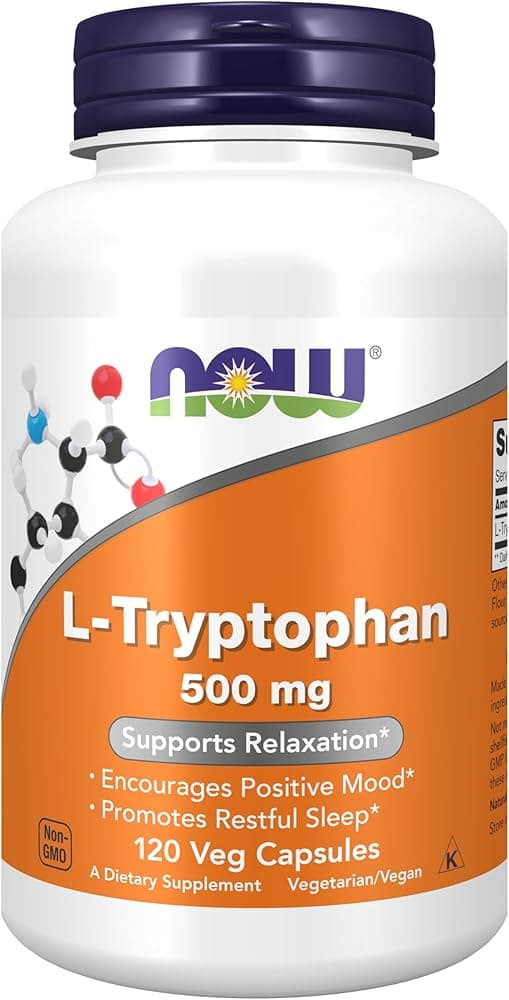
L-Tryptophan.
May help improve sleep and mood, especially when related to serotonin levels. Your body uses it to make serotonin, the brain's 'feel-good' and 'calm-down' chemical. More serotonin can lead to a better mood and an easier transition to sleep.
Reviewed March 2026
- Category
- Amino acid
- Also filed under
- Mood EnhancementSleep ImprovementAnxiety Reduction
What L-Tryptophan is, and what it does.
- Does it work
- Maybe. It's not a heavy hitter, but for some people, it's just what they need. If you're stressed and not sleeping well, it's a reasonable first step.
- How much to take
- 500-1000mg, taken 30-60 minutes before bed. Start on the lower end to see how you respond.
- Time to feel it
- Blood levels peak in one to two hours, so an evening dose acts the same night. Steadier mood across a week takes one to two weeks of nightly use.
- The first dose
- Probably nothing. This isn't a sleeping pill. It needs a few nights of consistent use to start making a difference.
- With regular use
- After 1-2 weeks, the goal is a more stable mood and an easier time winding down at night. Some find it helps them stay asleep, too.
- How well tolerated
- Generally well tolerated. It's an amino acid found in food. But the antidepressant interaction is real and serious. Don't freelance that combo.
- How it feels
- A gentle calming effect. Not drowsy, just less 'on edge.' It helps smooth out the transition from a busy day to a restful night.
- The overlooked benefit
- Most of it never becomes serotonin. The bulk runs down the kynurenine route into NAD synthesis, which is why tryptophan counts toward niacin activity.
500 to 1,000mg a day is where L-Tryptophan works.
Source: Silber & Schmitt 2010 J Psychiatry Neurosci meta-analysis; Hartmann 1982 sleep research
The proof, claim by claim.
These words describe the research, not the molecule's worth. Research strength is how much work stands behind one claim, and it is never a product score.
While research supports L-Tryptophan's role in serotonin production and potential benefits for sleep and mood, results can vary significantly among individuals. Its effectiveness appears more pronounced in those with existing serotonin deficiencies or imbalances.
- Precursor supply for serotonin and melatoninNarrative review
- Sleep onset and self-rated sleep qualityMeta-analysis
- Mood steadiness in healthy adultsRandomised trial
- Partial contribution to niacin activity through de novo NAD synthesisNarrative review
- Dependence on vitamin B6, iron and riboflavin for its conversion stepsNarrative review
Questions people ask about L-Tryptophan.
- Is this the stuff in turkey that makes you sleepy?
- Kind of, but the myth is overblown. It's really the huge meal and all the carbs you eat with the turkey that causes the post-dinner crash.
- Will it make me groggy in the morning?
- Unlikely. It's not a sedative, so it doesn't typically cause a 'hangover' effect like some sleep aids.
- What's the difference between this and 5-HTP?
- Tryptophan is one step before 5-HTP in the serotonin production line. Your body has more control over converting tryptophan, making it a gentler, safer option.
- Can I take it with melatonin?
- Yes, for most people this is a safe combination. They work on different aspects of sleep. Tryptophan helps with calming down, melatonin signals 'it's nighttime'.
- How long until I know if it's working?
- Give it at least a week of consistent nightly use. The effects are cumulative, not immediate.
- Is L-Tryptophan addictive?
- No. It's an essential amino acid your body needs from food. You don't build a tolerance or dependence on it.
Why these belong in the same formula. Each row says what the basis is, from settled biochemistry through to a trial that measured the pair.
The enzyme that converts 5-hydroxytryptophan, the intermediate the body makes from tryptophan, into serotonin depends on pyridoxal-5-phosphate from vitamin B6 as its cofactor. Adequate B6 status supports this normal decarboxylation step in serotonin synthesis.
Tryptophan and tyrosine are both large neutral amino acids that cross into the brain on the same LAT1 carrier, so taken together in gram doses they compete for that limited transport. Spacing them apart keeps each from blunting the other's entry into the brain.
The body routes part of its tryptophan down the kynurenine pathway to make niacin and NAD, so dietary tryptophan contributes to normal niacin status. This conversion itself relies on B6 and riboflavin as cofactors, which is why these B vitamins tend to travel together in the pathway.
Tryptophan hydroxylase converts tryptophan to 5-hydroxytryptophan, which is then decarboxylated to serotonin. Supplying both bypasses the rate-limiting hydroxylation step while substrate remains available, and serotonergic effects add.
5-hydroxytryptophan is the direct intermediate between tryptophan and serotonin, so the two sit consecutively on one pathway. Effects on serotonin synthesis are additive rather than independent.
Serotonin made from tryptophan is acetylated and methylated to melatonin in the pineal gland. Tryptophan supplies the substrate for endogenous production while melatonin supplies the finished signal.
Magnesium is required by the ATP-dependent steps along the tryptophan pathway, including the acetyl and methyl transfer reactions that finish melatonin.
Tryptophan hydroxylase is a non-heme iron enzyme, so iron status sets the rate at which tryptophan is hydroxylated. Substrate cannot move down the pathway faster than that step allows.
Ascorbate keeps the iron centre of the aromatic amino acid hydroxylases in its reduced state and assists tetrahydrobiopterin recycling. Both roles sit directly on the tryptophan hydroxylation step.
Tryptophan hydroxylase consumes tetrahydrobiopterin, which is regenerated by flavin-dependent reductases built from riboflavin. Riboflavin also feeds the kynurenine branch where tryptophan is converted toward niacin.
Tryptophan crosses the blood-brain barrier on the LAT1 large neutral amino acid carrier, which also carries phenylalanine, tyrosine and the branched-chain amino acids. A large phenylalanine dose lowers the share of that carrier available to tryptophan.
Leucine is a high-affinity LAT1 substrate, so it competes with tryptophan for entry into the brain. Tryptophan is conventionally taken away from a large protein or branched-chain amino acid load.
Valine is one of the branched-chain amino acids that share the LAT1 carrier with tryptophan at the blood-brain barrier. Raising plasma valine lowers the tryptophan to competing amino acid ratio that governs brain entry.
St John's wort constituents slow serotonin reuptake while tryptophan increases how much serotonin is synthesised. Both raise serotonergic tone, so the effect is additive and worth disclosing.
Vitamin D response elements sit on the TPH2 gene, so vitamin D status influences how much brain tryptophan hydroxylase is expressed. Tryptophan supplies substrate to an enzyme whose amount vitamin D helps set.
Tryptophan becomes 5-hydroxytryptophan, then serotonin, then N-acetylserotonin, and the last step to melatonin is carried out by a methyltransferase that consumes SAM-e. Without an adequate methyl donor supply the pathway stalls at the penultimate step. This is settled pathway chemistry rather than a tested combination.
5-methyltetrahydrofolate donates a methyl group to homocysteine to regenerate methionine, which is the precursor to SAM-e. Folate is also involved in maintaining tetrahydrobiopterin, the cofactor tryptophan hydroxylase depends on. The link is indirect but well described in metabolic terms.
Tryptophan crosses the blood brain barrier on the same carrier as leucine, isoleucine, valine, tyrosine and phenylalanine, and it is the least abundant of them in most proteins. A whey serving delivers a large load of the competing amino acids, so free tryptophan taken alongside it faces stiffer competition at the transporter. Timing them apart is the practical implication.
A whole protein taken with free tryptophan raises the plasma concentration of competing large neutral amino acids more than it raises tryptophan, lowering the tryptophan to competitor ratio at the transporter. Casein is often taken in the evening, which is exactly when a tryptophan serving is usually placed. The two are better separated than combined.
Methionine is a large neutral amino acid that uses the same carrier system, so a substantial free methionine dose competes with tryptophan for entry. In the other direction, methionine feeds the SAM-e pool that the melatonin step needs, so the relationship runs both ways depending on timing and dose. Separating the doses keeps the transport competition out of the way.
The large majority of dietary tryptophan is metabolised down the kynurenine route, which ends in NAD synthesis rather than in serotonin. Supplying preformed NAD precursors reduces the demand on tryptophan for that purpose. Whether that leaves more tryptophan for the serotonin branch is a mechanistic inference and not a measured result.
Gut bacteria metabolise tryptophan into indole derivatives, a branch that competes with host absorption and with the serotonin and kynurenine routes. The cited work describes microbial and metabolic shifts including tryptophan handling, not a supplement combination in adults. Read it as a mechanistic pointer to how the microbiome divides the tryptophan pool.
Colonic bacteria convert unabsorbed tryptophan into indole, indole-3-propionate and related compounds that act on host receptors. Which strains are present therefore changes how much tryptophan is diverted down that branch. The direction of the effect depends on the strain, so this is a modulating relationship rather than a purely additive one.
Fermentable fibre shifts which bacteria dominate the colon and how much protein-derived substrate they ferment. That in turn changes the balance of indole metabolites produced from tryptophan. The interaction is on metabolite profile, a marker level effect, not on any measured mood or sleep endpoint.
Valerian acts on GABAergic signalling and tryptophan feeds serotonin and melatonin production, two different routes toward the same evening use. Stacking sedating ingredients compounds next-morning grogginess and matters for anyone driving or operating machinery. The combination itself has not been isolated in the literature cited here.
Lemon balm is used for calm and evening wind-down through GABAergic mechanisms distinct from tryptophan's serotonergic route. Where both appear in one formula the sedating effects add up. There is no combination trial behind this pairing.
Passionflower acts on GABA signalling, tryptophan on serotonin and melatonin synthesis, and evening formulas frequently carry both. The additive drowsiness is the practical consideration. The pairing is formulation convention rather than a tested combination.
Zinc-dependent enzymes participate broadly in amino acid handling, and zinc status influences the metabolic machinery tryptophan passes through. This is a background nutritional dependency rather than a direct pairing effect. It supports normal amino acid metabolism and nothing more specific should be read into it.
Caffeine blocks adenosine receptors and works against the wind-down effect an evening tryptophan serving is usually taken for. There is no shared enzyme or transporter between them. The conflict is behavioural and pharmacological timing. Formulas that combine them are working at cross purposes for that use case.
Talk to a doctor before taking L-Tryptophan if any of these apply to you: Pregnancy, Breastfeeding, MAOIs, SSRIs, Liver disease, Kidney disease. These are flags to check first, not effects L-Tryptophan is known to cause.
Not medical advice. Show the label to your pharmacist.What L-Tryptophan actually does.
L-tryptophan is an essential amino acid: your body can't make it, so all of it comes from food or supplements. It's also the scarcest amino acid in most dietary proteins.
The serotonin branch starts when tryptophan hydroxylase turns tryptophan into 5-hydroxytryptophan. That enzyme needs tetrahydrobiopterin and iron, and it's the slow step that sets the pace for the whole branch.
5-hydroxytryptophan then becomes serotonin through an enzyme that uses pyridoxal 5-phosphate, the active form of vitamin B6, as its helper molecule.
Serotonin gets an acetyl group added and then a methyl group to become melatonin. The methyl comes from S-adenosylmethionine, which is where one-carbon metabolism connects to this pathway.
Where L-Tryptophan comes from.
Bacteria are fed sugar in a large tank and produce the amino acid, which is then filtered out of the broth, purified and dried into a white powder. It is not extracted from meat or milk, and the version bacteria make is the one the body uses.
Built by fermentation, the same way vitamin B12 and many amino acids are made at scale. Controlled conditions, consistent output.
Glucose or sucrose from corn, sugar cane or sugar beet, plus an ammonium nitrogen source and mineral salts. The carbon skeleton of the finished amino acid comes from that sugar.
Engineered strains of Corynebacterium glutamicum or Escherichia coli are grown in stirred fermenters and overproduce L-tryptophan by way of the shikimate and anthranilate pathway, secreting it into the broth. Only the L-isomer is produced, which is a property of the enzymatic route.
Biomass is removed by centrifugation or membrane filtration, leaving the amino acid in the clarified broth alongside residual nutrients and by-products.
The amino acid is captured on ion exchange resin, eluted, decolourised with activated carbon and crystallised. Recrystallisation is the step that determines the impurity profile of the finished material.
Identity and purity are confirmed by chromatography, optical rotation confirms the L-configuration, and specifications cover residual solvents, heavy metals and process-related impurities. Impurity control in this class of material is specified tightly because of manufacturing history in the industry.
Washed crystals are dried, milled to a defined particle size and packed. The material is supplied as a free-flowing white to off-white powder for capsules, tablets and blends.
Strain identity, fermentation site and the exact purification sequence are usually treated as manufacturer confidential and do not appear on a label.
Getting L-Tryptophan from food.
The whole-food sources on file. A supplement closes the gap, it does not replace dinner.
A gram-for-gram figure (how much of each you would eat to match a dose) will appear here once it is sourced and reviewed. This page will not print a number it cannot cite.
The forms it comes in.
The essence, in one line each.
- Pooling controlled trials, tryptophan supplementation shortened wake after sleep onset by about 81 minutes per gram, with the effect strongest at doses of 1 gram or more.Systematic review and meta-analysis. Sutanto et al., 2022 (Nutrition Reviews). PMID 33942088 ↗
- Across 11 randomized trials in healthy adults, taking 0.14 to 3 grams of tryptophan a day alongside usual meals was associated with lower negative mood and higher positive mood.Systematic review. Kikuchi et al., 2020 (Journal of Dietary Supplements). PMID 32272859 ↗
- Pooling supplement trials, tryptophan was among the interventions linked to better self-reported sleep quality scores, with the size of the effect varying between studies.Meta-analysis. Mei et al., 2025 (Nutrients). PMID 41470897 ↗
- A systematic review of tryptophan as a modulator of behaviour and productivity in sows, pooling controlled feeding studies. Animal production evidence, which does not transfer to human dosing.Systematic review. Buchini JLC et al., 2026 (Journal of Animal Science). PMID 42054598 ↗
- A published protocol for a randomised test of branched-chain amino acids alone or combined with tryptophan or methionine on appetite control. Design only, with no outcome data reported.Study protocol. Zhang S et al., 2026 (JMIR Research Protocols). PMID 42166751 ↗
- Dietary L-tryptophan supplementation was reported to strengthen intestinal mucosal barrier measures in weaned piglets, with the authors describing effects on tight junction and barrier markers.Animal study. Liang H et al., 2018 (International Journal of Molecular Sciences). PMID 30577574 ↗
- Dietary L-tryptophan reduced markers of ammonia-induced stress in Nile tilapia fingerlings. A fish model, and the endpoints are stress and growth markers.Animal study. Mohammady EY et al., 2025 (Scientific Reports). PMID 41339441 ↗
- Prepartum L-tryptophan supplementation was assessed for postpartum production measures in Holstein cows. A dairy production endpoint reported by the authors, not a human outcome.Animal study. Liu X et al., 2024 (Animals). PMID 38731282 ↗
- Rumen-protected L-tryptophan was tested on productivity, physiological indicators and blood profiles in cattle, demonstrating that protecting the amino acid from ruminal degradation changes what reaches circulation.Animal study. Jo JH et al., 2024 (International Journal of Molecular Sciences). PMID 38279240 ↗
- Dietary L-tryptophan with varied lighting was assessed for growth and immune response measures in broilers. Poultry production data, reported as marker and performance measures.Animal study. Sharideh H et al., 2021 (Veterinary Research Forum). PMID 33953875 ↗
- Ruminal delivery of 5-hydroxytryptophan raised serum serotonin and produced peripheral vasodilation in growing beef cattle, showing the precursor to serotonin conversion running in a live animal.Animal study. Matos EMA et al., 2026 (Journal of Animal Science). PMID 42398021 ↗
- 5-hydroxy-L-tryptophan altered gene expression in cultured bovine mammary epithelial cells. A cell culture result about transcriptional response, not an effect in an animal or a person.In vitro study. Field SL et al., 2022 (Scientific Reports). PMID 35264606 ↗
- A review linking dietary patterns, gut microbiota and psychological wellbeing that names tryptophan metabolism as a route connecting them. A narrative synthesis, so it generates hypotheses rather than testing one.Narrative review. Marano G et al., 2025 (Nutrients). PMID 41515213 ↗
- A controlled sleep-loss protocol reporting shifts in circulating metabolite profiles in young adults, with tryptophan among the metabolites tracked. These are markers, not clinical outcomes.Open-label trial. Good L et al., 2026 (Journal of Translational Medicine). PMID 42231340 ↗
- A metabolomic analysis nested in a randomised folic acid and creatine trial, describing metabolite signatures that include tryptophan pathway intermediates. Marker-level associations within a trial of other nutrients.Randomised trial. Li W et al., 2025 (Environmental Science and Technology). PMID 40668877 ↗
These are the studies our verdict leans on, chosen from the 747 we read for L-Tryptophan. The full linked list is below.
The studies, linked.
3 sources behind our L-Tryptophan verdict: peer-reviewed studies and registered clinical trials. Every one links straight to PubMed, the journal, or ClinicalTrials.gov. Read them yourself.
- Clinical trialA Placebo Controlled Trial Of L-Tryptophan In Post-Operative DeliriumClinicalTrials.gov ↗Phase 3, 301 participants, Completed
- Clinical trialEffect of Amino Acids and Sugar Alcohols on Gastric Emptying and Release of Satiation Peptides in Normal Weight and Obese SubjectsClinicalTrials.gov ↗20 participants, Completed
- Clinical trialEffects of Combined Intraduodenal Administration of Calcium and L-tryptophan on Plasma Glucose, Glucoregulatory Hormones and Gastric Emptying in Response to a Mixed-nutrient Drink in Healthy Adult MalesClinicalTrials.gov ↗16 participants, Not yet recruiting
Evidence surfaced via Semantic Scholar (Allen Institute for AI) and ClinicalTrials.gov. Ranked by study type and citation weight, not cherry-picked.
Problems people have reported.
Read this carefully. These are 394 voluntary, unverified reactions reported to the FDA (openFDA). The number mostly reflects how popular L-Tryptophan is, not how risky it is. A report is not proof L-Tryptophan caused anything. It is a signal of what to watch for, nothing more.
Source: openFDA adverse-event reports. Voluntary reporting, not an incidence rate.
FDA Disclaimer: These statements have not been evaluated by the Food and Drug Administration. This information is for educational purposes only and is not intended to diagnose, treat, cure, or prevent any disease. Consult your healthcare provider before starting any supplement regimen.