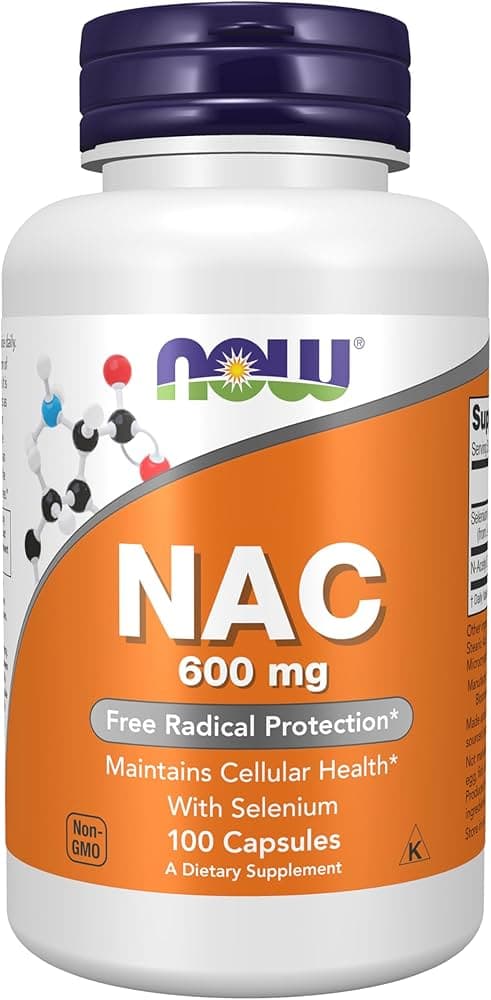
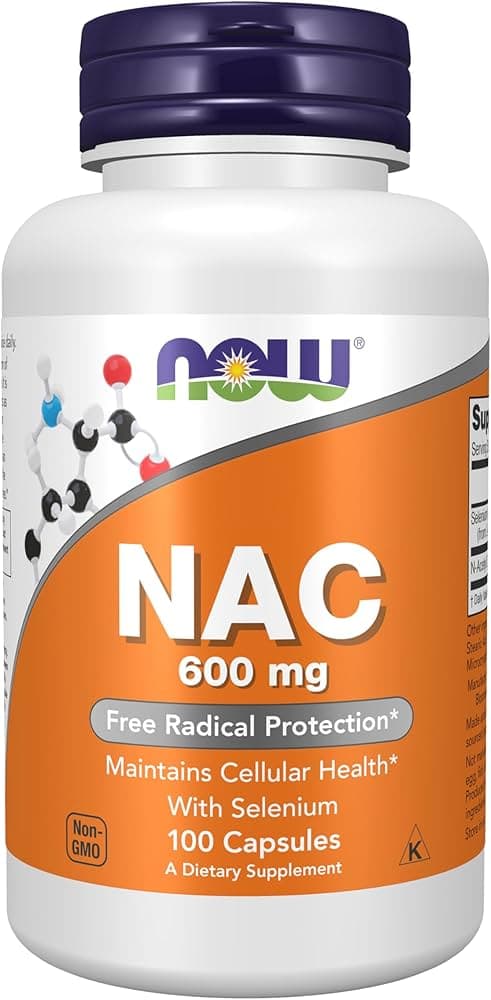
N-Acetyl Cysteine (Immune).
Supports glutathione levels for immune and antioxidant defense. It's a precursor to glutathione, your body's most powerful antioxidant. This helps protect cells from damage, supports liver detox, and can loosen mucus in your lungs.
Reviewed March 2026
- Category
- Amino acid
- Also filed under
- Supports antioxidant defensesMay promote healthy respiratory functionSupports liver health
What N-Acetyl Cysteine (Immune) is, and what it does.
- Does it work
- It has its uses, especially for lung and liver support. As a general immune supplement for healthy people, it's decent but not a first-line choice. The evidence is moderate.
- How much to take
- 600mg, once or twice a day. No need to get fancy. Stick to the 600-1200mg range for general support.
- Time to feel it
- Cysteine reaches cells within hours, but glutathione status is a build across weeks. Mucus consistency is the one thing some people notice inside a few days.
- The first dose
- Nothing. It needs time to build up your body's glutathione levels. This is a long-game supplement.
- With regular use
- After a few weeks, your antioxidant defenses are stronger. This might mean better recovery or respiratory health. The benefits are preventative and subtle, not immediate.
- How well tolerated
- Generally well tolerated. The main complaints are nausea or an upset stomach. Has a bit of a sulfur smell, which is normal. Check with a doc if you have bleeding disorders.
- How it feels
- You don't feel it. It's not like caffeine or L-theanine. It's a behind-the-scenes worker, building up your cellular defenses over time.
- The overlooked benefit
- Glutathione peroxidase carries a selenocysteine in its active site, so cysteine supply only pays off when selenium status is adequate. The two work as a pair.
600 to 1,200mg a day is where N-Acetyl Cysteine (Immune) works.
Source: De Flora et al., Eur Respir J, 1997; Shi & Bhagavan, Free Radic Biol Med, 2007
The proof, claim by claim.
These words describe the research, not the molecule's worth. Research strength is how much work stands behind one claim, and it is never a product score.
NAC is well-researched, but the evidence for its immune benefits in healthy individuals at typical supplement doses is moderate. Its primary benefit is as a glutathione precursor, supporting antioxidant defenses, which indirectly supports immune function. Evidence is stronger for specific conditions.
- Cysteine as the rate-limiting substrate for glutathione synthesisNarrative review
- Glutathione statusRandomised trial
- Mucus viscosity and clearanceMeta-analysis
- Oxidative stress markersRandomised trial
- Immune resilience in older adults through winterRandomised trial
Questions people ask about N-Acetyl Cysteine (Immune).
- What does NAC smell like?
- Sulfur. Like rotten eggs. It's normal, just means it's the real deal.
- Can I take it every day?
- Yes. It's meant for daily, long-term use. No need to cycle it.
- Will it make me feel sick?
- Maybe. Some people get nausea or an upset stomach. Taking it with food can help.
- Is this the same as cysteine in food?
- No. NAC is a more stable, supplement form of the amino acid cysteine. It's better absorbed and used by the body for specific tasks.
- Best time to take it?
- Anytime works. Morning or night, with or without food. Consistency is more important than timing.
- Is it safe for my liver?
- Yes, it's actually used in hospitals to protect the liver from Tylenol overdose. It's very supportive of liver health at standard doses.
Why these belong in the same formula. Each row says what the basis is, from settled biochemistry through to a trial that measured the pair.
Glutathione is built from glutamate, cysteine and glycine, and glycine becomes the limiting one once cysteine is supplied. Providing both removes the two usual bottlenecks in the tripeptide.
Glutamine is deamidated to glutamate, the first residue joined to cysteine by glutamate-cysteine ligase. It keeps the front of the glutathione assembly line stocked.
Glutathione peroxidase carries selenocysteine in its active site and is the enzyme that spends glutathione on peroxides. Substrate without the selenoenzyme leaves the cycle half built.
Oxidised glutathione is returned to its reduced form by glutathione reductase, a flavoenzyme that needs FAD from riboflavin. Poor riboflavin status strands glutathione in the spent form.
Dihydrolipoic acid reduces oxidised glutathione directly, returning it to the active thiol form. The two thiols sit in the same regeneration network.
Glutathione reduces dehydroascorbate back to ascorbate, and ascorbate in turn spares glutathione. The two pools regenerate one another rather than acting in isolation.
Tocopherol quenches lipid radicals in the membrane and becomes a tocopheroxyl radical, which ascorbate and glutathione reduce back. Cysteine supply keeps the glutathione end of that handoff stocked.
Cystathionine beta-synthase and cystathionine gamma-lyase, the two steps that make cysteine from homocysteine, both run on pyridoxal-5-phosphate. Active B6 governs the body's own route to the same molecule.
5-MTHF donates the methyl group that sends homocysteine back to methionine rather than down to cysteine. The two routes share one substrate, so folate status sets how much flows toward the sulphur pathway.
Methionine synthase needs cobalamin to accept the folate methyl group and rebuild methionine. Together with folate it balances the split between remethylation and the cysteine-producing branch.
Cysteine catabolism generates sulfite, which sulfite oxidase converts to sulfate using a molybdenum cofactor. A larger sulphur amino acid load leans harder on that molybdenum enzyme.
N-acetylcysteine supplies the cysteine that limits intracellular glutathione synthesis. Supplying both reaches the same pool from the outside and the inside.
Zinc is held and released by metallothionein through thiol redox changes that the glutathione pool influences. The two sit in the same cellular thiol buffering system.
The free sulphydryl group on N-acetylcysteine binds copper ions directly and can lower the free copper fraction available for uptake. Separating the two by a few hours avoids the interaction in the gut.
N-acetylcysteine is deacetylated by intracellular acylases to free cysteine, which is the rate-limiting substrate for glutathione synthesis. The acetyl group exists to make the molecule stable enough to survive storage and gastric passage, since free cysteine oxidises readily to cystine. Taking both delivers the same downstream substrate through two routes with different stability profiles.
Methionine is the dietary precursor that feeds cysteine synthesis through the transsulfuration pathway, passing through homocysteine and cystathionine. When methionine supply is adequate the body makes its own cysteine, and N-acetylcysteine supplies the same end point without transiting homocysteine. This is settled one-carbon and sulfur biochemistry.
Cystathionine beta-synthase condenses homocysteine with serine to form cystathionine, the committed step toward cysteine synthesis. Serine is therefore the carbon partner in the endogenous route that N-acetylcysteine bypasses. A formula addressing sulfur amino acid handling touches both points on that pathway.
Taurine is made from cysteine through cysteine dioxygenase and decarboxylation, so cysteine supply sits upstream of both glutathione and taurine. The two pathways compete for the same cysteine pool, which is why cysteine availability determines how much goes to each. Supplying both means the taurine pathway draws less on the shared pool.
S-adenosylmethionine is the methyl donor whose downstream product homocysteine feeds transsulfuration toward cysteine, and SAM-e itself allosterically activates cystathionine beta-synthase. The methionine cycle and the cysteine supply route are one connected system. This is textbook one-carbon biochemistry and needs no trial to state.
Betaine donates a methyl group to convert homocysteine back to methionine through betaine-homocysteine methyltransferase, pulling homocysteine away from the transsulfuration branch that leads to cysteine. Supplying cysteine directly as N-acetylcysteine reduces the demand on that branch. The two act on opposite arms of the same junction, which is why they are often formulated together.
Sulforaphane modifies cysteine residues on Keap1, releasing Nrf2 to induce transcription of glutamate-cysteine ligase and other glutathione-handling enzymes. N-acetylcysteine supplies the substrate those enzymes use. One raises the enzyme capacity and the other supplies the raw material, which is a substrate-and-machinery pairing rather than two identical actions. At high concentrations thiols can also blunt the electrophilic signal, so the interaction is not purely additive.
Quercetin oxidises to a quinone that reacts readily with free thiols, forming glutathionyl and cysteinyl adducts. Co-ingestion means part of each is consumed forming those conjugates, which changes what circulates rather than simply adding two antioxidant effects. The chemistry is well described. What it means for a person taking both has not been measured.
EGCG auto-oxidises in neutral solution to quinones and hydrogen peroxide, and thiols such as N-acetylcysteine quench both. That is why cell culture work often shows N-acetylcysteine abolishing EGCG effects entirely. In a supplement taken orally the interaction is likely smaller, but formulators should know the two chemistries oppose each other in the tube.
Curcumin is a Michael acceptor that reacts with free thiols, and it also activates Nrf2 by modifying Keap1 cysteines. Adding a large thiol dose can consume the electrophile before it reaches its target while also supplying glutathione substrate. Direction depends on the ratio, so this is a formulation flag rather than a claimed synergy.
Silymarin is described as supporting hepatic glutathione content and stabilising hepatocyte membranes, and N-acetylcysteine supplies the cysteine that limits glutathione synthesis. The two approach hepatic thiol status from different directions. They are frequently formulated together on that basis, without a combination trial behind the pairing.
Ubiquinol works in the lipid phase of membranes while glutathione works in the aqueous phase of the cytosol, and the two systems are linked because glutathione and ascorbate help regenerate lipid-phase antioxidants. Supplying cysteine supports the aqueous arm of that network. The pairing is a network argument rather than a measured combination result.
Astaxanthin spans the lipid bilayer and quenches singlet oxygen and lipid radicals, a job the water-soluble glutathione system cannot do. Cysteine supply supports the aqueous side of the same defence network. The two occupy different compartments, which is the whole basis for combining them.
MSM is a small sulfone often described as a sulfur donor, but the route by which its sulfur enters cysteine or glutathione in humans is not well characterised. N-acetylcysteine by contrast delivers sulfur already in the amino acid form the pathway uses. Pairing them is common in sulfur-themed formulas and the rationale for MSM's contribution stays weaker.
Bromelain is a proteolytic enzyme complex and N-acetylcysteine acts on mucus by breaking disulfide bridges between mucin chains. Both appear in blends aimed at normal airway clearance, working on different bonds in the same secretion. The combination is formulation convention and no joint measurement supports it.
Lactoferrin sequesters free iron at mucosal surfaces, which limits iron-driven Fenton chemistry, and thiols supply substrate for the intracellular glutathione system. Both are used in formulas addressing normal immune function from the mucosal side. The pairing is mechanistic and has not been measured together.
Vitamin D signalling shapes antimicrobial peptide expression and T cell differentiation, while cysteine availability limits the glutathione that activated lymphocytes need as they expand and shift their metabolism. The two support normal immune function through unrelated routes. This is a mechanistic pairing rather than a joint clinical finding.
Glutathione reductase requires NADPH to recycle oxidised glutathione back to its reduced form, and NADPH supply depends on the cell's pyridine nucleotide pools. Raising NAD precursor supply and cysteine supply addresses the recycling machinery and the substrate respectively. The connection is real biochemistry. The practical size of the effect from supplementation has not been quantified.
Retinol supports normal epithelial differentiation and mucin production in the airway and gut lining, while N-acetylcysteine changes the physical properties of mucus by reducing disulfide crosslinks. One shapes the tissue that makes the secretion, the other acts on the secretion. The combination is a formulation choice with mechanistic logic.
Activated charcoal adsorbs small organic molecules non-selectively across its large surface area, and N-acetylcysteine is among the compounds it binds. Taken in the same dose the charcoal reduces how much thiol reaches absorption. Any product pairing a binder with an oral active should separate them in time.
Thiols reduce ferric iron to the ferrous state and can also chelate it weakly, which alters both the solubility of the iron and its capacity to drive Fenton chemistry. Depending on concentration and oxygen availability that can either lower or raise local radical generation. Because the direction is not fixed, taking a large thiol dose alongside a large iron dose is worth separating rather than assuming a benefit.
Free thiols reduce disulfide bonds, and enzyme proteins depend on their disulfide bridges to hold conformation. A concentrated thiol in the same capsule as a proteolytic enzyme is a formulation stability question rather than a physiological interaction, since the two meet in the dosage form before they meet in the gut. Separate encapsulation is the usual answer.
Talk to a doctor before taking N-Acetyl Cysteine (Immune) if any of these apply to you: Gastrointestinal discomfort (nausea, diarrhea), May interact with certain medications (consult a doctor), Avoid if allergic to cysteine. These are flags to check first, not effects N-Acetyl Cysteine (Immune) is known to cause.
Not medical advice. Show the label to your pharmacist.What N-Acetyl Cysteine (Immune) actually does.
NAC is cysteine wearing a small acetyl cap on its nitrogen. Enzymes inside your cells pop that cap off, and free cysteine is what's left behind.
Glutathione is built from three amino acids, and cysteine is the one in short supply. The other two are usually sitting around in plenty.
Making glutathione takes two energy-hungry enzyme steps, and the first one gets dialled back by glutathione itself. A built-in brake, so it doesn't run away.
One enzyme spends glutathione to knock peroxides down, and a second enzyme recharges it using NADPH from the pentose phosphate pathway. It's a loop, not a one-way spend.
Where N-Acetyl Cysteine (Immune) comes from.
It starts as the amino acid cysteine, made either by fermenting sugars with bacteria or by breaking down keratin from feathers. One chemical step adds an acetyl group, which stops it spoiling on the shelf. The body removes that group again after absorption.
Chemically synthesised. The molecule is identical to the one a plant or an animal makes, and building it deliberately means a known purity, a fixed dose and no crop contaminants. For several nutrients this is the only route that reaches a usable amount.
Two production routes are in commercial use. Microbial fermentation of glucose using engineered bacteria yields L-cysteine without animal or human input. Acid hydrolysis of keratin from duck feathers or hog hair is the older route and is still used at scale. The finished molecule is identical either way. The route is what determines whether a product can carry a vegan or vegetarian statement.
The amino group of L-cysteine is acetylated with acetic anhydride under controlled pH and temperature. The acetyl group protects the amine and makes the molecule far more resistant to oxidation than free cysteine, which is why the supplement exists in this form at all.
The crude product is recrystallised from water or an aqueous solvent to remove residual acetic acid, unreacted cysteine and the cystine formed by oxidation during processing.
Batches are assayed by titration or chromatography and checked for optical rotation to confirm the L configuration, since the D form is a different molecule. Residual cystine and heavy metals are the usual specified impurities.
Dried and milled, then packed with attention to moisture and air exposure because the free thiol oxidises to the disulfide over time.
Getting N-Acetyl Cysteine (Immune) from food.
The whole-food sources on file. A supplement closes the gap, it does not replace dinner.
A gram-for-gram figure (how much of each you would eat to match a dose) will appear here once it is sourced and reviewed. This page will not print a number it cannot cite.
The forms it comes in.
The essence, in one line each.
- The trial measured whether adding N-acetylcysteine changed the duration and frequency of acute gastrointestinal symptoms in children, and reports its findings on those symptom measures.Randomised trial. Heydari et al., 2025 (BMC Pediatrics). PMID 40069676 ↗
- N-acetylcysteine supplementation was assessed against growth performance, blood biochemistry and expression of growth and antioxidant genes in poultry.Animal study. El-Barbary et al., 2026 (Poultry Science). PMID 41935446 ↗
- The review sets out how redox and metabolic circuits, including cysteine availability and glutathione status, act as regulators of T cell function. N-acetylcysteine appears as a tool compound within that mechanistic account.Narrative review. McPhedran et al., 2026 (Frontiers in Immunology). PMID 42220526 ↗
- A randomised zinc supplementation trial reported shifts in metabolomic profiles, with sulfur amino acid and cysteine-related metabolites among the panel measured. N-acetylcysteine appears within the metabolite listing rather than as an intervention.Randomised trial. Liu et al., 2024 (The Journal of Nutrition). PMID 38092153 ↗
These are the studies our verdict leans on, chosen from the 4 we read for N-Acetyl Cysteine (Immune). The full linked list is below.
FDA Disclaimer: These statements have not been evaluated by the Food and Drug Administration. This information is for educational purposes only and is not intended to diagnose, treat, cure, or prevent any disease. Consult your healthcare provider before starting any supplement regimen.