Olive Fruit Extract.
Olive Fruit Extract supplementation for targeted health support. Provides hydroxytyrosol and oleuropein, powerful polyphenols with antioxidant, anti-inflammatory, and cardioprotective effects. May support blood pressure, cholesterol, and blood sugar regulation.
Reviewed March 2026
- Category
- Plant extract
What Olive Fruit Extract is, and what it does.
- Does it work
- Suits people building a Mediterranean-style routine, and anyone who wants olive phenolics daily without eating olives daily. Most useful if you track cardiovascular markers.
- How much to take
- 50-500mg extract daily, standardized to hydroxytyrosol content (typically 5-20%).
- Time to feel it
- Trials read out cardiovascular markers at four to eight weeks of daily use. The change lands on a panel rather than in how your afternoon feels.
- The first dose
- Phenolics from the fruit reach blood as conjugates within an hour or two, and the oil-soluble fraction rides in with the fat in your meal. Day one is chemistry, not sensation.
- With regular use
- Potential improvements in cardiovascular markers over 4-8 weeks. Benefits are preventive and cumulative.
- How well tolerated
- Well tolerated. Watch blood pressure and blood sugar interactions.
- How it feels
- Subtle. Benefits show up in cardiovascular health markers, not immediate sensation.
- The overlooked benefit
- The fruit also carries maslinic and oleanolic acid plus squalene, an oil-soluble fraction the leaf doesn't supply, which is why a meal containing fat helps it along.
250 to 500mg a day is where Olive Fruit Extract works.
Source: Lockyer et al. 2017 Eur J Nutr (n=60 RCT); Susalit et al. 2011 Phytomedicine.
The proof, claim by claim.
These words describe the research, not the molecule's worth. Research strength is how much work stands behind one claim, and it is never a product score.
- Protects LDL from oxidationEFSA-approved health claim
- Supports cardiovascular healthMultiple clinical trials
- Has anti-inflammatory effectsHuman and lab studies
- Helps blood pressureSome clinical support
Questions people ask about Olive Fruit Extract.
- Is this better than olive oil?
- Different and complementary. Olive oil provides healthy fats plus some polyphenols. Extract is concentrated polyphenols. Both have value.
- What about olive leaf extract?
- Similar compounds but different ratios. Fruit extract may have better hydroxytyrosol absorption. Both work. Research quality is similar.
- How does hydroxytyrosol compare to other antioxidants?
- Among the most potent natural antioxidants measured by ORAC. Better absorbed than many polyphenols. Particularly good for LDL protection.
- Will this lower my blood pressure?
- Likely modest effect. Studies show 5-10 mmHg reductions in some people. Not a replacement for medication but supportive.
- Can I just eat more olives?
- Yes, that works too. But table olives are cured, which reduces some compounds. Extra virgin olive oil is also a good source.
- Is EFSA-approved the hydroxytyrosol claim?
- Yes. European Food Safety Authority approved a health claim for olive polyphenols protecting LDL from oxidation at 5mg hydroxytyrosol daily.
Why these belong in the same formula. Each row says what the basis is, from settled biochemistry through to a trial that measured the pair.
Hydroxytyrosol and the olive biphenols act in the aqueous phase while tocopherol works inside the lipid membrane, so the two cover different compartments of the same lipid peroxidation chain. Olive phenolics also help regenerate the oxidised tocopheroxyl radical.
Ascorbate reduces phenoxyl radicals formed when olive polyphenols and tocopherol donate an electron, returning them to their active form. That recycling is why phenolic antioxidants are routinely paired with vitamin C.
Long-chain omega-3 fatty acids are highly unsaturated and prone to peroxidation, and olive polyphenols slow that chain reaction in the lipid fraction. Pairing them keeps the fatty acids intact in the product and in circulating lipoproteins.
Olive leaf carries oleuropein and olive fruit carries oleuropein plus its hydrolysis product hydroxytyrosol. They contribute to the same secoiridoid pool, so the two should be counted together rather than as separate actives.
Catechol-type polyphenols such as hydroxytyrosol chelate non-heme iron in the gut and lower its uptake. Separating the two by a couple of hours keeps the mineral available.
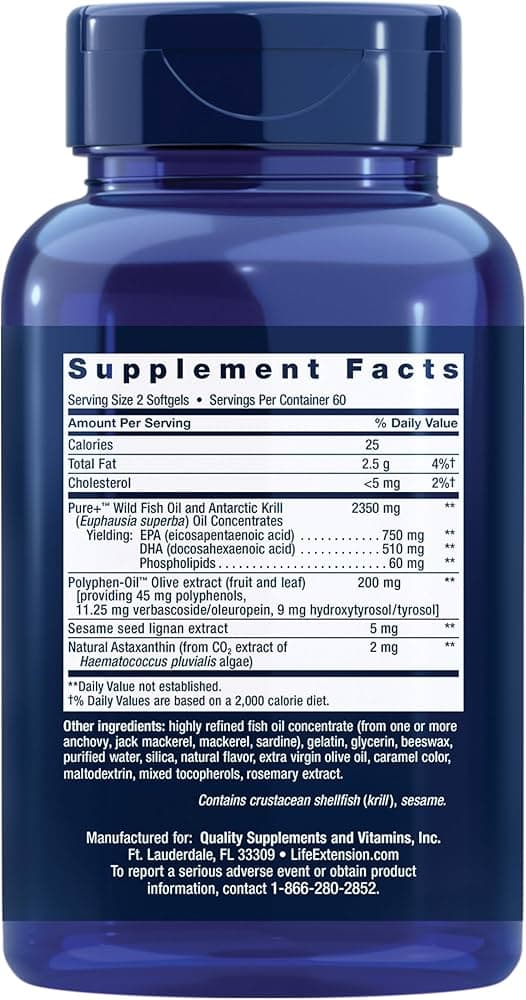
Olive fruit phenolics are ortho-diphenols that donate a hydrogen atom to lipid peroxyl radicals in the aqueous and interfacial layers, while tocopherols do the same work inside the lipid core. The two therefore act at different positions in the same emulsion rather than duplicating each other. In an oil-based softgel this pairing is also a formulation decision, because tocopherol slows oxidation of the carrier oil itself. Marker chemistry, not an outcome.
Reduced coenzyme Q10 and olive phenolics both intercept lipid radicals, and ubiquinol can be regenerated by other reducing species present in the same matrix. Co-formulation is common in oil-filled capsules where an added phenolic slows oxidation of the vehicle. What has been measured for either compound alone is oxidation markers rather than a clinical endpoint.
Astaxanthin spans the membrane bilayer while hydroxytyrosol and tyrosol sit at the polar interface, so the two occupy different positions in the same oxidisable structure. Formulators pair them for that reason in oil-based antioxidant blends. No combination trial is cited here and the reasoning is chemical.
Hydroxytyrosol and catechins are both heavily sulfated and glucuronidated by intestinal and hepatic SULT and UGT enzymes on first pass. Taken together in quantity they draw on the same conjugating capacity, which can shift how much of either circulates unconjugated. The direction of that shift depends on dose and is a pharmacokinetic point, not an efficacy claim.
Resveratrol shares the sulfation and glucuronidation route that limits free hydroxytyrosol in plasma, so the two are competitors for clearance capacity as much as partners. They differ in where they distribute, resveratrol being more lipophilic. Any combined effect described here is mechanistic reasoning about exposure.
Dihydrolipoic acid reduces oxidised forms of several antioxidants, and phenolic radicals formed after hydrogen donation are chemically available to such reductants. That makes the pair complementary in a redox network sense. The claim is about chemistry in solution, not a measured human outcome.
The phenolic fraction of olive fruit extract is water soluble, but the same extracts carry lipophilic components including maslinic and oleanolic acid and squalene, which need dietary or formulated fat to be solubilised into mixed micelles. A medium-chain triglyceride vehicle supplies that fat in a small volume. This applies to the fat-soluble fraction only and says nothing about the hydroxytyrosol content.
Phospholipids are used to disperse polyphenol extracts, keeping them in a fine emulsion rather than settling or aggregating in an oil fill. That is a delivery and stability decision made at the bench. Whether it changes what reaches the blood depends on the specific formulation and is not established for this extract.
Catechol groups such as those on hydroxytyrosol bind divalent transition metals, copper included, which is part of why they slow metal-catalysed lipid oxidation. In the gut lumen that same binding can reduce the fraction of a copper salt available for uptake if both are taken at once. Separating the two by a couple of hours removes the question. The chelation chemistry is settled. The size of any effect on copper status is not.
Polyphenol-rich extracts bind divalent cations and can lower the soluble fraction of a zinc salt taken in the same dose. This is the same chemistry that makes tea reduce non-heme iron uptake. Spacing the doses is the ordinary handling. The competition is established. The magnitude for olive extract specifically has not been quantified here.
N-acetylcysteine feeds cysteine into glutathione synthesis, giving a thiol arm to a system where olive phenolics act by direct hydrogen donation. The two work by different chemistry on the same problem. This is mechanism only and neither claim here is an outcome.
Piperine inhibits glucuronidation in the gut wall and liver, which is the main route that clears hydroxytyrosol and its relatives. Co-formulation is therefore a plausible way to raise the unconjugated fraction of a phenolic dose. The same inhibition applies to unrelated compounds a person may be taking, so it is a general pharmacokinetic lever rather than a targeted one.
Nothing specific on file for Olive Fruit Extract. Match the label to the daily amount above, and tell your doctor what you take.
Not medical advice. Show the label to your pharmacist.What Olive Fruit Extract actually does.
Hydroxytyrosol and oleuropein carry a catechol group, a pair of neighbouring phenol groups. It donates a hydrogen atom to a fat-derived peroxyl radical and leaves behind a resonance-stabilised radical of its own. That is the same chemistry that makes catechols chain-breaking antioxidants in an oil or emulsion.
Catechol groups grab hold of two-charge transition metals such as iron and copper. Bound metal is less able to drive the Fenton-type reactions that start fat oxidation, and in your gut the same binding lowers how much of a mineral salt taken at the same time stays soluble.
Once absorbed, hydroxytyrosol is quickly tagged with sulfate and glucuronide groups in the intestinal wall and liver, so most of what circulates is conjugated rather than free. A phenolic content figure on a label is a content number, not a measure of what reaches tissue unconjugated.
Olive fruit also carries a fat-loving fraction, including the triterpenes maslinic and oleanolic acid plus the hydrocarbon squalene. These need bile salts and dietary fat to enter mixed micelles, which is a different absorption route from the water-soluble phenolics in the same extract.
Where Olive Fruit Extract comes from.
Olives, or the water left over from pressing them, are washed with water or a water and alcohol mix to pull out the phenolic compounds. That liquid is concentrated, cleaned up, measured for how much hydroxytyrosol it contains, then dried into a powder or mixed into oil for a capsule.
Made from a plant. What ends up in the capsule tracks the harvest, so batch testing and a stated marker matter more here than with a made molecule.
Either whole or destoned Olea europaea fruit, or the aqueous stream separated during oil milling, which carries much of the fruit's water-soluble phenolic content.
Phenolics are pulled into water or a water and ethanol mixture. Solvent ratio and temperature set which compounds come across and how much of the oleuropein is hydrolysed in the process.
The crude extract is passed over adsorbent resin or through membranes to concentrate phenolics and strip sugars, acids and mineral salts.
The concentrate is assayed by HPLC and blended, usually with a carrier, until it hits a declared percentage of hydroxytyrosol or of total phenolics.
Dried onto maltodextrin or acacia for powders and tablets, or dispersed into a triglyceride carrier for softgels.
Labels rarely say whether the phenolics came from fruit pulp or from olive mill process water, and they rarely name the extraction solvent, both of which shape the compound profile.
Getting Olive Fruit Extract from food.
The whole-food sources on file. A supplement closes the gap, it does not replace dinner.
A gram-for-gram figure (how much of each you would eat to match a dose) will appear here once it is sourced and reviewed. This page will not print a number it cannot cite.
The forms it comes in.
The essence, in one line each.
- In 56 adults with systolic blood pressure of 130 mmHg or above, eight weeks of 440 mg olive dry extract providing about 124 mg oleuropein was followed by a systolic fall of about 8.3 mmHg against about 7.3 mmHg on placebo, a difference the trial did not detect as significant, and cholesterol changes were similar in both groups.Randomised trial. Lauwers et al., 2026 (PloS one). PMID 41805711 ↗
- The authors report that a hydroxytyrosol-enriched olive extract carried in proniosomes could be added before or after fermentation of yoghurt with its phenolic content and antioxidant activity retained in the product.In vitro study. Alper B et al., 2026 (Frontiers in Nutrition). PMID 42325534 ↗
- Supplementation with maslinic acid, a triterpene found in olive fruit, was examined for its effect on inflammation and oxidative stress markers after exercise. The reported endpoints are blood markers rather than performance outcomes.Randomised trial. Shirai T et al., 2023 (Journal of the International Society of Sports Nutrition). PMID 37498159 ↗
- The authors set out to measure whether plant-based foods and polyphenol supplementation shift gut microbial metabolite output in adults with excess body weight. Olive-derived polyphenols are named among the sources rather than tested alone.Randomised trial. Lanuza F et al., 2025 (BMJ Open). PMID 40962336 ↗
- A multi-plant concentrated powder containing several botanical extracts improved skin brightness measurements against placebo. The design cannot attribute the change to any single component.Randomised trial. He Y et al., 2025 (Journal of Cosmetic Dermatology). PMID 39927597 ↗
- The reviewers map randomised trials of anti-inflammatory dietary patterns against mood measures and describe the trial base as heterogeneous, with olive-derived polyphenols named as a dietary component rather than as a tested supplement.Systematic review. Sprengel ML et al., 2026 (Frontiers in Nutrition). PMID 42051341 ↗
- The review catalogues clinical trials of plant-derived compounds alongside their molecular mechanisms and names olive polyphenols among the candidates studied for cognitive endpoints. It draws no conclusion about the extract on its own.Systematic review. Bayo Jimenez MT et al., 2025 (International Journal of Molecular Sciences). PMID 41226670 ↗
- Antioxidant enzyme activity and oxidative stress markers were tracked across ageing in fruit flies, with olive-derived phenolics named among dietary antioxidants of interest. The readouts are enzyme markers in an insect model.Animal study. Savić A et al., 2026 (Journal of Insect Science). PMID 41873818 ↗
- The authors describe rapid instrumental measurement of primary and secondary oxidation markers in edible oils during deep frying, the analytical context in which olive phenolic content is quantified.In vitro study. Mehany T et al., 2026 (Foods). PMID 41683144 ↗
- A review of fruit seed and processing side streams as sources of functional compounds, olive material among them, framed around recovering phenolics from food waste.Narrative review. Fernandes DS et al., 2026 (Molecules). PMID 42197178 ↗
- Anaerobic bioconversion of mixed fruit waste yielded organic acids and an enzymatic bioproduct in a stirred reactor, one route by which fruit processing residues including olive residues are handled.In vitro study. Longo VD et al., 2026 (Microorganisms). PMID 42075303 ↗
These are the studies our verdict leans on, chosen from the 2,577 we read for Olive Fruit Extract. The full linked list is below.
FDA Disclaimer: These statements have not been evaluated by the Food and Drug Administration. This information is for educational purposes only and is not intended to diagnose, treat, cure, or prevent any disease. Consult your healthcare provider before starting any supplement regimen.