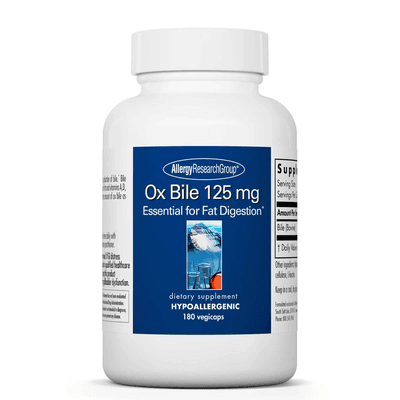
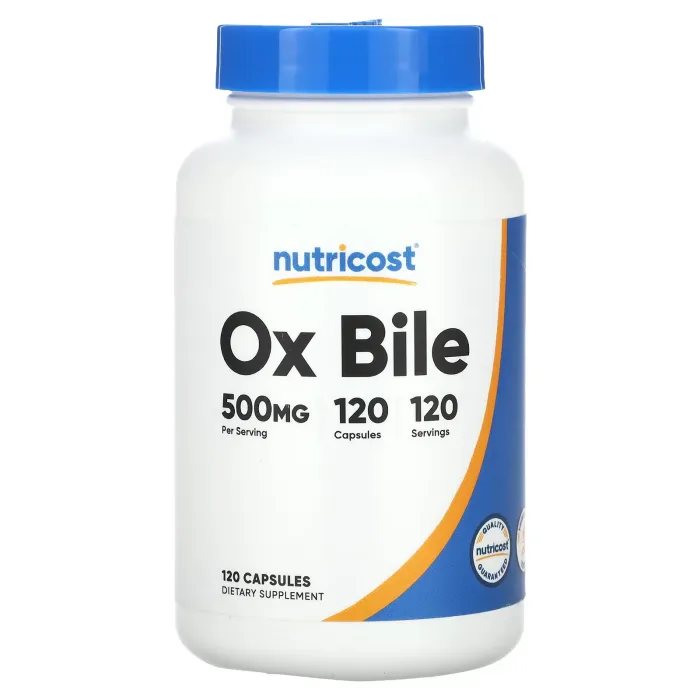
Ox Bile.
Digests fats and stops bloating, especially without a gallbladder. Provides bile acids to emulsify fats. Essential for fat digestion and absorption of fat-soluble vitamins.
Reviewed March 2026
- Category
- Enzyme
- Also filed under
- Improves fat digestionReduces bloating, gas, and indigestionSupports absorption of fat soluble vitamins (A, D, E, K)Alleviates symptoms of gallbladder removal
What Ox Bile is, and what it does.
- Does it work
- Yes if you need it. Specific use case but very effective.
- How much to take
- 100-500mg with fatty meals. Start low and adjust.
- Time to feel it
- It works on the meal you take it with. Fat handling is a same meal effect, so the first fatty meal after a dose is where it shows, not a week down the line.
- The first dose
- Should notice easier fat digestion with next fatty meal.
- With regular use
- Better fat and vitamin absorption. More comfortable digestion.
- How well tolerated
- Well tolerated if you need it. May cause diarrhea if overused or not needed.
- How it feels
- Fatty meals don't cause discomfort anymore. Better energy from absorbing fats.
- The overlooked benefit
- Bile salts are the carrier for vitamins A, D, E and K, so pair a dose with the meal that holds those. Viscous fibre taken at the same time binds bile salts away.
100 to 500mg a day is where Ox Bile works.
Source: Fiasse R et al. Acta Gastroenterol Belg. 1985
The proof, claim by claim.
These words describe the research, not the molecule's worth. Research strength is how much work stands behind one claim, and it is never a product score.
The mechanism is straightforward physiological replacement. For people with bile insufficiency or no gallbladder, it directly provides the missing tool for fat digestion. Its use is well-established in clinical practice.
- Improves fat digestion for individuals with bile insufficiency or post-gallbladder removal.Physiological principle and clinical application
- Reduces bloating, gas, and indigestion after consuming fatty foods.Clinical observation and strong anecdotal evidence
Questions people ask about Ox Bile.
- Do I need this without a gallbladder?
- Many people do. Without a gallbladder, bile trickles constantly instead of being stored and released for meals.
- Can I take it preventively?
- Not recommended. Only use if you have symptoms of fat maldigestion.
- What are signs I need it?
- Greasy stools, bloating after fatty meals, floating stools, fat-soluble vitamin deficiencies.
- Should I take digestive enzymes too?
- Often combined with lipase. Many supplements include both.
- Is it actually from oxen?
- Yes. It's bovine bile. Works identically to your own bile.
- Can vegetarians use it?
- No. It's an animal product. There's no plant-based equivalent.
Why these belong in the same formula. Each row says what the basis is, from settled biochemistry through to a trial that measured the pair.
Bile salts break dietary fat into fine droplets, and the lipase in digestive enzyme blends works on that enlarged fat surface to release the fatty acids the gut can take up. Emulsifying the fat and then splitting it are the two normal, consecutive steps of fat digestion.
Vitamin D3 is fat soluble, so it reaches the gut wall packaged inside the mixed micelles that bile salts build from dietary fat. Enough bile in the small intestine is a normal requirement for absorbing it.
Coenzyme Q10 is a large, oily molecule with very low water solubility, so its uptake from the gut depends on being carried inside bile-salt micelles alongside dietary fat. Supplemental bile supports the same micelle-forming step that sets how much CoQ10 crosses the gut wall.
Soluble fiber from psyllium binds bile acids in the gut, so a heavy dose taken at the same moment can hold onto some of the bile and leave less of it free to emulsify fat. Spacing the two apart keeps more bile available for that job.
Retinyl esters need bile salt micelles to reach the enterocyte brush border. Supplemental bile acids supply the emulsifying agent when endogenous bile output is low.
Tocopherol uptake is among the most bile-dependent of the fat-soluble vitamins. Bile salts form the mixed micelle that carries it across the unstirred water layer.
MK-7 is absorbed with dietary lipid in bile salt micelles. Added bile acids improve solubilisation of the menaquinone in the small intestine.
Carotenoid transfer from the food matrix into micelles requires bile salts. Without them a large share of the dose passes through unabsorbed.
Bile acids are conjugated with taurine or glycine before secretion, and taurocholate is the more water-soluble and acid-stable of the two. Taurine supply supports the conjugated pool that does the emulsifying.
Glycine is the other amino acid used to conjugate bile acids in the liver. Adequate glycine keeps conjugation running rather than leaving unconjugated bile acids in circulation.
Betaine HCl lowers gastric pH so pepsin can act, and bile acids then emulsify fat once the chyme reaches the duodenum. Digestive formulas stack them because they work in series, not in parallel.
Pepsin handles protein in the acid stomach while bile handles lipid downstream. Combining them covers two different macronutrients in one dose.
Phosphatidylcholine is a natural constituent of bile and is required for stable mixed micelles alongside bile salts. Adding lecithin supplies the phospholipid half of that emulsifying pair.
Artichoke cynarin raises endogenous bile secretion while ox bile adds preformed bile acids to the meal. One works on output, the other on supply.
Curcuminoids stimulate gallbladder contraction and are themselves highly lipophilic. Bile acids raise the micellar fraction of the curcumin dose while the curcumin encourages bile movement.
Long-chain omega-3 triglycerides must be emulsified before pancreatic lipase can act on them. Bile acids raise the interfacial surface area available for that hydrolysis.
Activated charcoal adsorbs bile acids along with everything else in the lumen, so it removes the emulsifier the same dose was meant to supply. The two should never share a timing window.
Bentonite's charged aluminosilicate layers bind bile salts and other organic anions. Co-dosing lowers the free bile acid pool available for micelle formation.
Medium chain fatty acids are absorbed largely without micellar solubilisation and enter the portal vein directly. They are the lipid choice when bile output is limited, which makes them complementary to rather than dependent on added bile acids.
Lipase hydrolyses triglyceride only at a droplet surface, and bile salts with colipase are what create and hold that surface. Supplying both together addresses two different steps of the same sequence rather than doubling one of them. Neither substitutes for the other.
Pancreatin carries lipase, amylase and protease activity, and its lipase fraction depends on emulsified substrate. Bile components in the same capsule supply the emulsifying half of the pair. Combination products are formulated this way as ordinary practice.
Phylloquinone is lipid soluble and reaches the enterocyte inside a mixed micelle. Bile salts are required to form that micelle, so the two act on the same transport step. This is a statement about absorption, not about any downstream clinical measure.
Lutein is a xanthophyll carotenoid with no meaningful water solubility, so its uptake tracks micellar solubilisation. Bile salts govern that step alongside the presence of dietary fat. Absorption is the endpoint here, not tissue levels.
Zeaxanthin partitions into the lipid core of mixed micelles in the same way as its isomer lutein. Bile salt availability therefore sits upstream of how much crosses the brush border. The mechanism concerns the transport step only.
Lycopene is a highly lipophilic carotene that must be transferred from the food matrix into a micelle before uptake. Bile salts drive that transfer. Nothing here speaks to what happens after absorption.
Astaxanthin is usually delivered esterified or in an oil carrier, and both routes rely on lipolysis plus micellar solubilisation. Bile salts participate in both steps. The pairing is about getting the molecule across the gut wall.
Tocotrienols share the lipophilic behaviour of the tocopherols and depend on micelle formation for uptake. Bile salt sufficiency is therefore part of the absorption picture. Plasma appearance, not any clinical outcome, is what the mechanism addresses.
Biliary phospholipid, mostly phosphatidylcholine, is a native constituent of mixed micelles alongside bile salts and cholesterol. Adding phosphatidylcholine contributes the same structural component the gallbladder normally supplies. The two are partners in one physical assembly rather than competitors.
A swallowed oil has to be emulsified and hydrolysed before its fatty acids can be absorbed. Bile salts set the droplet surface that lipase needs. Taken together the oil supplies substrate and the bile component supplies the emulsifier.
Boswellic acids are poorly water soluble pentacyclic triterpenes whose absorption is described as rising when taken with a fatty meal. Bile salts are the physiological reason a fatty meal helps. The reasoning is pharmacological rather than drawn from a combination trial.
Plant sterols and cholesterol compete for the limited sterol-carrying capacity of intestinal mixed micelles. Bile salts build those micelles, so the two interact within a shared, finite space. Worth flagging as a competition rather than a boost.
Guar gum forms a viscous gel that binds bile salts in the lumen and increases their faecal loss. Taken in the same meal it works against the emulsifying job an ox bile extract is there to do. Separating the two by a couple of hours is the usual formulation answer.
Pectin is a soluble fibre with documented bile acid binding capacity, which removes bile salts from the recycling pool. Co-ingestion therefore reduces the amount available for micelle formation. Flag it as an interaction to space out, not a hazard.
Oat beta-glucan raises intestinal viscosity and sequesters bile acids, which is the accepted explanation for its effect on cholesterol handling. That same sequestration works against supplemental bile salts in the same meal. Timing separates them.
Glucomannan is among the more viscous of the soluble fibres and traps luminal contents including bile salts. Taken together, less bile salt remains free to emulsify fat. The interaction is physical, in the lumen.
Calcium ions precipitate fatty acids as insoluble soaps and also bind bile acids, increasing their faecal excretion. At high calcium doses in the same meal this reduces the free bile salt pool. It is a luminal chemistry effect and does not depend on either being in short supply.
Many Lactobacillus and Bifidobacterium strains carry bile salt hydrolase, which deconjugates bile acids and changes the composition of the pool reaching the ileum. The traffic runs both ways: bile also stresses the bacteria, which is why bile tolerance is a screening step for candidate strains. Direction of the net effect depends on strain and dose.
Bile salt hydrolase activity is well documented in Lactobacillus acidophilus and is one of the traits used to select the species for supplement use. Deconjugated bile acids behave differently in the lumen from their taurine and glycine conjugates. This modulates the pool rather than adding to it.
Silymarin preparations are long paired with bile-supporting formulas in herbal practice, and silymarin itself is a poorly soluble flavonolignan complex whose absorption is influenced by micellar solubilisation. The pairing rests on formulation habit plus that solubility argument, not on a combination trial. Confidence is kept low for that reason.
Dandelion root is a traditional bitter used in digestive formulas alongside bile constituents. Bitter-tasting botanicals are conventionally described as stimulating upper digestive secretion. The basis is traditional use, and no combination trial is claimed.
Ginger appears in digestive blends with bile and enzyme components and is described in that context for gastric emptying and post-meal comfort. Its gingerols are also lipophilic and depend on micellar transport. Both threads are suggestive rather than tested together.
Talk to a doctor before taking Ox Bile if any of these apply to you: Not for general use, Can cause loose stools at high doses, Consult a doctor with liver conditions. These are flags to check first, not effects Ox Bile is known to cause.
Not medical advice. Show the label to your pharmacist.What Ox Bile actually does.
Bile salts act like a detergent, breaking dietary fat into droplets small enough for the gut to absorb.
Fat-splitting enzymes need the droplets bile makes before they can get to work.
The body attaches taurine or glycine to bile acids so they stay dissolved where they are needed.
Bile is recycled, not spent once, and the same pool circulates several times per meal.
Where Ox Bile comes from.
It comes from cattle bile collected at the abattoir, which is then extracted, cleaned up, tested for how much bile acid it contains and dried into a powder for capsules.
Made from an animal material. Species and tissue are the things worth knowing, and both belong on a label.
Fresh bile collected from cattle as a by-product of meat processing, an established rendering stream rather than a purpose-raised input.
The liquid bile is concentrated and the bile acid fraction taken up, commonly with alcohol, leaving much of the water and some pigment behind.
Filtration and precipitation steps reduce bilirubin and other non-bile-acid material. How far this goes is what separates whole ox bile extract from a purified bile salt fraction.
Lots are assayed and adjusted to a declared bile acid or cholic acid percentage, since raw bile composition varies with the animal and the season.
Spray drying or vacuum drying yields a hygroscopic powder that is usually encapsulated, sometimes with an enteric coating.
Suppliers rarely state the country of origin of the herd, the solvent used, or how much biliary phospholipid survives purification.
Getting Ox Bile from food.
The whole-food sources on file. A supplement closes the gap, it does not replace dinner.
A gram-for-gram figure (how much of each you would eat to match a dose) will appear here once it is sourced and reviewed. This page will not print a number it cannot cite.
The forms it comes in.
The essence, in one line each.
- In a person with a shortened bowel, natural conjugated bile acids from ox bile raised daily fat absorption by about 40 g, with a parallel rise in calcium absorption and weight gain across a four-month trial.Metabolic balance study. Gruy-Kapral et al., 1999 (Gastroenterology). PMID 9869597 ↗
- In a person with a shortened bowel, natural conjugated bile acids from ox bile cut fecal fat excretion from 119 to 79 g per day and lowered urinary oxalate excretion from 87 to 64 mg per day.Metabolic balance study. Emmett et al., 2003 (American Journal of Kidney Diseases). PMID 12500242 ↗
- Bile exposure altered phage and host interactions in multidrug-resistant Pseudomonas aeruginosa cultures, which shows bile as a chemically active signal in the gut lumen and not only a detergent.In vitro study. Khan MSI et al., 2025 (BMC Microbiology). PMID 41107717 ↗
- The review groups bile acids with trimethylamine N-oxide and short-chain fatty acids as gut microbiota derived metabolites that act as signalling molecules, and describes the microbial transformations that set the composition of the bile acid pool.Narrative review. Gao M et al., 2026 (Molecular Medicine Reports). PMID 42272249 ↗
- Chitin-glucan supplementation changed postprandial metabolic markers and gut microbiota composition in adults at cardiometabolic risk. Bile acids appear only as part of the measured metabolite panel, so the paper grounds the fibre and bile acid relationship rather than any effect of supplemental bile.Randomised trial. Ranaivo H et al., 2022 (Scientific Reports). PMID 35614185 ↗
- Bile salt tolerance was one of the screening criteria used to characterise a candidate Limosilactobacillus reuteri strain, illustrating how strongly bile challenges bacterial membranes during intestinal transit.In vitro study. Xu T et al., 2026 (Poultry Science). PMID 42096904 ↗
- Survival in bile was again used as a laboratory qualifying test for a spore-forming Lysinibacillus candidate, which supports bile as a selective pressure on gut microbes.In vitro study. El-Sayed SE et al., 2026 (Applied Microbiology and Biotechnology). PMID 41794991 ↗
These are the studies our verdict leans on, chosen from the 2,035 we read for Ox Bile. The full linked list is below.
The studies, linked.
1 source behind our Ox Bile verdict: peer-reviewed studies and registered clinical trials. Every one links straight to PubMed, the journal, or ClinicalTrials.gov. Read them yourself.
- Clinical trialEffect of Delayed-Release Bile Acid on Insulin Sensitivity, Gastric Emptying and Body Weight in Overweight or Obese Patients With Type 2 Diabetes MellitusClinicalTrials.gov ↗Phase 2, 24 participants, Completed
Evidence surfaced via Semantic Scholar (Allen Institute for AI) and ClinicalTrials.gov. Ranked by study type and citation weight, not cherry-picked.
Problems people have reported.
Read this carefully. These are 124 voluntary, unverified reactions reported to the FDA (openFDA). The number mostly reflects how popular Ox Bile is, not how risky it is. A report is not proof Ox Bile caused anything. It is a signal of what to watch for, nothing more.
Source: openFDA adverse-event reports. Voluntary reporting, not an incidence rate.
FDA Disclaimer: These statements have not been evaluated by the Food and Drug Administration. This information is for educational purposes only and is not intended to diagnose, treat, cure, or prevent any disease. Consult your healthcare provider before starting any supplement regimen.