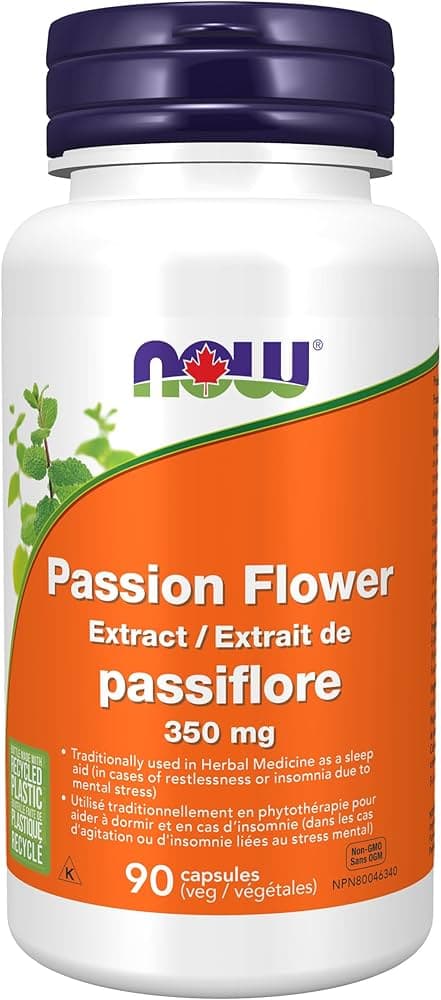
Passiflora Incarnata Flower Extract.
Research-backed herb with potential health benefits. Calms the nervous system. Helps you fall asleep faster and reduces mild anxiety by quieting down the 'chatter' in your brain.
Reviewed March 2026
- Category
- Herb
What Passiflora Incarnata Flower Extract is, and what it does.
- Does it work
- Yes. For mild cases, it's a well-researched, non-habit-forming alternative to stronger stuff. It actually works.
- How much to take
- For sleep, try 300-500 mg of a standardized extract 30-60 minutes before bed. For daytime anxiety, smaller doses of 150-250 mg up to twice a day.
- Time to feel it
- Often the same evening, roughly 30 to 60 minutes after a dose. The steadier daytime calm builds across one to two weeks of regular use.
- The first dose
- You'll likely feel a subtle calming effect within an hour. Don't expect a knockout punch. It's gentle.
- With regular use
- Consistent use can help establish better sleep patterns and lower your baseline level of anxiety. People report feeling less 'on edge' overall.
- How well tolerated
- Well tolerated at everyday amounts, with drowsiness the usual effect, so keep it to the evening. Check with your doctor if you take sedatives, or if you're pregnant or breastfeeding.
- How it feels
- Like your brain's dimmer switch is being turned down a notch. Calming and quieting, but you still feel like yourself.
- The overlooked benefit
- Its flavones amplify GABA signalling that is already happening rather than switching it on, which is why the calm arrives gently and you can still think straight.
200 to 500mg a day is where Passiflora Incarnata Flower Extract works.
Source: Akhondzadeh et al., J Clin Pharm Ther, 2001; Ngan & Conduit, Phytother Res, 2011
The proof, claim by claim.
These words describe the research, not the molecule's worth. Research strength is how much work stands behind one claim, and it is never a product score.
Passiflora Incarnata Flower Extract is documented in the library. The clinical read is in the queue. Nothing about the strength of the research prints until the read is done.
- falling asleep more easilyRandomised trial
- sleep quality across the nightRandomised trial
- everyday nervous tension and calmRandomised trial
- settling before a stressful eventRandomised trial
- positive allosteric modulation at the GABA-A benzodiazepine siteIn vitro study
- traditional use for restlessness and evening wind-downNarrative review
Questions people ask about Passiflora Incarnata Flower Extract.
- Will this make me groggy the next day?
- Probably not. One of its main benefits is a lack of 'hangover' effect compared to other sleep aids.
- Is it addictive?
- No. It's not considered habit-forming. You can stop taking it without withdrawal symptoms.
- Can I drink alcohol with it?
- Bad idea. It can amplify the sedative effects of alcohol, making you much drowsier than expected.
- How quickly does it work?
- For sleep, you'll usually feel it within 30 to 60 minutes. For anxiety, the effects can be more cumulative over several days.
- Can I take this every night?
- Yes, it's generally considered well tolerated in nightly use for short-to-medium term periods. Check with your doc for long-term use.
- Is this the same as passion fruit?
- Related, but no. The supplement comes from the flower, leaves, and stem of a specific species, not the fruit you eat.
Why these belong in the same formula. Each row says what the basis is, from settled biochemistry through to a trial that measured the pair.
Both are used in evening formulas for a calm-alertness effect without a stimulant load. Passionflower flavonoids are reported to act at GABA-A binding sites, while theanine is reported to raise alpha-band cortical activity and to modulate glutamate signalling. The two may arrive at a similar felt outcome through different receptor routes, which is why they are stacked. Human data on the specific combination is thin, so read this as mechanistic rather than clinical.
Magnesium is a physiological modulator of NMDA receptor activity and a cofactor in over three hundred enzymatic steps, including those that support normal nervous system function. Glycine itself is an inhibitory neurotransmitter at its own receptor. Paired with passionflower's GABA-A activity, the combination covers two distinct inhibitory routes. The pairing is formulation convention rather than a tested combination.
Valerian and passionflower have appeared together in European herbal preparations for well over a century. Both are reported to interact with GABAergic signalling, valerian through valerenic acid at the beta subunit and passionflower through its flavone fraction. Anyone combining them should expect the calming effect to stack rather than cancel. Caution applies alongside anything else that promotes drowsiness.
Lemon balm contributes rosmarinic acid, which inhibits GABA transaminase and so slows the breakdown of GABA already present. Passionflower works at the receptor end of the same system. The two are long-standing partners in tea blends and tinctures aimed at evening calm. The rationale is pharmacological overlap, not a head-to-head trial.
Chamomile's apigenin is a benzodiazepine-site ligand at GABA-A, and passionflower extracts carry chrysin and related flavones with affinity for the same complex. Stacking them raises total flavone load at one receptor family. That is a reason to start low rather than to assume a bigger effect is better. The combination is common in sleep-support blends.
Apigenin is one of the flavones present in Passiflora incarnata itself, so supplementing it alongside a standardised extract raises the dose of a compound the extract already delivers. Both act at the benzodiazepine binding site of GABA-A without being benzodiazepines. Total flavone exposure, not the label count, is what changes. This is straightforward additive chemistry.
Melatonin acts on MT1 and MT2 receptors to shift circadian timing, a different axis from passionflower's GABAergic calming. Sleep formulas commonly pair a timing signal with a calming agent because they address separate parts of falling asleep. Drowsiness effects add together. Neither ingredient substitutes for the other.
Supplemental GABA is the endogenous ligand for the receptor that passionflower flavones modulate. How much oral GABA reaches central receptors remains contested, so the pairing rests on the receptor logic rather than on established central delivery. Passionflower does not depend on the added GABA to act. Read the combination as speculative in humans.
Glycine is an inhibitory neurotransmitter at its own strychnine-sensitive receptor and a co-agonist at NMDA receptors, and it lowers core body temperature in the evening. Passionflower contributes GABA-A modulation. The two inhibitory systems are separate, which is the basis for combining them. Effects on drowsiness add.
Tryptophan is the dietary precursor for serotonin and downstream melatonin, a supply-side route that is unrelated to receptor modulation. Passionflower acts on the receptor side of the inhibitory system. Formulators combine a precursor with a modulator because the two act at different points. Anyone already taking a serotonergic medicine should raise the combination with a clinician.
5-HTP sits one enzymatic step downstream of tryptophan and bypasses the rate-limiting hydroxylase. Passionflower contributes no serotonergic precursor of its own. The pairing joins a substrate route to a receptor route. Serotonergic loading is the reason to be careful when other serotonergic agents are in use.
Honokiol and magnolol from magnolia bark are positive modulators at GABA-A, overlapping directly with the passionflower flavone fraction. Two positive modulators at one receptor complex is a genuine additive load. Evening formulas pair them for that reason. Sedation effects stack and should be accounted for.
Ashwagandha withanolides act largely through the hypothalamic-pituitary-adrenal axis and cortisol rhythm, a slow endocrine route measured over weeks. Passionflower acts acutely at receptors within an evening. Combining a slow axis-level agent with an acute one is a common formulation shape. They are not redundant.
Rhodiola is generally used for daytime stimulation and monoamine modulation, which pulls in the opposite direction from passionflower's evening calming. Some formulas use rhodiola in the morning and passionflower at night in one regimen. Taken together at the same hour the two may partly offset. Timing, not exclusion, is the practical point.
Caffeine is an adenosine receptor antagonist that raises central arousal, the opposite direction from GABA-A positive modulation. Taken close together the arousal signal will blunt the calming one. This is a well-understood pharmacological opposition, not a hazard. Separating them by several hours is the usual approach.
St John's wort is a potent inducer of CYP3A4 and P-glycoprotein and alters plasma levels of many co-administered compounds. Passionflower's flavonoid constituents undergo phase I and phase II handling that induction can accelerate. The interaction runs on the metabolic side rather than the receptor side. Anyone taking prescription medicines should clear this pairing with a clinician first.
Nothing specific on file for Passiflora Incarnata Flower Extract. Match the label to the daily amount above, and tell your doctor what you take.
Not medical advice. Show the label to your pharmacist.What Passiflora Incarnata Flower Extract actually does.
Passionflower's above-ground parts carry C-glycosyl flavones, mainly vitexin, isovitexin, orientin and isoorientin. Those four are the markers an extract gets standardised against.
Flavonoid glycosides barely cross the gut wall intact. Gut enzymes and colon bacteria strip the sugar off first, so the delivered dose depends on the extract's glycoside profile and on your own gut bugs.
Once the sugar-free forms are absorbed, the gut lining and liver tag them heavily, so what circulates is mostly glucuronides and sulfates rather than the free compounds the extract spec lists.
Flavones in the chrysin and apigenin family latch onto the benzodiazepine site of the GABA-A receptor and work as positive modulators. They boost the response when GABA is already parked there instead of opening the channel themselves.
Where Passiflora Incarnata Flower Extract comes from.
The flowering tops of the passionflower vine are cut, dried and ground, then soaked in water or alcohol to pull out the plant compounds. The liquid is evaporated off and what remains is measured so every batch carries the same amount of the marker compound. Whether you get a powder, a capsule or a dropper bottle depends on where in that sequence the maker stops.
Made from a plant. What ends up in the capsule tracks the harvest, so batch testing and a stated marker matter more here than with a made molecule.
Flowering and early-fruiting aerial parts, the plant part European pharmacopoeial monographs specify, cut during the flowering window when flavone content is at its practical peak.
Harvested material is dried at controlled temperature to arrest enzymatic degradation of the glycosides, then milled to a defined particle size to open cell walls for extraction.
The milled herb is extracted with water, ethanol or an ethanol-water mixture. The ratio sets which constituents come across, with more ethanol pulling more of the less polar fraction.
The extract is filtered to remove plant solids and the solvent is evaporated under reduced pressure to keep the temperature low, leaving a concentrated soft or dry residue.
The dried extract is assayed by HPLC against vitexin or total flavonoids and blended with a carrier such as maltodextrin to bring each batch to the declared percentage.
Finished as a free-flowing powder for capsules and tablets, or held as a fluid extract for tinctures and liquid blends.
The forms it comes in.
The essence, in one line each.
- The authors reviewed human and preclinical work on Passiflora incarnata and concluded the flavonoid-rich extracts show calming and sleep-supporting activity, while noting that trials are small and preparations are not standardised in a common way.Systematic review. Janda et al., 2020 (Nutrients). PMID 33352740 ↗
- A review of the Passiflora genus catalogues the C-glycosyl flavones such as vitexin and isovitexin as the characteristic constituents and links the reported calming activity to GABAergic modulation.Narrative review. Nikolova et al., 2024 (Plants). PMID 38256781 ↗
- Passiflora incarnata appears among the plants this review discusses for mood support, with the authors describing the evidence base as active but not yet settled. The ingredient is named inside a broader survey rather than tested on its own.Narrative review. Nurzynska-Wierdak et al., 2024 (Pharmaceuticals). PMID 39598400 ↗
These are the studies our verdict leans on, chosen from the 3 we read for Passiflora Incarnata Flower Extract. The full linked list is below.
FDA Disclaimer: These statements have not been evaluated by the Food and Drug Administration. This information is for educational purposes only and is not intended to diagnose, treat, cure, or prevent any disease. Consult your healthcare provider before starting any supplement regimen.