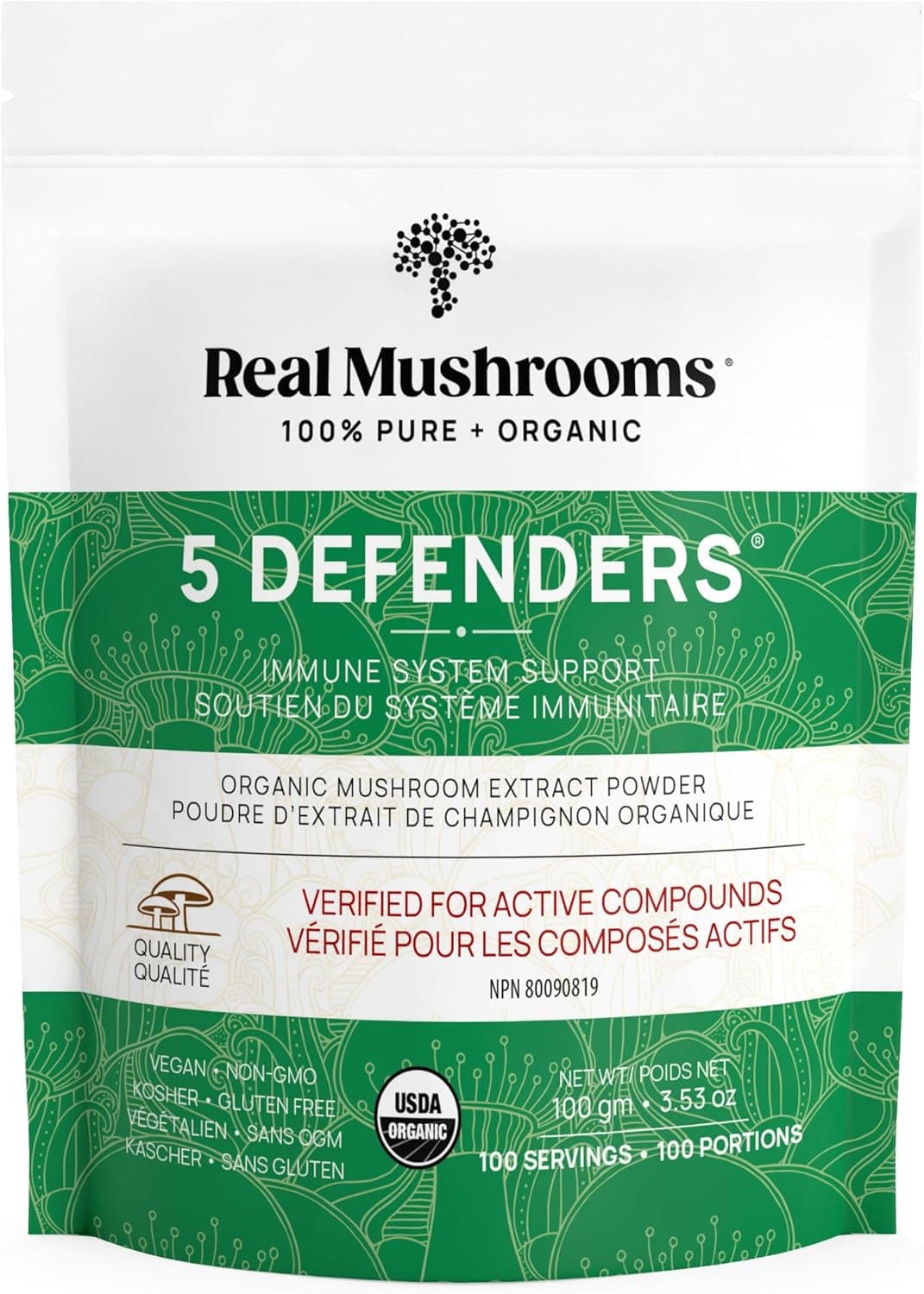
Turkey Tail Mushroom.
May offer immune support and gut health benefits. Boosts certain immune cell activity and acts as a prebiotic, feeding the good bacteria in your gut. Think of it as support crew for your internal defenses.
Reviewed March 2026
- Category
- Herb
- Also filed under
- Immune supportGut healthAntioxidant effects
What Turkey Tail Mushroom is, and what it does.
- Does it work
- It's promising. Lots of lab data, but the big human trials are still catching up. Not a guaranteed win, but worth a shot for general wellness.
- How much to take
- 1 to 3 grams of a quality extract per day. Look for a label that says it's standardized for polysaccharides or beta-glucans. That's the important part.
- Time to feel it
- Four to eight weeks of daily use is the honest window. Digestive changes tend to arrive first, and immune measures are a laboratory readout rather than a sensation.
- The first dose
- Zero. Don't expect anything.
- With regular use
- After 4-8 weeks, you might notice better digestion or feel like you're shaking off colds a little easier. The effect is cumulative and subtle.
- How well tolerated
- Generally well tolerated. The main cautions are for people with overactive immune systems (autoimmune) or those on specific meds. For most people, it's well-tolerated.
- How it feels
- Like nothing, mostly. It's not a stimulant or a sedative. You're paying for what it does in the background over time, not for a feeling.
- The overlooked benefit
- The alcohol step some makers add is not decoration. Adding ethanol to a concentrated water extract drops the high-weight glucans out of solution, which is how a glucan fraction gets enriched.
1 to 3g a day is where Turkey Tail Mushroom works.
Source: Eliza et al. 2012 Evid Based Complement Alternat Med review; Torkelson et al. 2012 ISRN Oncol (n=11).
The proof, claim by claim.
These words describe the research, not the molecule's worth. Research strength is how much work stands behind one claim, and it is never a product score.
Research shows some benefits, but more robust human trials are needed, especially at doses commonly found in supplements.
- Gut microbiome balanceRandomised trial
- Recognition by dectin-1 on innate immune cellsIn vitro study
- Short-chain fatty acid production from colonic fermentationNarrative review
- Immune marker changes with daily dosingRandomised trial
Questions people ask about Turkey Tail Mushroom.
- Is this from an actual turkey?
- Nope. It's a mushroom that grows on trees and just happens to look like a turkey's fanned-out tail.
- Can I just eat the mushroom?
- You could, but it's tough and woody like bark. An extract is how you actually get the beneficial compounds.
- What's better: fruiting body or mycelium?
- Fruiting body is generally considered better. It's the actual mushroom part and where the key compounds are most concentrated.
- How long until I notice anything?
- Be patient. Give it at least a month or two of consistent daily use. It needs time to build up.
- Is it a psychedelic mushroom?
- No. Zero psychedelic effects. This one is strictly for wellness.
- Can I take it with my morning coffee?
- Yes. Mix the powder right in or just take a capsule alongside it. No interactions there.
Why these belong in the same formula. Each row says what the basis is, from settled biochemistry through to a trial that measured the pair.
Turkey tail's polysaccharide K and polysaccharopeptide are beta-glucan backbones with bound protein, read by dectin-1 and complement receptor 3 on innate immune cells. Additional beta-glucan presents more ligand to the same receptors.
Reishi contributes triterpenes alongside its own beta-glucans, a fraction turkey tail lacks. Combining the two broadens both the polysaccharide and the terpene profile in one formula.
Lentinan from shiitake is a 1,3 beta-glucan with 1,6 branches, structurally close to the turkey tail backbone and read by the same innate receptors. Blends combine them to widen the branching pattern presented.
The maitake D-fraction is a proteoglucan acting on the same dectin-1 and TLR2 signalling as turkey tail polysaccharopeptide. The two are standard co-members of mushroom immune blends.
Chaga adds betulinic acid derivatives and melanin-rich polyphenols on top of its beta-glucans, constituents turkey tail does not carry. The polysaccharide actions overlap while the polyphenol fraction does not.
Astragalus polysaccharides act on pattern recognition receptors on the same innate cells that read fungal beta-glucans, from a plant rather than fungal source. Pairing them is long-standing practice in polysaccharide immune formulas.
Cordyceps brings cordycepin and adenosine derivatives acting on cellular energy handling alongside its beta-glucans. Turkey tail supplies the protein-bound polysaccharide, so the fractions are complementary.
Turkey tail polysaccharides are largely not digested by human enzymes and are fermented by colonic bacteria, acting as a substrate that shifts the community. Delivering live cultures alongside gives the substrate organisms to work on.
Inulin is fermented to short-chain fatty acids by colonic bacteria, the same route turkey tail polysaccharides take. Two fermentable substrates of different chain chemistry feed a broader set of organisms.
Monocytes and macrophages express the vitamin D receptor and use calcitriol to regulate antimicrobial peptide expression. Those are the same cells the beta-glucan receptor sits on.
Zinc is needed for thymulin and for the zinc finger transcription factors that drive lymphocyte development. It supplies the mineral requirement of the cells the mushroom polysaccharides signal to.
Phagocytes accumulate ascorbate to high intracellular levels and use it to buffer their own oxidative burst. That keeps the cell type responding to beta-glucan signalling in working order.
Both are basidiomycete fruiting bodies whose cell walls carry beta-1,3/1,6-glucans, the ligand class recognised by dectin-1 and complement receptor 3 on innate immune cells. Stacking them raises total glucan intake rather than adding a second mechanism. Lion's mane contributes hericenones and erinacines that turkey tail does not, so the pairing widens the compound profile. The combination itself has not been measured in a controlled human trial.
Zinc is a structural and catalytic cofactor for hundreds of enzymes and for zinc-finger transcription factors used by normal immune cell development. Turkey tail glucans act on receptors, not on that cofactor role, so the two support normal immune function through separate routes. Adequate zinc status is a background requirement rather than an amplifier of the mushroom. No trial has tested the pairing.
Selenium is incorporated as selenocysteine into glutathione peroxidases and thioredoxin reductases, which set the redox tone normal lymphocytes work in. That is a cofactor role and it is independent of the polysaccharide signalling turkey tail contributes. Mushroom mycelium can also accumulate selenium from its substrate, so a selenium-enriched biomass and a separate selenium ingredient can double up. Check total intake rather than assuming the two are separate.
Human digestive enzymes do not hydrolyse beta-1,3 glucan linkages, so a meaningful share of an oral dose reaches the colon intact and becomes substrate for saccharolytic bacteria. Lactobacillus plantarum is among the species able to use fungal polysaccharide fractions. The relationship is substrate to organism, which is why it reads as enabling rather than additive. Fermentation extent varies with extraction method and with the individual microbiota.
Undigested mushroom polysaccharide arriving in the colon is fermented to short-chain fatty acids, and bifidobacteria are a principal genus in that conversion. Supplying the organism alongside the substrate is the standard synbiotic construction. Output depends on the fibre fraction actually present, which hot-water extracts carry and alcohol-precipitated concentrates carry in higher proportion. Species-level yield from turkey tail specifically has not been mapped in people.
S. boulardii is itself a yeast whose wall carries beta-glucan and mannan, so pairing it with turkey tail adds both a live organism and more fungal wall polysaccharide. The two act on different levels, one transient colonisation and one substrate supply. Neither depends on the other to work. The combination is formulation logic rather than a tested pairing.
GOS is rapidly fermented in the proximal colon while fungal beta-glucan ferments more slowly and further along. Combining a fast and a slow substrate spreads fermentation across the length of the colon rather than concentrating gas production in one segment. This is standard fibre-blend practice. Tolerance still tracks total fermentable load, so the sum matters more than the ratio.
FOS and mushroom beta-glucan are both fermentable by colonic bacteria but differ in fermentation rate and in the bacterial groups that use them. Together they broaden the substrate profile reaching the microbiota. Rapidly fermented FOS drives most of the early gas, so a stack that feels uncomfortable is usually the FOS fraction rather than the mushroom. Adjust the fast fibre first.
Resistant starch is fermented preferentially to butyrate by starch-degrading colonic species, a different output profile from the mixed acids produced from fungal glucan. Pairing them widens both the substrate range and the short-chain fatty acid mix. Neither displaces the other, since the enzymes involved are distinct. The specific yield of the pairing has not been measured.
PHGG is a low-viscosity soluble fibre fermented gradually across the colon, which pairs with the slow fermentation of fungal glucans. Both are soluble, so a blend stays dispersible in a stick pack rather than gelling. The two contribute to one fermentable fibre total. Any digestive comfort effect belongs to the fibre load, not to the mushroom.
Butyrate is one end product of colonic fermentation of undigested polysaccharide, so supplying it directly and supplying its substrate land in the same pathway from opposite ends. Delivered butyrate acts in the proximal gut unless it is coated, while fermentation-derived butyrate is generated where the substrate is used. This is a supply relationship, not an amplification. Total exposure is what the pairing changes.
Lactoferrin is an iron-binding glycoprotein of the innate response that sequesters free iron and interacts with mucosal surfaces. Turkey tail polysaccharide works through glucan receptors instead, so the two occupy different parts of innate function. A formula can carry both without either interfering with the other. The pairing has not been evaluated in a controlled trial.
Bovine colostrum supplies immunoglobulins, lactoferrin and growth factors that act at the mucosal surface. Turkey tail contributes fungal polysaccharide recognised by innate receptors. Their inputs do not overlap, which is why the pairing appears in mucosal-support blends. Neither is required for the other, and the combination itself is untested in people.
Elderberry contributes anthocyanins and turkey tail contributes glucans, and the two are routinely combined in seasonal immune formulas. The pairing rests on category convention plus separate mechanisms rather than on a combination study. Anthocyanin absorption is low and largely microbial, so elderberry also arrives partly in the colon. Read the pairing as formulation convention with two independent inputs.
Quercetin is a flavonol that is heavily conjugated in the gut wall and liver, with much of an oral dose reaching colonic bacteria for ring cleavage. Turkey tail polysaccharide reaches the same compartment by a different route. Both therefore end up interacting with the microbiota, from different chemistry. The combination has not been tested together in humans.
Panax ginseng and turkey tail appear together in traditional East Asian tonic formulas. Ginsenosides require microbial deglycosylation before absorption, which places part of ginseng's activity in the colon alongside fermented mushroom polysaccharide. The link is a shared compartment plus long-standing pairing, not a measured interaction. No controlled trial has assessed the two together.
Eleuthero is a conventional partner for medicinal mushrooms in adaptogen-plus-mushroom blends. Its eleutherosides and turkey tail's polysaccharide-protein complexes are unrelated chemistries with no known competition. The basis here is category practice rather than a study. State it as convention.
Schisandra lignans and turkey tail polysaccharides are combined in traditional tonic preparations. Schisandra lignans are known modulators of hepatic drug-metabolising enzymes, which is a consideration for anything else in the stack rather than for the mushroom. Turkey tail polysaccharide is not appreciably absorbed intact, so it is not a substrate for those enzymes. The pairing is traditional, not trial-supported.
Human amylase, protease and lipase do not hydrolyse beta-1,3 or beta-1,6 glucan linkages, so a standard digestive enzyme blend does not increase how much mushroom polysaccharide is absorbed. What breaks the fungal wall open is hot-water extraction during manufacture, not enzymes taken at the table. The protein fraction of polysaccharide-peptide complexes is protease-accessible, which can change the complex rather than release more glucan. Read this pairing as neutral for delivery.
Activated charcoal adsorbs a wide range of organic molecules in the gut lumen without selectivity. Taken in the same window as a mushroom extract, it reduces what stays available for absorption or for colonic fermentation. Separating doses by several hours is the usual handling. This is a general adsorbent effect rather than anything specific to turkey tail.
Bentonite is a binding clay that adsorbs organic and ionic species non-selectively in the gut. Co-dosing with a mushroom extract lowers the amount of extract left in solution. Spacing the two apart preserves each. The interaction is physical and applies to most co-administered actives.
Talk to a doctor before taking Turkey Tail Mushroom if any of these apply to you: Pregnancy, Autoimmune conditions, Bleeding disorders. These are flags to check first, not effects Turkey Tail Mushroom is known to cause.
Not medical advice. Show the label to your pharmacist.What Turkey Tail Mushroom actually does.
Turkey tail mushroom cell walls are built from branched glucan chains, often bound to protein as specific polysaccharide-protein complexes.
Human digestive enzymes can't break down this type of fungal glucan, so it passes through the small intestine mostly intact and reaches the colon whole.
These fungal glucans are recognized by specific receptors on innate immune cells, the recognition step behind the interest in fungal glucans for immune support.
Gut bacteria ferment the undigested fungal polysaccharide into short-chain fatty acids, mainly acetate, propionate and butyrate.
Where Turkey Tail Mushroom comes from.
Turkey tail is a bracket fungus grown on hardwood or on grain. The useful part of it sits inside a wall that human digestion cannot open, so the mushroom is simmered for hours in hot water, the liquid is concentrated, and that concentrate is dried into powder. Some makers add an alcohol step to pull out compounds water leaves behind.
Made from a plant. What ends up in the capsule tracks the harvest, so batch testing and a stated marker matter more here than with a made molecule.
Trametes versicolor is a white-rot fungus of hardwood. Cultivated material is grown on supplemented hardwood sawdust blocks or on sterilised grain. Some supply is wild-collected from standing deadwood.
The substrate is inoculated and held under controlled humidity and light until the mycelium colonises it and forms the banded fruiting bodies. Grain-grown mycelium is instead harvested before any fruiting occurs.
Dried, milled biomass is held in near-boiling water for hours to solubilise the wall polysaccharide, since human digestion cannot open those linkages. A separate ethanol pass is added when a dual extract is being made.
The liquor is filtered and concentrated under vacuum. Adding ethanol precipitates the high-molecular-weight polysaccharide and leaves smaller sugars behind, which is how a glucan-enriched fraction is obtained.
The concentrate is assayed for total polysaccharide or specifically for beta-glucan and blended to a declared percentage. Beta-specific assays separate fungal glucan from substrate starch. Total-carbohydrate methods do not.
The concentrate is dried to a free-flowing powder, often onto a small amount of carrier, then milled and filled into capsules or blended into powders.
Labels often do not state whether the material is fruiting body or grain-grown mycelium, nor whether a stated polysaccharide percentage was measured as beta-glucan specifically or as total carbohydrate.
The forms it comes in.
The essence, in one line each.
- The authors review edible and medicinal mushrooms, turkey tail among them, and conclude that support for normal neurological function rests mainly on compound-level and preclinical work rather than on controlled human outcomes.Narrative review. Bell et al., 2025 (Nutrients). PMID 40362877 ↗
- The review characterises cultivated mushrooms as a protein and polysaccharide source and describes their amino acid and beta-glucan composition, with turkey tail named among the species covered.Narrative review. Pawde et al., 2026 (Foods). PMID 42073187 ↗
- The authors survey mushroom-derived compounds and glucose-handling markers in adults with high blood sugar and conclude the supporting data are predominantly preclinical, so the findings are markers and mechanisms rather than clinical outcomes.Narrative review. Németh et al., 2025 (International Journal of Molecular Sciences). PMID 39859540 ↗
- A molecular-level review of dietary and medicinal mushrooms, including turkey tail polysaccharides, that sets out the proposed cell-signalling targets alongside the authors' own caution that most evidence is laboratory-based.Narrative review. Kirdeeva et al., 2026 (International Journal of Molecular Sciences). PMID 41683739 ↗
- A non-human review of mushroom inclusion in poultry diets reporting changes in immune and growth measures. The findings are animal production markers and do not transfer to people.Narrative review, in animals. Salahuddin et al., 2025 (Poultry Science). PMID 40446686 ↗
- A clinical review that names turkey tail among mushroom-derived products used in integrative care settings and states the supporting evidence remains limited. The mention is descriptive of practice, not a demonstrated effect.Narrative review. Berman et al., 2026 (Current Oncology Reports). PMID 41697452 ↗
These are the studies our verdict leans on, chosen from the 6 we read for Turkey Tail Mushroom. The full linked list is below.
The studies, linked.
1 source behind our Turkey Tail Mushroom verdict: peer-reviewed studies and registered clinical trials. Every one links straight to PubMed, the journal, or ClinicalTrials.gov. Read them yourself.
- Clinical trialA Phase 2 Pilot Window of Opportunity Study Turkey Tail Mushrooms (TTM) (Trametes Versicolor) in Post-Menopausal Women With HER2 (-) ER (+) Breast Cancer Planning to Undergo Surgical TherapyClinicalTrials.gov ↗Phase 2, 40 participants, Recruiting
Evidence surfaced via Semantic Scholar (Allen Institute for AI) and ClinicalTrials.gov. Ranked by study type and citation weight, not cherry-picked.
Problems people have reported.
Read this carefully. These are 339 voluntary, unverified reactions reported to the FDA (openFDA). The number mostly reflects how popular Turkey Tail Mushroom is, not how risky it is. A report is not proof Turkey Tail Mushroom caused anything. It is a signal of what to watch for, nothing more.
Source: openFDA adverse-event reports. Voluntary reporting, not an incidence rate.
FDA Disclaimer: These statements have not been evaluated by the Food and Drug Administration. This information is for educational purposes only and is not intended to diagnose, treat, cure, or prevent any disease. Consult your healthcare provider before starting any supplement regimen.