Adipic acid.
A tart food acid rather than a nutrient. In a supplement it sets the sourness, holds the pH steady and drives the fizz in effervescent tablets.
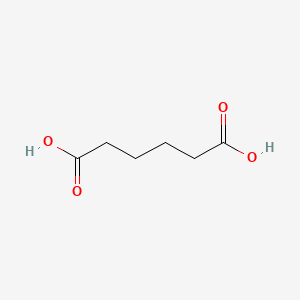 Compound
- Category
- Compound
What Adipic acid is, and what it does.
- Does it work
- You do not choose this one, the formulator does. It earns its place by keeping a powder tasting right and dissolving cleanly in the glass.
- How much to take
- There is no intake to aim for and no dose on record. The amount in a product is set by the formulator for taste and pH stability.
- Time to feel it
- There is nothing to wait for. Its whole effect is immediate: the sour note on the tongue and the fizz as the tablet dissolves.
- The first dose
- Day one is taste. Sourness in the mouth, carbon dioxide in the glass, and nothing else that registers.
- With regular use
- Weeks of use change nothing in the body. It is metabolised and cleared, and it goes on doing the same formulation job in every serving.
- How well tolerated
- Well tolerated at the amounts used in food and supplements. Very large amounts of any food acid can irritate the stomach or soften tooth enamel.
- How it feels
- Cleanly sour, with less of the lingering bite that citric acid leaves. Beyond taste and fizz there is no sensation attached to it.
- The overlooked benefit
- It pulls very little water from the air, so in a dry powder blend it stays free-flowing where citric or malic acid would clump.
The proof, claim by claim.
What these words mean
These words describe the research, not the molecule's worth. Research strength is how much work stands behind one claim, and it is never a product score.
- acidulant and pH control in food and supplement systemsNarrative review
- carbon dioxide generation with bicarbonate in effervescent productsIn vitro study
2 more claims
- sequestration of divalent metal cations in solutionIn vitro study
- urinary adipate as a marker of fatty acid omega-oxidationNarrative review
Why these belong in the same formula, 6 pairings
Why these belong in the same formula. Each row says what the basis is, from settled biochemistry through to a trial that measured the pair.
Adipic acid appears in urine as a dicarboxylic acid when fatty acids are shunted into omega-oxidation because beta-oxidation is running short. The dehydrogenase steps of beta-oxidation depend on FAD, which the body builds from riboflavin. Poor riboflavin status therefore tends to raise dicarboxylic acid excretion, and correcting it tends to lower it. That is a urinary marker moving, not a clinical outcome.
Long chain fatty acids need carnitine to cross into the mitochondrion for beta-oxidation. When that route is limited, more fatty acid is handled by omega-oxidation in the endoplasmic reticulum, and adipic acid is one of the dicarboxylic end products. So carnitine status sits upstream of how much adipate shows up in urine. This describes a metabolic relationship, not a supplement pairing.
Adipic acid is a solid food-grade acid with low hygroscopicity, which is exactly why it is paired with bicarbonate in effervescent tablets and powders. The two sit stable and dry together until water is added, then react to release carbon dioxide. The pairing is formulation engineering, and it has no nutritional meaning.
In a powder blend, adipic acid and calcium carbonate react on contact with moisture, forming calcium adipate and releasing carbon dioxide. Formulators either exploit this for fizz or separate the two by granulation to stop premature reaction in the pack. Which of the two is intended depends entirely on the product design.
The two carboxyl groups on adipate can coordinate divalent metal ions, which is the basis of its use as a sequestrant in food systems. In a mixed powder that can hold iron and other divalent minerals in complexes. Whether that changes how much mineral is absorbed from a finished supplement has not been measured, so this is chemistry rather than an established nutritional effect.
Ascorbic acid and adipic acid are both used to set the pH and the tart edge of powdered drink mixes and chewables. Adipic acid holds a steadier tartness and takes on less moisture from the air, so blending the two lets the formulator keep the flavour profile without relying on ascorbate for acidity. The purpose is taste and stability, not added nutrition.
Nothing specific on file for Adipic acid. Match the label to the daily amount above, and tell your doctor what you take.
Not medical advice. Show the label to your pharmacist.What Adipic acid actually does.
Adipic acid is a six-carbon molecule with an acid group on each end.
3 more mechanisms
It's a food acidifier that pulls very little moisture from the air compared with citric or malic acid, which is why it holds up well in dry powder mixes.
In the body, adipate isn't something you need. It's made when fat gets broken down through a side pathway that gets busier when normal fat burning is limited, so measuring it in urine is used as a metabolic marker.
It can grab onto metal ions in solution, which is why it's used as a stabilizer in food products.
Where Adipic acid comes from.
A tart food acid made mostly from petroleum feedstock, though sugar-fermentation versions are appearing. In supplements it is there to set the sourness, hold the pH steady and make effervescent tablets fizz. It is not a nutrient.
What this route gives you
The same molecule is reached more than one way. Which route a given product used is a manufacturing choice, and the finished compound is the same either way.
4 steps on record
The dominant industrial route starts from cyclohexane. Fermentation routes starting from glucose exist and are commercialising slowly.
Cyclohexane is air-oxidised to a cyclohexanol and cyclohexanone mixture known as KA oil, which is then oxidised with nitric acid to the diacid.
The crude acid is recovered and recrystallised to food or pharmaceutical grade, with residual solvents and nitrogen oxides controlled at this step.
Sold as the crystalline free acid at a specified particle size, or neutralised with sodium or potassium hydroxide to the corresponding adipate salt.
Getting Adipic acid from food.
The whole-food sources on file. A supplement closes the gap, it does not replace dinner.
A gram-for-gram figure (how much of each you would eat to match a dose) will appear here once it is sourced and reviewed. This page will not print a number it cannot cite.
The forms it comes in.
2 more forms
The essence, in one line each.
Chosen from the 1 we read for Adipic acid.
The studies, linked.
1 source behind our Adipic acid verdict, every one linked to PubMed, the journal or ClinicalTrials.gov.
- Clinical trialA Phase I, Open-Label, Multi-Center Dose Finding Study to Investigate the Safety, Pharmacokinetics, and Preliminary Efficacy of ATG-017 Monotherapy or Combination Therapy With Nivolumab in Patients With Advanced Solid Tumors and Hematological MalignanciesClinicalTrials.gov ↗Phase 1, 36 participants, Terminated
From clinical trials and PubMed, ranked by study type and citation weight, not cherry-picked.
FDA Disclaimer: These statements have not been evaluated by the Food and Drug Administration. This information is for educational purposes only and is not intended to diagnose, treat, cure, or prevent any disease. Consult your healthcare provider before starting any supplement regimen.