
You paid for the click. Your shopper looks for one reason to trust you, and looks fast.
We read every ingredient on your label against the clinical evidence and put the proof on your product page, as a badge your shopper can tap.
Shopify app Listing in review. On a demo we show it on your own product page, in minutes.
Each row of your label reaches your shopper three ways.
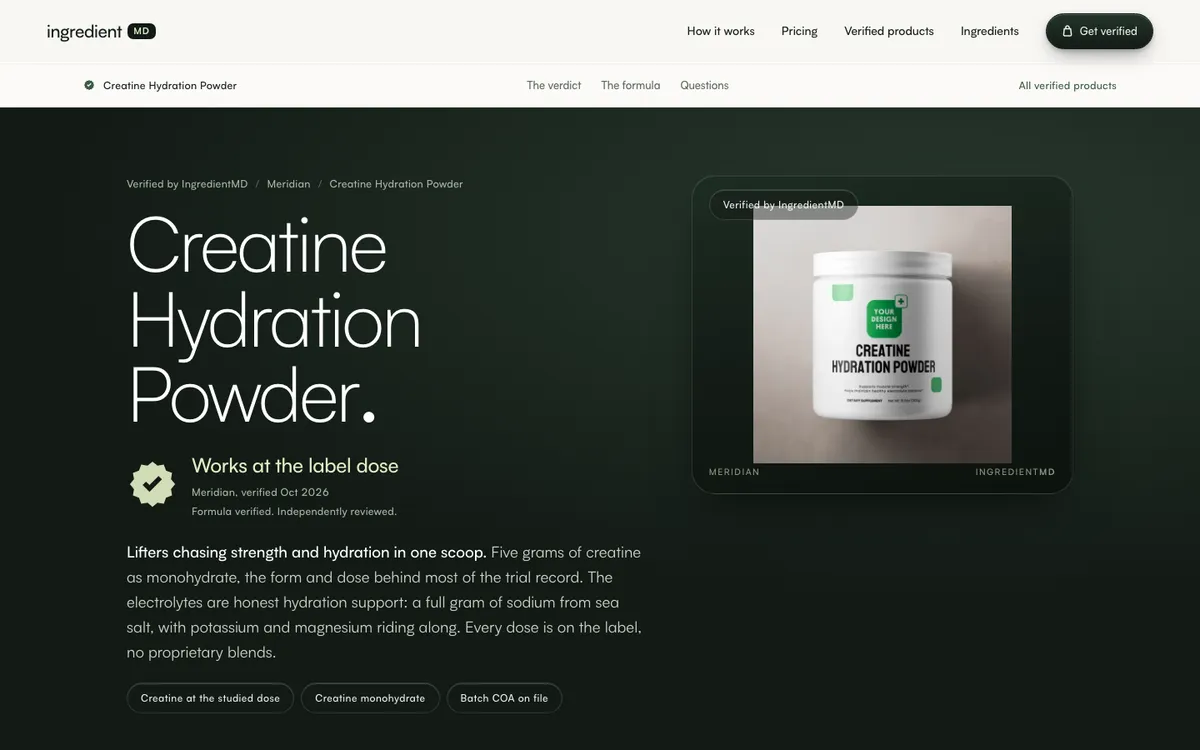
- Trust badgeOn your product page before anyone clicks, in your store's colours.
- Proof cardOpens on a tap: the take, the actives, the lab work and the limits, each with its source.
- Verification pagePublic and cited, and nobody can edit it, you included.
One verification sits behind all three. Which problem each one answers.
 Trust badgeProof cardVerification page
 Trust badgeProof cardVerification page
Behind every badge, the whole library.
Every figure is counted from the tables themselves and recounted when new rows land. None is typed.
Every ingredient searched across the literature, with the papers that matched it.
A finding, a dose, who a study measured, each with its source.
Pairings, mechanisms, forms, origins, time courses.
Linked where used, checked for a retraction every night.
The ones the citations name, counted.
Of 3,848 documented, each on its own page.
- Each ingredient on your label is read against its own rows, the ones counted above.
- A blend is read member by member. What holds up goes on your page with the study named beside it.
How one row of your label gets read.
The sources on the left, your badge on the right, the same five stations between them for every ingredient you sell.
What we read
Clinical trials, PubMed and more than a hundred vetted sources. A study at its design, a monograph at its authority, a regulator in its own words.
What a row has to carry
- What it does
- Does it work
- How much
- When
- First 24 hours
- After weeks
- Safety
- How it feels
- The overlooked benefit
Nine answers, every ingredient, every time. Where one is missing, the gap shows rather than a filler.
The kind of source sets the ceiling
- A meta-analysisStrong
- A randomised trialPromising
- An observational studyEmerging
- A monographEstablished
- A regulatorEstablished
- A textbookEstablished
- A manufacturer's documentno band
The band is read from the source type, never chosen, so a row cannot be talked up.
Two registers, one row
ClinicalIn the trial record, muscle creatine stores rise to a loaded level over about 4 weeks at 3 g daily, or about 1 week with a higher loading dose, and return toward baseline about 4 weeks after stopping.
PlainMuscle stores fill over about four weeks of daily use, and fall back toward their starting level about four weeks after stopping.
The plain line is a translation of the clinical one on the same row, never a stronger claim.
Read against its own paper
- Every row that could reach a badge is read against the abstract it cites. Only a pass goes to a brand.
- Every cited paper is checked for a retraction each night.
- Where a regulator says a substance cannot be sold as a supplement, its words stop the verdict first.
The second product, with the study beside it.
70,171 pairings in the tables, each with the reason it works and the kind of source behind it. This is creatine's corner of the field, the pairing module your page can carry.
The second product in the basket, earned by a published combination rather than a bundle discount.
What belongs together, and why, before they ask an assistant that cannot show its sources.
Nine steps per product, in your admin.
Click through them, or let them play. Nothing goes live until you say.


Check the rows we read off your label.
Everything your shoppers read later is built from this label, so a wrong amount here becomes a wrong sentence on your product page.
What you will want to know before you start.
How long does a read take?
The read runs the moment you press it and comes back in minutes, from a product link or a label photo. Verification adds your batch COA from the lab, and once that clears, the badge is yours to put live.
What if my formula does not pass?
Nothing public happens. There is no fail list and no negative verdict, and nothing is published about the attempt. A formula that does not hold up earns silence. You get the private findings and the exact steps to earn more, and nobody knows you asked.
How is this different from NSF or Informed Sport?
A certification seal tells your shopper what is in the bottle: identity and purity, which is a lab question. We check what your ingredients do (dose against the trials, form, synergy) and hand you that evidence as trust badges and proof cards a shopper can tap and check. The seal says it is clean. The badge says what the evidence found for your formula, with the studies named.
What if a product has a proprietary blend?
A blend is not a defect. We read every member we can name, say what is present, and stay silent on what the label does not disclose. The badge carries what the members earned.
Bring one product. Leave with its proof.
Private until you publish, and nothing goes live until you say.