Everything in a supplement starts with an ingredient.
So that is where we start. One ingredient, read against everything published about it. Then the next. Then the whole label.
Here is one, the way it sits in our tables.
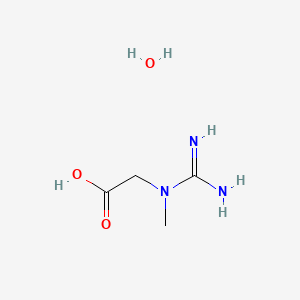
Creatine is made in a reactor from two simple chemicals and crystallised out of water, with no animal involved, whatever its meaty reputation suggests. It is the same molecule the body makes and stores in muscle, and testing focuses on two known process leftovers.
On its row: 19 human studies, 23 pairings, 8 forms, 7 mechanisms.
- 10 meta-analyses
- 9 trials
Creatine monohydrate. Creatine monohydrate increased the creatine stored in muscle, compared with placebo, in a controlled trial.
Spillane and others, 2009 (J Int Soc Sports Nutr). 8 forms on file, each with what it suits and its trade-off.- Creatine monohydrate + Beta-AlanineEstablished
- Creatine monohydrate + GlycineEstablished
- Creatine monohydrate + L-ArginineEstablished
Then we did that for every ingredient we could find.
Every figure here is counted from the tables themselves and recounted when new rows land. None of them is typed.
Every ingredient searched across the literature, with the papers that matched it, and a paper two ingredients share counted twice.
Values kept with their source: a finding, a dose, who a study measured, which way it points.
The rows those values sit in, across the layers below.
Each one linked where it is used, and checked again for a retraction every night.
The ones the citations name, counted.
Of 3,848 documented in the library, each on its own page.
134,434 readings of those rows. What a second reader found when a row was checked: whether its paper says what it says, who was studied, whether a brand may print it.
- Each ingredient on your label is read against its own rows, the ones you just saw.
- A blend is read member by member.
- What holds up goes on your product page, with the study named beside it.
How one ingredient gets read.
The sources on the left, the badge on the right, and the same five stations in between for every ingredient.
What we read
Clinical trials, PubMed and more than a hundred vetted sources. A study at its design, a monograph at its authority, a regulator in its own words.
What a row has to carry
- What it does
- Does it work
- How much
- When
- First 24 hours
- After weeks
- Safety
- How it feels
- The overlooked benefit
Nine answers, every ingredient, every time. Where one is missing, the gap shows rather than a filler.
The kind of source sets the ceiling
- A meta-analysisStrong
- A randomised trialPromising
- An observational studyEmerging
- A monographEstablished
- A regulatorEstablished
- A textbookEstablished
- A manufacturer's documentno band
The band is read from the source type, never chosen, so a row cannot be talked up.
Two registers, one row
ClinicalIn the trial record, muscle creatine stores rise to a loaded level over about 4 weeks at 3 g daily, or about 1 week with a higher loading dose, and return toward baseline about 4 weeks after stopping.
PlainMuscle stores fill over about four weeks of daily use, and fall back toward their starting level about four weeks after stopping.
The plain line is a translation of the clinical one on the same row, never a stronger claim.
Read against its own paper
- Every row that could reach a badge is read against the abstract it cites. Only a pass goes to a brand.
- Every cited paper is checked for a retraction each night.
- Where a regulator says a substance cannot be sold as a supplement, its words stop the verdict first.
The whole method, including what we never do, is on how a verdict gets earned.
No ingredient is taken alone.
70,171 pairings in the tables, each with the reason it works and the kind of source behind it. This is creatine monohydrate's corner of the field.
The second product in the basket, with the study beside it rather than a bundle discount.
What belongs together, and why, before they ask an assistant that cannot show its sources.
From the rows to your page.
Three things land on a product page, all of them drawn from the same rows.
Seen before a click, beside the price.
Proof cardOpens on a tap, one module at a time.
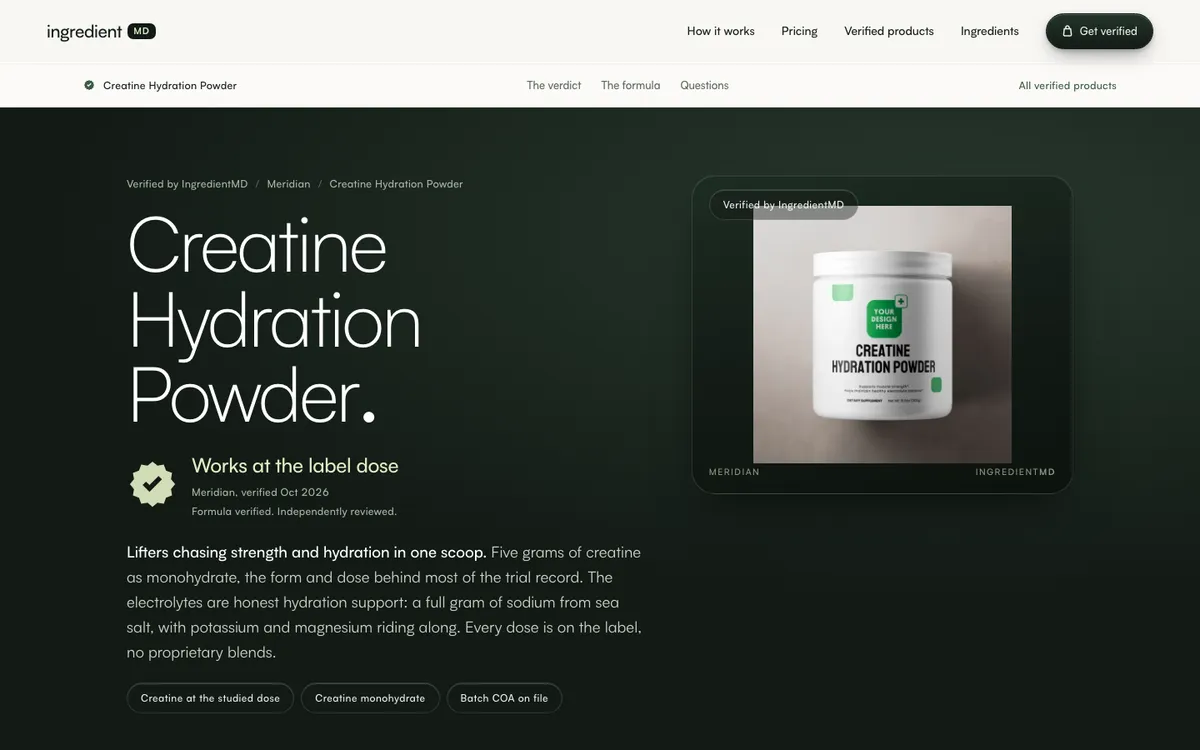
Public, every statement cited, nobody can edit it.
True, cited statements your shopper meets before the doubt, in three places you choose, in a register a regulator would read without flinching.
What this does at the dose on the label, who measured it and for how long, in plain words with the paper one tap away.
What never changes.
The verdict can't be bought or edited. The brand chooses how the proof is shown, never what it says.
Every cited paper resolves at PubMed and is checked again each night. No number and no letter rates an ingredient on any public page: the words are Strong, Promising and Early, and the counts lead.