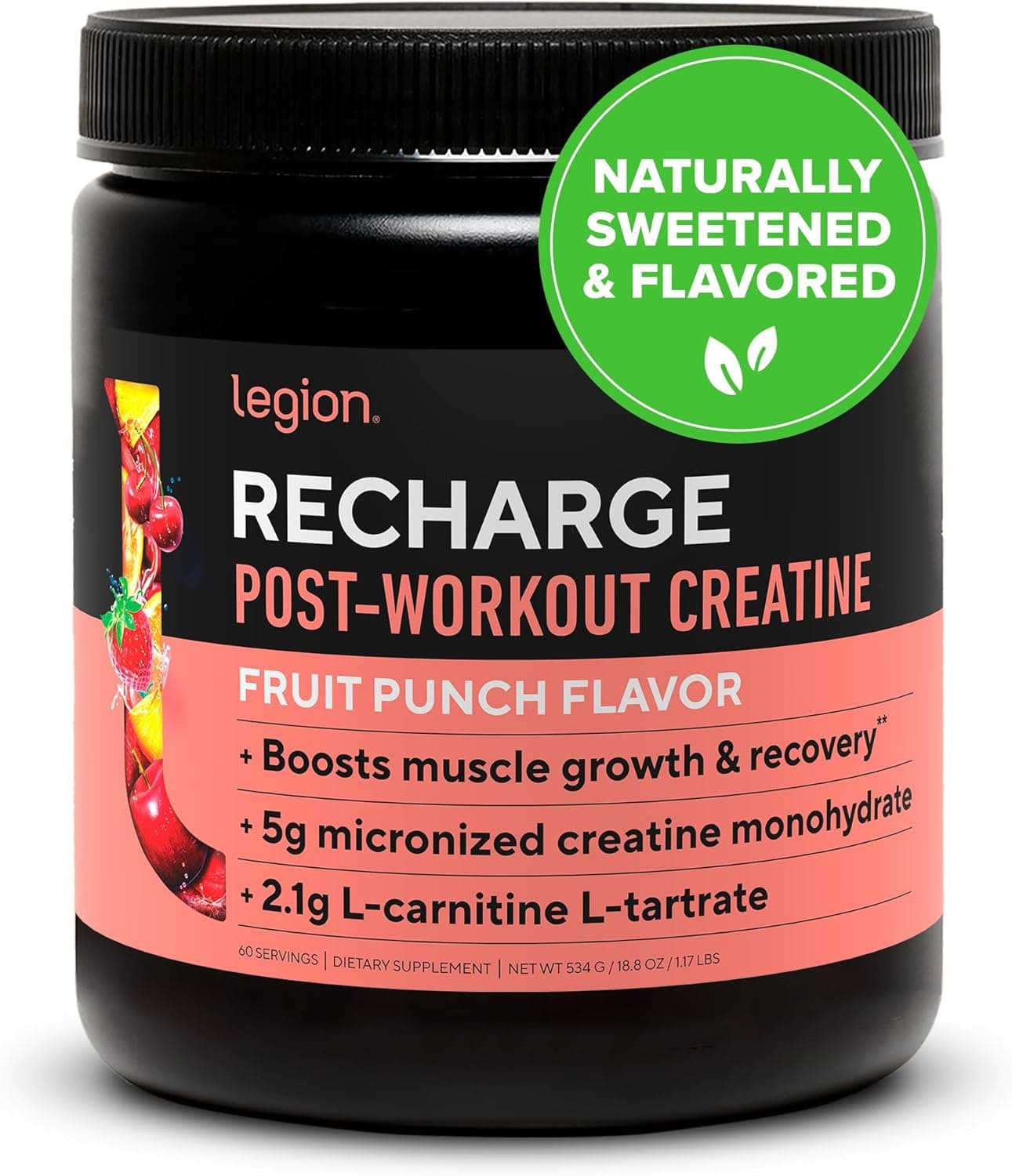
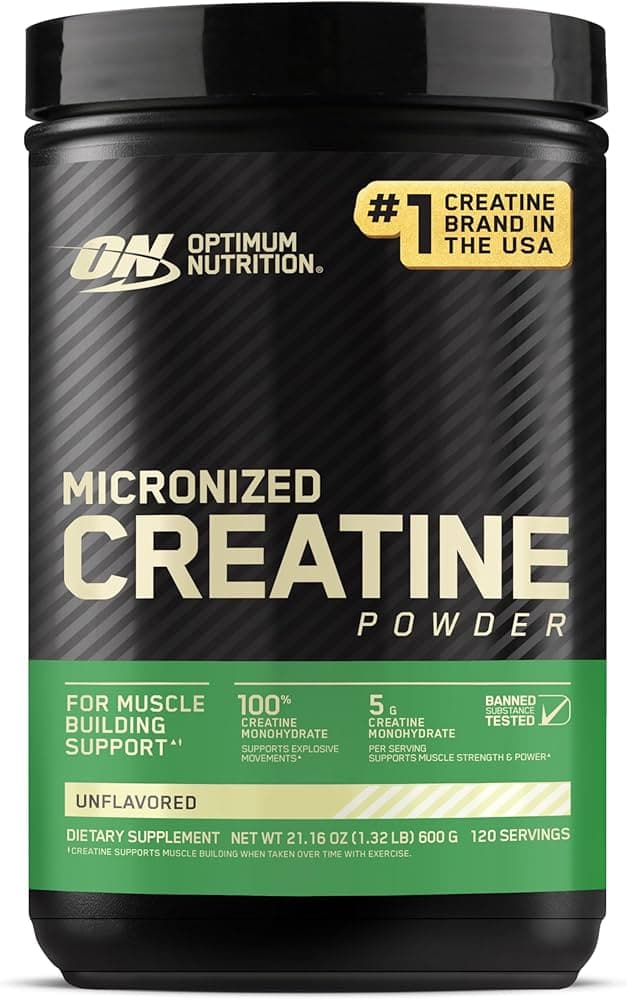
Creatine Monohydrate.
The energy reservoir. Helps you lift heavier and think clearer. Your muscles get more fuel for explosive efforts. Your brain gets a backup energy supply.
Reviewed March 2026
- Category
- Amino acid
- Also filed under
- StrengthBrainEnergyMusclePerformance
- Also called
- Creatine Monohydrate (standard), Micronized Creatine
What Creatine Monohydrate is, and what it does.
- Does it work
- Yes. One of the most studied supplements in existence, with over 500 human trials. The evidence is overwhelming.
- How much to take
- 5 grams daily. That's it. Skip the loading phase nonsense. One scoop in your morning coffee or shake is perfect.
- Time to feel it
- About 4 weeks of daily use.
- The first dose
- Nothing. Seriously. It needs to build up in your muscles over 2-3 weeks to work.
- With regular use
- After 3-4 weeks, your gym sessions feel better. You're recovering faster between sets. Some people notice clearer thinking, too.
- How well tolerated
- Well tolerated. The kidney myth is just that, a myth. Hundreds of studies confirm this in healthy people. Just drink normal amounts of water.
- How it feels
- Fuller, slightly heavier muscles in the first weeks as cells draw in water, then sets that end a rep later than they used to. No rush, no stimulant edge.
- The overlooked benefit
- It raises measured serum creatinine on a blood panel without any change in kidney filtration, purely because your stored pool is bigger. Worth telling whoever reads your results.
3 to 5g a day is where Creatine Monohydrate works.
Source: Kreider et al. 2017 ISSN Position Stand (n=1,847 across meta-analyses)
In the trial record, muscle creatine stores rise to a loaded level over about 4 weeks at 3 g daily, or about 1 week with a higher loading dose, and return toward baseline about 4 weeks after stopping.
Kept, not banked. The cited trial measured a return toward baseline after the last dose, so the effect holds while it is taken daily, not stored up. That rests on the trial window above.
The proof, claim by claim.
These words describe the research, not the molecule's worth. Research strength is how much work stands behind one claim, and it is never a product score.
Gold standard for performance and brain health.
- Increases maximal muscle strength and power outputMeta-analysis of 22 RCTs
- Increases lean body massSystematic review of nearly 100 RCTs
- Enhances short-term memory and intelligenceMeta-analysis of 6 RCTs
Questions people ask about Creatine Monohydrate.
- Will it make me bloated or gain weight?
- You might gain a few pounds of water weight in your muscles at first. This is a good sign it's working. It's not fat.
- Is it safe for my kidneys?
- Yes, for healthy kidneys. This has been studied extensively for decades. The myth is based on outdated and flawed assumptions.
- When is the best time to take it?
- Doesn't matter. Morning, post-workout, whenever. Just take it consistently every day.
- Does creatine cause hair loss?
- No good evidence for this. The rumor comes from one small, old study that didn't even measure hair loss. Most research shows no link.
- Do I need to cycle off of it?
- No. It's well tolerated in continuous long-term use. No need to stop and start.
- What happens if I stop taking it?
- Your creatine levels will slowly return to your normal baseline over about 4-6 weeks. There's no crash.
What the trials show about these together.
Outcomes the engine found studied for these actives as a combination, not one at a time. Each is a finding a named trial measured, cited and dated, never written by the brand.
- EarlyCreatine Monohydrate + CarbohydrateAbsorption
In a controlled trial in 24 men, taking creatine with a simple carbohydrate drink raised muscle total creatine about 60 percent more than creatine alone, and lowered the amount lost in urine.
Green et al., 1996 (Am J Physiol)PMID 8944667
Research strength. Research strength says how much work stands behind the combination. It is never a product score.
Fail closed. Where actives were studied on their own rather than together, each shows on its own evidence, never a combined effect no trial measured.
Independent record. Every finding is cited to a named trial, dated, and never written by the brand.
Findings from trials that studied these actives as a combination. Context for how the actives were tested together, not a statement about any individual and not a claim about this product.
Why these belong in the same formula. Each row says what the basis is, from settled biochemistry through to a trial that measured the pair.
Creatine keeps the phosphocreatine pool topped up so muscles can rapidly regenerate ATP in the first seconds of a maximal effort, while beta-alanine raises muscle carnosine, the buffer that soaks up the acidity that builds as high-intensity work continues. They support different, consecutive stages of the same energy demand, which is the long-standing reason the two are stacked together.
Building creatine in the body is the largest single use of methyl groups, drawing on the same S-adenosylmethionine pool that betaine helps refill by remethylating homocysteine back into methionine. Supplemental creatine lowers that methylation demand while betaine feeds the cycle that supplies it, and both also act as osmolytes that pull water into muscle cells.
Creatine acts through creatine kinase, the enzyme that shuttles a phosphate between phosphocreatine and ADP to regenerate ATP, and that reaction depends on magnesium because the cell uses ATP as its magnesium complex. Magnesium is the cofactor the phosphocreatine energy system runs on, so it works in the same machinery creatine feeds.
AGAT joins arginine and glycine into guanidinoacetate, the first committed step of creatine synthesis. Glycine supply sits directly upstream of the molecule.
Arginine donates the guanidino group that AGAT transfers onto glycine to begin creatine synthesis. The two feed one pathway.
The final step is a methyl transfer by GAMT using SAM as the donor, which makes creatine synthesis one of the largest single consumers of SAM.
Choline oxidises to betaine, which re-methylates homocysteine back to methionine and refills the SAM pool GAMT draws on. Choline-derived methyl groups ease the load creatine synthesis places on methylation.
B12-dependent methionine synthase regenerates methionine, which becomes the SAM used to methylate guanidinoacetate into creatine. Lower B12 status leaves less methyl capacity for that step.
Folate carries the one-carbon unit used to regenerate methionine, keeping the SAM pool that creatine synthesis spends topped up. Folate and creatine share the methylation circuit.
Creatine enters muscle via CRT1 (SLC6A8), which is sodium and chloride dependent, so sodium is part of the transport step. Both also raise intracellular water, the reason they share loading formulas.
Taurine and creatine are both muscle osmolytes moved by sodium-dependent SLC6 family transporters and both increase intracellular water. Their uptake is linked through that shared transporter family.
Creatine transport into muscle responds to insulin signalling, and alpha lipoic acid increases insulin sensitivity and muscle glucose uptake. It acts as a carrier for loading rather than on its own.
Caffeine has been reported to blunt the performance gain from creatine loading even when muscle creatine rose, and the two work against each other on muscle relaxation time and fluid retention. Separating them in time is the usual formulation answer.
HMB and creatine are often stacked on the assumption that a leucine metabolite and a phosphagen substrate act on different parts of the same training response. A randomised trial adding HMB to creatine monohydrate did not detect improvements in anthropometric or performance measures beyond creatine alone. That is a failure to detect a difference in that trial, not evidence that no difference exists. The pairing remains reasonable to formulate, without an expectation of an additive result.
Creatine enters muscle through the sodium- and chloride-dependent transporter CRT1, and transporter activity rises with an insulin stimulus, which is why creatine is commonly co-ingested with protein and carbohydrate. A trial of creatine taken with carbohydrate and protein reported effects on repeated sprint performance for the combination. Protein also supplies the amino acid substrate for the training adaptation creatine supports. The two act on different limiting steps rather than the same one.
Endogenous creatine synthesis consumes S-adenosylmethionine, and methionine is the amino acid from which S-adenosylmethionine is made. Creatine synthesis is one of the largest single consumers of labile methyl groups in the body. Taking creatine reduces the demand the synthesis pathway places on methionine-derived methyl groups. The relationship is a substrate accounting one, not a performance claim.
Creatine acts inside the cell by regenerating ATP from ADP through the creatine kinase reaction, which also consumes a proton. Bicarbonate acts outside the cell, raising extracellular buffering capacity and proton efflux. The two address the same limiting factor in repeated high-intensity work at different sites. Stacking them is mechanistically coherent, and the size of any combined effect is not settled.
Leucine is the amino acid that signals most strongly through mTORC1 to start muscle protein synthesis, while creatine increases the energy available for the training that drives that signal. They occupy separate steps: one is a signal, one is a substrate for work. Co-supplementation is common in post-training formulas for that reason.
Coenzyme Q10 carries electrons in the mitochondrial respiratory chain, which is where ATP is made, while creatine buffers and shuttles the phosphate group that keeps cytosolic ATP available between contractions. The two sit on either side of the same energy transfer. Human data on the combination is thin, so this is a mechanistic pairing rather than a measured one.
Casein is often paired with creatine in evening or slow-release products because its gastric clotting slows amino acid delivery while creatine loading is dose-dependent rather than timing-dependent. The combination is a convenience of formulation with a plausible substrate rationale. No trial isolates the casein contribution.
Vitamin D receptor signalling in skeletal muscle influences fibre size and calcium handling, both of which shape how much a phosphagen substrate can be used. Studies pairing them in older adults report muscle and bone measures rather than isolating the interaction. This is an association-level rationale, not a demonstrated causal synergy.
Both creatine and inositol act as intracellular osmolytes, and cells adjust one osmolyte pool when another rises. Creatine loading increases intracellular water, which is part of why lean mass measures move early. Whether an added osmolyte changes that is not established in humans.
Glutamine and creatine are both cell-volumising amino compounds routinely blended in recovery powders. Each is taken up by its own transporter, so they do not compete for entry. The pairing is common in practice and has little combination evidence behind it.
Nothing specific on file for Creatine Monohydrate. Match the label to the daily amount above, and tell your doctor what you take.
Not medical advice. Show the label to your pharmacist.What Creatine Monohydrate actually does.
An enzyme swaps a phosphate between phosphocreatine and ADP, so muscle rebuilds ATP within seconds of a contraction. Supplementing raises that stored pool. That's the short-burst effect.
Your body builds creatine in two steps. Arginine and glycine join to form guanidinoacetate, then an enzyme adds a methyl group to it using S-adenosylmethionine.
Muscle doesn't make creatine. It pulls it in through a transporter working uphill, which is why loading depends on dose and why people take it with carbs and protein.
Creatine and phosphocreatine break down to creatinine at a steady daily fraction, and your kidneys clear it. A bigger stored pool nudges a creatinine lab reading up without filtering changing.
Where Creatine Monohydrate comes from.
Creatine is made in a reactor from two simple chemicals and crystallised out of water, with no animal involved, whatever its meaty reputation suggests. It is the same molecule the body makes and stores in muscle, and testing focuses on two known process leftovers.
Chemically synthesised. The molecule is identical to the one a plant or an animal makes, and building it deliberately means a known purity, a fixed dose and no crop contaminants. For several nutrients this is the only route that reaches a usable amount.
Two simple industrial chemicals: sarcosine, itself made from glycine, and cyanamide.
Reacted together in water under controlled temperature and pH, the two combine directly into creatine.
Creatine crystallises out of solution carrying one water molecule per creatine, is washed, recrystallised and milled. Specifications watch the process side-products dicyandiamide and dihydrotriazine.
Often milled fine to slow settling in a shaker, which changes texture and nothing else.
Getting Creatine Monohydrate from food.
The whole-food sources on file. A supplement closes the gap, it does not replace dinner.
A gram-for-gram figure (how much of each you would eat to match a dose) will appear here once it is sourced and reviewed. This page will not print a number it cannot cite.
Creatine Monohydrate is a form of Creatine.
Creatine Monohydrate is the monohydrate form of Creatine. Same mineral, bound to a different partner, so absorption and feel differ from form to form.
See the other 2 forms
The essence, in one line each.
- In older adults doing resistance training, adding creatine increased lean tissue mass by about 1.37 kg and produced greater chest and leg press strength than training alone across 22 trials.Meta-analysis. Chilibeck et al., 2017 (Open Access Journal of Sports Medicine). PMID 29138605 ↗
- Pooling about 100 controlled studies, creatine gave a small but significant improvement in short-duration, high-intensity exercise performance (effect size around 0.24 for efforts under 30 seconds), with no improvement in running or swimming.Meta-analysis. Branch, 2003 (International Journal of Sport Nutrition and Exercise Metabolism). PMID 12945830 ↗
- Across 8 randomized trials, creatine improved memory performance in healthy people (standardized mean difference 0.29), with the largest effect in adults aged 66 to 76 (0.88).Systematic review and meta-analysis. Prokopidis et al., 2023 (Nutrition Reviews). PMID 35984306 ↗
- Across seven placebo-controlled trials in older women, creatine added about 0.37 kg of lean mass and about 7.5 kg to leg-press one-repetition maximum, mainly at 5 g a day alongside resistance training, while bone density was unchanged.Meta-analysis. Naddafha et al., 2026 (Journal of the International Society of Sports Nutrition). PMID 42141930 ↗
- Pooling 69 trials with 1,937 adults, creatine with resistance training added about 1.43 kg to bench press, 5.64 kg to squat, 1.48 cm to vertical jump and 47.8 watts to Wingate peak power, with no measurable change in handgrip strength.Meta-analysis. Kazeminasab et al., 2025 (Nutrients). PMID 40944139 ↗
- In 40 healthy men and women, 33 days of creatine before an eccentric exercise bout brought maximal voluntary contraction back faster than placebo, with lower muscle stiffness and less fatigue, and less post-exercise swelling in the women.Randomised trial. Yamaguchi et al., 2025 (Nutrients). PMID 40507040 ↗
- Across 12 trials, creatine raised serum creatinine slightly (mean difference 0.07, mostly within the first week) with no detectable change in filtration rate, which the authors read as metabolic turnover rather than altered kidney function.Meta-analysis. Naeini et al., 2025 (BMC Nephrology). PMID 41199218 ↗
- Pooled trials found no detectable effect of creatine on C-reactive protein (standardised mean difference -0.11 chronic, 95% CI -0.69 to 0.48) or interleukin-6, which is a failure to detect a change rather than evidence that none exists.Meta-analysis. de Camargo et al., 2026 (Frontiers in Immunology). PMID 41798953 ↗
- Across eight trials, creatine showed no detectable effect on total cholesterol (mean difference 2.9 mg/dL, 95% CI -7.44 to 13.24), LDL, HDL or triglycerides, at low to very low certainty.Meta-analysis. Gimenez et al., 2026 (Frontiers in Nutrition). PMID 42180567 ↗
- Pooled trials in women found creatine supplementation alongside exercise added to gains in muscle strength and lean mass over exercise alone.Meta-analysis. Chen et al., 2026 (International journal of medical sciences). PMID 42158825 ↗
- A comparison of protein, creatine and omega-3 found each supported muscle strength and endurance outcomes to a different degree alongside training.Systematic review. Wang et al., 2026 (Nutrients). PMID 41901084 ↗
- Seven days of creatine monohydrate raised muscle creatine stores in young adults eating plant-based diets, with no clear change detected in sprint performance.Randomised trial. Bonne et al., 2025 (Physiological reports). PMID 40939139 ↗
- In female collegiate athletes, creatine monohydrate raised total body water and DXA-estimated lean mass.Randomised trial. Brooks et al., 2023 (Journal of the International Society of Sport). PMID 36960692 ↗
- Creatine monohydrate raised muscle creatine content in healthy adults, while creatyl-L-leucine did not.Randomised trial. Askow et al., 2022 (International journal of sport nutrition). PMID 36007881 ↗
- Taking creatine before a resistance training session improved measured strength performance more than taking it during or after the session.Randomised trial. Ben Maaoui et al., 2026 (Nutrients). PMID 42280432 ↗
- Creatine monohydrate was tested against control for macrovascular and microvascular endothelial function measures, which are vascular markers rather than clinical outcomes.Randomised trial. Clarke HE et al., 2024 (Nutrients). PMID 39796490 ↗
- Adding HMB to creatine monohydrate did not improve anthropometric or performance measures beyond creatine alone, a failure to detect a difference rather than evidence of equivalence.Randomised trial. Mangine GT et al., 2020 (Journal of the International Society of Sports Nutrition). PMID 32460801 ↗
- Creatine monohydrate was combined with multicomponent exercise training and assessed for muscle function and body composition measures in the oldest age band.Randomised trial. Fernandez-Gonzalez de la Riva M et al., 2026 (The British Journal of Nutrition). PMID 42093614 ↗
- A review of creatine monohydrate use in older adults and clinical settings, summarising muscle, bone and functional measures across the existing trial literature.Narrative review. Candow DG et al., 2025 (Journal of the International Society of Sports Nutrition). PMID 40673730 ↗
- Reviews the combined muscle and bone measures reported for creatine monohydrate in adults with age-related loss of muscle and reduced bone density.Narrative review. Candow DG et al., 2025 (Current Opinion in Clinical Nutrition and Metabolic Care). PMID 40014064 ↗
- A pilot study reporting skeletal muscle microvascular blood flow measures with creatine monohydrate and NADPH oxidase involvement. A physiological marker, and pilot-sized.Open-label trial. Baker PA et al., 2025 (Pflugers Archiv: European Journal of Physiology). PMID 40447849 ↗
- Eight weeks of creatine monohydrate was associated with higher muscle strength and size measures in older adults with impaired memory. An association within a single-arm design, not a controlled effect.Open-label trial. Smith AN et al., 2025 (Frontiers in Nutrition). PMID 40977987 ↗
- Gastrocnemius muscle measures were assessed after creatine monohydrate feeding in a mouse model of muscle degeneration. Non-human and mechanistic only.Animal study. Fernandes VAR et al., 2025 (Pathophysiology). PMID 39846639 ↗
- A systematic review of behavioural and neurobiological findings for creatine in rodents. It grounds mechanism and is not human evidence for a cognitive effect.Systematic review, in animals. Sal-Sarria S et al., 2026 (Behavioural Brain Research). PMID 42331064 ↗
- Reports repeated sprint performance when creatine was taken with carbohydrate and protein rather than alone.Randomised trial. Wang Y et al., 2026 (Scientific Reports). PMID 41888192 ↗
These are the studies our verdict leans on, chosen from the 3,356 we read for Creatine Monohydrate. The full linked list is below.
The studies, linked.
8 sources behind our Creatine Monohydrate verdict: peer-reviewed studies and registered clinical trials. Every one links straight to PubMed, the journal, or ClinicalTrials.gov. Read them yourself.
- Clinical trialClinical Trial of Creatine in Amyotrophic Lateral SclerosisClinicalTrials.gov ↗Phase 2, 110 participants, Completed
- Clinical trialEffects of Creatine Monohydrate Timing on Resistance Training Adaptations in Male and Female Collegiate AthletesClinicalTrials.gov ↗47 participants, Completed
- Clinical trialA Double-blind, Parallel, Randomized, add-on Clinical Trial of Creatine Versus Placebo Added to Antidepressant Treatment of Patients With Major Depressive Episode.ClinicalTrials.gov ↗Phase 4, 18 participants, Terminated
- Clinical trialAcute Effects of Creatine and L-Arginine Co-Supplementation on Anaerobic Power, Jump Performance, and Cognitive Reaction Time in Recreationally Active Males: A Randomized Crossover TrialClinicalTrials.gov ↗18 participants, Completed
- Clinical trialThe Effect of Creatine Supplementation on Muscle Function in Childhood MyositisClinicalTrials.gov ↗13 participants, Completed
- Clinical trialA Multicenter Randomized Placebo-Controlled Double-Blind Study to Assess Efficacy and Safety of Glutamine and Creatine Monohydrate in Duchenne Muscular Dystrophy (DMD)ClinicalTrials.gov ↗Phase 3, Completed
- Clinical trialCan Creatine Supplementation Improve Body Composition and Physical Function in Rheumatoid Arthritis Patients? A Randomised Controlled Pilot TrialClinicalTrials.gov ↗43 participants, Unknown
- Clinical trialThe Effect of High-velocity Resistance Training (HVRT) and Creatine Supplementation in Healthy Aging MalesClinicalTrials.gov ↗Phase 2, 40 participants, Unknown
Evidence surfaced via Semantic Scholar (Allen Institute for AI) and ClinicalTrials.gov. Ranked by study type and citation weight, not cherry-picked.
Problems people have reported.
Read this carefully. These are 432 voluntary, unverified reactions reported to the FDA (openFDA). The number mostly reflects how popular Creatine Monohydrate is, not how risky it is. A report is not proof Creatine Monohydrate caused anything. It is a signal of what to watch for, nothing more.
Source: openFDA adverse-event reports. Voluntary reporting, not an incidence rate.
FDA Disclaimer: These statements have not been evaluated by the Food and Drug Administration. This information is for educational purposes only and is not intended to diagnose, treat, cure, or prevent any disease. Consult your healthcare provider before starting any supplement regimen.