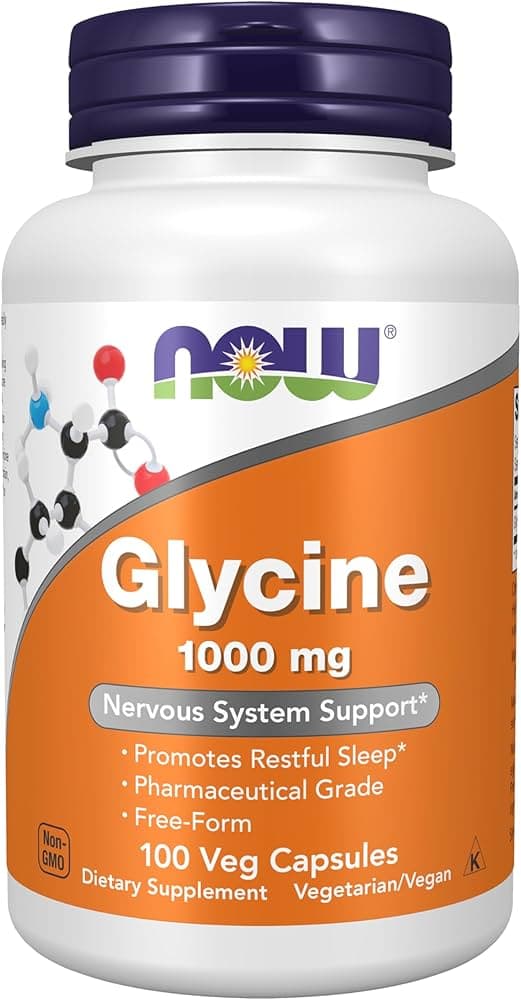
Glycine.
The sleep amino. Taken in the evening it helps you settle and wake up feeling more rested. It is also the amino acid your body builds collagen and glutathione from.
Reviewed March 2026
- Category
- Amino acid
- Also filed under
- SleepCollagenRecoveryAmino Acid
What Glycine is, and what it does.
- Does it work
- Suits people who sleep lightly, wake unrefreshed, or eat little gelatin-rich food. Also suits anyone leaning on collagen turnover or glutathione production.
- How much to take
- Start with 3g a day, stirred into water about an hour before bed. That's the daily maintenance band, and the larger amounts used in trials are a research condition.
- Time to feel it
- The morning after a single 3 g dose taken before bed.
- The first dose
- Faintly sweet in water and easy to take. Many people notice an easier drift into sleep on the first night, while the collagen and glutathione side is quiet chemistry.
- With regular use
- Weeks of nightly use keep glycine available for collagen, glutathione and haem synthesis, and the evening effect tends to hold rather than fade.
- How well tolerated
- Well tolerated at a few grams a day. A large amount at once can loosen stools. If you take prescription medication, check with your doctor first.
- How it feels
- Faintly sweet in water. Most people describe an easier drift into sleep rather than sedation, and a clear head in the morning.
- The overlooked benefit
- Glycine is the final piece glutathione synthetase adds, so how much you have sets a ceiling on glutathione no matter how much cysteine you take.
3g a day is where Glycine works.
Source: Inagawa 2006 + Bannai 2012 sleep studies
In a placebo-controlled study in healthy volunteers whose sleep was cut to 25 percent below their usual time for three consecutive nights, 3 g of glycine was taken before bedtime and outcomes were measured the following day. Visual analogue scale scores showed a significant reduction in fatigue and a tendency toward reduced sleepiness, and a psychomotor vigilance test improved significantly. The measures were self-rated scales plus one computer-based performance test, not polysomnography. The work was carried out by employees of Ajinomoto Co., Inc, an amino acid manufacturer.
The proof, claim by claim.
These words describe the research, not the molecule's worth. Research strength is how much work stands behind one claim, and it is never a product score.
Good evidence for sleep quality improvement.
- Improves subjective sleep quality and reduces daytime fatigue3 RCTs (n=11 to n=19)
- Reduces sleep onset latency (time to fall asleep)Polysomnography study (n=15)
- Supports insulin sensitivity and glucose responseSmall clinical trials (n=9 to n=60)
Questions people ask about Glycine.
- When should I take it?
- Timing matters less than consistency. Pick a time that works for you and take it daily.
- Should I take it on an empty stomach?
- Most amino acids absorb better on an empty stomach since they don't compete with food proteins for absorption. 30 minutes before meals is ideal.
- Can I get enough from protein?
- If you eat enough protein (0.8-1g per pound bodyweight), you probably get enough aminos. Supplementing specific ones only makes sense for targeted goals.
- Can I take it with other supplements?
- Usually fine. The main thing to watch is not doubling up on the same ingredient from different products. If you're on prescription meds, check with your pharmacist first.
- Who benefits most from this?
- People with a specific, evidence-backed need. Glycine has strong research. If your situation matches the studied use case, it's one of the more reliable supplements you can take.
Why these belong in the same formula. Each row says what the basis is, from settled biochemistry through to a trial that measured the pair.
Glutathione, the body's main built-in antioxidant, is a small peptide built from three amino acids. Glycine and the cysteine that NAC delivers supply two of them, including the cysteine that usually limits how fast the body can make more.
The body builds its own creatine by joining glycine and arginine, the two amino acid substrates the first synthesis step draws on. Supplying both supports the phosphocreatine system that muscle and brain cells use to recycle short-term energy.
Glycine is the carrier that wraps around magnesium in magnesium glycinate, a chelated form many people find gentler on the stomach than inorganic magnesium salts. The two glycine molecules buffer the mineral so it stays stable and better tolerated as it moves through digestion.
Glycine makes up about a third of the collagen backbone, and vitamin C is the cofactor the enzymes need to hydroxylate that backbone so it can fold into a stable triple helix. Together they cover both the raw material and the helper the body relies on to form normal collagen.
Serine hydroxymethyltransferase interconverts serine and glycine in one reversible step, so serine is the main endogenous source of glycine. Supplying either one moves the shared pool.
Serine hydroxymethyltransferase and the glycine cleavage system both run on pyridoxal phosphate. B6 status governs how freely glycine moves in and out of the one-carbon pool.
The carbon glycine loses is handed to tetrahydrofolate as a methylene group, feeding methylation and nucleotide synthesis. Folate availability sets whether that carbon has anywhere to go.
About one residue in three of the collagen triple helix is glycine, because only glycine is small enough to sit at the tight turn. Collagen peptides are the richest common dietary source of it.
Creatine is built from glycine, arginine and a methyl group from SAM, with glycine supplying the backbone. Taking creatine directly spares the glycine that endogenous synthesis would otherwise consume.
Glycine is the third residue of the glutathione tripeptide and becomes limiting for synthesis in some older adults. Adding glycine addresses that residue while the tripeptide supplies the finished molecule.
Glycine nudges core body temperature down through peripheral vasodilation, part of the normal drop that accompanies sleep onset, while melatonin acts on circadian timing. Different mechanisms, same nightly process.
Glycine is itself an inhibitory neurotransmitter at strychnine-sensitive receptors and a co-agonist at the NMDA receptor, while theanine shifts glutamate and GABA tone. Both settle excitatory signalling by separate routes.
Betaine is glycine carrying three methyl groups, and it gives them up stepwise to dimethylglycine, sarcosine and then glycine. The two are directly connected on the methyl transfer pathway.
Glutamine is deamidated to glutamate, the first residue of glutathione, while glycine is the third. Together they cover two of the three amino acids the synthesis enzymes need.
Heme is assembled from glycine and succinyl-CoA, then finished by inserting iron into the porphyrin ring. Glycine supplies the carbon skeleton and iron the metal centre of the same molecule.
Bile acids leave the liver conjugated to either glycine or taurine, so the two amino acids share that conjugation step. Both also act on inhibitory chloride channels in the central nervous system.
Glutathione synthesis runs in two steps, and the second one attaches glycine to gamma-glutamylcysteine. Cysteine availability usually sets the pace, but glycine has to be there for the final ligation. Supplying both covers the two ends of the same molecule, which is the reasoning behind pairing them.
Glycine coordinates zinc into a small neutral complex that behaves differently in the gut than an inorganic zinc salt. A poultry study of zinc glycine tracked bone measures, gut barrier markers and short-chain fatty acids. The work was done in birds, so it grounds the chelation rationale rather than a human effect.
The collagen triple helix only packs correctly because the smallest amino acid sits at every third position, with proline and hydroxyproline filling the other two. Both residues are therefore consumed in large amounts whenever collagen is laid down. This is compositional biochemistry. It does not by itself show that taking the two together changes tissue.
When methionine intake is high, S-adenosylmethionine accumulates and glycine N-methyltransferase drains the excess by transferring methyl groups onto glycine. Glycine availability therefore influences how a methionine load is buffered. The relationship is enzymatic and well described. It is not an outcome measured in a combination trial.
Glycine is one of the few acceptors dedicated to clearing surplus S-adenosylmethionine rather than to producing a needed methylated product. That makes the two direct partners at a single enzyme, with glycine on the receiving end. The pairing describes methyl-group traffic, not a measured joint benefit.
The choline oxidation pathway ends in glycine after three successive demethylations, each releasing a one-carbon unit into folate-dependent metabolism. Choline intake therefore contributes to endogenous glycine supply. This is established pathway chemistry rather than a tested supplement combination.
Selenium builds the active site of glutathione peroxidase. Glycine helps build its substrate. Neither the enzyme nor the substrate does anything without the other, which is why the two sit on the same antioxidant cycle. Glutathione levels are a biochemical marker of that cycle, not a clinical outcome.
Glycine decarboxylation depends on a lipoamide swinging arm that shuttles the aminomethyl intermediate between subunits and hands a one-carbon unit to tetrahydrofolate. That cofactor is protein-bound lipoyl, which the body makes rather than absorbs, so supplemental lipoic acid is not a direct substitute. The link is real biochemistry stated at its limits.
Strychnine-sensitive glycine receptors and GABA-A receptors are both ligand-gated chloride channels, and in the brainstem and spinal cord they are frequently co-released at the same synapse. That shared inhibitory role is the rationale for pairing them in products aimed at settling before sleep. Oral GABA crosses into the brain poorly, so the combination reads as plausible rather than demonstrated.
Nothing specific on file for Glycine. Match the label to the daily amount above, and tell your doctor what you take.
Not medical advice. Show the label to your pharmacist.What Glycine actually does.
Glycine is the smallest amino acid, so it fits into tight spots in a protein that others cannot.
About a third of collagen is glycine, spaced every third slot along the chain.
Glycine is the third piece the body clips on to finish building glutathione.
Haem starts from glycine joining a molecule from the energy cycle, with vitamin B6 doing the joining.
Where Glycine comes from.
Glycine is either made in a chemical reactor, grown by fermentation, or pulled out of collagen from animals. Only the collagen route matters for a vegan label. The molecule itself is identical either way.
The same molecule is reached more than one way. Which route a given product used is a manufacturing choice, and the finished compound is the same either way.
The dominant industrial route starts from monochloroacetic acid. Fermentation routes start instead from a carbohydrate feedstock such as glucose.
Chloroacetic acid is aminated with ammonia, often with hexamethylenetetramine as a catalyst, to give glycine and ammonium chloride. Fermentation instead uses a selected microbial strain to accumulate the amino acid in the broth.
A third route recovers glycine from acid or enzymatic hydrolysis of animal collagen or gelatin, where glycine is the most abundant residue. This route is not suitable for vegan labelling.
Crude glycine is decolourised, passed through ion exchange to strip residual chloride and ammonium, then recrystallised. Residual chloride and any catalyst carry-over are the specification points that distinguish a feed grade from a supplement grade.
Finished glycine is assayed against a pharmacopoeial monograph for purity, chloride, sulfate, heavy metals and appearance, and glycine has no chiral centre so there is no D and L distinction to control.
The purified amino acid is milled to a target particle size for solubility, granulated for tabletting, or reacted with a mineral salt to make a bisglycinate chelate.
Getting Glycine from food.
The whole-food sources on file. A supplement closes the gap, it does not replace dinner.
A gram-for-gram figure (how much of each you would eat to match a dose) will appear here once it is sourced and reviewed. This page will not print a number it cannot cite.
The forms it comes in.
The essence, in one line each.
- Across 52 human studies, glycine's clearest effects were on the nervous system, with longer-term use associated with better sleep in healthy adults.Systematic review. Soh et al., 2023 (GeroScience). PMID 37851316 ↗
- Taken together with 25 g of glucose, glycine cut the rise in blood glucose over the following two hours by more than half compared with glucose alone.Randomised trial. Gannon et al., 2002 (American Journal of Clinical Nutrition). PMID 12450897 ↗
- In an uncontrolled two-week study of 19 adults with a very high body mass index, dietary glycine at 100 mg/kg a day raised plasma glycine and urinary acylglycine excretion, and plasma triglyceride and liver enzyme values fell, with no change in body weight. With no control group these marker shifts cannot be attributed to glycine alone.Clinical trial. Tan et al., 2025 (Sci Rep). PMID 41107432 ↗
- Enteral glycine raised plasma glycine in critically ill adults. Muscle structure, size and function were also measured, and plasma glycine is a blood marker rather than a functional outcome.Randomised trial. Ali Abdelhamid et al., 2025 (Clinical Nutrition). PMID 41109034 ↗
- Reviews the reasoning and the available studies for glycine in physical performance and recovery, describing the human evidence base as still developing.Narrative review. Ramos-Jimenez et al., 2024 (Sports). PMID 39453231 ↗
- Glycine supplementation partly restored glutathione levels in ageing cats with low glutathione. Measured in cats, so it supports the glutathione mechanism and is not human evidence.Animal study. Ruparell et al., 2024 (British Journal of Nutrition). PMID 38418414 ↗
- Dietary glycine increased tissue glutathione availability in pigs with restricted intrauterine growth, supporting glycine's role as a glutathione precursor. An animal finding.Animal study. He et al., 2024 (Journal of Animal Science). PMID 38271555 ↗
- Dietary glycine improved post-weaning growth and meat quality measures in growth-restricted pigs. Measured in pigs, so it is not human evidence.Animal study. He et al., 2023 (Journal of Animal Science). PMID 37837640 ↗
- Glycine supplementation increased growth in sow-reared piglets with restricted intrauterine growth. An animal study of growth measures.Animal study. Hu et al., 2025 (Animals). PMID 40646755 ↗
- Dietary glycine maintained antioxidant status and intestinal barrier markers in heat-stressed birds. Measured in poultry, so these are mechanistic markers and not human outcomes.Animal study. Deng et al., 2023 (Poultry Science). PMID 36584416 ↗
- Zinc glycine supplementation changed bone quality measures, gut microbiota and short-chain fatty acid levels in meat geese. An animal study of a glycine chelate rather than of glycine alone.Animal study. Zulfiqar et al., 2025 (Poultry Science). PMID 40036933 ↗
- Interval training combined with glycine altered ferroptosis-related markers in animals. A mechanistic animal finding on iron-dependent cell death pathways, not a human result.Animal study. Ni et al., 2025 (Medicine and Science in Sports and Exercise). PMID 40197604 ↗
- A cross-over dietary intervention tested glycine supplementation in captive cheetahs and reported metabolic measures. A species-specific animal study.Animal study. van Boom et al., 2024 (Zoo Biology). PMID 37721178 ↗
- Glycine supplementation affected growth and blood indices in Florida pompano. A fish nutrition study.Animal study. Ngo et al., 2025 (Aquaculture Nutrition). PMID 40746444 ↗
- Dietary glycine improved growth performance in phase II hybrid striped bass. A fish nutrition study of growth measures.Animal study. He et al., 2023 (Journal of Animal Science). PMID 38038705 ↗
- Adding glycine during vitrification changed the developmental potential of warmed immature oocytes, consistent with glycine acting as an osmolyte. A laboratory result in animal cells.In vitro study. Yaqout et al., 2023 (Reproduction in Domestic Animals). PMID 36779638 ↗
These are the studies our verdict leans on, chosen from the 3,116 we read for Glycine. The full linked list is below.
The studies, linked.
8 sources behind our Glycine verdict: peer-reviewed studies and registered clinical trials. Every one links straight to PubMed, the journal, or ClinicalTrials.gov. Read them yourself.
- ClinicalTrials.gov ↗
- Clinical trialEffects of Sublingual Microencapsulated Glycine on Attentional Difficulties and Hyperactivity in Prepuberal Children - A Placebo-controlled, Double-blind, Randomized, Cross-over StudyClinicalTrials.gov ↗30 participants, Completed
- Clinical trialFacilitation of NMDA Receptor Function in Patients With Schizophrenia and Co-morbid AlcoholismClinicalTrials.gov ↗Phase 2, 20 participants, Completed
- Clinical trialAnalyzing the Effect of Sodium Bicarbonate and Glycine Air Polishing on Tooth Surfaces With Two Different Imaging MethodsClinicalTrials.gov ↗14 participants, Completed
- Clinical trialA Double-blind, Placebo-controlled, Cross-over Study to Evaluate the Efficacy, Safety, Tolerability, Pharmacodynamics and Pharmacokinetics of Oral Administration of AIM-102 in Patients With Mild to Moderate Allergic AsthmaClinicalTrials.gov ↗Phase 2, 11 participants, Completed
- Clinical trialProspective Double Blinded Randomized Clinical Trial of Alanyl-Glutamine or Glycine in Children With Persistent Diarrhea or MalnutritionClinicalTrials.gov ↗Phase 3, 108 participants, Withdrawn
- Clinical trialInvestigating the Effects of Dietary Glycine Supplementation in Patients With Metabolic Dysfunction-associated Steatotic Liver DiseaseClinicalTrials.gov ↗60 participants, Not yet recruiting
- ClinicalTrials.gov ↗
Evidence surfaced via Semantic Scholar (Allen Institute for AI) and ClinicalTrials.gov. Ranked by study type and citation weight, not cherry-picked.
Problems people have reported.
Read this carefully. These are 6,078 voluntary, unverified reactions reported to the FDA (openFDA). The number mostly reflects how popular Glycine is, not how risky it is. A report is not proof Glycine caused anything. It is a signal of what to watch for, nothing more.
Source: openFDA adverse-event reports. Voluntary reporting, not an incidence rate.
FDA Disclaimer: These statements have not been evaluated by the Food and Drug Administration. This information is for educational purposes only and is not intended to diagnose, treat, cure, or prevent any disease. Consult your healthcare provider before starting any supplement regimen.