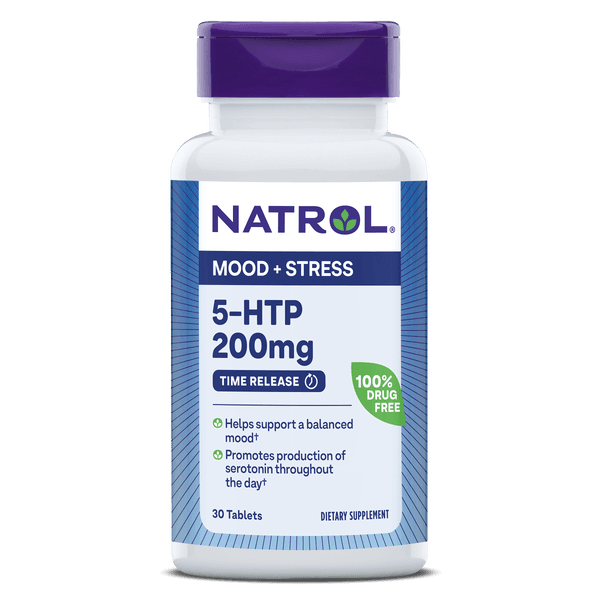
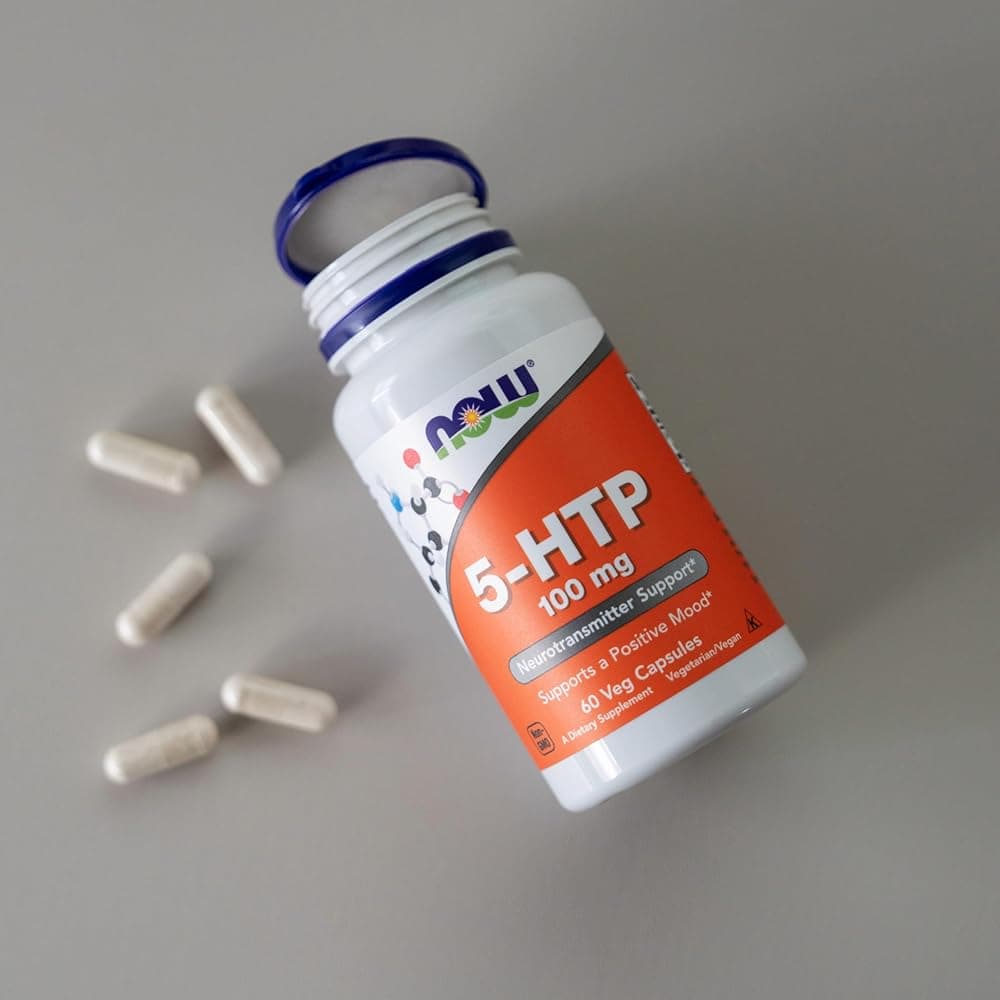
5-HTP.
May gently lift mood and improve sleep quality. Your body turns it directly into serotonin. That's the neurotransmitter involved in mood, sleep, and appetite. The goal is to give your brain the raw material it needs.
Reviewed March 2026
- Category
- Amino acid
- Also filed under
- Mood supportSleep improvementAnxiety reduction
- Also called
- 5 Hydroxytryptophan, Hydroxytryptophan, 5-Hydroxytryptophan
What 5-HTP is, and what it does.
- Does it work
- Suits people who want a gentle evening wind-down or steadier mood without a prescription. Anyone on a serotonergic medicine needs a prescriber's sign-off first.
- How much to take
- Start with 50-100mg, taken in the evening on an empty stomach. You can work up to 200mg if needed.
- Time to feel it
- A calming effect can land within a few hours of an evening dose. Steadier mood, where it comes, is usually a two to three week story.
- The first dose
- You might feel slightly calmer or sleepier within a few hours. Many people feel nothing at all. The effects are subtle and build over days.
- With regular use
- After 2-3 weeks of consistent use, you might notice your mood is a bit more stable or you're falling asleep slightly easier. It's not a night-and-day difference.
- How well tolerated
- The big one: DO NOT mix with antidepressants. Seriously. Can cause serotonin syndrome. Otherwise, some people get nausea, heartburn, or an upset stomach.
- How it feels
- A mild sense of calm. Not sedating, just... less edgy. Some people report more vivid dreams.
- The overlooked benefit
- The enzyme that converts it needs vitamin B6 in its active form, so your B6 status sits directly on this pathway. That's why the two are so often taken together.
50 to 200mg a day is where 5-HTP works.
Source: Turner 2006 + Jangid 2013 depression study
The proof, claim by claim.
These words describe the research, not the molecule's worth. Research strength is how much work stands behind one claim, and it is never a product score.
While 5-HTP is a precursor to serotonin, its effectiveness as a supplement is debated. Some studies show benefits for mood and sleep, but others are inconclusive or have methodological limitations. The conversion rate to serotonin can vary, and individual responses differ.
- Alleviation of depressive symptomsSystematic review of 27 clinical trials
- Promotes weight loss by increasing satietyMultiple Double-Blind RCTs (n=19 to n=25)
- Reduces sleep latency (time to fall asleep)Small RCTs and open-label studies
Questions people ask about 5-HTP.
- Will it make me happy?
- It's not a 'happy pill'. It might provide the raw materials for a more stable mood, but that's it.
- Is it addictive?
- No, it's not considered addictive. However, it's smart to cycle off occasionally to see if you still need it.
- Can I take it with melatonin?
- Generally fine for most people, but they both can cause drowsiness. Start with one or the other.
- Why take it on an empty stomach?
- Other amino acids from food, like protein, can compete with it for absorption in the brain.
- Is this the same as Tryptophan?
- It's the next step. Your body converts Tryptophan to 5-HTP, which then becomes serotonin. 5-HTP is more direct.
- Can I get this from eating turkey?
- No. You get tryptophan from turkey, not 5-HTP. The supplement is the only direct source.
Why these belong in the same formula. Each row says what the basis is, from settled biochemistry through to a trial that measured the pair.
The enzyme that converts 5-HTP into serotonin, aromatic L-amino acid decarboxylase, uses the active form of vitamin B6 (pyridoxal 5'-phosphate) as its cofactor. Adequate B6 status is what lets the body carry out that conversion step at a normal rate.
The body makes melatonin from serotonin, and it makes serotonin from 5-HTP, so the two sit on the same nighttime pathway. 5-HTP supplies raw material upstream while melatonin is the end product of that chain, supporting the body's normal wind-down toward sleep.
5-HTP feeds the serotonin branch of monoamine synthesis while L-tyrosine feeds the dopamine and norepinephrine branch, and both branches are finished by the same B6-dependent decarboxylase. Formulas commonly pair them so that pushing one precursor does not leave the other branch unsupported.
Tryptophan is hydroxylated to 5-HTP, which is then decarboxylated to serotonin, so the two sit one step apart on the same route. Because they act at the same place, formulators pick one entry point rather than stacking both freely.
Most dietary tryptophan is pulled down the kynurenine route toward niacin, so adequate niacin intake leaves more tryptophan available for the serotonin route. The pairing supports the pathway rather than pushing it.
SAM-e supplies the methyl group used in converting serotonin onward toward melatonin, so it sits directly downstream of 5-HTP. Both raise serotonergic tone, so the combination is additive and doses are kept modest.
St. John's Wort constituents slow serotonin reuptake while 5-HTP supplies more substrate for synthesis, so the two push the same synapse from both ends. This is a settled additive interaction to declare rather than a pairing to encourage.
The L-dopa in mucuna and 5-HTP are both handled by aromatic L-amino acid decarboxylase, so each competes for the same enzyme and can lower the other's conversion. Long-standing pharmacology, and the reason the two are dosed apart.
Phenylalanine competes with tryptophan for the large neutral amino acid carrier into the brain and feeds the catecholamine arm rather than the serotonin arm. Formulators pair them deliberately to keep the two amine routes in balance.
5-methyltetrahydrofolate participates in regenerating tetrahydrobiopterin, the cofactor the hydroxylase enzymes need, and supplies methyl groups for downstream amine handling. Adequate folate keeps the pathway 5-HTP feeds running.
Saffron constituents slow serotonin reuptake at the synapse while 5-HTP supplies substrate for synthesis, so the two act at the same junction by different routes. Doses are kept modest for that reason.
Aromatic L-amino acid decarboxylase converts 5-HTP to serotonin and requires pyridoxal-5-phosphate as its cofactor. P5P is that cofactor in its already-phosphorylated form, so it does not depend on hepatic pyridoxal kinase to become active. Without adequate cofactor the decarboxylation step is limited. This is textbook enzymology and applies to both peripheral and central conversion.
Pyridoxal kinase, the enzyme that phosphorylates dietary pyridoxine to the active P5P cofactor, is magnesium and zinc dependent. That cofactor is what the decarboxylase converting 5-HTP to serotonin needs. Magnesium therefore sits one step upstream of the conversion rather than acting on it directly.
Zinc participates in pyridoxal kinase activity and in the wider handling of vitamin B6, the cofactor pool that the 5-HTP decarboxylation step draws on. The relationship is upstream and nutritional. Adequate status supports the pathway. Extra zinc does not push conversion higher.
Theanine raises alpha-band cortical activity and modulates glutamatergic and GABAergic tone, while 5-HTP feeds the serotonergic system that shapes sleep onset. The two act on different transmitter systems that both influence arousal, so their effects on calm and sleep readiness can add. Combining them in an evening formula is common. Anyone taking a sedating medicine should account for the additive direction.
GABA is the principal inhibitory transmitter and 5-HTP supplies the serotonin system that gates sleep onset and, through the pineal pathway, melatonin production. Their effects on arousal run in the same direction. Oral GABA's central access is debated, so the pairing is described as additive in intent rather than established in magnitude.
Valerian constituents interact with GABA-A signalling, a separate route from the serotonergic one 5-HTP feeds. Sleep formulas stack the two routinely. The combined sedative direction is the reason to flag it, and anyone on sedating medicine should raise the pairing with their clinician.
Passionflower flavonoids including chrysin are associated with GABA-A modulation. Paired with 5-HTP, two different calming routes are engaged at once. The pairing is long-standing herbal formulation practice, and the additive direction on sedation is the practical point.
Apigenin from chamomile binds benzodiazepine-site receptors in laboratory work. That is a different mechanism from the serotonergic route 5-HTP supplies. Evening formulas combine the two, and the combined effect on alertness runs in one direction.
Lemon balm constituents inhibit GABA transaminase in vitro, raising GABA availability, which is unrelated to serotonin synthesis. As a companion to 5-HTP it contributes calm through a separate route. The pairing is formulation convention with an additive direction on sedation.
Honokiol and magnolol are described as GABA-A positive modulators in preclinical work. Combined with 5-HTP in an evening product, two calming routes operate together. The evidence base is preclinical, and the additive direction is what a formulator should note.
Apigenin is the isolated flavone behind much of chamomile's benzodiazepine-site activity in laboratory assays. Paired with 5-HTP it adds an inhibitory-tone route alongside a serotonergic one. Any combination that layers two calming mechanisms deserves a plain statement of that fact.
Ashwagandha withanolides are studied for effects on the hypothalamic-pituitary-adrenal axis and cortisol rhythm, while 5-HTP acts on serotonin availability. The two touch stress physiology from different ends. Blends pair them for that reason. No combination trial defines the joint effect.
Rosavins and salidroside are associated with monoamine turnover, and 5-HTP loads one specific monoamine pathway. Stacking an agent that alters monoamine handling with a direct serotonin precursor is a pairing to describe carefully rather than promote. Anyone using a serotonergic medicine should discuss the combination with their clinician before adding either.
Inositol is the precursor of phosphatidylinositol-4,5-bisphosphate, the membrane lipid that Gq-coupled receptors including several serotonin receptor subtypes hydrolyse to generate second messengers. 5-HTP supplies the ligand side of that system. The relationship is signal transduction chemistry, and it is not evidence that combining the two changes any measured outcome.
Ascorbate keeps the iron in the aromatic amino acid hydroxylases in its reduced state and supports tetrahydrobiopterin recycling, the cofactor system those enzymes use. 5-HTP enters the pathway after the hydroxylation step, so ascorbate acts on the wider monoamine synthesis apparatus rather than on 5-HTP itself. Stating that boundary matters for anyone reading a label that stacks them.
Caffeine antagonises adenosine receptors and raises arousal, the opposite direction from the effect an evening 5-HTP serving is taken for. Taken close together, they work against each other on sleep onset. This is a timing conflict to design around, not a chemical interaction between the two molecules.
Glycine is an inhibitory transmitter in the brainstem and spinal cord and also acts at the NMDA receptor co-agonist site, and it has been studied for effects on sleep onset and core temperature. That route is separate from serotonergic signalling. As a companion in an evening formula the direction on arousal is shared.
5-HTP crosses the blood-brain barrier without competing at the large neutral amino acid transporter, which is the main pharmacokinetic difference between it and tryptophan. Amino acid supplements taken together with tryptophan do compete at that carrier. 5-HTP is the exception. The practical point is that this competition argument does not apply to 5-HTP, and labels that imply it does are overstating the case.
Talk to a doctor before taking 5-HTP if any of these apply to you: Pregnancy, Breastfeeding, Combining with antidepressants, Serotonin Syndrome risk, Digestive upset. These are flags to check first, not effects 5-HTP is known to cause.
Not medical advice. Show the label to your pharmacist.What 5-HTP actually does.
5-HTP is what tryptophan hydroxylase makes directly from L-tryptophan, and that hydroxylation step is the rate-limiting one in serotonin synthesis. Taking 5-HTP joins the pathway after that step.
An enzyme called aromatic L-amino acid decarboxylase converts 5-HTP into serotonin, using pyridoxal-5-phosphate as its cofactor. The same enzyme also decarboxylates L-DOPA into dopamine.
Unlike tryptophan, 5-HTP crosses the blood-brain barrier without competing at the large neutral amino acid transporter, so how much gets in centrally does not depend on the ratio of other amino acids in your meal.
That same decarboxylase enzyme is plentiful in tissue outside the brain, including the gut wall, liver and kidney, so a substantial share of an oral dose is converted to serotonin before it reaches the brain. That peripheral conversion is why gastrointestinal upset is the most commonly reported effect.
Where 5-HTP comes from.
5-HTP comes out of the seeds of a West African shrub and is purified until only the one molecule is left. It is the same stepping-stone compound the body makes from tryptophan on the way to serotonin.
Made from a plant. What ends up in the capsule tracks the harvest, so batch testing and a stated marker matter more here than with a made molecule.
The seeds of a West African climbing shrub, the only commercial source, naturally accumulate 5-hydroxytryptophan.
Ground seeds are extracted and the 5-HTP, present at percent levels, is pulled from the seed matrix.
The extract is refined and crystallised to a high-purity single compound, leaving the rest of the seed chemistry behind.
A defined single molecule at the end of a botanical supply chain, one step short of serotonin in the body's own pathway.
The forms it comes in.
The essence, in one line each.
- Across the pooled trials, about 65% of adults with low mood had their symptoms ease while taking 5-HTP, an effect the authors call preliminary because few of the trials used a placebo group.Meta-analysis. Javelle et al., 2020 (Nutrition Reviews). PMID 31504850 ↗
- In a double-blind trial, adults with a high body-mass index taking 900 mg a day reported earlier satiety, ate fewer carbohydrates, and lost weight over two consecutive six-week periods.Randomised trial. Cangiano et al., 1992 (American Journal of Clinical Nutrition). PMID 1384305 ↗
- Among older adults who started as poor sleepers, 100 mg a day for twelve weeks shortened self-reported time to fall asleep by about three minutes and raised blood serotonin.Randomised trial. Sutanto et al., 2024 (Clinical Nutrition). PMID 38309227 ↗
- In 30 older adults taking 100 mg of 5-HTP daily for 12 weeks, the average Montreal Cognitive Assessment score moved by about one point, from 26.6 to 27.6, and serum serotonin, a blood marker rather than an outcome, rose, with no change measured on the anxiety inventory.Randomised trial. Li et al., 2025 (Nutrients). PMID 40944161 ↗
- In 17 healthy volunteers, 28 days of 100 mg Griffonia simplicifolia, the plant source of 5-HTP, showed no detectable effect on heat-induced pain intensity or on descending pain inhibition, the single difference being a wider area of mechanical sensitivity.Randomised trial. Schlemmer et al., 2026 (Nutrients). PMID 42197069 ↗
- Among 112 adults grouped by high or low attention and impulsivity trait scores, a single dose of 5-HTP produced no detectable improvement on any measure of distractibility, and 19.6 percent of those taking it reported fatigue, nausea or vomiting.Randomised trial. Jackson et al., 2026 (PLoS One). PMID 42160304 ↗
- Ruminally delivered 5-hydroxytryptophan raised serum serotonin and produced peripheral vasodilation in growing beef cattle, which confirms in a live animal that the compound is converted to serotonin and that circulating serotonin acts peripherally.Animal study. Matos et al., 2026 (Journal of Animal Science). PMID 42398021 ↗
- Dietary proanthocyanidins reduced markers of age-related cognitive decline and neuroinflammation in an accelerated-ageing rodent model. The paper names 5-HTP only among pathway metabolites, so it supports the serotonin pathway as a measured readout rather than any effect of supplemental 5-HTP.Animal study. Yuan et al., 2026 (npj Science of Food). PMID 42431994 ↗
- In vitro fermentation of Astragalus polysaccharide altered gut microbial composition and metabolite output, with 5-HTP named as one tryptophan-pathway metabolite measured. The design is a fermentation model, so it speaks to microbial handling of the pathway and not to human dosing.In vitro study. Lin et al., 2026 (Frontiers in Psychiatry). PMID 41822218 ↗
- Amino acid derivatives and polyphenol supplementation were assessed for effects on ovine muscle growth in cell culture and in the animal, with 5-HTP appearing among the derivatives named. The relevance to human supplementation is a mention of the compound class only.Animal study. Iheanacho et al., 2026 (Muscles). PMID 42496383 ↗
These are the studies our verdict leans on, chosen from the 6,170 we read for 5-HTP. The full linked list is below.
The studies, linked.
6 sources behind our 5-HTP verdict: peer-reviewed studies and registered clinical trials. Every one links straight to PubMed, the journal, or ClinicalTrials.gov. Read them yourself.
- Clinical trialEffects of Daily Supplementation of 5-HTP on Body Composition, a Randomized InvestigationClinicalTrials.gov ↗65 participants, Completed
- Clinical trialImpact of Nutritional Supplementation on Gut-brain Axis in Older Adults With Normal Cognition vs. Mild Cognitive ImpairmentClinicalTrials.gov ↗33 participants, Completed
- Clinical trialAn Exploratory Single Blind Study of Ergoloid Mesylates, 5-Hydroxytryptophan, and the Combination in Adult Males With Fragile X SyndromeClinicalTrials.gov ↗Phase 2, 15 participants, Completed
- Clinical trialThe Effect of 5-hydroxytryptophan on Microsaccades and Distractibility in Individual With High Levels of ADHD Traits: a Randomised, Double-blind TrialClinicalTrials.gov ↗150 participants, Recruiting
- Clinical trial31P-MRS and Resting State Functional Connectivity Analysis of the Effects of 5-hydroxytryptophan and Creatine for Antidepressant Augmentation in Patients With SSRI/SNRI-resistant Major Depressive DisorderClinicalTrials.gov ↗Phase 2, 106 participants, Recruiting
- Clinical trialThe Effects of 5-hydroxytryptophan (5-HTP) and L-3,4-dihydroxyphenylalanine (L-DOPA) Supplementation on Central Nervous System Excitability and Motor Function in Individuals With Spinal Cord InjuryClinicalTrials.gov ↗Phase 2, 30 participants, Suspended
Evidence surfaced via Semantic Scholar (Allen Institute for AI) and ClinicalTrials.gov. Ranked by study type and citation weight, not cherry-picked.
Problems people have reported.
Read this carefully. These are 1,200 voluntary, unverified reactions reported to the FDA (openFDA). The number mostly reflects how popular 5-HTP is, not how risky it is. A report is not proof 5-HTP caused anything. It is a signal of what to watch for, nothing more.
Source: openFDA adverse-event reports. Voluntary reporting, not an incidence rate.
FDA Disclaimer: These statements have not been evaluated by the Food and Drug Administration. This information is for educational purposes only and is not intended to diagnose, treat, cure, or prevent any disease. Consult your healthcare provider before starting any supplement regimen.