Caffeine.
The world's favorite stimulant. Boosts energy, sharpens focus, and improves physical performance. It works by blocking the signals in your brain that make you feel tired.
Reviewed March 2026
- Category
- Compound
- Also filed under
- EnergyFocusPerformanceAlertness
What Caffeine is, and what it does.
- Does it work
- It suits anyone wanting reliable alertness and more output in training. If it keeps you up at night, your cut-off time matters more than the amount.
- How much to take
- 100-200mg at a time. A standard cup of coffee has about 100mg. For performance, 3-6mg per kg of body weight about an hour before a workout.
- Time to feel it
- Within about 45 to 60 minutes of a single dose.
- The first dose
- You'll feel it in 30-60 minutes. Increased alertness, better focus. The peak hits around 90 minutes.
- With regular use
- Tolerance is real. The 'buzz' fades with daily use, but the performance benefits often remain. Cycle off it for a week every month or two to reset.
- How well tolerated
- Well tolerated in most people under 400mg a day. More than that can cause anxiety, poor sleep, and heart palpitations. Know your limit.
- How it feels
- Clean energy and focus. Not a jittery, cracked-out feeling at normal doses. Just 'on' and ready to work.
- The overlooked benefit
- About 95 percent of it clears through one liver enzyme, and that enzyme runs at very different speeds in different people. Same cup, half-life anywhere from three to six hours.
100 to 400mg a day is where Caffeine works.
Source: EFSA 2015 caffeine safety + Goldstein 2010 review
In a double-blind placebo-controlled crossover trial, 15 resistance-trained women took 4 mg per kg body mass of caffeine 60 minutes before a strength and power battery. Squat one-repetition maximum rose 4.5 percent and countermovement jump height 7.6 percent against placebo. A separate crossover trial in 11 active adults began its cycling tests 45 minutes after a 3 mg per kg capsule and recorded a peak-power increase of about 4 percent on the first day of ingestion.
The proof, claim by claim.
These words describe the research, not the molecule's worth. Research strength is how much work stands behind one claim, and it is never a product score.
The most studied psychoactive compound.
- Enhances athletic performance (strength, power, and endurance)Umbrella review of 21 meta-analyses
- Improves cognitive alertness, vigilance, and reaction timeMultiple systematic reviews (EFSA Panel)
- Increases metabolic rate and fat oxidationMeta-analysis of 12 RCTs
Questions people ask about Caffeine.
- How much caffeine is too much?
- The FDA says 400mg a day is fine for most adults. That's about four cups of coffee. Some people are more sensitive.
- Does it dehydrate you?
- Myth. It's a mild diuretic, but the liquid it's in usually offsets the effect. Just drink water like a normal person.
- Will it ruin my sleep?
- Yes, if you take it too late. Its half-life is about 5-6 hours. Stop all caffeine by 2 PM if you want to sleep well.
- Can I get addicted?
- You can become dependent. Skipping it might give you a headache and make you cranky for a day or two. It's not a true addiction.
- Is coffee or a pill better?
- Pills give you a precise dose. Coffee has other beneficial compounds. Both work. Pick what's convenient for you.
- Does it actually help with weight loss?
- It slightly boosts metabolism, but not enough to make a real difference on its own. Don't count on it for fat loss.
What the trials show about these together.
Outcomes the engine found studied for these actives as a combination, not one at a time. Each is a finding a named trial measured, cited and dated, never written by the brand.
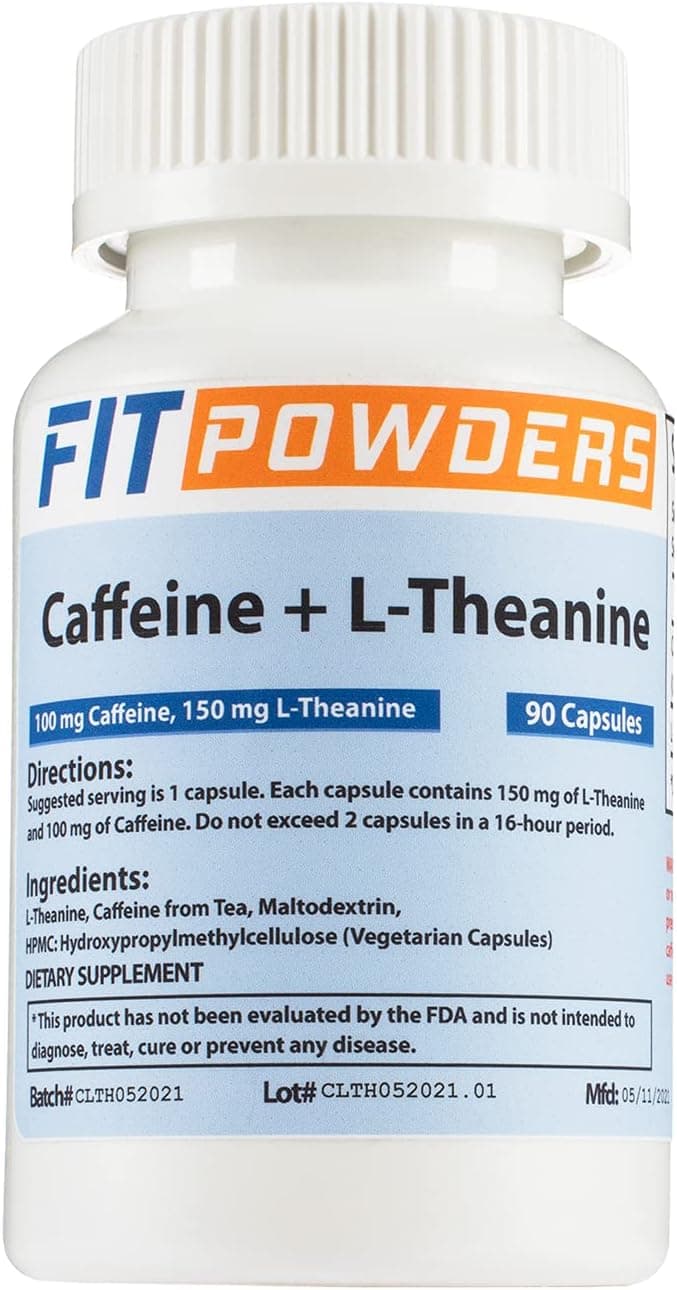
- PromisingCaffeine + L TheanineFocus
In a 2025 meta-analysis of randomized trials in healthy adults, l-theanine taken together with caffeine improved accuracy on attention-switching and vigilance tasks in the second hour after dosing, versus placebo.
Payne et al., 2025 (Nutrition Reviews)PMID 40314930 - PromisingCaffeine + Green Tea ExtractMetabolism
In a meta-analysis of respiration-chamber trials, green tea catechins taken with caffeine raised 24-hour energy expenditure by about 4.7 percent and increased 24-hour fat oxidation, which caffeine alone did not.
Hursel et al., 2011 (Obesity Reviews)PMID 21366839 - PromisingCaffeine + TaurineEnergy
In a 2025 network meta-analysis, caffeine and taurine taken together improved reaction time and anaerobic capacity more than either compound alone.
Deng et al., 2025 (J Int Soc Sports Nutr)PMID 41032459 - EarlyCaffeine + CarbohydrateEndurance
In a 2026 meta-analysis of eleven crossover trials, caffeine taken together with carbohydrate improved high-intensity interval performance compared with carbohydrate or placebo, but not compared with caffeine alone. The benefit was smaller when the carbohydrate was swallowed than when it was only rinsed in the mouth, and the authors graded the certainty of the evidence as low.
Li et al., 2026 (Nutrients)PMID 42356256
Research strength. Research strength says how much work stands behind the combination. It is never a product score.
Fail closed. Where actives were studied on their own rather than together, each shows on its own evidence, never a combined effect no trial measured.
Independent record. Every finding is cited to a named trial, dated, and never written by the brand.
Findings from trials that studied these actives as a combination. Context for how the actives were tested together, not a statement about any individual and not a claim about this product.
Why these belong in the same formula. Each row says what the basis is, from settled biochemistry through to a trial that measured the pair.
Caffeine has a small but consistent depressant effect on how much calcium the gut absorbs, and it briefly raises urinary calcium loss soon after intake. Both shifts are minor, so getting enough calcium alongside caffeine offsets them and keeps the body's calcium balance steady.
Through the same kidney effect that briefly pushes more calcium into the urine, caffeine also modestly raises urinary magnesium loss. The amount is small, so pairing caffeine with adequate magnesium helps cover the loss and supports normal magnesium status.
Caffeine raises catecholamine release and turnover, and tyrosine is the amino acid those catecholamines are built from. Supplying the precursor supports the pool that faster turnover draws down.
Alpha-GPC supplies choline for acetylcholine synthesis, a cholinergic route entirely separate from adenosine receptor blockade. The two act on different transmitter systems in the same session.
Beta-alanine raises muscle carnosine for intracellular hydrogen ion buffering, which has nothing to do with central adenosine signalling. Standard practice combines them because neither limits the other.
Capsaicinoids act on TRPV1 channels and raise sympathetic outflow, while caffeine prolongs the cyclic AMP signal that outflow produces. The mechanisms sit upstream and downstream of the same signal.
Coffee is the natural source of the same alkaloid, so taking both stacks one dose on top of another. The total load matters more than either item on its own.
Melatonin acts on MT1 and MT2 receptors to shift the sleep signal, while caffeine blocks the adenosine receptors that build sleep pressure through the day. Taken close together they pull in opposite directions, so separating them by many hours is the sensible order.
Some reports suggest caffeine works against the shorter muscle relaxation time seen with creatine loading, likely through effects on calcium reuptake in the sarcoplasmic reticulum. The finding is not settled, and the two are still formulated together routinely.
Bicarbonate raises extracellular buffering capacity, which matters for high-intensity efforts lasting one to several minutes. Caffeine acts centrally on perceived effort and on calcium handling in muscle. Because the routes are separate, stacking them is a reasonable additive proposition and is commonly done in sprint and repeated-effort protocols. The gastrointestinal load from bicarbonate is the practical limit.
Dietary nitrate raises nitric oxide availability through the nitrate to nitrite pathway and reduces the oxygen cost of submaximal work. Caffeine works on adenosine receptors and perceived effort. Combining them targets the same endpoint from two directions and is a common practice in endurance preparation. Effects do not always add cleanly, since both have ceilings in trained athletes.
Citrulline raises plasma arginine and nitric oxide substrate availability, a different route from caffeine's adenosine antagonism. The two are standard companions in pre-workout formulas, so most product-level data tests the blend. Early on the pairing itself.
Catechins and caffeine occur together in tea and are studied together for effects on energy expenditure and fat oxidation, with the caffeine contribution well characterised on its own. A green tea extract also contributes caffeine unless it is decaffeinated, so total caffeine in a stack is easy to undercount. Read the total, not just the line that says caffeine.
Valerian is used for sedation and caffeine is an arousal agent, so the two work against each other on the same endpoint. Taking them in the same window means each is partly cancelling the other rather than complementing it. Timing, not exclusion, is the point: caffeine's half-life is long enough that an afternoon dose reaches bedtime.
Oral GABA's own central effects are limited by poor blood-brain barrier penetration, so the opposition here is more about product intent than about a measured interaction. Where a formula pairs the two, the caffeine effect is the one with a clear time course. Early.
Passionflower extracts are studied for calming effects with GABAergic activity described in laboratory work, which puts them opposite caffeine on the arousal axis. Combined in the same product they compete rather than complement. Early.
Chamomile's apigenin binds GABA-A receptors in binding assays, a calming direction opposite to caffeine's adenosine antagonism. In practice the two show up in the same daily routine at different times of day rather than in the same capsule. Early, and about scheduling.
Magnolia bark honokiol and magnolol are studied for calming activity, the opposite direction from caffeine. Stacking them in one dose works against both intents. Early.
Glycine acts as an inhibitory neurotransmitter in the brainstem and spinal cord and is used before sleep, which puts it opposite caffeine on that endpoint. No interaction study is available. The tension is one of intent and timing. Early.
5-HTP is decarboxylated to serotonin and is used in evening protocols, while caffeine is a daytime arousal agent whose long half-life carries into the evening. Any stack containing both is working two directions on sleep onset. Early, and a timing flag rather than a synergy.
Caffeine is cleared overwhelmingly by CYP1A2, and cruciferous vegetable constituents including indoles are established inducers of that enzyme. Higher CYP1A2 activity means faster caffeine clearance and a shorter effective window from the same dose. This is pharmacokinetics, so it changes duration rather than whether caffeine works.
Quercetin inhibits CYP1A2 in laboratory systems, which would slow caffeine clearance if it happened at achievable intakes. Oral quercetin bioavailability is low and the effect has not been shown to matter at supplement doses in people. Early, and pointing at duration rather than intensity.
Ashwagandha is studied for lowering perceived stress and cortisol measures while caffeine acutely raises cortisol and catecholamines. Products increasingly combine them to blunt the stimulant edge, which is a plausible but untested proposition. Early, and cortisol is a marker rather than an outcome.
Caffeine has a mild acute diuretic effect in people who are not habituated, which is why it is often paired with an electrolyte source in endurance products. Habitual users show little of that effect, and caffeinated fluids still contribute to hydration. Early, and included to correct the overstatement rather than to endorse it.
Coffee and tea reduce nonheme iron absorption, but the responsible chemistry is chlorogenic acid and tannin binding, not caffeine itself. Isolated caffeine is not an established inhibitor of iron absorption. The row exists to keep the attribution straight: separate iron from coffee, not necessarily from a caffeine tablet.
Caffeine blocks adenosine receptors, which is what lifts alertness and also what brings the edge. L-theanine acts on glutamate signalling and raises alpha-wave activity, a calmer footing that softens the jitter without cancelling the alertness. Formulas pair them so the stimulant reads as focus rather than agitation.
Green tea catechins slow the enzyme that breaks down noradrenaline, and caffeine blocks the adenosine receptors that would otherwise damp the same signal. The two act on one pathway from different sides, which is why catechins raise energy expenditure more in the presence of caffeine than alone. Most green tea extracts carry some caffeine of their own.
Taurine is an amino acid that helps regulate calcium handling and cell volume in muscle and nerve tissue, and it sits beside caffeine in most energy formulas. The pairing is formulation convention with a growing trial record behind it rather than a settled mechanism. The two are studied together far more often than taurine is studied alone.
Talk to a doctor before taking Caffeine if any of these apply to you: Anxiety disorders, pregnancy. These are flags to check first, not effects Caffeine is known to cause.
Not medical advice. Show the label to your pharmacist.What Caffeine actually does.
Caffeine parks on adenosine A1 and A2A receptors and blocks them. Blocking that build-up signal is what accounts for how alert you feel at ordinary intakes.
Roughly 95 percent of caffeine is cleared by one liver enzyme, CYP1A2. That is why smoking, cruciferous vegetables and things that block that enzyme all shift how long it hangs around.
That liver enzyme turns caffeine into three active compounds, mainly paraxanthine plus theobromine and theophylline. So one caffeine dose delivers a family of active molecules, not just one.
In adults the half-life usually runs around three to six hours, and it varies severalfold between people. That is why an afternoon dose can still be sitting on receptors at bedtime.
Where Caffeine comes from.
Two routes reach the same molecule. Most is built up from simple industrial chemicals, then crystallised out of water and dried. Some is collected from the water left over when coffee and tea are decaffeinated. Once purified, the caffeine from either route is the same compound. What differs is the trace material it arrives with and what the label can say about where it came from.
The same molecule is reached more than one way. Which route a given product used is a manufacturing choice, and the finished compound is the same either way.
Synthetic caffeine is built from small industrial chemicals, most commonly a urea and chloroacetic acid route through a dimethylurea intermediate. The recovered route starts from the caffeine-laden water or solvent produced when coffee and tea are decaffeinated.
In the synthetic route the intermediates are cyclised to a xanthine skeleton, typically theophylline, which is then methylated at the remaining nitrogen to give caffeine.
In the recovered route caffeine is separated from the decaffeination water or supercritical carbon dioxide stream by adsorption or partition, then concentrated.
Crude caffeine from either route is recrystallised, usually from water, to remove reaction by-products or residual plant material, then dried.
The purified solid is dried to the anhydrous form and milled, or reacted further with citric or malic acid, or co-crystallised, depending on the intended format.
Getting Caffeine from food.
The whole-food sources on file. A supplement closes the gap, it does not replace dinner.
A gram-for-gram figure (how much of each you would eat to match a dose) will appear here once it is sourced and reviewed. This page will not print a number it cannot cite.
The forms it comes in.
The essence, in one line each.
- Caffeine in moderate doses of 3 to 6 mg/kg shortened endurance time-trial completion time by about 2.2 percent and raised mean power output by about 3 percent versus placebo, pooled across 46 randomized placebo-controlled trials.Systematic review and meta-analysis. Southward et al., 2018 (Sports Medicine). PMID 29876876 ↗
- Caffeine produced a small increase in maximal muscle strength (standardized mean difference 0.20) and muscle power (0.17) over placebo, pooled across ten strength trials and ten power trials.Systematic review and meta-analysis. Grgic et al., 2018 (Journal of the International Society of Sports Nutrition). PMID 29527137 ↗
- Caffeine lowered the rating of perceived exertion during exercise by about 5.6 percent versus placebo across 21 studies, so a given effort felt easier.Meta-analysis. Doherty & Smith, 2005 (Scandinavian Journal of Medicine & Science in Sports). PMID 15773860 ↗
- Caffeine improved orientation and attention (standardized mean difference 0.55) and reduced errors on cognitive tests versus placebo, in a Cochrane review of 13 randomized trials in shift workers.Systematic review and meta-analysis. Ker et al., 2010 (Cochrane Database of Systematic Reviews). PMID 20464765 ↗
- Pooling acute caffeine trials in cyclists, time-trial performance improved, with the size of the effect varying by how long the effort lasted.Systematic review. Wang et al., 2026 (Frontiers in Physiology). PMID 42445506 ↗
- In female athletes specifically, pooled trials of a single caffeine dose showed improvements across physical and sport-specific performance measures.Systematic review. Zhang et al., 2026 (Frontiers in Nutrition). PMID 42488219 ↗
- Pooled trials in volleyball players found better performance on jump and sport-specific tests after caffeine than after placebo.Meta-analysis. Chen et al., 2025 (Nutrients). PMID 40431449 ↗
- Caffeine increased muscle strength but left endurance unchanged, and simply expecting caffeine also shifted some of the outcomes.Randomised trial. Soares et al., 2026 (Nutrients). PMID 41829971 ↗
- Across nine randomised trials in athletes, caffeine taken close to training was linked with shorter and more broken sleep in most of the trials.Systematic review. Bodur et al., 2025 (Clinical Nutrition ESPEN). PMID 39551351 ↗
- Pooled trials in rugby players found acute caffeine supplementation improved measures of physical performance, with the authors reporting effects across the sport-specific outcomes assessed.Meta-analysis. Li et al., 2026 (Frontiers in Nutrition). PMID 42490897 ↗
- The review did not find consistent evidence across trials that CYP1A2 genotype determines the size of caffeine's ergogenic effect. A failure to detect a genotype-dependent difference is not evidence that none exists.Meta-analysis. Wang et al., 2024 (Journal of Sport and Health Science). PMID 38158179 ↗
- Exercise performance under caffeine supplementation was compared across CYP1A2 genotype groups in physically active people, adding a single-trial datapoint to a mixed literature.Randomised trial. Messenburger et al., 2025 (Nutrition Research). PMID 41207073 ↗
- Caffeine supplementation was tested on cognitive function and neuromuscular performance across different menstrual cycle phases, addressing a phase-specific gap in the literature.Randomised trial. Ben Hsen et al., 2026 (Nutrients). PMID 42196972 ↗
- Caffeine supplementation was tested alongside low-load resistance training with blood flow restriction, examining neuromuscular adaptations to the training rather than a single acute session.Randomised trial. Lin et al., 2025 (Journal of the International Society of Sports Nutrition). PMID 40954555 ↗
- Acute caffeine supplementation was tested on anaerobic performance and functional strength measures in female soccer players.Randomised trial. Mor et al., 2025 (Nutrients). PMID 40647262 ↗
- A randomised crossover study of pre-exercise caffeine for fatigue management in basketball, examining whether the acute dose changes fatigue-related performance measures.Randomised trial. Pernigoni et al., 2025 (Nutrition). PMID 40543159 ↗
- A review of caffeine supplementation in soccer that sets out the strengths, the limitations and the specific knowledge gaps in the existing trial base.Narrative review. Tallis et al., 2026 (International Journal of Sports Medicine). PMID 40992426 ↗
- A systematic review of caffeine and hair, summarising a literature made up largely of topical and laboratory work rather than oral supplementation trials.Systematic review. Ly et al., 2025 (Journal of Drugs in Dermatology). PMID 41187241 ↗
- A retrospective analysis reported better oocyte quality and embryo development measures when caffeine was added in the laboratory phase of assisted reproduction in older oocytes.In vitro study. Ha et al., 2026 (Reproductive Medicine and Biology). PMID 41695143 ↗
These are the studies our verdict leans on, chosen from the 5,911 we read for Caffeine. The full linked list is below.
The studies, linked.
9 sources behind our Caffeine verdict: peer-reviewed studies and registered clinical trials. Every one links straight to PubMed, the journal, or ClinicalTrials.gov. Read them yourself.
- ClinicalTrials.gov ↗
- Clinical trialEffect of Early Use of Caffeine Citrate in Preterm Neonates Needing Respiratory Support.ClinicalTrials.gov ↗Phase 3, 54 participants, Completed
- Clinical trialAn Open-label, Single-sequence Study of the Effect of Belatacept on the Pharmacokinetics of Caffeine, Losartan, Omeprazole, Dextromethorphan, and Midazolam Administered as "Inje Cocktail" in Healthy SubjectsClinicalTrials.gov ↗Phase 4, 45 participants, Completed
- Clinical trialThe Acute Effects of PLT Health Solutions zümXR Extended-Release Caffeine on Side Effects, Mood and Alertness Following a Night of Suboptimal SleepClinicalTrials.gov ↗36 participants, Completed
- Clinical trialEvaluation of the Potential Pharmacokinetic Interactions Between Probe Drugs in the Geneva Phenotyping CocktailClinicalTrials.gov ↗Phase 1, 30 participants, Completed
- Clinical trialDoes a Cup of Turkish Coffee Affect Postural Control and Hand-eye Coordination in Young Adults? A Quasi-experimental StudyClinicalTrials.gov ↗20 participants, Completed
- Clinical trialDysautonomia InVestigation in Individuals With Down SyndromE: DIVE StudyClinicalTrials.gov ↗Phase 3, 200 participants, Recruiting
- Clinical trialPsychophysiological Mechanisms of the Placebo Effect on Physical Performance in Field SettingsClinicalTrials.gov ↗120 participants, Not yet recruiting
- ClinicalTrials.gov ↗
Evidence surfaced via Semantic Scholar (Allen Institute for AI) and ClinicalTrials.gov. Ranked by study type and citation weight, not cherry-picked.
Problems people have reported.
Read this carefully. These are 220,642 voluntary, unverified reactions reported to the FDA (openFDA). The number mostly reflects how popular Caffeine is, not how risky it is. A report is not proof Caffeine caused anything. It is a signal of what to watch for, nothing more.
Source: openFDA adverse-event reports. Voluntary reporting, not an incidence rate.
FDA Disclaimer: These statements have not been evaluated by the Food and Drug Administration. This information is for educational purposes only and is not intended to diagnose, treat, cure, or prevent any disease. Consult your healthcare provider before starting any supplement regimen.