L-Tyrosine.
The stress armor. It supplies the raw material for dopamine and noradrenaline, which is why it shows up most when short sleep, cold or pressure are draining those stores.
Reviewed March 2026
- Category
- Amino acid
- Also filed under
- FocusStressBrainNootropicEnergy
What L-Tyrosine is, and what it does.
- Does it work
- Suits shift workers, students in exam season and anyone working under load. On a well-slept, low-pressure day there is less for it to do.
- How much to take
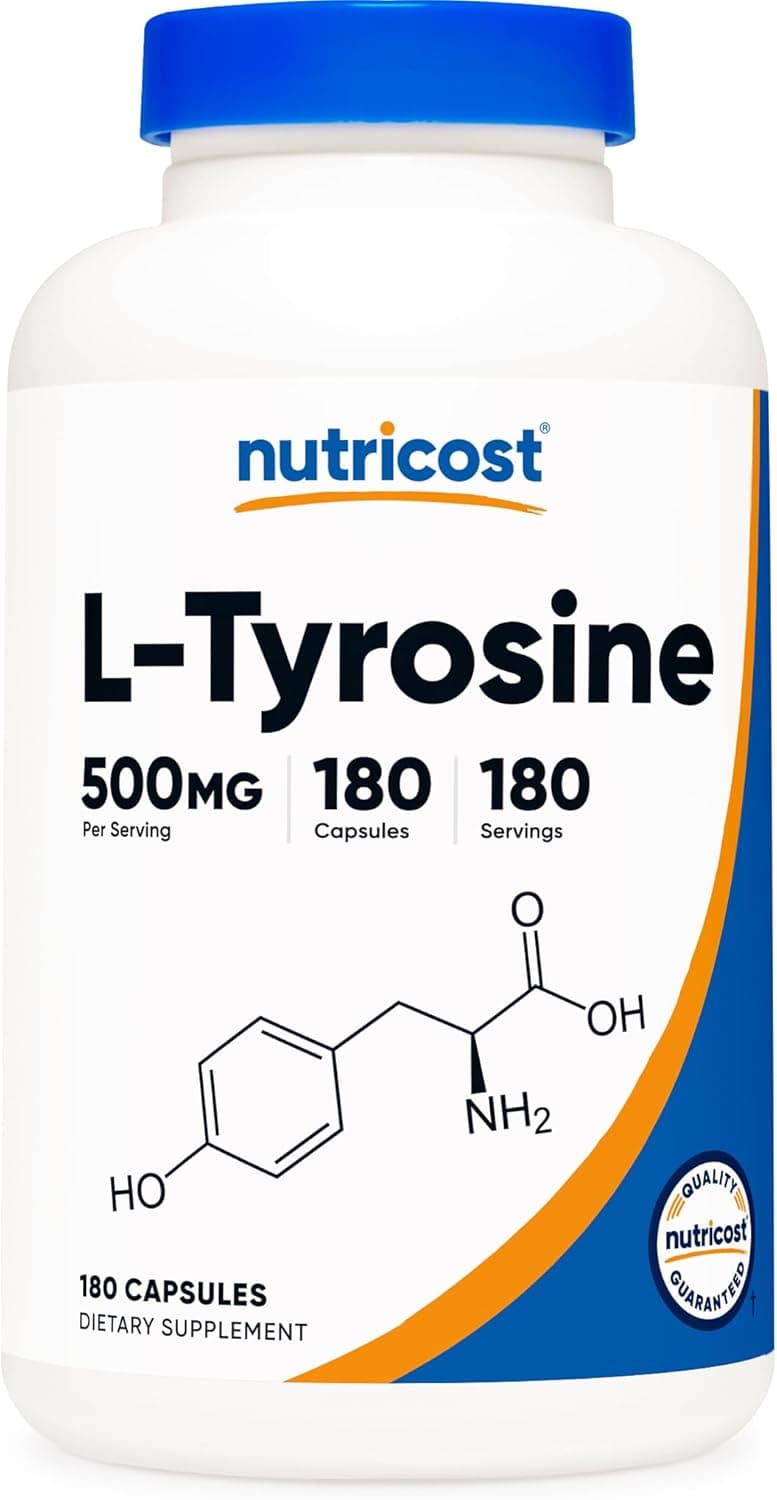
- Start with 500mg to 2,000mg, the maintenance band on record, about an hour before the demanding stretch and away from a large protein meal.
- Time to feel it
- About two hours after a single dose, under cold stress.
- The first dose
- Within about an hour it is working. Under real load people describe thinking that holds its shape longer, and on an easy day the effect is quiet.
- With regular use
- Daily use keeps the raw material for dopamine and norepinephrine in ready supply. It doesn't accumulate like a vitamin. Each dose does its work that day.
- How well tolerated
- Well tolerated in most people. Check with your clinician if you have thyroid concerns, are pregnant, or take mood or blood pressure medication.
- How it feels
- Clear rather than buzzy. There's no stimulant push and no jitter. Under load it feels like your thinking holds its shape a little longer than it otherwise would.
- The overlooked benefit
- Tyrosine residues on thyroglobulin are the sites iodine attaches to when thyroid hormone is built, so it feeds normal thyroid chemistry as well as the focus story.
500 to 2,000mg a day is where L-Tyrosine works.
Source: Jongkees 2015 meta + Mahoney 2007 military study
Two controlled crossover trials in cold-exposure stress measured working memory at a set interval after dosing. Eight men took 150 mg per kg of L-tyrosine two hours before a 30 minute delayed matching-to-sample task at 4 degrees Celsius. Matching accuracy at the longest delay returned to the level seen at 22 degrees Celsius. In 19 volunteers immersed twice for 90 minutes in roughly 10 degree water, a 150 mg per kg bar taken before each immersion raised correct responses on the same memory measure. Both were small trials in an induced-stress setting, and a later crossover trial under exercise heat stress in eight men found no cognitive change despite raised serum tyrosine.
The proof, claim by claim.
These words describe the research, not the molecule's worth. Research strength is how much work stands behind one claim, and it is never a product score.
Proven to preserve cognition during acute stress.
- Preserves working memory during acute stressSystematic review of 15 human studies
- Mitigates performance decline during sleep deprivationMultiple crossover RCTs (n=12-20)
- Improves cognitive flexibilitySingle RCT (n=22)
Questions people ask about L-Tyrosine.
- When should I take it?
- Timing matters less than consistency. Pick a time that works for you and take it daily.
- Should I take it on an empty stomach?
- Most amino acids absorb better on an empty stomach since they don't compete with food proteins for absorption. 30 minutes before meals is ideal.
- Can I get enough from protein?
- If you eat enough protein (0.8-1g per pound bodyweight), you probably get enough aminos. Supplementing specific ones only makes sense for targeted goals.
- Can I take it with other supplements?
- Usually fine. The main thing to watch is not doubling up on the same ingredient from different products. If you're on prescription meds, check with your pharmacist first.
- Who benefits most from this?
- People with a specific, evidence-backed need. L Tyrosine has strong research. If your situation matches the studied use case, it's one of the more reliable supplements you can take.
Why these belong in the same formula. Each row says what the basis is, from settled biochemistry through to a trial that measured the pair.
The body builds thyroid hormone by attaching iodine atoms to tyrosine, then joining those iodinated tyrosines into T3 and T4. Tyrosine supplies the backbone and iodine supplies the atoms that make it active, so the two together are the raw materials for normal thyroid hormone production.
Tyrosine hydroxylase, the first and rate-limiting enzyme that starts converting tyrosine into dopamine's precursor L-DOPA, carries an iron atom in its active site and cannot run the step without it. Iron availability therefore paces how readily the body moves tyrosine down the catecholamine pathway.
After tyrosine is converted to L-DOPA, the enzyme that turns L-DOPA into dopamine (aromatic amino acid decarboxylase) works only with vitamin B6 in its active PLP form. B6 is the cofactor that lets that decarboxylation step proceed, supporting the normal conversion of tyrosine into dopamine.
Copper is the metal built into dopamine beta-hydroxylase, the enzyme that converts dopamine into norepinephrine one step further along the pathway that starts with tyrosine. That conversion depends on copper, so copper supports the normal production of norepinephrine from tyrosine-derived dopamine.
The step that converts dopamine to noradrenaline runs on a copper enzyme that needs ascorbate to keep its copper reduced. Tyrosine supplies the substrate and vitamin C keeps that step turning.
Phenylalanine hydroxylase converts phenylalanine directly into tyrosine. Phenylalanine sits one step upstream of the whole catecholamine route.
The L-form is hydroxylated to tyrosine, feeding the same catecholamine route from one step upstream. The pairing supplies the pathway at two consecutive points.
Thyroid hormone is built on iodinated tyrosine residues, and the deiodinase enzymes that activate it are selenoproteins. Tyrosine and iodine supply the structure while selenium handles the conversion.
S-adenosyl methionine donates the methyl group that converts noradrenaline to adrenaline and is also used to inactivate catecholamines. Methyl supply shapes what happens after tyrosine.
Betaine remethylates homocysteine back to methionine, replenishing the S-adenosyl methionine used in catecholamine methylation. It keeps the methyl pool behind that step stocked.
Tyrosine hydroxylase needs tetrahydrobiopterin, whose salvage uses dihydrofolate reductase, and folate also refills the methyl pool used downstream. Both touchpoints sit on the catecholamine route.
Tyrosine and tryptophan compete for the same large neutral amino acid carrier into the brain and for aromatic amino acid decarboxylase afterwards. A large dose of one lowers central delivery of the other.
5-HTP and the tyrosine-derived L-dopa are both handled by aromatic amino acid decarboxylase, so heavy use of one draws on the shared enzyme and its B6 cofactor. Formulators balance the two rather than loading one alone.
Branched-chain amino acids compete with tyrosine at the large neutral amino acid carrier at the brain barrier. A large leucine dose lowers how much tyrosine reaches central tissue.
Valine uses the same large neutral amino acid carrier tyrosine needs to cross into the brain. Taken together at high dose they compete for that transport.
Mucuna carries L-dopa, which is the product of the tyrosine hydroxylase step. It enters the catecholamine route past the point that usually limits it.
Tyrosine supplies catecholamine substrate while theanine raises alpha activity and lowers arousal. Formulas combine them for focus without the restless feel.
Caffeine raises catecholamine signalling and turnover, and tyrosine is the substrate those transmitters are built from. Pairing substrate with a stimulus is long-standing formulation practice.
Zinc takes part in thyroid hormone metabolism and in the nuclear receptor that reads it, downstream of the iodinated tyrosine backbone. It sits on the same axis tyrosine and iodine feed.
Tyrosine crosses the blood-brain barrier on the LAT1 carrier, which it shares with tryptophan, the branched-chain amino acids, phenylalanine, methionine and histidine. A whey protein serving delivers all of those at once, so brain tyrosine uptake depends on the ratio of tyrosine to the sum of its competitors, not on the absolute amount. Taking free tyrosine inside a large mixed protein load flattens that ratio. This is transport competition, well characterised, and it argues for spacing rather than against either ingredient.
Isoleucine is one of the branched-chain amino acids that compete directly with tyrosine at LAT1. Supplemental branched-chain amino acids taken at the same time as tyrosine lower the plasma tyrosine ratio that governs brain entry. Neither is thereby wasted. The timing is what changes. Stated as a transport interaction, not a claim about performance.
Tyrosine hydroxylase, the rate-limiting step toward dopamine, requires tetrahydrobiopterin as cofactor, and 5-methyltetrahydrofolate can act as an alternative electron donor supporting pterin recycling. Modelling of the tyrosine hydroxylase pathway shows how strongly output tracks tetrahydrobiopterin availability rather than substrate alone. The folate connection is a cofactor-regeneration link, not a demonstrated additive effect on any endpoint in people.
Histidine and L-tyrosine were added together to an oocyte maturation medium in a buffalo in vitro study and developmental outcomes were tracked. Both amino acids also share the LAT1 carrier, so a systemic pairing has a competition side as well. Nothing here was measured in a person taking either by mouth. Kept at Early and labelled as non-human in vitro work.
Gut bacteria metabolise aromatic amino acids, and a paediatric inulin study in children with excess body weight reported changes in microbiota-derived metabolites related to brain function, with tyrosine-pathway metabolites among those measured. The direction of interest is what a fermentable fibre does to how much aromatic amino acid survives the colon. Tyrosine was a measured metabolite there, not the intervention. This is a metabolite association, not an outcome.
Tyrosine supplies the substrate for catecholamine synthesis under conditions that deplete it, while rhodiola preparations are used for stress load through a different and less mechanistically resolved route. Products pair them for that reason. No trial of the combination is in this candidate set, so the pairing rests on formulation rationale. Early confidence is the honest label.
Talk to a doctor before taking L-Tyrosine if any of these apply to you: MAOI Antidepressants. These are flags to check first, not effects L-Tyrosine is known to cause.
Not medical advice. Show the label to your pharmacist.What L-Tyrosine actually does.
The first and slowest step from tyrosine toward dopamine needs iron and the cofactor tetrahydrobiopterin, not just tyrosine.
Turning tyrosine into dopamine and then noradrenaline takes vitamin B6, copper and vitamin C along the way.
Thyroid hormones are built by attaching iodine onto tyrosine units held inside a large thyroid protein.
Tyrosine shares a doorway into the brain with several other amino acids, so what matters is how much of it there is compared with them.
Where L-Tyrosine comes from.
The tyrosine in a supplement is grown by microbes fed on glucose or assembled by a single enzyme in a reactor. Both end at the same amino acid found in any protein meal, crystallised out of the liquid it was made in.
The same molecule is reached more than one way. Which route a given product used is a manufacturing choice, and the finished compound is the same either way.
The fermentation route feeds glucose to production strains. The enzymatic route builds the molecule from phenol, pyruvate and ammonia using tyrosine phenol lyase.
Engineered strains overproduce tyrosine beyond their own needs and excrete it into the broth. The enzymatic route runs one dedicated enzyme in a reactor to couple its three inputs into the amino acid.
Tyrosine's low solubility works in the manufacturer's favour: it crystallises readily out of broth or reactor stream and is washed and recrystallised to specification.
A white crystalline amino acid, identical to the tyrosine in dietary protein.
Getting L-Tyrosine from food.
The whole-food sources on file. A supplement closes the gap, it does not replace dinner.
A gram-for-gram figure (how much of each you would eat to match a dose) will appear here once it is sourced and reviewed. This page will not print a number it cannot cite.
The forms it comes in.
The essence, in one line each.
- Across the human cognitive and behavioral trials, tyrosine reliably supported working memory and cognitive control during short-term demanding or stressful conditions, with little added benefit when neurotransmitter demand was not raised.Systematic review. Jongkees et al., 2015 (Journal of Psychiatric Research). PMID 26424423 ↗
- Cadets taking 2 g of tyrosine daily through a week of demanding military training scored higher on memory and tracking tasks and showed lower systolic blood pressure than those on a calorie-matched control drink.Randomised controlled trial. Deijen et al., 1999 (Brain Research Bulletin). PMID 10230711 ↗
- During 4.5 hours of combined cold and low-oxygen exposure, a single 100 mg/kg dose of tyrosine reduced stress symptoms, low mood, and performance decline in the people who reacted most to the conditions.Double-blind placebo-controlled crossover trial. Banderet & Lieberman, 1989 (Brain Research Bulletin). PMID 2736402 ↗
- One hour after a 150 mg/kg dose, tyrosine held working-memory accuracy higher while participants juggled several tasks at once, compared with placebo, with no change on the simpler single-task version.Controlled human trial. Thomas et al., 1999 (Pharmacology, Biochemistry, and Behavior). PMID 10548261 ↗
- In a crossover trial in 30 healthy men taking 0 to 4 g a day for 4 weeks, no dose-related changes appeared in blood, biochemical or electrolyte laboratory measures, and mild side effects were no more common than with placebo.Randomised trial. Matsumoto et al., 2026 (Nutrients). PMID 42356406 ↗
- In 9 older and 9 young adults cooled for 90 minutes, 150 mg/kg of oral l-tyrosine more than doubled the skin vessel narrowing response in the older adults (33% versus 14% change in cutaneous vascular conductance) and helped hold core temperature.Randomised trial. Lang et al., 2020 (Medicine and Science in Sports and Exercise). PMID 31609301 ↗
- In 12 recreational cyclists made mentally tired by a 60-minute Stroop task, 300 mg/kg of l-tyrosine extended time to exhaustion by about 16% (460 versus 399 seconds) and slowed the rise in perceived effort.Randomised trial. Solon-Junior et al., 2026 (European Journal of Sport Science). PMID 41818465 ↗
- In 11 young and 11 older adults cooled from 34 to 30.5 degrees C, 150 mg/kg of oral l-tyrosine increased the sympathetically driven narrowing of skin blood vessels in older skin.Randomised trial. Lang and Smaller, 2017 (Experimental Physiology). PMID 28477375 ↗
- L-tyrosine supplementation around exercise was associated with changes in the thiol and disulphide redox balance, a laboratory marker of oxidative stress rather than a performance outcome.Randomised trial. Kayacan Y et al., 2018 (Archives of Physiology and Biochemistry). PMID 29020830 ↗
- L-tyrosine supplementation did not ameliorate skeletal muscle dysfunction in zebrafish and mouse models. The authors report a failure to detect benefit in these models, which is not evidence that no effect exists elsewhere.Animal study. Messineo AM et al., 2018 (Scientific Reports). PMID 30065346 ↗
- Computational modelling of the tyrosine hydroxylase pathway shows dopamine synthesis output constrained by tetrahydrobiopterin availability as much as by tyrosine substrate supply. A model, not a measurement in people.Computational model. Damdoum M et al., 2026 (Cognitive Neurodynamics). PMID 42266201 ↗
- Adding histidine and L-tyrosine to the maturation medium changed in vitro developmental outcomes for buffalo oocytes.In vitro study. El-Naga EMA et al., 2024 (BMC Veterinary Research). PMID 39272083 ↗
- Beetroot nitrate supplementation altered nitric oxide pathway and oxy-inflammatory markers in amateur triathletes. Tyrosine appears here as one of the measured metabolites, not as the intervention.Randomised trial. Mrakic-Sposta S et al., 2026 (Nutrients). PMID 42075028 ↗
- Inulin supplementation shifted gut microbiota-derived metabolites related to brain function in children with excess body weight. Tyrosine-pathway metabolites were among those measured, and metabolite shifts are markers.Randomised trial. Andriyas T et al., 2025 (Scientific Reports). PMID 41057493 ↗
- In a folic acid and creatine trial, the metabolic signature of arsenic exposure included changes across amino acid pathways with tyrosine among the named metabolites. An exposure-metabolomics finding, not a tyrosine intervention.Randomised trial. Li W et al., 2025 (Environmental Science and Technology). PMID 40668877 ↗
These are the studies our verdict leans on, chosen from the 791 we read for L-Tyrosine. The full linked list is below.
The studies, linked.
1 source behind our L-Tyrosine verdict: peer-reviewed studies and registered clinical trials. Every one links straight to PubMed, the journal, or ClinicalTrials.gov. Read them yourself.
- Clinical trialImpact of Multimodal Diagnostic Assessment of Cerebral Gliomas With F-18-fluoroethyl-L-tyrosine PET/CT, F-18-fluorocholine PET/CT and Magnetic Resonance Imaging and SpectroscopyClinicalTrials.gov ↗51 participants, Completed
Evidence surfaced via Semantic Scholar (Allen Institute for AI) and ClinicalTrials.gov. Ranked by study type and citation weight, not cherry-picked.
Problems people have reported.
Read this carefully. These are 637 voluntary, unverified reactions reported to the FDA (openFDA). The number mostly reflects how popular L-Tyrosine is, not how risky it is. A report is not proof L-Tyrosine caused anything. It is a signal of what to watch for, nothing more.
Source: openFDA adverse-event reports. Voluntary reporting, not an incidence rate.
FDA Disclaimer: These statements have not been evaluated by the Food and Drug Administration. This information is for educational purposes only and is not intended to diagnose, treat, cure, or prevent any disease. Consult your healthcare provider before starting any supplement regimen.