Pairs well with16 on file
Why these belong in the same formula. Each row says what the basis is, from settled biochemistry through to a trial that measured the pair.
The body builds thyroid hormones by attaching iodine atoms onto tyrosine residues, so tyrosine supplies the amino acid backbone while iodine supplies the atoms that make the finished hormone active. Together they are the two raw materials the thyroid draws on to keep normal hormone production running.
Iodine lets the thyroid assemble its storage hormone T4, and selenium-dependent deiodinase enzymes then convert that T4 into the active form T3, so one nutrient makes the hormone and the other switches it on. Selenium also runs the antioxidant enzymes that shield thyroid tissue from the reactive byproducts formed while it works with iodine.
Thyroid peroxidase, the iron-containing heme enzyme that attaches iodine to the growing hormone, needs adequate iron to do its job. When iron status runs low the thyroid uses iodine less efficiently, so the two nutrients support the same synthesis step.
Thyroid hormone receptors are built as zinc-finger proteins, so zinc forms part of the structure a cell uses to read the hormone's signal and act on it. That gives the hormone iodine helps assemble the receptor machinery it needs to work, which is why zinc sits among the nutrients thyroid function draws on.
Retinoid X receptors partner with thyroid hormone receptors on shared DNA response elements, and retinol status also influences pituitary TSH output. Iodine supplies the hormone's raw material while vitamin A governs how the finished signal is read.
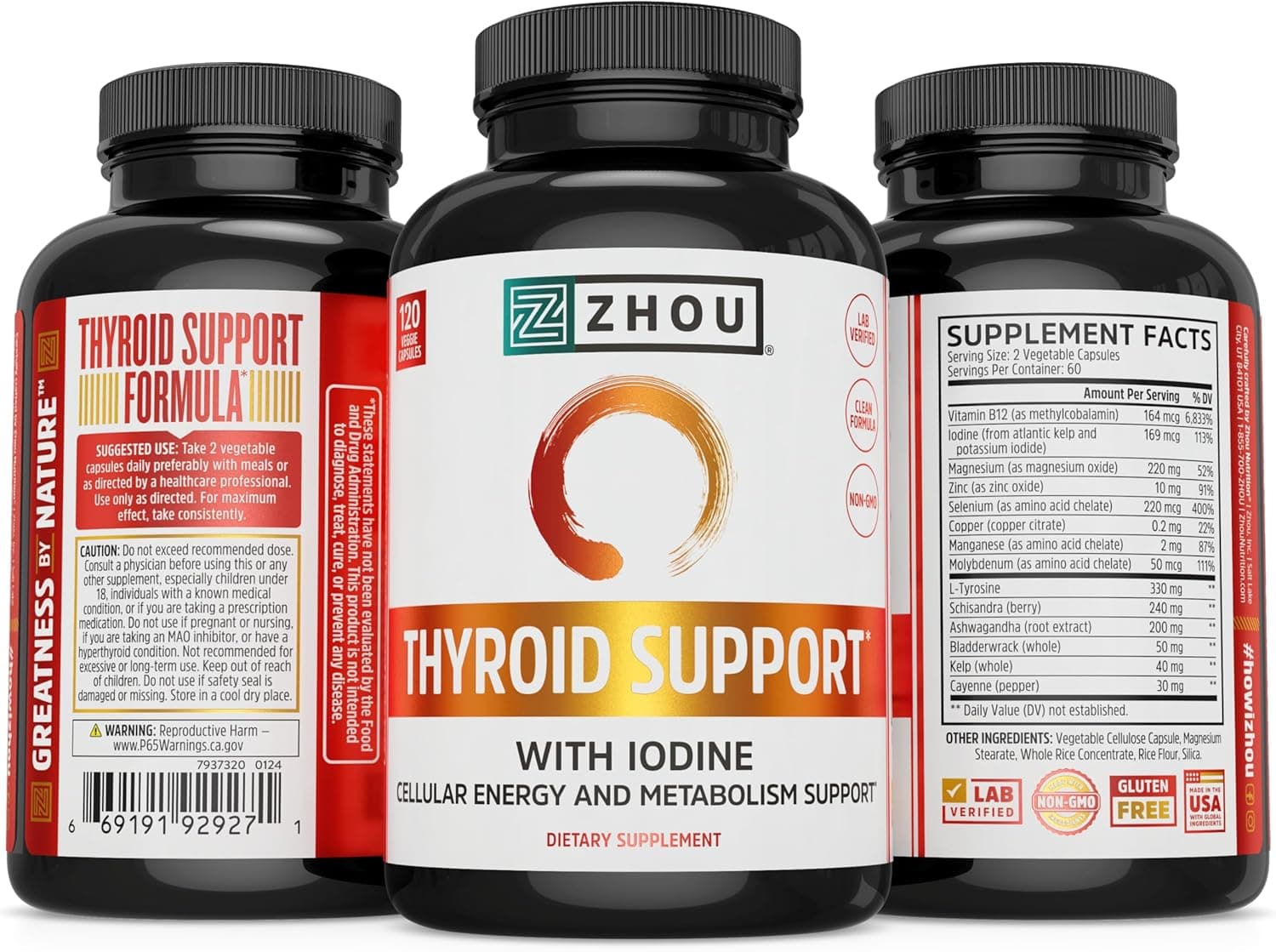
Bladderwrack is a brown seaweed that concentrates iodide, so it contributes iodine on top of any added potassium iodide in the same formula. Total intake is the sum of both, which matters because thyroid hormone output responds to iodine at both low and high intakes.
Glucosinolate breakdown yields thiocyanate, a monovalent anion that competes with iodide for the sodium-iodide symporter that concentrates iodide in thyroid tissue. A generous iodine intake blunts this competition, which is why the two are worth flagging together in one formula.
Carnitine reduces entry of T3 and T4 into cell nuclei, so it acts as a peripheral counterweight to thyroid hormone signalling. Iodine supplies hormone synthesis while carnitine damps the tissue-level response, an opposing pair rather than a reinforcing one.
Withanolides nudge pituitary TSH signalling and raise circulating T4, which draws on the available iodide pool for hormone assembly. Adequate iodine keeps that raw material in place when the two are formulated together.
Guggulsterones increase iodine uptake by thyroid tissue and support conversion of T4 to the more active T3 in peripheral tissue. Iodine covers synthesis and guggul the activation step.
Iodine + SaltEstablished public-health delivery vehicle for iodine as iodide or iodate Table salt fortified with potassium iodide or potassium iodate is the main route by which iodine reaches most populations, because salt intake is steady and the carrier is cheap. Iodised salt appears repeatedly in the co-study record for this mineral for that reason. Iodine content of salt falls with heat, humidity and long storage, so the pairing is about delivery and stability rather than any added biological effect.
Iodide enters the thyroid on the sodium-iodide symporter, and nitrate, thiocyanate and perchlorate are all recognised competitive inhibitors at that transporter. High nitrate exposure therefore competes with iodide uptake, which matters most when iodine intake is already low. This is established transport pharmacology and is a direction to flag, not a benefit.
Ascorbate reduces molecular iodine to iodide quantitatively, which is the basis of a standard titration. In a liquid or a shared tablet matrix that reaction changes which iodine species is present. It is a formulation and analytical consideration, not a claim about absorption or thyroid function.
Activated charcoal adsorbs a wide range of co-ingested substances, and separating it from nutrients by several hours is standard practice for that reason. Iodide is a small anion delivered in small amounts, so co-ingestion is a plausible loss route. No study in this candidate set measured iodine absorption with charcoal, so the confidence stays short of established.
Clay binders are used precisely because they hold onto ions in the gut, which is a reason to space them away from micronutrient doses. Whether bentonite meaningfully reduces iodide uptake in people has not been measured in this candidate set. Flagged as a timing consideration rather than an established interaction for this specific mineral.
Conversion of riboflavin to its active flavin coenzymes is influenced by thyroid hormone status, and iodine is the element those hormones are built from. The relationship is described in nutritional biochemistry and runs in both directions. No trial in this candidate set gave the two together, so this is a mechanism note only.