Gamma butyrobetaine.
It is the last molecule your body makes before carnitine. Supplying it hands the liver and kidney the direct raw material for carnitine synthesis.
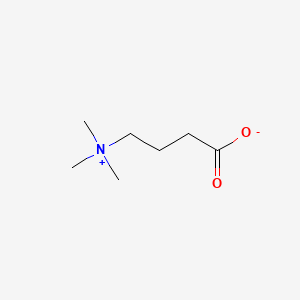 Compound
- Category
- Compound
What Gamma butyrobetaine is, and what it does.
- Does it work
- Of interest to people thinking about carnitine supply, plant-based eaters in particular. Human outcome trials are few, so the case rests on the biochemistry.
- How much to take
- No human dose figure is on record. Start with what your product states and keep it daily, because carnitine pools shift slowly rather than in one dose.
- Time to feel it
- Nobody has measured a felt timeline in people. Carnitine supply changes over weeks and shows up on a blood measure.
- The first dose
- Day one is quiet. The conversion happens in liver and kidney tissue, not somewhere you would sense it.
- With regular use
- Over weeks the expectation from the pathway is a steadier carnitine supply, though human trials measuring that directly are limited.
- How well tolerated
- Human safety data is limited. Gut bacteria can also route it to trimethylamine and on to TMAO, a blood marker rather than an outcome. Check with a clinician.
- How it feels
- No distinctive sensation. Its work sits in carnitine supply, which is read on a blood panel rather than felt through the day.
- The overlooked benefit
- The enzyme that converts it needs ferrous iron and ascorbate, so your carnitine synthesis is only ever as good as your iron and vitamin C status.
The proof, claim by claim.
What these words mean
These words describe the research, not the molecule's worth. Research strength is how much work stands behind one claim, and it is never a product score.
- Conversion to carnitine by gamma-butyrobetaine dioxygenase in liver and kidneyNarrative review
- Iron and ascorbate dependence of carnitine synthesisNarrative review
2 more claims
- Raising tissue carnitine after oral precursor intakeAnimal study
- Microbial conversion onward to trimethylamine and TMAO, a blood markerAnimal study
Why these belong in the same formula, 9 pairings
Why these belong in the same formula. Each row says what the basis is, from settled biochemistry through to a trial that measured the pair.
Every molecule of endogenously made carnitine passes through gamma-butyrobetaine. The BBOX1 enzyme hydroxylates it to carnitine, mostly in liver and kidney. Loss-of-function variants in BBOX1 produce carnitine deficiency with gamma-butyrobetaine piling up behind the block, which is direct human confirmation of the pathway order. Supplementing the precursor and the product together is chemically redundant at the same step rather than complementary.
Two of the four enzymes in carnitine synthesis are ascorbate-dependent hydroxylases, and the final gamma-butyrobetaine to carnitine step is one of them. Without adequate ascorbate the iron centre oxidises and the enzyme stalls. This is why severe long-term ascorbate deficiency lowers carnitine synthesis. It does not follow that extra ascorbate above sufficiency pushes the pathway faster.
The catalytic centre of gamma-butyrobetaine dioxygenase holds a ferrous iron atom. Adequate iron status is a structural requirement for the enzyme to work at all. This is a floor effect, not a dose-response lever, and iron above sufficiency does not accelerate carnitine synthesis.
Lysine supplies the carbon skeleton for the entire carnitine pathway. Trimethyllysine, released when methylated proteins are broken down, is hydroxylated, cleaved and oxidised through to gamma-butyrobetaine. Gamma-butyrobetaine is the last intermediate before carnitine itself. Lysine availability sits several steps upstream and is not usually the rate-limiting element in a normal diet.
No methyl donation, no trimethyllysine, and therefore no gamma-butyrobetaine and no endogenous carnitine. Methionine is the source of those methyl groups through SAM. This links carnitine synthesis directly to one-carbon status, which is one reason folate, B12 and betaine also touch this pathway indirectly.
Betaine remethylates homocysteine to methionine, which sustains SAM and therefore the methyl supply that starts the carnitine pathway. The connection is real but several enzymatic steps removed from gamma-butyrobetaine itself. Nothing has measured whether betaine intake changes gamma-butyrobetaine levels in people.
Gut bacteria convert dietary carnitine to gamma-butyrobetaine and then onward to trimethylamine, which the liver oxidises to TMAO. Carnitine challenge studies in people show wide between-person variation in this output that tracks with microbiome composition. Whether any particular probiotic shifts that conversion in a useful direction has not been shown, and TMAO itself is a circulating marker rather than a demonstrated outcome. Read this as a modulating relationship worth measuring, not a benefit to claim.
Inulin was tested on the hypothesis that shifting the gut community would lower plasma TMAO. The trial did not detect a reduction, which is a failure to detect an effect rather than proof that no effect exists in any population or at any dose. The measured endpoint was a circulating marker, not a clinical outcome. It sits on the gamma-butyrobetaine route only indirectly.
The bacterial conversion of carnitine through gamma-butyrobetaine to trimethylamine is carried by a subset of gut organisms. Any substrate that changes community composition could in principle change that flux. This is mechanistic reasoning, not a measured result, and no human trial has tested resistant starch against gamma-butyrobetaine directly.
Nothing specific on file for Gamma butyrobetaine. Match the label to the daily amount above, and tell your doctor what you take.
Not medical advice. Show the label to your pharmacist.What Gamma butyrobetaine actually does.
Gamma-butyrobetaine is the last step before the body makes carnitine, an enzyme mostly in the liver and kidney converts it directly into L-carnitine.
3 more mechanisms
That enzyme needs iron, oxygen and vitamin C to keep working, which is why carnitine production is tied to a person's iron and vitamin C status.
The body's own route to carnitine runs through several intermediate steps and four enzymes, two of which need vitamin C to work.
Gut bacteria can also make gamma-butyrobetaine from dietary carnitine and push it further to a compound the liver converts into TMAO, so this molecule sits on both our own biosynthesis route and a separate bacterial breakdown route.
Where Gamma butyrobetaine comes from.
Your body builds carnitine in four steps, and this is the last thing it makes before carnitine itself. The version in a capsule is made in a factory rather than pulled from a plant or an animal. Worth knowing: gut bacteria make the same molecule out of the carnitine in your food, and they can also take it in a different direction entirely.
What this route gives you
The same molecule is reached more than one way. Which route a given product used is a manufacturing choice, and the finished compound is the same either way.
5 steps on record
Commercial synthesis starts from a four-carbon acid backbone that can accept a trimethylammonium group at the terminal position.
The terminal amine is methylated three times, or a halide is displaced by trimethylamine, to install the quaternary ammonium head that defines the molecule.
The quaternary ammonium product is separated from unreacted starting material and salts, then crystallised, usually as the hydrochloride.
HPLC or LC-MS confirms identity and quantifies residual trimethylamine, which carries a strong fishy odour when present.
Supplied as the hydrochloride salt in capsules or as a bulk powder, sometimes alongside carnitine or its cofactors.
Getting Gamma butyrobetaine from food.
The whole-food sources on file. A supplement closes the gap, it does not replace dinner.
A gram-for-gram figure (how much of each you would eat to match a dose) will appear here once it is sourced and reviewed. This page will not print a number it cannot cite.
The forms it comes in.
2 more forms
The essence, in one line each.
- In omnivores, dietary l-carnitine was converted by gut microbes through gamma-butyrobetaine to trimethylamine and then TMAO, a process that occurred to a markedly lower extent in vegans and vegetarians.Clinical trial (non-randomised). Koeth RA et al., 2019 (Journal of Clinical Investigation). PMID 30530985 ↗
1 more finding
- Punicalagin was identified as the pomegranate polyphenol that inhibits gut microbial trimethylamine production from L-carnitine.In vitro study. Haarhuis JE et al., 2026 (Food & Function). PMID 41627321 ↗
Chosen from the 8 we read for Gamma butyrobetaine.
FDA Disclaimer: These statements have not been evaluated by the Food and Drug Administration. This information is for educational purposes only and is not intended to diagnose, treat, cure, or prevent any disease. Consult your healthcare provider before starting any supplement regimen.