Inositol nicotinate.
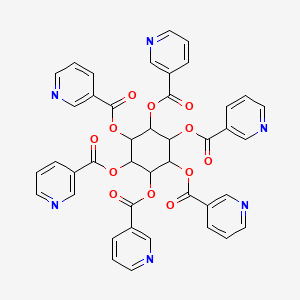
A slow-release form of niacin: six niacin units on an inositol core, freed by esterases. It covers vitamin B3 without the hot red flush plain nicotinic acid brings.
 Compound
- Category
- Compound
What Inositol nicotinate is, and what it does.
- Does it work
- It suits people who want B3 without flushing. Worth knowing that the low peak removing the flush is the same low peak behind nicotinic acid's lipid effects.
- How much to take
- No amount is on record for the ester itself. Start from B3 needs: adults need roughly 14 to 16mg of niacin equivalents a day, and this form releases niacin slowly.
- Time to feel it
- Nothing arrives sharply, by design. Hydrolysis is gradual, so blood nicotinic acid rises slowly and B3 status is a marker that moves over weeks.
- The first dose
- Quiet. The absence of flushing is the point, and B3 status changes show up on a blood panel over weeks rather than as a sensation on day one.
- With regular use
- Weeks of daily use keeps B3 topped up through the Preiss-Handler route into NAD. Lipid change is not this form's story, since flushing and those effects share a receptor.
- How well tolerated
- Generally well tolerated, and gentler on flushing than plain nicotinic acid. High-dose niacin forms warrant a doctor's input, especially alongside a lipid medicine.
- How it feels
- Mostly nothing, which is the design: no flush, no tingling, no hot ears. What it does shows in B3 status on a panel rather than as a sensation.
- The overlooked benefit
- No flush is a signal, not only a comfort: it tells you free nicotinic acid stays low. Useful if you were told this form does what high-dose niacin does.
2,000 to 4,000mg a day is where Inositol nicotinate works.
Source: Unfer 2017 (meta-analysis) + Levine 1995
The proof, claim by claim.
What these words mean
These words describe the research, not the molecule's worth. Research strength is how much work stands behind one claim, and it is never a product score.
- vitamin B3 provision through released nicotinic acidNarrative review
- much less flushing than plain nicotinic acidRandomised trial
3 more claims
- change in blood lipidsRandomised trial
- peripheral circulation in the hands and feetRandomised trial
- entry into NAD synthesis through the Preiss-Handler pathwayNarrative review
Why these belong in the same formula, 8 pairings
Why these belong in the same formula. Each row says what the basis is, from settled biochemistry through to a trial that measured the pair.
Each molecule of inositol nicotinate carries six nicotinic acid units esterified to a myo-inositol core, so taking both means counting the same vitamin twice. Anyone stacking a flush-free product on top of plain nicotinic acid can reach a far higher total nicotinic acid intake than either label suggests. The two are not complementary. Read them as one input arriving by two routes.
Full hydrolysis of inositol hexanicotinate releases one myo-inositol alongside the nicotinic acid. On a molar basis the inositol contribution is modest next to the gram doses used in dedicated inositol products. Anyone taking both should be aware the overlap exists, though it is small enough that it rarely changes a plan.
Nicotinic acid enters the NAD pool through the Preiss-Handler route while nicotinamide enters through the salvage route, and both end at the same place. What differs is everything upstream of that. Nicotinamide does not activate GPR109A, so it neither flushes nor produces the lipid effects that free nicotinic acid does. Substituting one for the other changes the outcome even though the vitamin activity is the same.
Nicotinamide riboside enters NAD synthesis through nicotinamide riboside kinase, a third entry point into the same pool that nicotinic acid feeds. Combining forms raises total precursor supply but does not multiply the result, because NAD synthesis is regulated and precursors are not interchangeable in their side effects. There is no evidence that stacking the two does more than either at an adequate dose.
The body makes its own niacin from tryptophan, and kynureninase, the committed step in that route, is a pyridoxal phosphate enzyme. Low vitamin B6 status throttles endogenous niacin production and raises reliance on dietary intake. This is textbook one-carbon and amino acid biochemistry, not a supplement interaction, and it is why B6 status matters when assessing niacin adequacy.
Kynurenine 3-monooxygenase, another step on the tryptophan to niacin route, is a flavin-dependent enzyme requiring FAD derived from riboflavin. Riboflavin depletion therefore reduces how much niacin a person makes from protein. The relationship runs through cofactor supply and applies whatever niacin form is taken.
Tryptophan converts to niacin equivalents at roughly a sixty to one weight ratio in people with adequate B2 and B6 status, which is why niacin requirements are stated in niacin equivalents rather than niacin alone. A protein-adequate diet supplies a meaningful share of niacin need this way. It means supplemental niacin sits on top of an endogenous supply that varies with protein intake.
Free nicotinic acid at gram doses lowers triglycerides and raises HDL, while monacolin K inhibits HMG-CoA reductase like a statin. Stacking them is an additive lipid intervention that also stacks their liver and muscle monitoring requirements. This combination belongs under clinical supervision with liver enzymes checked, not in self-directed stacking.
Nothing specific on file for Inositol nicotinate. Match the label to the daily amount above, and tell your doctor what you take.
Not medical advice. Show the label to your pharmacist.What Inositol nicotinate actually does.
It is six niacin molecules parked on a sugar alcohol. Nothing happens until the body cuts them loose.
3 more mechanisms
The flush comes from a sudden spike of free niacin hitting skin receptors. No spike, no flush.
The flush is a side effect of the thing that works. Removing it usually removes the effect too.
Whatever niacin does get released counts toward the vitamin B3 you need.
Where Inositol nicotinate comes from.
A lab-made molecule that parks six niacin units on a sugar alcohol so they release slowly. Sold as the no-flush version of niacin.
What this route gives you
Chemically synthesised. The molecule is identical to the one a plant or an animal makes, and building it deliberately means a known purity, a fixed dose and no crop contaminants. For several nutrients this is the only route that reaches a usable amount.
5 steps on record
Myo-inositol comes from hydrolysis of phytate in corn steep liquor or from microbial fermentation of glucose. Nicotinic acid is made industrially by oxidation or ammoxidation of 3-picoline.
The two are joined by esterifying all six inositol hydroxyls, typically using an activated nicotinic acid derivative such as nicotinoyl chloride in the presence of a base.
The poorly soluble hexaester is precipitated and washed free of residual acid, base and partially substituted species.
Material is assayed for total nicotinic acid content and for degree of substitution, since partial esters behave differently on hydrolysis.
Dried and milled, then blended with excipients. It is not water soluble, so it does not suit liquid formats.
The forms it comes in.
3 more forms
Problems people have reported.
Read this carefully. These are 115 voluntary, unverified reactions reported to the FDA (openFDA). The number mostly reflects how popular Inositol nicotinate is, not how risky it is. A report is not proof Inositol nicotinate caused anything. It is a signal of what to watch for, nothing more.
3 more reported effects
Source: openFDA adverse-event reports. Voluntary reporting, not an incidence rate.
FDA Disclaimer: These statements have not been evaluated by the Food and Drug Administration. This information is for educational purposes only and is not intended to diagnose, treat, cure, or prevent any disease. Consult your healthcare provider before starting any supplement regimen.