Quinine sulphate.
The sulphate salt is how quinine is handled in manufacturing and prescribing. At the tiny levels used in drinks it is a bitterant. At working amounts it is a prescription medicine.
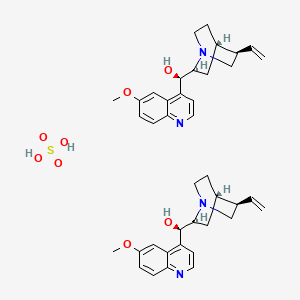 Compound
- Category
- Compound
What Quinine sulphate is, and what it does.
- Does it work
- It suits formulators who need a defined bitter reference point. Anyone considering it otherwise should know that a working amount is a prescription decision, not a shelf one.
- How much to take
- No supplement amount is on record, and none should be inferred. Anything past flavour level is prescribed and monitored by a clinician.
- Time to feel it
- Bitterness registers instantly on the tongue. Nothing else about it has a supplement-scale timeline that anyone has measured.
- The first dose
- At flavour level day one is taste alone. The salt is only sparingly soluble in water and dissolves more readily in an alcohol-containing base.
- With regular use
- Nobody has measured long-term supplement-scale use. Its plasma binding shifts with an acute-phase protein, so exposure is not constant even at a fixed intake.
- How well tolerated
- It carries the reactions of the parent alkaloid, including immune-mediated blood effects, and it inhibits CYP2D6. Several regulators restrict it off prescription. Ask your doctor first.
- How it feels
- Sharply bitter and drying, the fixed point sensory scientists calibrate their scales against. At flavour level that taste is the whole of it.
- The overlooked benefit
- As a weak base with a pKa near 8.5 it is mostly ionised in the stomach and less so further down, which shapes both how it is absorbed and how the kidney handles it.
The proof, claim by claim.
What these words mean
These words describe the research, not the molecule's worth. Research strength is how much work stands behind one claim, and it is never a product score.
- Reference bitterant in sensory testingIn vitro study
- Occasional night-time muscle crampingMeta-analysis
3 more claims
- CYP3A4 metabolism to 3-hydroxyquinineNarrative review
- CYP2D6 inhibition and co-administered substancesNarrative review
- Plasma alpha-1-acid glycoprotein binding and free fractionNarrative review
Why these belong in the same formula, 7 pairings
Why these belong in the same formula. Each row says what the basis is, from settled biochemistry through to a trial that measured the pair.
Weak bases are excreted more readily in acidic urine because they stay ionised and cannot be reabsorbed across the tubule. Alkalinising the urine with bicarbonate shifts more quinine to the un-ionised form, which is reabsorbed, so plasma levels run higher for longer. That direction matters because quinine has a narrow margin between useful and unpleasant. This is a documented pharmacokinetic relationship, not a benefit pairing.
Quinine is an alkaloid with the aromatic and basic features that charcoal binds well. Taken in the same window, charcoal will cut how much quinine reaches circulation. Anyone using charcoal for unrelated reasons should separate it from any alkaloid-containing product by several hours.
Quinine's principal metabolic route is CYP3A4 hydroxylation to 3-hydroxyquinine. Piperine slows CYP3A4 and P-glycoprotein, so co-exposure would be expected to raise quinine exposure rather than lower it. The direction is predictable from the enzymology even though the specific pair has not been measured in people. With a compound this narrow-margined, an unmeasured push upward is worth naming.
Quinine reduces the excitability of the motor end plate and lengthens the muscle refractory period, effects that sit downstream of calcium movement in the muscle fibre. This is mechanistic, from muscle physiology work, and is not a statement that calcium intake changes anything a person would notice. Read it as background to why quinine turns up in muscle-related contexts at all.
Tannins and catechins precipitate alkaloids out of aqueous solution, a chemistry used for centuries to isolate them. In the gut this means a strongly polyphenolic drink taken alongside an alkaloid can lower what gets absorbed. The size of the effect depends on polyphenol load and timing and has not been quantified for this pair.
Magnesium and quinine occupy the same shelf in the cramping conversation, which makes co-use likely even though no shared pathway links them. Magnesium acts on neuromuscular excitability through NMDA and calcium channel modulation. Quinine acts on the muscle membrane directly. Overlap in intent is not overlap in mechanism, and neither should be assumed to substitute for medical advice.
Quinoline compounds interact with heme, which is the basis of quinine's classical pharmacology in the parasite digestive vacuole. That is parasite biochemistry and does not transfer to a person's iron status. It is listed here so the heme connection is not mistaken for an iron-nutrition interaction.
Nothing specific on file for Quinine sulphate. Match the label to the daily amount above, and tell your doctor what you take.
Not medical advice. Show the label to your pharmacist.What Quinine sulphate actually does.
Quinine is a plant alkaloid from cinchona bark, a mirror-image version of a related compound called quinidine, built from two ring structures joined together.
3 more mechanisms
The sulphate form pairs two quinine molecules with one sulphate piece, usually sold with water molecules built into the crystal, and it dissolves better in alcohol than in water.
Quinine strongly activates bitter taste receptors on the tongue, which is why it's the standard reference for bitterness in taste research and why we can detect it at very low levels in drinks.
The liver breaks quinine down mainly through one enzyme pathway, and quinine itself slows down a different liver enzyme, which can delay clearance of other compounds that depend on it.
Where Quinine sulphate comes from.
It comes from the bark of a South American tree, now mostly grown in Indonesia and Africa. The bark is treated with lime, the bitter compounds are pulled out, and the one called quinine is crystallised away from its close chemical cousins. In tiny amounts it makes tonic water bitter. At real doses it is a prescription medicine, not a supplement, and that line is worth respecting.
What this route gives you
The same molecule is reached more than one way. Which route a given product used is a manufacturing choice, and the finished compound is the same either way.
6 steps on record
Bark of Cinchona ledgeriana, C. officinalis and related species, cultivated chiefly in Indonesia, the Democratic Republic of the Congo and parts of South America
Milled bark is treated with lime or another base to free the alkaloids from their natural salts, then extracted into an organic solvent
Quinine is separated from quinidine, cinchonine and cinchonidine by fractional crystallisation of their salts, exploiting differing solubilities of the diastereomers
Purified quinine base is reacted with sulphuric acid and crystallised as the dihydrate sulphate
Content is verified by HPLC or titration against a reference standard, with limits set on the quinidine and dihydroquinine content
White odourless crystals with an intensely bitter taste, light-sensitive and stored protected from light
The forms it comes in.
4 more forms
The studies, linked.
1 source behind our Quinine sulphate verdict, every one linked to PubMed, the journal or ClinicalTrials.gov.
- Clinical trialA Relative Bioavailability Study of Quinine Sulfate Capsules Under Fasting and Fed ConditionsClinicalTrials.gov ↗Phase 1, 27 participants, Completed
From clinical trials and PubMed, ranked by study type and citation weight, not cherry-picked.
Problems people have reported.
Read this carefully. These are 1,725 voluntary, unverified reactions reported to the FDA (openFDA). The number mostly reflects how popular Quinine sulphate is, not how risky it is. A report is not proof Quinine sulphate caused anything. It is a signal of what to watch for, nothing more.
3 more reported effects
Source: openFDA adverse-event reports. Voluntary reporting, not an incidence rate.
FDA Disclaimer: These statements have not been evaluated by the Food and Drug Administration. This information is for educational purposes only and is not intended to diagnose, treat, cure, or prevent any disease. Consult your healthcare provider before starting any supplement regimen.