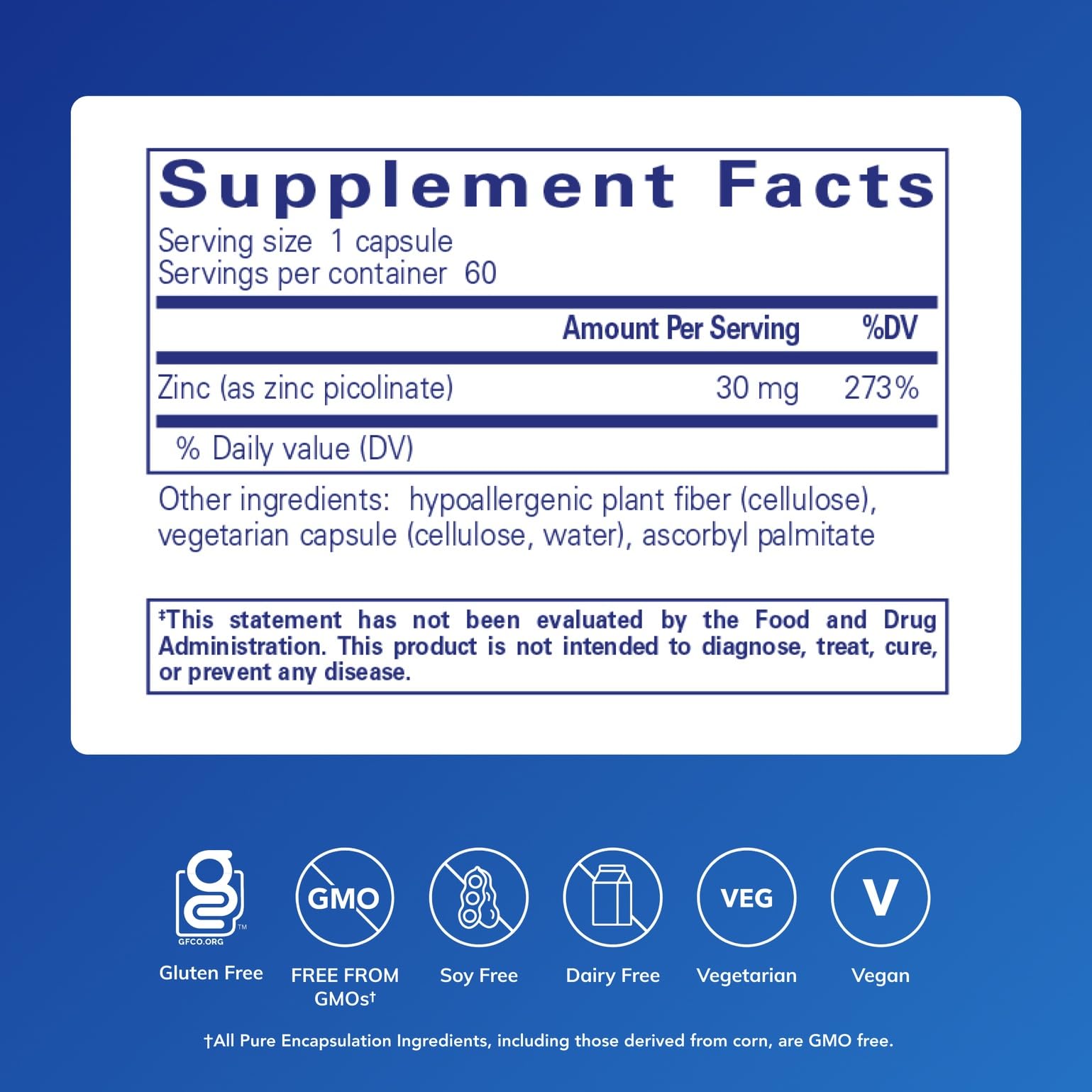
Zinc (as zinc picolinate)NHANES 2005 to 2016
About 15% of US adults
take in less zinc than the estimated average requirement.
Peer-reviewed analysisZinc (as zinc picolinate) is the lead active here, studied most for skin health. 4 human studies on Zinc (as zinc picolinate) back this formula, each one cited. Who it fits: skews toward men, adults.
 Verified by IngredientMD
The panel on the left is the one we evaluated, line by line.
All 1 actives checked against the clinical evidence: dose, form, and what the research actually shows.
Doses, ratios, and how the ingredients work together. That assessment is the verdict above: "Backed by human trials".
The verdict is public and identical whether or not a brand pays. A formula that does not clear the bar gets nothing.
Read by the engine against 2.1 million data points from clinical trials, PubMed and more than a hundred vetted sources. No individual reviewer is named or implied.
Cross-checked against 2 documented interactions for these actives.
Public health figures the engine matched to this formula's ingredients. Reported by their source, cited and dated, never written by the brand.
About 15% of US adults
take in less zinc than the estimated average requirement.
Peer-reviewed analysis35.1% of US adults
had at least one sunburn during the previous 12 months, in the 2024 National Health Interview Survey.
CDC National Center for Health Statistics, 202650% of US adults
said they have a very or somewhat consistent skin care routine, in a YouGov survey fielded in April 2024.
YouGov, 202446% of US women
said they use moisturizer at least once a day, in a YouGov survey fielded in April 2024.
YouGov, 20249% of US women
said they would spend more than $60 on a single skin care product, in a YouGov survey fielded in April 2024.
YouGov, 202429.0% of US women
aged 18 and older said they always use sunscreen when outside for more than one hour on a sunny day, in the 2020 National Health Interview Survey.
CDC National Center for Health Statistics, 202259 to 66 days
was the median time it took adults to make a new daily health habit automatic across the studies a 2024 review pooled, with individuals ranging from 4 to 335 days.
Systematic review and meta-analysis, 202461% to 74%
About 61 to 74 percent of adults refilling a long-term medicine on their own stopped within a year, versus 33 to 44 percent on one set pickup day.
Cohort study, 2015Systematic review, 2020
In a review of 28 studies on reduced taste sensitivity, zinc was one of the few options backed by controlled trial evidence of better taste perception.
Clinical oral investigationsRandomised trial, 1987
In a crossover trial of 15 adults, four weeks of zinc picolinate raised zinc levels in blood cells, hair and urine, while zinc gluconate, zinc citrate and a control did not.
Agents and ActionsSystematic review, 2026
A review of mineral supplements including zinc and picolinate salts reported changes in markers of insulin sensitivity in adults, and those markers are laboratory measures rather than clinical outcomes.
BMC Endocrine DisordersOpen-label trial, 2020
A yogurt trial found no detected absorption difference between iron bound to picolinate and iron sulfate, testing iron with picolinate as the binding molecule.
European Journal of NutritionPopulation figures from public health data. Context for the category, not a statement about any individual and not a claim about this product.
Each line below was derived from this formula's own record at the time of verification. Nothing here was written by the brand, and nothing can be added that the evidence does not carry.
Time-to-effect windows the engine read from the trial record. Each is a window a named study measured, cited and dated, never written by the brand.
In a controlled feeding study in nine healthy men, six weeks of restricted zinc intake raised DNA strand breaks in peripheral blood cells, and four weeks of repletion at 11 mg a day, with 20 mg of supplemental zinc for the first seven days, reversed the rise. In a separate randomised placebo-controlled trial in 40 Ethiopian women eating a high-phytate diet, 20 mg a day of zinc sulfate for 17 days lowered mean comet tail moment from 39.7 to 30.0 while plasma zinc did not change significantly. Both windows were measured on a DNA damage marker in blood cells, not on a symptom.
Windows measured in the cited trials. Context for how the active behaves over time, not a statement about any individual and not a claim about this product.
One ingredient, from its own page.
Nothing registers day to day. Where researchers looked, plasma zinc and taste sensitivity moved across two to twelve weeks of daily intake.
How each ingredient usually behaves over time, from its own page on IngredientMD. General timing for the ingredient, not a measurement of this product.
What each form is, and where it fits in a formula. Measured findings carry the study that reported them.
Zinc chelated to two molecules of picolinic acid, a metabolite of tryptophan, usually supplied as the dihydrate. It carries about 21 percent zinc by weight, is poorly soluble in water and is handled as a dry chelate powder rather than a solution ingredient.
The only human head-to-head involving this form is a 1987 double-blind, four-period crossover in 15 healthy volunteers, a foundational trial that has not been replicated with stable-isotope methods. Over four-week periods at 50 mg elemental zinc daily, hair, urine and erythrocyte zinc rose significantly during zinc picolinate (p < 0.005, p < 0.001 and p < 0.001) while zinc gluconate, zinc citrate and placebo produced no significant change in those markers, and serum zinc did not change significantly in any arm. In a later double-blind, placebo-controlled trial in 73 patients with idiopathic zinc-deficiency taste disorder at 29 mg zinc picolinate three times daily for three months, there was no significant difference from placebo in subjective symptoms or whole-mouth taste sensation, while filter-paper-disk testing and serum zinc both favoured the zinc group.
Descriptions of the form itself, read from the cited studies. Not a comparison between products and not a statement about any individual.
It is a capsule, so the amount per serving is fixed and travels without measuring.
Because the effect builds and holds only with continued daily use, a steady recurring supply is the practical way to keep it going.
Put an earned verification on your own product page.
These statements have not been evaluated by the Food and Drug Administration. This product is not intended to diagnose, treat, cure, or prevent any disease. This record is not medical advice. Always consult your healthcare provider before starting any supplement regimen.