17-Hydroxydocosahexaenoic Acid.
Your body makes it from DHA through a 15-lipoxygenase step. It's the committed first step toward the D-series resolvins and protectins, mediators that help resolve an inflammatory response.
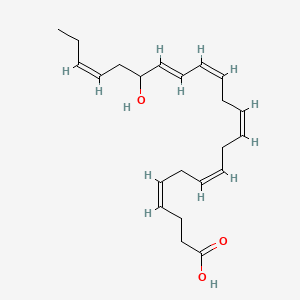 Compound
- Category
- Compound
What 17-Hydroxydocosahexaenoic Acid is, and what it does.
- Does it work
- Researchers measure it rather than sell it. It suits you to know about if you already take DHA, because your intake sets how much raw material this pathway has to work with.
- How much to take
- No daily figure is on record, and it isn't taken on its own. DHA from fish or algae oil supplies the pathway, so that's where a daily amount is meaningful.
- Time to feel it
- Nobody has timed an effect for this metabolite. Blood DHA climbs within days of steady intake and red cell status takes a couple of months to settle.
- The first dose
- Day one passes without a sensation. What does change is measurable: oxylipin panels pick up shifts in the hours after a DHA dose.
- With regular use
- Across weeks, steady DHA intake keeps circulating levels of this metabolite higher. It tracks DHA status closely, which is why research uses it as a handling marker.
- How well tolerated
- Your body makes it, so no separate tolerance record exists. It's unstable to air, light and heat, which is why isolated material is a lab standard rather than a capsule ingredient.
- How it feels
- No distinct feeling comes with it. Its presence is read on an oxylipin panel, or inferred from an omega-3 index result.
- The overlooked benefit
- Aspirin changes which mirror image you make. Acetylated COX-2 produces the 17R form, and that is the origin of the aspirin-triggered branch of this whole pathway.
The proof, claim by claim.
What these words mean
These words describe the research, not the molecule's worth. Research strength is how much work stands behind one claim, and it is never a product score.
- committed intermediate in D-series resolvin and protectin formationNarrative review
- circulating levels track DHA intake and statusRandomised trial
2 more claims
- aspirin-triggered 17R epimer formation by acetylated COX-2In vitro study
- resolution of inflammatory responses in animal modelsAnimal study
Why these belong in the same formula, 7 pairings
Why these belong in the same formula. Each row says what the basis is, from settled biochemistry through to a trial that measured the pair.
17-hydroxydocosahexaenoic acid is made from docosahexaenoic acid, so tissue DHA availability sets the ceiling on how much of it can be formed. Studies that raise DHA intake report parallel rises in circulating 17-HDHA. Nobody generates the oxylipin without the parent fatty acid being there first.
Fish oil supplies both DHA and EPA, and the same lipoxygenase machinery converts them into their respective hydroxy fatty acids. Measured plasma and erythrocyte oxylipin profiles shift within weeks of supplementation. What that shift means for any outcome is a separate question from whether it happens.
15-lipoxygenase, the enzyme that oxygenates DHA at carbon 17, is a non-heme iron enzyme and cycles between ferrous and ferric states during catalysis. Iron is structural to the enzyme rather than something extra iron intake would speed up. It belongs on this list as biochemistry, not as a reason to take more iron.
The immediate lipoxygenase product is the hydroperoxide 17-HpDHA, and selenium-dependent glutathione peroxidases reduce it to the stable alcohol 17-HDHA. Selenium status therefore sits on the pathway between the enzyme and the measured metabolite. This is established peroxide handling, not a demonstrated supplementation effect.
Glutathione is the reducing substrate that peroxidases consume when converting fatty acid hydroperoxides to their alcohols. Depleted glutathione leaves hydroperoxides to break down along non-enzymatic routes into reactive aldehydes instead. The relationship is upstream chemistry rather than a pairing anyone doses for.
DHA has six double bonds and oxidises readily without enzymes, producing a scatter of hydroxy and hydroperoxy isomers that are not the ones lipoxygenase makes. Alpha-tocopherol chain-breaks that autoxidation in the oil and in membranes. Fish oil products include it for exactly this reason.
EPA and DHA are handled by the same lipoxygenase and cyclooxygenase enzymes, giving 18-HEPE from EPA and 17-HDHA from DHA. Because they compete for the same catalytic sites, the ratio of the two fatty acids in the diet shapes which oxylipin family predominates. High-EPA and high-DHA oils therefore produce different metabolite profiles from the same total dose.
Nothing specific on file for 17-Hydroxydocosahexaenoic Acid. Match the label to the daily amount above, and tell your doctor what you take.
Not medical advice. Show the label to your pharmacist.What 17-Hydroxydocosahexaenoic Acid actually does.
17-HDHA is a compound made when an enzyme adds oxygen to DHA at a specific spot, forming an unstable intermediate that then gets turned into the stable form.
3 more mechanisms
It's a required stepping stone in the body's production of resolvins and protectins, two families of signaling molecules made from DHA.
Aspirin changes one enzyme so it makes a mirror-image version of this compound, which starts the aspirin-triggered branch of this pathway.
This molecule has several double bonds and breaks down easily with oxygen, light or heat, which is why it's used as a lab reference standard rather than sold in bulk.
Where 17-Hydroxydocosahexaenoic Acid comes from.
This is not something people buy in a bottle. It is a molecule your own body makes out of the DHA in fish or algae oil, and it is the first step on the way to a family of signalling molecules that help wind inflammation back down. In practice, the way to have more of it is to have more DHA.
What this route gives you
The same molecule is reached more than one way. Which route a given product used is a manufacturing choice, and the finished compound is the same either way.
5 steps on record
Sourced from marine oil or algal biomass for synthesis, or already present in body lipid pools for endogenous formation.
15-lipoxygenase, or acetylated cyclooxygenase-2 in the aspirin-triggered route, inserts oxygen at carbon 17 to give the hydroperoxide.
Glutathione peroxidases reduce 17-HpDHA to the stable 17-HDHA alcohol.
Reference material is made by total or semi-synthesis and purified by preparative chromatography under inert conditions.
Supplied as a dilute solution under argon at minus 80 degrees Celsius for analytical use.
The forms it comes in.
3 more forms
The essence, in one line each.
- In a study of older adults, men and Hispanic participants with a diagnosed cognitive condition had lower levels of hydroxydocosahexaenoic acids on their high-density lipoprotein (HDL) than their counterparts without the condition.Case-control, in older (70+) adults with or without mild cognitive impairment. Kelliher JC et al., 2026 (Journal of Lipid Research). PMID 41831526 ↗
2 more findings
- 15-lipoxygenase products were incorporated into glycerophospholipids in a substrate-dependent way, showing where these oxylipins are stored rather than released.In vitro study. Carpanedo L et al., 2025 (Journal of Lipid Research). PMID 40523624 ↗
- Oxygenated metabolites of docosahexaenoic acid and arachidonic acid altered contractility in cultured cardiac cells, a mechanistic observation in tissue.Animal study. Kawakami H et al., 2026 (Journal of Artificial Organs). PMID 41933083 ↗
Chosen from the 4 we read for 17-Hydroxydocosahexaenoic Acid.
FDA Disclaimer: These statements have not been evaluated by the Food and Drug Administration. This information is for educational purposes only and is not intended to diagnose, treat, cure, or prevent any disease. Consult your healthcare provider before starting any supplement regimen.