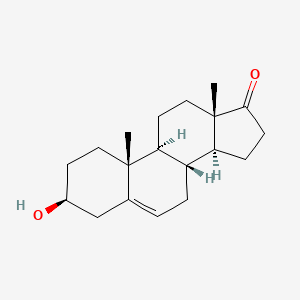
5-androsten-3beta-ol-17-one.
This is DHEA, the adrenal steroid your tissues convert into small amounts of testosterone and oestrogen. Levels peak in your twenties and drift down from there.
 Compound
- Category
- Compound
What 5-androsten-3beta-ol-17-one is, and what it does.
- Does it work
- Suits adults curious about the age-related decline in this steroid, working with a clinician who can measure it. Blood testing before and during is the sensible route.
- How much to take
- No dose figure is on record. It's a hormone precursor, so the daily amount belongs to a clinician reading your bloodwork rather than to a label.
- Time to feel it
- Circulating steroid markers shift within weeks. Anything a person notices sits further out than that, and it varies a lot from one person to the next.
- The first dose
- Day one is quiet for most people. The first measurable change is in circulating steroid levels, not in how you feel.
- With regular use
- Weeks of daily use raise circulating DHEA sulfate and its downstream steroids. How far that carries depends on which enzymes your own tissues express.
- How well tolerated
- It's a hormone precursor, not a vitamin. Anyone on hormone medication, or in tested sport, should check with a doctor first.
- How it feels
- Most people report no distinct sensation. Where anything registers, it's a gradual shift in drive or mood across weeks, and reports differ widely.
- The overlooked benefit
- Almost all of it circulates as the sulfate ester, which lasts far longer in blood than the free steroid. That's why one morning blood draw reads your level reliably.
The proof, claim by claim.
What these words mean
These words describe the research, not the molecule's worth. Research strength is how much work stands behind one claim, and it is never a product score.
- Circulating androgen and oestrogen levels in older adultsRandomised trial
- Bone mineral density in later lifeRandomised trial
3 more claims
- Skin hydration and thickness in older adultsRandomised trial
- Mood steadiness and wellbeing scoresRandomised trial
- Age-related decline in adrenal steroid outputCohort study
Why these belong in the same formula, 9 pairings
Why these belong in the same formula. Each row says what the basis is, from settled biochemistry through to a trial that measured the pair.
Pregnenolone sits directly upstream: CYP17A1 converts it through 17-hydroxypregnenolone to this compound. Supplying the upstream steroid feeds the same branch of the pathway from one step earlier. Where the carbon actually goes depends on which downstream enzymes a given tissue expresses, so upstream dosing does not predict the downstream product.
This steroid can be aromatised into oestrogens in peripheral tissue, and DIM shifts oestrogen metabolism toward the 2-hydroxy route through CYP1A1 induction. That is why the two appear together in male-oriented formulations. The effect is on the metabolic split of oestrogen, and it is measured as urinary metabolite ratios rather than as an outcome.
Steroid hormones are cleared largely as glucuronide conjugates, and calcium D-glucarate inhibits beta-glucuronidase, the bacterial enzyme that cuts those conjugates apart in the gut and allows reabsorption. The combination is used with the intention of increasing net steroid clearance. The mechanism is well described. Human data on the pairing is not.
Glycyrrhizin inhibits 11-beta-hydroxysteroid dehydrogenase type 2, altering cortisol handling and, at sustained intake, causing potassium loss and higher blood pressure. Stacking it with an adrenal steroid precursor means acting on two points of the same axis at once. This one belongs in the caution column.
Small human studies have reported shifts in sex hormone binding globulin and in the free fraction of circulating androgens with boron supplementation. A change in binding protein alters how much of a hormone is unbound, which is a laboratory measure rather than a demonstrated effect. The studies are small and the finding is not settled.
Several steroidogenic and steroid-metabolising enzymes are zinc-dependent, and marked zinc deficiency lowers androgen production. Correcting a deficiency is not the same as adding zinc on top of adequate status. The relationship applies at the deficient end of the range.
Ashwagandha has been studied for its effects on cortisol measures, and this steroid is itself an adrenal product whose ratio to cortisol is often what gets reported. Combining them means two agents acting on the same axis from different directions. Any joint effect is on hormone measurements, and it has not been tested as a combination.
Both derive from cholesterol and both act through nuclear receptor signalling, and the two are frequently co-measured in ageing research. Shared ancestry in a biosynthetic tree is not a functional interaction. Read this as background context rather than a reason to combine them.
Magnesium has been reported in small studies to reduce binding of testosterone to sex hormone binding globulin, raising the free fraction. That is a change in a laboratory measure with limited replication. It is not a reason to expect a downstream effect.
Nothing specific on file for 5-androsten-3beta-ol-17-one. Match the label to the daily amount above, and tell your doctor what you take.
Not medical advice. Show the label to your pharmacist.What 5-androsten-3beta-ol-17-one actually does.
This is the chemical name for DHEA, a steroid hormone made mainly by a layer of the adrenal glands.
3 more mechanisms
The body builds it from another steroid precursor through an enzyme that both adds a hydroxyl group and snips off a small side chain.
Most of what circulates in blood is a sulfate-bound form that lasts much longer than the free hormone and acts as a storage reservoir, with enzymes converting back and forth between the two forms.
It's more a building block than a hormone that's active in its own right: tissues around the body convert it step by step into testosterone and estrogens locally, a process called intracrinology.
Where 5-androsten-3beta-ol-17-one comes from.
It starts as a compound in wild yam or soy, but the hormone itself is built in a factory through several chemical steps. Eating the plant does not produce it, and neither does taking a wild yam supplement.
What this route gives you
Chemically synthesised. The molecule is identical to the one a plant or an animal makes, and building it deliberately means a known purity, a fixed dose and no crop contaminants. For several nutrients this is the only route that reaches a usable amount.
6 steps on record
Wild yam saponins or soy sterols supply the steroid nucleus. The plant provides a scaffold, not the finished hormone.
Diosgenin is converted through the classic Marker degradation to 16-dehydropregnenolone acetate. Alternatively, microbial fermentation cleaves the phytosterol side chain to give androstenedione-type intermediates.
The intermediate is carried forward by chemical steps to dehydroepiandrosterone, including the reduction and functional group changes needed at C17 and C3.
Recrystallised to pharmaceutical purity, with control of related steroid impurities such as androstenedione and testosterone, since these are the impurities that matter both pharmacologically and for anti-doping testing.
Identity and purity by HPLC or GC against a reference standard, with a related-substances specification.
Micronised for oral dosage forms, or dispersed in a base for topical and vaginal preparations.
The forms it comes in.
2 more forms
The essence, in one line each.
- Dehydroepiandrosterone and allopregnanolone reduced apoptosis in cultured sympathoadrenal medulla cells through antiapoptotic signalling. This is cell culture pharmacology at defined concentrations, not evidence of an effect from supplementation.In vitro study. Charalampopoulos I et al., 2004 (PNAS). PMID 15148390 ↗
Chosen from the 1 we read for 5-androsten-3beta-ol-17-one.
FDA Disclaimer: These statements have not been evaluated by the Food and Drug Administration. This information is for educational purposes only and is not intended to diagnose, treat, cure, or prevent any disease. Consult your healthcare provider before starting any supplement regimen.