Boron.
The forgotten trace mineral. Bones, testosterone, brain. Supports bone metabolism, may increase free testosterone, helps metabolize vitamin D and magnesium, possible cognitive benefits.
Reviewed March 2026
- Category
- Mineral
- Also filed under
- BonesTestosteroneJoints
What Boron is, and what it does.
- Does it work
- Useful if your intake is low or for specific goals like testosterone support. Not needed if diet is already rich in fruits and vegetables.
- How much to take
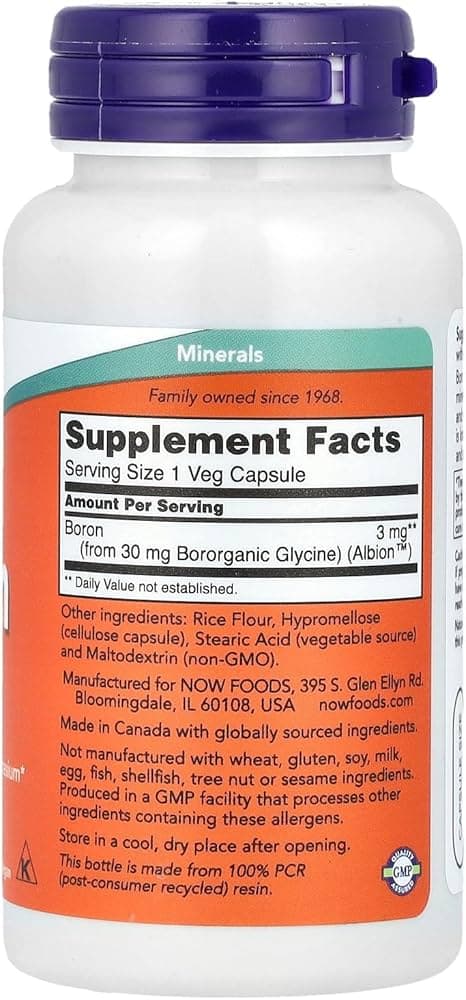
- 3-10mg daily. Studies on testosterone use 6-10mg.
- Time to feel it
- Within about six hours of a single dose.
- The first dose
- Nothing you'd feel. Boron is absorbed almost completely within hours and plasma tracks it straight away, so day one is a measured change rather than a sensation.
- With regular use
- Potential improvements in hormone levels, bone density, and possibly cognition.
- How well tolerated
- Well tolerated at recommended doses. Upper limit is 20mg daily.
- How it feels
- Subtle. Some men report better energy or libido after weeks of use.
- The overlooked benefit
- Because boron isn't stored, a stretch of meals light on fruit, nuts and vegetables moves your boron status faster than it moves most other minerals.
3 to 10mg a day is where Boron works.
Source: NIH + Naghii 2011 + Nielsen 2014 review
Eight healthy male volunteers took a placebo capsule with breakfast on one day and a capsule containing 10 mg of boron on the next, with blood drawn every two hours for six hours on both days. Plasma boron rose significantly, and at six hours sex hormone binding globulin, high sensitivity C-reactive protein and tumour necrosis factor alpha had all fallen significantly. This is one small study of eight men with the placebo day fixed before the boron day rather than randomised, and the measures are blood markers rather than any bone or strength outcome.
The proof, claim by claim.
These words describe the research, not the molecule's worth. Research strength is how much work stands behind one claim, and it is never a product score.
Based on 20 human trials with 60% consistency.
- Urinary calcium and magnesium retention markersRandomised trial
- Bone mineral supportNarrative review
- Testosterone already in the normal rangeRandomised trial
- Vitamin D metabolite concentrationsRandomised trial
- Cognitive performance measures at low intakeRandomised trial
- A healthy inflammatory responseNarrative review
Questions people ask about Boron.
- When should I take it?
- With food, ideally a meal containing some fat for better absorption. Morning or evening, pick one and stick with it.
- How long until I notice something?
- If you're deficient, you might notice within 1-2 weeks. For general maintenance, give it 4-8 weeks.
- Can I get enough from food?
- Sometimes. If your diet is solid and varied, you might not need to supplement. But deficiency is more common than most people think. A blood test is the only way to know for sure.
- Can I take too much?
- Yes. More isn't better with minerals. Stick to the recommended dose. High doses can compete with other minerals for absorption.
- Can I take it with other supplements?
- Usually fine. The main thing to watch is not doubling up on the same ingredient from different products. If you're on prescription meds, check with your pharmacist first.
- Who benefits most from this?
- People with a specific, evidence-backed need. Boron has strong research. If your situation matches the studied use case, it's one of the more reliable supplements you can take.
Why these belong in the same formula. Each row says what the basis is, from settled biochemistry through to a trial that measured the pair.
Boron influences how the body retains calcium, and early metabolic studies found it lowered the amount lost in urine, so more stays available for normal bone mineral metabolism. That shared role in bone is why the two minerals are so often paired in a formula.
Boron appears to reduce how much magnesium is lost in urine, and its effect on mineral balance grows more pronounced when magnesium intake is low, so the body tends to handle the two together. Magnesium supports the same bone and mineral processes boron influences.
Boron is reported to slow the hydroxylation and clearance steps that remove vitamin D metabolites, so circulating 25-hydroxyvitamin D tends to sit higher on the same intake. The pair is standard in bone formulas for that reason.
K2 carboxylates osteocalcin so mineral is directed into bone matrix, while boron acts on how much calcium and magnesium are retained rather than excreted. They work on separate halves of normal bone mineral turnover.
Silicon supports the collagen and glycosaminoglycan scaffold that mineral is laid down onto, and boron acts on the mineral side of that same scaffold.
Copper-dependent lysyl oxidase forms the cross-links that give bone collagen its tensile strength. Boron works on mineral retention in the same tissue, so the two cover matrix and mineral together.
Manganese is the metal cofactor for the glycosyltransferases that build cartilage and bone glycosaminoglycans, a step boron does not touch.
Zinc is the metal at the active site of bone alkaline phosphatase and supports normal steroid hormone production. Boron sits on the same axis by lowering sex hormone binding globulin, which raises the free hormone fraction.
Borate binds the cofactor site of S-adenosylhomocysteine hydrolase, which slows the step that clears the product of every SAM-e methyl transfer. That places boron on the methylation cycle SAM-e feeds.
Ascorbate has adjacent hydroxyls that borate can esterify reversibly, the same chemistry that lets borate bind sugars and nucleotides. In a dry blend nothing happens. In solution a fraction of both species exists as the complex. This is chemistry described in the solution phase and it has not been shown to change how much of either nutrient a person absorbs.
Inositol is a cyclitol with several cis-diol pairs, and borate binds polyols of that shape reversibly, which is why polyol-borate complexes are a standard part of borate solution chemistry. The practical relevance sits at the formulation level, in liquids and syrups where pH and water activity allow the complex to form. No human absorption consequence should be read into it.
Aminosugars carry the hydroxyl arrangement borate esterifies, so borate and glucosamine can associate in solution. Both are also used in products aimed at joint comfort and mobility, which is why the pair turns up together on labels. The overlap in use is a formulation fact. The chemistry is a solution interaction and neither one is evidence that the two act together in the body.
Boron influences how the kidney handles calcium and magnesium, and strontium is a divalent cation handled by the same bone mineral machinery that takes up calcium. Products built around supporting normal bone mineral density often carry both. The connection is a shared handling pathway inferred from mineral physiology rather than a tested combination, and strontium is measured by its incorporation into bone mineral, a marker rather than an outcome.
Bone mineral is a calcium phosphate lattice, and boron sits upstream of that lattice through its effect on calcium and magnesium retention and on the steroid and vitamin D metabolites that regulate them. Animal work on boron and bone measures mineral and enzyme endpoints alongside dietary phosphorus. Read this as two inputs to the same mineral pool, not as a demonstrated combined effect in people.
The ribose rings in NAD present cis-hydroxyls that borate binds, which is the classical explanation for borate inhibition of some dehydrogenases in vitro. That is enzyme chemistry measured in a tube at borate concentrations well above dietary intakes. It grounds a mechanism and says nothing about what happens at the microgram to low milligram boron intakes people actually take.
Borate crosslinks polysaccharide chains through hydroxyl esterification, the same chemistry that holds plant cell wall pectin together through rhamnogalacturonan II. Hyaluronan is a hydroxyl-rich polysaccharide, so the interaction is chemically plausible and shows up in gel and viscosity work. Nothing here bears on ingested hyaluronan or on joint tissue in a person.
Nothing specific on file for Boron. Match the label to the daily amount above, and tell your doctor what you take.
Not medical advice. Show the label to your pharmacist.What Boron actually does.
In your gut and blood, boron is almost entirely boric acid, a small uncharged molecule that crosses membranes easily. Borate salts all turn into it, so absorption is close to complete.
Boric acid grabs reversibly onto pairs of neighbouring hydroxyl groups, the kind found on sugars, ribose, vitamin C and flavins. That one piece of chemistry explains most of what boron gets linked to in biology.
Boron is not stockpiled in any real way. It spreads through your body water and the kidneys clear it, so blood levels track what you took recently and drop off quickly when you stop.
In plants boron is structural: it crosslinks pectin in the cell wall. That is why it counts as a plant nutrient, and why plant studies of boron read very differently from mammal ones.
Where Boron comes from.
Boron comes out of the ground as a borate mineral from ancient dried lake beds. It gets dissolved, cleaned up and recrystallised, then usually joined to an organic acid or an amino acid to make the version on the label. Whichever version you take, your gut ends up with the same simple boron compound.
From a mineral source, then refined and usually bound to a carrier so the body can take it up.
Evaporite borate minerals, principally tincal (sodium borate) and colemanite (calcium borate), mined from dried lake beds and marine evaporite deposits.
The ore is dissolved, filtered free of clay and insolubles, then crystallised as borax or converted with acid to boric acid.
Repeated crystallisation lowers heavy metal and insoluble residue, which is where a food-grade specification is actually earned.
Refined boric acid or borate is reacted with an organic acid or an amino acid, giving citrate, aspartate, glycinate or fructoborate materials, then dried.
Milled and assayed to a stated elemental boron percentage, since every form is dosed on elemental boron rather than on total salt mass.
Which ore and which region a given batch came from is rarely stated on a label, and the organic acid partner in a chelate may be sourced separately.
Getting Boron from food.
The whole-food sources on file. A supplement closes the gap, it does not replace dinner.
A gram-for-gram figure (how much of each you would eat to match a dose) will appear here once it is sourced and reviewed. This page will not print a number it cannot cite.
The forms it comes in.
Same mineral in different salts. Each is its own molecule with its own page, and absorption and feel differ from one to the next.
See all 2 forms
The essence, in one line each.
- Across 11 human studies covering 594 people, 3 mg of boron a day supported bone mineral density through its effects on calcium, vitamin D and sex steroid hormone metabolism.Narrative review. Rondanelli et al., 2020 (Journal of Trace Elements in Medicine and Biology). PMID 32540741 ↗
- In eight healthy men, one week of 10 mg boron a day raised average plasma free testosterone and lowered estradiol, alongside reductions in the inflammatory markers hsCRP and TNF-alpha.Human supplementation study. Naghii et al., 2011 (Journal of Trace Elements in Medicine and Biology). PMID 21129941 ↗
- Calcium fructoborate, a natural boron complex, lowered blood levels of the inflammatory marker C-reactive protein across human studies.Review. Scorei and Scorei, 2013 (Biological Trace Element Research). PMID 23982445 ↗
- In 113 female university students, 10 mg a day of boron taken from two days before menstrual flow through its third day lowered rated menstrual pain and shortened how long it lasted compared with placebo across two cycles.Randomised trial. Nikkhah et al., 2015 (Complementary Therapies in Clinical Practice). PMID 25906949 ↗
- A double-blind placebo-controlled trial in which the authors reported effects of boron supplementation on the trial's urinary and mineral measures. Those are laboratory measures, not a clinical endpoint.Randomised trial. Vousoughi G et al., 2025 (Food Science & Nutrition). PMID 40792045 ↗
- Dietary boron altered bone, antioxidant and immune status measures in heifers, as reported by the authors.Animal study. Behari B et al., 2026 (Tropical Animal Health and Production). PMID 42420633 ↗
- Boron added to close-up rations was associated with changes in colostrum quality measures and certain blood metabolites.Animal study. Celik C et al., 2025 (Biological Trace Element Research). PMID 39422828 ↗
- Proteomic profiling of rat duodenum found boron supplementation shifted the abundance of immune-related proteins. Protein abundance is a marker.Animal study. Zhao C et al., 2023 (Genes). PMID 37628612 ↗
- Dietary boron was reported to change testicular function measures and thyroid activity indices in male goats.Animal study. Abdel-Wahab A et al., 2022 (Reproduction in Domestic Animals). PMID 35864721 ↗
- Boron supplementation affected laying performance in hens, with the effect differing by the adequacy of another dietary mineral.Animal study. Adarsh V et al., 2021 (Tropical Animal Health and Production). PMID 34420099 ↗
- Dietary boron was reported to influence performance, egg quality and physiological response measures in late-laying hens.Animal study. Uysal S et al., 2026 (Biological Trace Element Research). PMID 42406331 ↗
These are the studies our verdict leans on, chosen from the 109 we read for Boron. The full linked list is below.
Problems people have reported.
Read this carefully. These are 1,364 voluntary, unverified reactions reported to the FDA (openFDA). The number mostly reflects how popular Boron is, not how risky it is. A report is not proof Boron caused anything. It is a signal of what to watch for, nothing more.
Source: openFDA adverse-event reports. Voluntary reporting, not an incidence rate.
FDA Disclaimer: These statements have not been evaluated by the Food and Drug Administration. This information is for educational purposes only and is not intended to diagnose, treat, cure, or prevent any disease. Consult your healthcare provider before starting any supplement regimen.