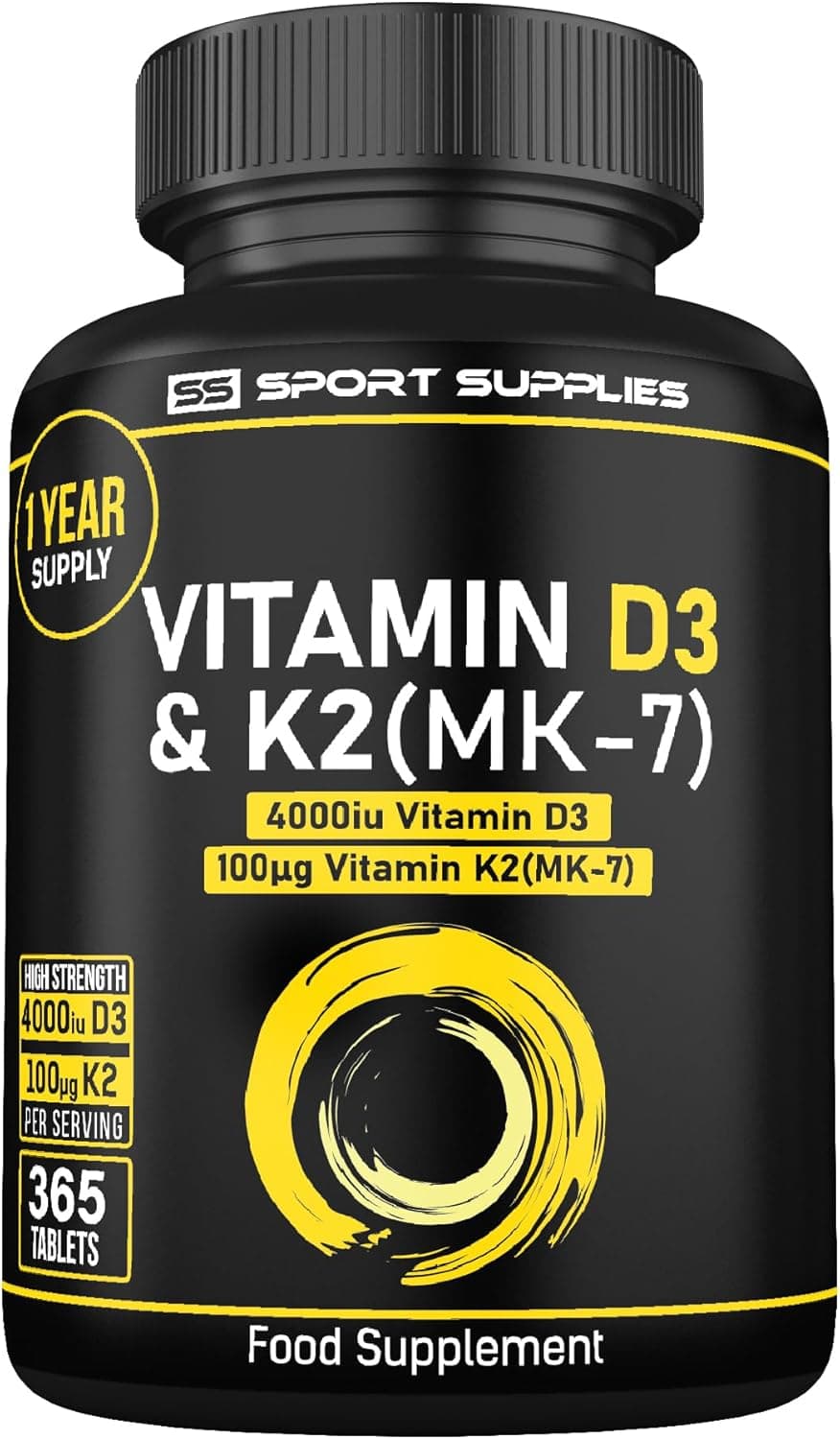
Vitamin K2 (MK-7).
Calcium traffic cop. Directs calcium to bones, away from arteries. Activates the proteins that let calcium bind where it belongs, in bone matrix rather than soft tissue, and supports normal clotting. One daily dose covers a lot of ground.
Reviewed March 2026
- Category
- Vitamin
- Also filed under
- Bone healthCardiovascularCalcium metabolism
What Vitamin K2 (MK-7) is, and what it does.
- Does it work
- Suits anyone taking vitamin D or calcium and anyone building a bone routine. People on anticoagulant medication need their prescriber's steer before starting.
- How much to take
- Start with 100 to 200mcg a day of MK-7, taken with a meal that contains fat. That band keeps carboxylation markers moving day to day.
- Time to feel it
- Four to twelve weeks for undercarboxylated osteocalcin to shift. It is a blood marker of carboxylation rather than something that registers as a sensation.
- The first dose
- Day one is quiet. It's absorbed with your meal's fat and into circulation within hours, then rides on lipoproteins for days rather than clearing overnight.
- With regular use
- Months of daily use keep more osteocalcin and matrix Gla protein in their calcium-binding form. Bone and arterial measures are read over a year or more.
- How well tolerated
- Well tolerated at usual amounts. Anyone taking a vitamin K antagonist anticoagulant must keep intake steady and clinician-supervised, since it acts on the same enzyme.
- How it feels
- No sensation to report. What changes is a carboxylation marker on a blood panel and, over years, what a bone density scan shows.
- The overlooked benefit
- Taken on an empty stomach, much of it goes unabsorbed. Bile and dietary fat are required, so the meal you pair it with changes how much actually gets in.
100 to 200mcg a day is where Vitamin K2 (MK-7) works.
Source: Knapen 2013 + Geleijnse 2004 Rotterdam study
The proof, claim by claim.
These words describe the research, not the molecule's worth. Research strength is how much work stands behind one claim, and it is never a product score.
Vitamin K2 (MK-7) has solid evidence, with 16 cited human studies on this page.
- undercarboxylated osteocalcin statusRandomised trial
- carboxylated matrix Gla protein statusRandomised trial
- bone mineral density maintenanceRandomised trial
- arterial stiffness measuresRandomised trial
- long circulating half-life on lipoproteinsRandomised trial
Questions people ask about Vitamin K2 (MK-7).
- When should I take it?
- With food, ideally a meal containing some fat for better absorption. Morning or evening, pick one and stick with it.
- How long until I notice something?
- If you're deficient, you might notice within 1-2 weeks. For general maintenance, give it 4-8 weeks.
- Can I get enough from food?
- Sometimes. If your diet is solid and varied, you might not need to supplement. But deficiency is more common than most people think. A blood test is the only way to know for sure.
- Can I take too much?
- Water-soluble vitamins (B, C) are harder to overdose on since you pee out the extra. Fat-soluble ones (A, D, E, K) can build up. Stick to recommended doses unless a doctor says otherwise.
- Can I take it with other supplements?
- Usually fine. The main thing to watch is not doubling up on the same ingredient from different products. If you're on prescription meds, check with your pharmacist first.
- Who benefits most from this?
- People with a specific, evidence-backed need. Vitamin K2 Mk7 has strong research. If your situation matches the studied use case, it's one of the more reliable supplements you can take.
Why these belong in the same formula. Each row says what the basis is, from settled biochemistry through to a trial that measured the pair.
Vitamin D3 raises calcium absorption and drives production of osteocalcin and matrix Gla protein, and MK-7 supplies the carboxylation step those proteins need to bind calcium. The two act on opposite ends of the same calcium-handling pathway, which is why they are formulated together.
Carboxylated osteocalcin is the protein that binds calcium into the bone matrix, and MK-7 is the cofactor for that carboxylation. Calcium supplies the mineral and MK-7 supports where the body directs it.
Magnesium is the cofactor for the hydroxylases that activate vitamin D, and active vitamin D drives the Gla protein expression MK-7 carboxylates. It sits upstream on the same sequence rather than duplicating any step.
MK-7 is one menaquinone among several, and it differs from MK-4 mainly in side-chain length, lipoprotein binding and half-life. Formulas often pair the fast-acting MK-4 with the persistent MK-7.
Phylloquinone is taken up mostly by liver and cleared in hours, while MK-7 stays in circulation for days and reaches bone and vessel wall. Carrying both covers the full spread of vitamin K-dependent carboxylation.
MK-7 acts through the identical carboxylase and epoxide reductase cycle that defines vitamin K activity. Total intake across vitamers is what the cycle sees.
High alpha-tocopherol intakes interfere with menaquinone absorption and with the carboxylase cycle, which adds to effects on normal clotting. It is a genuine dose-dependent anti-synergy worth stating.
MK-7 is more lipophilic than phylloquinone and depends on bile salts and dietary fat for micellar uptake. An oil base raises the absorbed fraction and is standard in MK-7 softgels.
Vitamin D raises calcium absorption and induces osteocalcin and matrix Gla protein, and MK-7 supplies the carboxylation that lets those proteins bind calcium. The pairing is the most common reason MK-7 appears in a formula at all.
Menaquinone-7 and ubiquinone are both quinones carrying a long polyisoprenoid tail assembled from the same prenyl pyrophosphate pool. That shared chemistry is why the two behave alike in a softgel: both partition into the oil phase and both travel on lipoproteins after a meal containing fat. The overlap is structural and pharmacokinetic, not a demonstrated combined clinical effect.
Natto fermentation produces menaquinone-7 and the fibrinolytic enzyme nattokinase in the same broth, which is why the two appear together in products built on a natto platform. The link is provenance rather than a measured interaction between them. Anyone using either alongside blood-thinning medication should be under clinician supervision, since vitamin K and fibrinolytic enzymes act on opposite sides of clot chemistry.
Menaquinone-7 is strongly lipophilic and reaches the enterocyte only after bile salts and phospholipids emulsify it into mixed micelles. Lecithin supplies phosphatidylcholine that participates in that micellar phase, which is why powdered vitamin K preparations are often co-formulated with it. The effect is on delivery, not on vitamin K activity itself.
Phosphatidylcholine is the phospholipid that carries fat-soluble vitamins through the mixed-micelle step and into chylomicrons. Menaquinone-7 then circulates on triglyceride-rich lipoproteins, which is one reason its plasma residence is longer than that of shorter-chain menaquinones. This is delivery chemistry and says nothing about a joint clinical outcome.
Krill oil carries a large phospholipid fraction alongside its fatty acids, so it provides both the fat and the emulsifier that menaquinone-7 absorption depends on. Formulators use it as a single-ingredient carrier. The rationale is absorption chemistry rather than a measured combination.
Retinol and menaquinone-7 both depend on bile salt micelles and overlapping enterocyte lipid transporters, so very large doses of one fat-soluble vitamin can reduce the uptake of another taken at the same moment. At the amounts used in ordinary multivitamins this competition is generally minor. It is worth knowing when a high-dose retinol product and a vitamin K product are taken with the same meal.
Colonic bacteria produce a mixture of menaquinones, and part of the body's vitamin K pool has microbial origin. How much of that colonic menaquinone is actually absorbed remains uncertain, because the colon has little bile salt and limited lipid absorption capacity. Regard the pairing as mechanistic support for the endogenous pool, not a substitute for the ingested vitamin.
Several lactic acid bacteria generate menaquinones during fermentation, which is why fermented dairy and vegetable foods carry measurable vitamin K2. In a supplement the contribution from a live culture is far smaller than the dose in the capsule. The row records a real biosynthetic capability rather than a clinical additive effect.
Fermentable fibre feeds the colonic community that produces menaquinones, so a prebiotic can change the composition of that endogenous pool. The size of the change in circulating vitamin K status has not been established. Read this as a plausible modulating link rather than a measured one.
Menaquinone-7 supports the carboxylation of osteocalcin, a bone matrix protein, while boron is studied in the handling of calcium and magnesium in bone tissue. The two are frequently combined in bone formulas on that reasoning. No combination trial supports a joint effect, so the confidence stays low.
Strontium incorporates into the hydroxyapatite lattice in place of calcium, and it also inflates bone densitometry readings because it is denser than calcium. Menaquinone-7 acts earlier in the sequence, on the carboxylation of matrix proteins. Anyone combining them should know the density reading is a marker distorted by strontium, not an outcome.
Alkaline phosphatase is a zinc metalloenzyme active in mineralising tissue, and osteocalcin carboxylation by vitamin K happens in the same osteoblast. The two nutrients touch different steps of one process. The link is cofactor biochemistry, not a trial of the combination.
Talk to a doctor before taking Vitamin K2 (MK-7) if any of these apply to you: a blood thinner. These are flags to check first, not effects Vitamin K2 (MK-7) is known to cause.
Not medical advice. Show the label to your pharmacist.What Vitamin K2 (MK-7) actually does.
Vitamin K is the helper molecule an enzyme needs to add a chemical tag to certain proteins, and that tag is what lets those proteins bind calcium.
Osteocalcin and matrix Gla protein need that vitamin K dependent tag to bind calcium, which is why the untagged form is used as a marker of vitamin K status rather than as a result in itself.
Each time that tagging happens, vitamin K gets converted to a used-up form, which another enzyme recycles back so the same molecule can be reused many times.
MK-7 has a longer tail than the plant form of vitamin K, which makes it more fat-loving, lets it travel with LDL cholesterol, and keeps it circulating in the body for much longer.
Where Vitamin K2 (MK-7) comes from.
Vitamin K2 as MK-7 is made either by the same bacteria that ferment natto, a traditional Japanese soybean food, or by building the molecule chemically. Either way it is purified and checked for the correct shape, because only one shape works in the body. It ends up dissolved in an oil for softgels or dried into a powder for capsules and tablets.
The same molecule is reached more than one way. Which route a given product used is a manufacturing choice, and the finished compound is the same either way.
The fermentation route starts from a cooked legume substrate, historically soybean and increasingly chickpea for allergen reasons. The synthetic route starts from a naphthoquinone head and an isoprenoid side-chain precursor.
In fermentation the organism makes menaquinone-7 as part of its own respiratory chain over a controlled multi-day run. In synthesis the side chain is coupled to the quinone head under conditions chosen to favour the all-trans geometry.
MK-7 is lipophilic, so it is taken up into an organic solvent phase away from the aqueous broth or the spent reagents.
Crystallisation and chromatographic steps remove fermentation lipids, residual substrate protein and, in the synthetic route, the cis isomer.
Each lot is assayed for total MK-7 and for the all-trans fraction, since only the all-trans geometry carries the vitamin activity.
The purified material is either dissolved into an edible oil for softgels or built into a protective matrix for dry blends, with light and alkalinity controlled in both.
Getting Vitamin K2 (MK-7) from food.
The whole-food sources on file. A supplement closes the gap, it does not replace dinner.
A gram-for-gram figure (how much of each you would eat to match a dose) will appear here once it is sourced and reviewed. This page will not print a number it cannot cite.
The forms it comes in.
The essence, in one line each.
- Pooling 16 randomized trials in postmenopausal women (6,425 subjects), vitamin K2 supplementation maintained and improved lumbar spine bone mineral density and lowered undercarboxylated osteocalcin levels.Meta-analysis. Ma et al., 2022 (Frontiers in Public Health). PMID 36033779 ↗
- In 244 healthy postmenopausal women, three years of 180 micrograms per day of MK-7 lowered carotid-femoral pulse wave velocity and the stiffness index, and reduced inactive matrix Gla protein by about 50 percent versus placebo.Randomised trial. Knapen et al., 2015 (Thrombosis and Haemostasis). PMID 25694037 ↗
- In 42 healthy adults, daily MK-7 at nutritional doses around the RDA increased the carboxylation of circulating osteocalcin and matrix Gla protein, with no adverse effect on thrombin generation.Randomised trial. Theuwissen et al., 2012 (British Journal of Nutrition). PMID 22289649 ↗
- Across nine trials in 2,570 older women with low bone mass, vitamin K2 raised osteocalcin (mean difference 1.86) and lowered undercarboxylated osteocalcin (-1.54), markers of how bone protein is activated rather than measured bone outcomes.Meta-analysis. Zhang et al., 2025 (Frontiers in Endocrinology). PMID 41268154 ↗
- Pooled trials in middle-aged and older adults found vitamin K supplementation raised lumbar spine bone mineral density (p = 0.035) and shifted osteocalcin toward its carboxylated form, with no measurable change in other bone markers.Meta-analysis. Xie et al., 2024 (Bone and Joint Research). PMID 39657786 ↗
- In 71 young and older adults, 12 weeks of 240 micrograms MK-7 daily did not change muscle strength, physical function, soreness or the inflammatory response after muscle-damaging resistance exercise, though creatine kinase at 72 hours was lower in the older adults taking it.Randomised trial. Lithgow et al., 2026 (Medicine and Science in Sports and Exercise). PMID 41843412 ↗
- Across six mostly observational Japanese studies covering 2,327 people, habitual natto eaters had higher serum MK-7 (d = 2.10), less undercarboxylated osteocalcin (d = -0.50) and modestly higher bone mineral density (d = 0.35), an association rather than a tested effect.Systematic review. Wen et al., 2025 (Frontiers in Nutrition). PMID 41393956 ↗
- In older adults reporting night-time leg cramps, the trial reported fewer cramp episodes on vitamin K2 than on placebo.Randomised trial. Tan et al., 2024 (JAMA Internal Medicine). PMID 39466236 ↗
- A narrative review setting out the proposed mechanisms linking vitamin K to normal muscle tissue, and describing the clinical evidence as still developing.Narrative review. Ran et al., 2026 (Frontiers in Nutrition). PMID 41835384 ↗
- A systematic narrative review of vitamins generated by microorganisms in fermented foods, including menaquinone production and its contribution to human vitamin status.Systematic review. Keyvan et al., 2025 (Frontiers in Nutrition). PMID 41127087 ↗
- A multicentre randomised trial of menaquinone-7 with arterial stiffness, a vascular marker, as the measured endpoint in adults receiving long-term haemodialysis.Randomised trial. Naiyarakseree et al., 2023 (Nutrients). PMID 37299386 ↗
- A double-blind placebo-controlled trial of vitamin K supplementation with bone mineral density, a marker, as the measured endpoint in adults on dialysis.Randomised trial. Levy-Schousboe et al., 2023 (Nephrology Dialysis Transplantation). PMID 36460034 ↗
- In a rat model of reduced bone density, low and high doses of MK-7 were compared on bone structure and remodelling markers and no difference between the two doses was detected. A failure to detect a difference is not evidence that none exists.Animal study. Chiang et al., 2026 (Nutrients). PMID 42197064 ↗
- A randomised trial of combined vitamins A, D, K1 and K2 measuring growth and development in preterm infants.Randomised trial. Ding et al., 2026 (Nutrition in Clinical Practice). PMID 42125969 ↗
- A longitudinal analysis of height growth patterns in children receiving menaquinone-7. An association observed over time, not a demonstrated cause.Cohort study. Nguyen et al., 2026 (Nutrients). PMID 42356365 ↗
- A randomised controlled trial of vitamins K2 and D3 reporting changes in inflammation and gut-permeability markers in adults with persistent symptoms after viral infection.Randomised trial. Atieh et al., 2025 (Nutrients). PMID 39861434 ↗
- A review of vitamin K and glycaemic markers reporting that effects differ by baseline blood sugar status.Systematic review. Ahmed et al., 2026 (Nutrients). PMID 41599883 ↗
- A systematic review of studies linking vitamin K status and low mood, reporting associations rather than a demonstrated causal effect.Systematic review. Hashim et al., 2025 (Medicina). PMID 40428819 ↗
These are the studies our verdict leans on, chosen from the 1,595 we read for Vitamin K2 (MK-7). The full linked list is below.
Problems people have reported.
Read this carefully. These are 122 voluntary, unverified reactions reported to the FDA (openFDA). The number mostly reflects how popular Vitamin K2 (MK-7) is, not how risky it is. A report is not proof Vitamin K2 (MK-7) caused anything. It is a signal of what to watch for, nothing more.
Source: openFDA adverse-event reports. Voluntary reporting, not an incidence rate.
FDA Disclaimer: These statements have not been evaluated by the Food and Drug Administration. This information is for educational purposes only and is not intended to diagnose, treat, cure, or prevent any disease. Consult your healthcare provider before starting any supplement regimen.