Vitamin K2.
The calcium traffic cop. Directs calcium to your bones and teeth. Keeps it from building up in arteries and soft tissues. It's the essential coworker for Vitamin D.
Reviewed March 2026
- Category
- Probiotic
- Also filed under
- BoneHeartVitaminCalcium
What Vitamin K2 is, and what it does.
- Does it work
- Yes. Especially if you supplement with D3. Taking D without K is like calling a thousand Ubers to your house with no destination.
- How much to take
- 100-200 mcg of the MK-7 form daily. That's the one with the best long-term research behind it. Take it with a meal containing fat.
- Time to feel it
- About four weeks of daily use.
- The first dose
- Nothing. It's working quietly to activate proteins. No immediate feeling, no rush.
- With regular use
- The benefits are invisible but crucial. Better bone density, more flexible arteries. It's preventative maintenance for your skeleton and heart.
- How well tolerated
- Well tolerated. The only major flag is for people on blood-thinning medication like Warfarin. Check with your doctor if that's you.
- How it feels
- You feel nothing directly. This is all about what you *don't* experience later in life: fractures and hardened arteries.
- The overlooked benefit
- MK-7 stays in circulation for days while MK-4 clears in hours. That half-life gap is the whole reason the two forms use amounts that look nothing alike on a label.
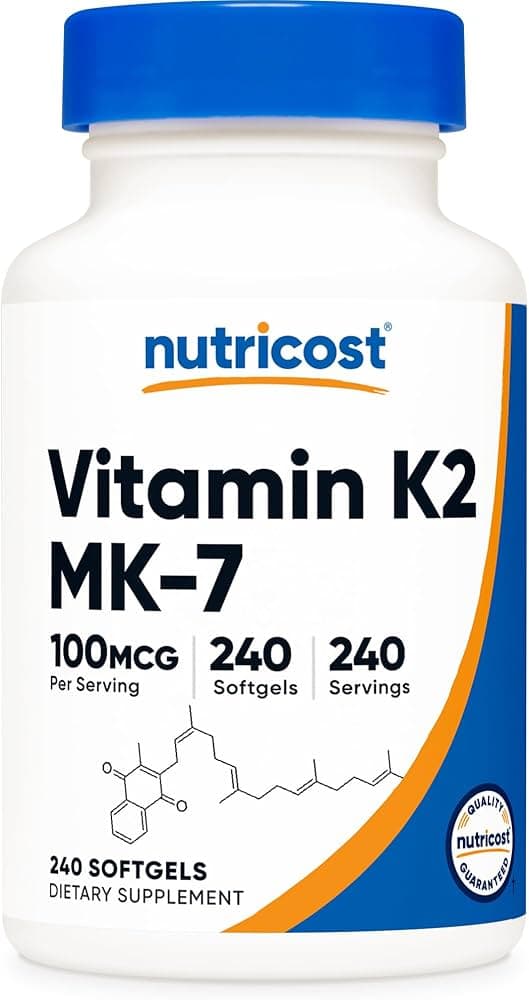
100 to 200mcg a day is where Vitamin K2 works.
Source: Knapen 2013 + Geleijnse 2004 Rotterdam study
A double-blind randomised dose-finding trial gave 60 postmenopausal women aged 50 to 69 either 0, 50, 100 or 200 micrograms of menaquinone-7 daily for four weeks on a controlled diet. The ratio of carboxylated to undercarboxylated osteocalcin rose dose dependently, with significant differences from the 0 microgram group at 100 and 200 micrograms. A companion 12-week trial in 120 people aged 20 to 69 confirmed the change at 100 micrograms daily. Both studies were run by authors affiliated with the R and D division of J-Oil Mills. An independent 8-week double-blind trial in 55 healthy prepubertal children found the same direction at 45 micrograms daily. What was measured is a blood marker of vitamin K status, not bone density and not a sensation.
The proof, claim by claim.
These words describe the research, not the molecule's worth. Research strength is how much work stands behind one claim, and it is never a product score.
Essential partner for Vitamin D.
- Improves bone mineral density and reduces fracture riskMeta-analysis of 19 RCTs
- Reduces arterial stiffness and improves vascular elasticity3-Year RCT (n=244)
- PromisingIncreases activation of osteocalcin (bone formation marker)Meta-analysis
Questions people ask about Vitamin K2.
- Do I really need this if I take Vitamin D?
- Yes. D increases calcium absorption, and K2 tells that calcium where to go. They're a team.
- What's the difference between MK-4 and MK-7?
- MK-7 stays in your body much longer, so you only need one daily dose. It's the form with the best research for bone and heart health.
- Can I get enough from food?
- It's tough. You'd have to eat a lot of natto (fermented soybeans) or specific aged cheeses. A supplement is far more practical.
- Should I take it with food?
- Yes, take it with a meal that contains some fat. It's a fat-soluble vitamin, so this helps your body absorb it.
- Is this just for women?
- No. Bone and heart health matter for everyone. The mechanism works the same in men.
- Can you take too much?
- There's no established upper limit, and it's considered well tolerated. But there's no benefit to mega-dosing. Stick to the 100-200mcg range.
What the trials show about these together.
Outcomes the engine found studied for these actives as a combination, not one at a time. Each is a finding a named trial measured, cited and dated, never written by the brand.
- PromisingVitamin K2 + Vitamin DBone
In a meta-analysis of eight randomized trials, vitamin K2 taken together with vitamin D raised total bone mineral density and lowered undercarboxylated osteocalcin, a marker of vitamin K status.
Kuang et al., 2020 (Food & Function)PMID 32219282
Research strength. Research strength says how much work stands behind the combination. It is never a product score.
Fail closed. Where actives were studied on their own rather than together, each shows on its own evidence, never a combined effect no trial measured.
Independent record. Every finding is cited to a named trial, dated, and never written by the brand.
Findings from trials that studied these actives as a combination. Context for how the actives were tested together, not a statement about any individual and not a claim about this product.
Why these belong in the same formula. Each row says what the basis is, from settled biochemistry through to a trial that measured the pair.
Vitamin D3 raises calcium absorption and drives production of osteocalcin, one of the proteins that vitamin K2 has to carboxylate before it can work. K2 then activates that osteocalcin and matrix Gla protein, so the calcium D3 brings in gets bound into bone rather than deposited in soft tissue.
Vitamin K2 carboxylates osteocalcin and matrix Gla protein, the proteins that bind calcium into the bone matrix and hold it out of soft tissue. K2 adds no calcium of its own. It governs where supplemented calcium ends up.
Magnesium is a required cofactor for the enzymes that turn vitamin D into its active form, and active vitamin D is what teams with K2 to route calcium into bone. Magnesium is also part of bone mineral itself, so it supports the same normal mineralization the D3 and K2 pairing feeds, though its connection to K2 runs through vitamin D rather than being direct.
Menaquinones run the same vitamin K cycle as phylloquinone, with the epoxide reductase regenerating the reduced quinol after each carboxylation. Total vitamin K activity is the sum of the two families.
Phylloquinone is cleared quickly and is used mainly in liver, while menaquinones persist in circulation and reach bone and vessel wall. Together they cover hepatic and extrahepatic carboxylation.
MK-7 carries a longer isoprenoid side chain than MK-4, binds lipoproteins more tightly and stays in circulation for days rather than hours. It is the menaquinone that delivers steady extrahepatic carboxylation.
MK-4 and coenzyme Q10 are both built from the same mevalonate-derived isoprenoid units, and the enzyme UBIAD1 handles the prenylation step for menaquinone-4. Anything that limits that shared pathway limits both quinones together.
High alpha-tocopherol intakes interfere with the vitamin K cycle and with menaquinone absorption, lowering carboxylation of vitamin K-dependent proteins and adding to effects on normal clotting. Formulas holding both keep the tocopherol dose moderate.
Menaquinones need bile salts and dietary fat to form the micelles that carry them into the enterocyte, so an oil carrier raises the absorbed fraction. Oil bases are standard in K2 softgels for this reason.
Menaquinones and retinol are both absorbed in mixed micelles and exported in chylomicrons, so their uptake depends on the same dietary fat and bile. At the transcriptional level, retinoic acid receptors heterodimerise with the vitamin D receptor and influence osteocalcin expression, and osteocalcin is the protein vitamin K carboxylates. This is established signalling biology rather than a combination trial, and high retinol intake carries its own upper-limit considerations.
Vitamin K is the cofactor for gamma-carboxylation of clotting factors II, VII, IX and X, so it supports normal coagulation capacity. Nattokinase is a fibrinolytic enzyme from the same fermentation that acts on the clot-dissolving side. The two are frequently sold from the same natto source while pulling in opposite directions on the same system, which is a formulation fact worth stating rather than a benefit.
Bone is a mineralised collagen scaffold. Vitamin C is needed to hydroxylate proline and lysine residues so that collagen triple helices form and cross-link, which is textbook enzymology. Vitamin K acts later, carboxylating osteocalcin and matrix Gla protein so they can bind calcium at that scaffold. The two occupy different steps of normal bone matrix handling.
Boron affects urinary calcium and magnesium excretion and circulating steroid hormone concentrations in controlled feeding work, placing it in the same mineral-handling territory as the vitamin K dependent Gla proteins. The overlap is at the level of bone mineral economy rather than a shared enzyme. No combination study in the candidate list tested the pair.
Dietary silicon has been linked to bone mineral density in cohort analyses, which is an association and not a demonstrated cause, and animal work points at collagen matrix formation. Vitamin K acts on the Gla proteins that bind mineral to that matrix. The pairing is a matrix-plus-mineral-binding rationale at early confidence.
Strontium is a calcium analogue that incorporates into bone mineral and also interferes with densitometry readings because of its higher atomic number, so density measurements taken during use overstate mineral content. Vitamin K acts on the protein side of mineralisation, not the ion. The pairing is coherent chemically, and the measurement caveat is the part worth stating.
Alkaline phosphatase is a zinc metalloenzyme that hydrolyses pyrophosphate, an inhibitor of mineral deposition, and its activity is a routine marker of osteoblast function. Vitamin K carboxylates osteocalcin secreted by those same osteoblasts. Zinc supplies the cofactor, vitamin K enables the calcium-binding protein, and the two steps are distinct.
Bone is roughly a third organic matrix, predominantly type I collagen. Collagen peptides supply glycine, proline and hydroxyproline plus di- and tripeptides that reach circulation intact. Vitamin K acts on osteocalcin and matrix Gla protein rather than on collagen itself, so the two address different halves of bone tissue. No combination trial is in the candidate set.
Menaquinones MK-5 through MK-13 are produced by gut bacteria including Bacteroides and Escherichia species, and appreciable amounts are found in the colon. How much of that pool is absorbed from the colon is limited and not well quantified, so this is a real biosynthetic route with an uncertain contribution. It is a mechanism note, not a reason to expect a supplement-scale effect from cultures alone.
Vitamin K is fat soluble and its uptake rises when taken with a fat-containing meal, which is established absorption physiology. A marine oil supplies that fat and shares the chylomicron route, where MK-7 in particular circulates bound to low density lipoprotein. The pairing is about delivery. The size of the absorption difference depends on the meal and the format.
Lecithin lowers interfacial tension and reduces oil droplet size, increasing the surface area pancreatic lipase and bile salts can act on. Fat-soluble vitamin formats routinely use it for that reason. This is formulation physiology and does not by itself predict a clinical difference.
The vitamin K cycle depends on reduction of the quinone to hydroquinone, work done by NAD(P)H-dependent and flavin-linked reductases including NQO1 alongside vitamin K epoxide reductase. Riboflavin supplies the flavin cofactors those reductases use. The link is at cofactor supply for the recycling step, and it is early rather than measured.
NQO1 uses NADH or NADPH to reduce vitamin K quinone to the hydroquinone that gamma-glutamyl carboxylase requires, which is the warfarin-insensitive arm of the vitamin K cycle. Pyridine nucleotide availability is therefore an input to that step. This is established enzymology. Nothing here says a nicotinamide precursor supplement changes carboxylation in people.
Vitamin D raises how much calcium the gut takes in. Vitamin K2 activates osteocalcin and matrix Gla protein, the proteins that bind that calcium into bone and keep it out of soft tissue. Paired, the calcium vitamin D brings in has the machinery to be put where it belongs.
Talk to a doctor before taking Vitamin K2 if any of these apply to you: Blood thinners (Warfarin). These are flags to check first, not effects Vitamin K2 is known to cause.
Not medical advice. Show the label to your pharmacist.What Vitamin K2 actually does.
It switches on a set of proteins by adding a chemical group that lets them grip calcium.
The same vitamin activates clotting proteins, a bone protein and a protein found in artery walls and cartilage.
One of these proteins grabs stray calcium in soft tissue, which is how the body keeps mineral where it belongs.
Labs measure the unfinished versions of these proteins to judge vitamin K status. It is a status reading, not a health result.
Where Vitamin K2 comes from.
The MK-7 form is grown, not built: a bacterium used to ferment soybeans makes it naturally, and the process pulls it out and cleans it up. The MK-4 form is put together chemically instead, and the body also makes that one itself from the vitamin K in leafy greens. Light and heat degrade all of it, which is why the packaging matters.
The same molecule is reached more than one way. Which route a given product used is a manufacturing choice, and the finished compound is the same either way.
Fermentation routes use cooked soybeans in the traditional natto process, or chickpea and non-soy media where an allergen-free claim is wanted. Synthetic routes start from menadione and a prenyl chain building block.
The bacterium synthesises menaquinone-7 as part of its own respiratory quinone pool. The synthetic route to menaquinone-4 couples a geranylgeranyl-type side chain to the menadione naphthoquinone ring, and isomer control at that step determines the all-trans content.
The lipophilic menaquinone is taken up into a solvent or supercritical carbon dioxide phase and separated from biomass, peptides and residual medium.
Crystallisation and chromatographic steps raise purity and remove cis isomers, which are inactive, along with residual solvent and process impurities.
High performance liquid chromatography sets both the amount and the all-trans fraction, and the isomer ratio is specified because the cis form does not carry activity.
The purified material is dispersed in a lipid carrier or encapsulated in a protective matrix under light-protected, low-oxygen conditions, since it degrades on exposure to light and alkali.
Getting Vitamin K2 from food.
The whole-food sources on file. A supplement closes the gap, it does not replace dinner.
A gram-for-gram figure (how much of each you would eat to match a dose) will appear here once it is sourced and reviewed. This page will not print a number it cannot cite.
The forms it comes in.
The essence, in one line each.
- Across nine randomised trials in postmenopausal women, vitamin K2 raised lumbar spine bone mineral density by about 2.2 percent and forearm bone mineral density by about 1.6 percent compared with control.Meta-analysis. Zhou et al., 2022 (Journal of Bone and Mineral Metabolism). PMID 35711002 ↗
- Three years of 180 micrograms a day of MK-7 lowered arterial stiffness, measured as carotid-femoral pulse wave velocity and the Stiffness Index, in healthy postmenopausal women and cut the vitamin K status marker dp-ucMGP by half versus placebo.Randomised trial. Knapen et al., 2015 (Thrombosis and Haemostasis). PMID 25694037 ↗
- Three years of 180 micrograms a day of MK-7 slowed the age-related decline in bone mineral density at the lumbar spine and femoral neck and improved bone strength in healthy postmenopausal women.Randomised trial. Knapen et al., 2013 (Osteoporosis International). PMID 23525894 ↗
- Across nine randomised trials in 2,570 older women with low bone mass, vitamin K2 shifted bone-turnover markers: osteocalcin rose (mean difference 1.86) along with bone-specific alkaline phosphatase, and undercarboxylated osteocalcin fell (-1.54). These are markers, not measured bone outcomes.Meta-analysis. Zhang et al., 2025 (Front Endocrinol). PMID 41268154 ↗
- Pooling six mostly observational studies in 2,327 Japanese adults, habitual natto intake was associated with much higher serum MK-7 (d 2.10), less undercarboxylated osteocalcin (d -0.50) and modestly greater bone mineral density, an association from food intake rather than a measured effect of supplementation.Meta-analysis. Wen et al., 2025 (Front Nutr). PMID 41393956 ↗
- In 71 young and older adults, 240 micrograms of MK-7 a day for 12 weeks raised circulating MK-7 but showed no measurable effect on muscle strength, physical function, soreness or inflammatory response after muscle-damaging resistance exercise.Randomised trial. Lithgow et al., 2026 (Med Sci Sports Exerc). PMID 41843412 ↗
- In 68 adults with elevated blood sugar, 360 micrograms of MK-7 a day for 12 weeks produced lipid and glucose index differences that no longer held once baseline values were accounted for, so no effect was detected.Randomised trial. Rahimi Sakak et al., 2021 (BMC Complement Med Ther). PMID 33933059 ↗
- In this randomised trial of a low daily menaquinone-7 amount, the authors reported an effect on bone mineral density measurements over the study period in the supplemented group. Bone mineral density is an imaging measurement, not a clinical event.Randomised trial. Zhang Y. et al., 2020 (Calcified Tissue International). PMID 32060566 ↗
- The authors reported reductions in cardiometabolic risk markers in the supplemented group. These are blood and anthropometric markers rather than clinical events.Randomised trial. Olivares-Ochoa X.C. et al., 2026 (Biomedicines). PMID 42193338 ↗
- A substudy of a randomised trial assessing combined menaquinone and cholecalciferol supplementation on epicardial adipose tissue volume and circulating inflammatory markers. The authors report imaging and marker outcomes, not clinical events.Randomised trial. Hasific S. et al., 2025 (Atherosclerosis). PMID 41100911 ↗
- A randomised dose-finding study reporting a dose-dependent fall in dephosphorylated uncarboxylated matrix Gla protein, which is a carboxylation status marker and not a clinical outcome.Randomised trial. Caluwe R. et al., 2014 (Nephrology, Dialysis, Transplantation). PMID 24285428 ↗
- Over one year of follow-up the authors did not detect a difference between groups in progression of vascular calcium deposition on imaging. A failure to detect a difference is not evidence that none exists, and the trial was small.Randomised trial. Oikonomaki T. et al., 2019 (International Urology and Nephrology). PMID 31529295 ↗
- The authors report that effects on glycaemic measures differ across groups with differing baseline blood sugar status, so results are not uniform across populations. The outcomes assessed are blood markers.Systematic review. Ahmed S.R. et al., 2026 (Nutrients). PMID 41599883 ↗
- In an experimental model of age-related joint wear, the authors report effects of oral menaquinone on cartilage and metabolic measures. Animal findings do not establish an effect on joint comfort in people.Animal study. Uzun E. et al., 2026 (Metabolites). PMID 42346405 ↗
These are the studies our verdict leans on, chosen from the 244 we read for Vitamin K2. The full linked list is below.
The studies, linked.
12 sources behind our Vitamin K2 verdict: peer-reviewed studies and registered clinical trials. Every one links straight to PubMed, the journal, or ClinicalTrials.gov. Read them yourself.
- Clinical trialClinical Trial on Beneficial Effects of Long Term Menaquinone-7 (Vitamin K2) Intake by Postmenopausal WomenClinicalTrials.gov ↗240 participants, Completed
- Clinical trialEffect of Jarlsberg Cheese Compared to Cheese Without Vitamin K2 Regarding Increased Osteocalcin Level in Healthy WomenClinicalTrials.gov ↗64 participants, Completed
- Clinical trialEvaluating the Vitamin K2 Status of Calcium-based Stone FormersClinicalTrials.gov ↗60 participants, Completed
- Clinical trialComparative Study Evaluating the Effect of the Administration of Vitamin K1 Versus Vitamin K2 on Vascular Calcification in Dialysis PatientsClinicalTrials.gov ↗Phase 2, 40 participants, Completed
- Clinical trialComparison of Pharmacokinetics of Omega-3 Fatty Acid Supplements in Monoacylglycerol or Ethyl Ester in Humans: a Randomized Controlled Trial.ClinicalTrials.gov ↗20 participants, Completed
- Clinical trialEvaluation of Factors II, VII, IX, X, and Proteins C and S, Following High-dose Vitamin K SupplementationClinicalTrials.gov ↗8 participants, Completed
- Clinical trialPhase 2 Study Randomized Placebo Controlled With Vitamin K2 in Asymptomatic Calcified Carotid StenosisClinicalTrials.gov ↗Phase 2, 200 participants, Unknown
- Clinical trialHealth Effects of Vitamin K2 Supplementation on Skeletal Muscle and Neurological Function After Ischemic StrokeClinicalTrials.gov ↗190 participants, Active not recruiting
- Clinical trialEfficacy of Vitamin K2 Supplementation in Adult Episodic MigraineClinicalTrials.gov ↗160 participants, Recruiting
- Clinical trialThe Role of Vitamin K2 in Preventing Glucocorticoid-Induced Bone Loss in Children With Nephrotic SyndromeClinicalTrials.gov ↗60 participants, Recruiting
- Clinical trialVitamin K and Glucose Metabolism in Adults at Risk for DiabetesClinicalTrials.gov ↗30 participants, Unknown
- Clinical trialThe Local Effect of Vitamin K2 on Bone Remodeling in Socket Preservation of Mandibular Single Rooted Teeth Randomized Clinical TrailClinicalTrials.gov ↗Phase 4, 20 participants, Recruiting
Evidence surfaced via Semantic Scholar (Allen Institute for AI) and ClinicalTrials.gov. Ranked by study type and citation weight, not cherry-picked.
Problems people have reported.
Read this carefully. These are 2,441 voluntary, unverified reactions reported to the FDA (openFDA). The number mostly reflects how popular Vitamin K2 is, not how risky it is. A report is not proof Vitamin K2 caused anything. It is a signal of what to watch for, nothing more.
Source: openFDA adverse-event reports. Voluntary reporting, not an incidence rate.
FDA Disclaimer: These statements have not been evaluated by the Food and Drug Administration. This information is for educational purposes only and is not intended to diagnose, treat, cure, or prevent any disease. Consult your healthcare provider before starting any supplement regimen.