Cichoric acid.
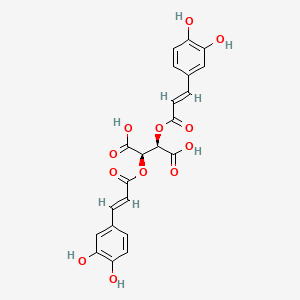
The compound Echinacea products are measured by. Two caffeic acid units on a tartaric backbone, and its catechol groups do the antioxidant chemistry seen in laboratory assays.
 Compound
- Category
- Compound
What Cichoric acid is, and what it does.
- Does it work
- Suits anyone using Echinacea who wants a handle on how well the batch was made, since the figure tracks how quickly the harvest got processed.
- How much to take
- No daily amount is on record for the isolated compound. It's normally taken inside a standardised Echinacea preparation, where the label figure describes the extract.
- Time to feel it
- Nobody has measured a time course for the compound on its own. Preparations holding it are conventionally used across days rather than as one serving.
- The first dose
- Day one passes without a sensation. What happens is esterase hydrolysis releasing caffeic acid, which turns up in blood as conjugates within hours.
- With regular use
- Weeks of use haven't been studied for the isolated compound. Intake registers mostly as caffeic acid conjugates, which turn over quickly rather than building up.
- How well tolerated
- No particular caution attaches to the amounts found in Echinacea preparations. Check with your doctor if you take medicines, since it usually arrives inside a whole plant extract.
- How it feels
- Slightly sour and green in a pressed juice. Past the taste, no distinct sensation has been described for the compound itself.
- The overlooked benefit
- It falls apart quickly once plant tissue is damaged, so a high label figure is really a report on how fast the harvest was dried or pressed.
The proof, claim by claim.
What these words mean
These words describe the research, not the molecule's worth. Research strength is how much work stands behind one claim, and it is never a product score.
- Antioxidant activity in chemical assaysIn vitro study
- Immune cell signallingIn vitro study
3 more claims
- Marker compound for Echinacea extract qualityNarrative review
- Healthy glucose metabolismAnimal study
- Hydrolysis to caffeic acid after oral intakeNarrative review
Why these belong in the same formula, 5 pairings
Why these belong in the same formula. Each row says what the basis is, from settled biochemistry through to a trial that measured the pair.
Most commercial Echinacea purpurea extracts state a cichoric acid percentage on the label, so the two are not independent ingredients so much as a whole and one of its parts. Echinacea also contains alkylamides and polysaccharides with quite different behaviour. Attributing an Echinacea effect to cichoric acid alone is not supported by the composition of the products actually studied.
The two catechol groups on cichoric acid make it prone to oxidation, and stability is the main practical problem in Echinacea products. Ascorbate holds it in reduced form during processing and in the gut. This is a stability effect, documented in formulation work rather than in a human absorption trial. It has no bearing on any claimed activity beyond keeping the molecule intact.
Chicory root inulin products carry residual caffeic acid derivatives including cichoric acid unless the purification is aggressive. The two act on entirely different systems, inulin as a fermentable fibre and cichoric acid as a polyphenol. Their co-occurrence is botanical, not mechanistic. Highly purified inulin will have very little cichoric acid left.
Cichoric acid's tartaric ester bonds are hydrolysed by plant and gut esterases, releasing caffeic acid. Compounds that alter that hydrolysis change what actually reaches circulation. Thiol compounds have been examined in this context in vitro. The evidence is preclinical and the practical relevance is unknown.
Caffeic acid derivatives and flavonols compete for sulfotransferase and UDP-glucuronosyltransferase capacity in the enterocyte. At high combined polyphenol intake that competition can raise circulating levels of both. This is standard polyphenol pharmacokinetics rather than a specific cichoric acid finding, and it cuts both ways depending on which compound is in excess.
Nothing specific on file for Cichoric acid. Match the label to the daily amount above, and tell your doctor what you take.
Not medical advice. Show the label to your pharmacist.What Cichoric acid actually does.
Cichoric acid is made of two caffeic acid units attached to a tartaric acid backbone. That structure gives it four active hydroxyl groups arranged in pairs.
3 more mechanisms
The bonds holding this compound together get broken down by enzymes in the plant and in your gut, releasing free caffeic acid. Much of what ends up in your blood after eating it is caffeic acid and its byproducts rather than the intact original compound.
This compound breaks down quickly once plant tissue is damaged, because of an enzyme that's released in that process. That's why fresh pressed echinacea juice and dried extracts can differ so much in content, and why the amount on a label depends heavily on how the product was processed.
The active groups on this molecule can neutralize free radicals and bind certain metals, which is the basis for the antioxidant activity measured in test tube assays. That test tube activity is not evidence it does the same thing in your body.
Where Cichoric acid comes from.
It is the compound Echinacea products are usually measured by. It breaks down fast once the plant is cut, so how quickly the harvest was processed matters more than almost anything else on the label.
What this route gives you
Made from a plant. What ends up in the capsule tracks the harvest, so batch testing and a stated marker matter more here than with a made molecule.
5 steps on record
Purple coneflower flowering tops and roots are the main commercial source. Chicory leaf and root, dandelion and basil also carry it.
The decisive step. Polyphenol oxidase released at harvest destroys cichoric acid within hours unless the material is stabilised quickly by alcohol, rapid drying or heat.
Aqueous ethanol pulls the caffeic acid derivatives together with alkylamides. Water alone favours the polysaccharide fraction and leaves alkylamides behind.
Quantified by HPLC and reported as percent cichoric acid. This figure is the industry's proxy for extract quality even though it is only one of several active fractions.
Finished as a liquid tincture, a spray-dried powder or a preserved pressed juice, each of which holds cichoric acid differently over shelf life.
Getting Cichoric acid from food.
The whole-food sources on file. A supplement closes the gap, it does not replace dinner.
A gram-for-gram figure (how much of each you would eat to match a dose) will appear here once it is sourced and reviewed. This page will not print a number it cannot cite.
The forms it comes in.
3 more forms
The essence, in one line each.
- In a trial with 12 healthy adults, taking an Echinacea purpurea supplement for 28 days had no significant effect on the activity of several key drug-metabolizing enzymes, though the authors noted the effects were minor.Randomised crossover trial. Gurley BJ et al., 2004 (Clinical Pharmacology and Therapeutics). PMID 15536458 ↗
3 more findings
- Echinacea extract fed to layer chicks altered antibody titres and intestinal histology relative to control.Animal study. Gurbuz E et al., 2010 (British Poultry Science). PMID 21161788 ↗
- Selenium nanoparticle exposure changed growth and secondary metabolite production in chicory seedlings through epigenetic modification, showing that phenolic content in chicory is highly condition-dependent.In vitro study. Mokhtarabadi E et al., 2025 (Environmental Pollution). PMID 39993707 ↗
- A network pharmacology analysis of a related Asteraceae botanical mapped caffeic acid derivative targets computationally, with no experimental confirmation of the predicted interactions.In vitro study. Hu R et al., 2025 (Nutrients). PMID 41097169 ↗
Chosen from the 4 we read for Cichoric acid.
FDA Disclaimer: These statements have not been evaluated by the Food and Drug Administration. This information is for educational purposes only and is not intended to diagnose, treat, cure, or prevent any disease. Consult your healthcare provider before starting any supplement regimen.