Cytidine.
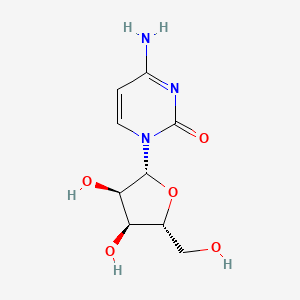
Cytidine is one of the four building blocks of RNA, and your cells also route it into the pathway that builds the phospholipids of cell membranes.
 Compound
- Category
- Compound
What Cytidine is, and what it does.
- Does it work
- Suits people interested in membrane phospholipid support, usually taken as citicoline. Your body also makes its own, so it sits as an add-on rather than a daily essential.
- How much to take
- No daily amount is on record for cytidine on its own. Most of what people take arrives as citicoline, and the cytidine share of that is not separately established.
- Time to feel it
- Nobody has measured a time course for cytidine by itself. The citicoline work reports change over weeks rather than hours.
- The first dose
- Day one is quiet. Blood uridine rises within hours because your gut converts most cytidine on the way in, and that shows up on a lab draw rather than in how you feel.
- With regular use
- Weeks of daily use keep the pool of activated cytidine nucleotides topped up for membrane building. It shows in biochemistry rather than in sensation.
- How well tolerated
- Generally well tolerated at the amounts used in citicoline research, mainly mild stomach upset or headache. Check with your clinician if you're pregnant, breastfeeding or on medication.
- How it feels
- Most people report no distinct sensation. It's a substrate your cells draw on, not a stimulant, so the effect sits in membrane chemistry.
- The overlooked benefit
- It's the only route to CMP-sialic acid, the donor for every sialylation reaction in your cells, which decorates cell-surface proteins and mucus.
The proof, claim by claim.
What these words mean
These words describe the research, not the molecule's worth. Research strength is how much work stands behind one claim, and it is never a product score.
- Precursor supply for membrane phospholipid synthesisNarrative review
- Conversion to circulating uridine after an oral doseNarrative review
2 more claims
- Cognitive support when delivered as citicolineRandomised trial
- Sialic acid donor supply for glycoprotein buildingIn vitro study
Why these belong in the same formula, 11 pairings
Why these belong in the same formula. Each row says what the basis is, from settled biochemistry through to a trial that measured the pair.
Phosphatidylcholine synthesis by the Kennedy pathway needs CTP and phosphocholine to make CDP-choline, and cytidine supplies the cytidine half of that molecule while choline supplies the other. Neither alone completes the step. This is settled biochemistry and does not by itself say what a supplement dose does.
Oral CDP-choline does not survive intact. It is hydrolysed in the gut wall and liver into cytidine and choline, which are absorbed separately and recombined inside cells. So citicoline is functionally a delivery vehicle for these two molecules, and in humans the cytidine portion largely appears in blood as uridine.
Phosphatidylcholine is the product of the same pathway that consumes CDP-choline, so cytidine sits two steps upstream of it. Supplying the finished phospholipid bypasses the pathway rather than feeding it. The two approaches address the same molecule from different ends, which is worth stating plainly rather than presenting as additive.
Membrane phospholipid synthesis needs the head group route that cytidine feeds and the acyl chains that DHA supplies. The combination of uridine or cytidine with DHA and choline is the basis of several membrane-precursor formulations. Mechanistic logic is solid, and the clinical picture across those formulations is mixed.
Uridine-cytidine kinase and the downstream nucleoside diphosphate kinases all use magnesium-ATP as the true substrate, not free ATP. Without adequate magnesium the phosphorylation steps that convert cytidine into usable CTP run slower. This is a cofactor requirement, not a claim that extra magnesium accelerates the pathway.
The liver makes phosphatidylcholine by two routes: the CDP-choline route that cytidine feeds, and PEMT methylation that consumes three methyl groups from S-adenosylmethionine. B12 status governs methyl group supply for the second route. Supporting one route reduces demand on the other, which is a biochemical relationship rather than a tested combination.
Folate provides the one-carbon unit for thymidylate synthesis, the branch of pyrimidine metabolism that runs parallel to cytidine salvage, and also supplies methyl groups for the PEMT route to phosphatidylcholine. Cytidine feeds the salvage side of the same broad network. The connection is real biochemistry and does not imply a combined supplement effect.
Cytidine is cytosine attached to a ribose sugar, and salvage of the free base to a nucleotide requires phosphoribosyl pyrophosphate derived from ribose 5-phosphate. That places ribose availability upstream of nucleotide formation. Supplemental ribose has not been shown to change nucleotide pool sizes in healthy people.
Inosine feeds the purine side of nucleotide salvage while cytidine feeds the pyrimidine side, and nucleic acid synthesis needs balanced pools of both. Loading one class heavily without the other can skew the ratio. This is a balance argument from biochemistry, not a demonstrated combination benefit.
Uridine monophosphate is dephosphorylated in the gut to uridine before absorption, then rephosphorylated intracellularly, arriving at the same pool cytidine feeds after deamination. Taking both is largely redundant rather than additive. Anyone stacking them should count the total pyrimidine load once.
Caffeine blocks adenosine receptors, and adenosine is a purine nucleoside. Cytidine is a pyrimidine and does not act at those receptors, so the two do not interact at that site. The point is worth stating because nucleoside supplements are often assumed to share adenosine's signalling behaviour, and they do not.
Nothing specific on file for Cytidine. Match the label to the daily amount above, and tell your doctor what you take.
Not medical advice. Show the label to your pharmacist.What Cytidine actually does.
Cytidine is one of the four building blocks of RNA, formed by cytosine attached to a ribose sugar.
3 more mechanisms
An enzyme adds a phosphate to cytidine to make CMP, and further enzymes that need magnesium-ATP add more phosphates to build it up to CDP and then CTP.
CTP acts as the activated carrier for building certain phospholipids, and the cytidine part of both CDP-choline and CDP-ethanolamine in that pathway comes from CTP.
An enzyme converts cytidine to uridine, and in people this happens so much during and after absorption that taking cytidine by mouth raises blood uridine far more than it raises blood cytidine itself.
Where Cytidine comes from.
Most of it is grown, not mined. Engineered bacteria are fed sugar and build the molecule for you, or it is stripped out of yeast RNA. What actually ends up in a bottle is usually citicoline, which is cytidine already joined to choline, and your gut takes that apart again before absorbing either piece.
What this route gives you
The same molecule is reached more than one way. Which route a given product used is a manufacturing choice, and the finished compound is the same either way.
6 steps on record
Two production routes exist. Engineered bacteria build cytidine de novo from sugar and a nitrogen source, or yeast RNA is hydrolysed to release its nucleotides.
Escherichia coli or Bacillus strains carry deregulated pyrimidine biosynthesis and, in recent work, amplified NADPH-regenerating modules to raise yield.
Fermentation broth is separated from cells, or yeast RNA is treated enzymatically or with alkali to release 5' nucleotides.
Ion exchange resin separates cytidine and CMP from the other nucleosides and nucleotides, then the target is crystallised.
Purity is verified by HPLC, with the related nucleosides uridine and cytosine as the impurities of concern.
Cytidine may be sold as the nucleoside, converted to the disodium monophosphate salt, or enzymatically coupled to choline to make citicoline.
Getting Cytidine from food.
The whole-food sources on file. A supplement closes the gap, it does not replace dinner.
A gram-for-gram figure (how much of each you would eat to match a dose) will appear here once it is sourced and reviewed. This page will not print a number it cannot cite.
The forms it comes in.
3 more forms
The essence, in one line each.
- Amplifying NADPH-regenerating modules in engineered Escherichia coli raised cytidine biosynthesis yield, which is a manufacturing result rather than a physiological one.In vitro study. Liu L et al., 2026 (Synthetic and Systems Biotechnology). PMID 41574266 ↗
4 more findings
- Rumen-protected choline and methionine altered choline metabolites and amino acids in the periparturient period, with cytidine-containing metabolites among those measured.Animal study. Potts SB et al., 2023 (Journal of Dairy Science). PMID 37173256 ↗
- A review of glycerophospholipids in cattle, covering the CDP-choline pathway in which cytidine participates.Narrative review, in animals. Sheedy DB et al., 2026 (The Journal of Dairy Research). PMID 41883310 ↗
- A review of sialic acid biosynthetic and genetic pathways, in which CMP-sialic acid, a cytidine nucleotide sugar, is the activated donor.Narrative review, in cells. Huang S et al., 2026 (The Journal of Biological Chemistry). PMID 41655697 ↗
- IGF1R-dependent signalling was examined in blastocyst formation, with nucleoside metabolites including cytidine among the measured species.In vitro study. Park CH et al., 2026 (Frontiers in Cell and Developmental Biology). PMID 41799434 ↗
Chosen from the 6 we read for Cytidine.
Problems people have reported.
Read this carefully. These are 245 voluntary, unverified reactions reported to the FDA (openFDA). The number mostly reflects how popular Cytidine is, not how risky it is. A report is not proof Cytidine caused anything. It is a signal of what to watch for, nothing more.
3 more reported effects
Source: openFDA adverse-event reports. Voluntary reporting, not an incidence rate.
FDA Disclaimer: These statements have not been evaluated by the Food and Drug Administration. This information is for educational purposes only and is not intended to diagnose, treat, cure, or prevent any disease. Consult your healthcare provider before starting any supplement regimen.