Erythrodiol.
An olive-skin triterpene that travels with its twin uvaol. It sits one oxidation step below oleanolic acid, and it is poorly soluble, so only a small share of what you take gets in.
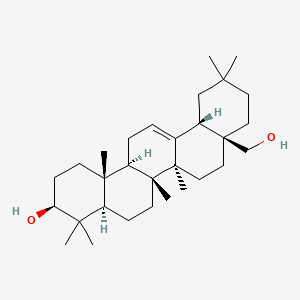 Compound
- Category
- Compound
What Erythrodiol is, and what it does.
- Does it work
- It suits people interested in olive triterpene chemistry alongside hydroxytyrosol. Human research is early, at 654 records in Europe PMC, mostly analytical and laboratory work.
- How much to take
- No dose figure is on record. Start with the triterpene-assayed amount its documentation gives, taken with a fat-containing meal, since absorption depends on bile micelles.
- Time to feel it
- Nothing acute here. The studies read cell and animal endpoints, and no human onset time has been measured.
- The first dose
- Day one gives no sensation. Whatever is absorbed is glucuronidated quickly, so plasma levels of the parent compound stay low from the first dose onward.
- With regular use
- Weeks of daily use with fat-containing meals is the pattern its chemistry points to. Long-term human outcomes for this triterpene have not been measured.
- How well tolerated
- It comes from olives, with a long history of dietary exposure through olive products. Dedicated human tolerance work at concentrated amounts has not been published.
- How it feels
- No subjective effect at all. This one lives in the laboratory and marker layer rather than anywhere you would notice day to day.
- The overlooked benefit
- It doubles as an authenticity marker. The combined erythrodiol and uvaol figure is what analysts use to tell pomace-derived olive oil from virgin olive oil.
The proof, claim by claim.
What these words mean
These words describe the research, not the molecule's worth. Research strength is how much work stands behind one claim, and it is never a product score.
- antioxidant activity of olive triterpenesIn vitro study
- healthy inflammatory responseAnimal study
3 more claims
- endothelial and vascular signallingIn vitro study
- analytical marker for pomace-derived olive oilNarrative review
- low oral bioavailability of pentacyclic triterpenesNarrative review
Why these belong in the same formula, 6 pairings
Why these belong in the same formula. Each row says what the basis is, from settled biochemistry through to a trial that measured the pair.
Beta-amyrin is hydroxylated stepwise at C-28, passing through the alcohol (erythrodiol) and the aldehyde before reaching oleanolic acid. The two compounds therefore travel together in olive material and their ratio reflects how far that oxidation has run. Any olive unsaponifiable fraction that contains one will contain the other.
Olive material supplies both a triterpene fraction and a phenolic fraction, and they partition into different phases, which is why extraction choices determine which one ends up in a given product. Combining them reproduces more of the whole olive profile than either alone. Nothing has been measured on the combination as such.
Erythrodiol has a very low aqueous solubility and disperses poorly from a dry powder. Delivering it in a medium-chain triglyceride or other lipid vehicle allows it into mixed micelles, which is the prerequisite for any absorption at all. This is why triterpene ingredients are generally sold as oil dispersions or lipid-based formulations.
Saponifying an olive oil or pomace and taking the unsaponifiable fraction pulls sterols and triterpene alcohols together. That is a processing consequence rather than a designed pairing, but it means most commercial olive triterpene ingredients also carry phytosterols. Specification sheets should state both, because the sterol content contributes its own sterol-competition behaviour in the gut.
Tocopherol comes along in the olive unsaponifiable fraction and is also added to protect oil dispersions from oxidation. The triterpene itself is comparatively stable, but the carrier oil is not. The pairing is about the vehicle.
Squalene is epoxidised and then cyclised by beta-amyrin synthase to give the oleanane skeleton that erythrodiol is built on. In olive material the two occur in the same unsaponifiable fraction because they sit on the same pathway. The relationship is biosynthetic, and it explains their co-occurrence rather than describing anything they do together in a person.
Nothing specific on file for Erythrodiol. Match the label to the daily amount above, and tell your doctor what you take.
Not medical advice. Show the label to your pharmacist.What Erythrodiol actually does.
Erythrodiol is a plant triterpene compound, one oxidation step away from oleanolic acid on the same basic structure.
3 more mechanisms
Plants build this compound through a multi step pathway starting from squalene, cycling through beta-amyrin, and getting oxidized step by step by specific enzymes to form erythrodiol and then oleanolic acid.
Erythrodiol and a related compound, uvaol, concentrate in olive skin and pomace rather than in the oil itself, which is why measuring the two together is used to tell pomace derived oil apart from virgin olive oil.
As a crystalline plant compound with only two active groups on a large hydrocarbon frame, erythrodiol barely dissolves in water, and its absorption depends on being dissolved into bile salt particles in the gut.
Where Erythrodiol comes from.
Erythrodiol is an olive compound that lives mostly in the fruit skin, which means it ends up in the pomace left over after the oil is pressed rather than in the oil itself. Chemically it is oleanolic acid one step short of finished, with an alcohol group where the acid would be. It almost never comes alone: its twin uvaol is nearly always alongside it, and the pair together is what analysts measure.
What this route gives you
Made from a plant. What ends up in the capsule tracks the harvest, so batch testing and a stated marker matter more here than with a made molecule.
6 steps on record
Erythrodiol concentrates in the fruit skin and therefore in the pomace left after oil pressing, and in the leaf. Virgin olive oil itself carries comparatively little.
Hexane or ethanol pulls the lipophilic triterpene fraction along with waxes, sterols and pigment.
Alkaline treatment removes the glyceride and wax ester material and leaves the unsaponifiable fraction where the triterpene alcohols sit.
Column separation resolves erythrodiol from uvaol and from the triterpene acids. Crystallisation raises purity for the isolated compound.
Erythrodiol and uvaol are conventionally reported together, since that combined figure is the established analytical marker.
Specification should state whether the figure is erythrodiol alone or the erythrodiol plus uvaol sum, because the two numbers are routinely confused.
Getting Erythrodiol from food.
The whole-food sources on file. A supplement closes the gap, it does not replace dinner.
A gram-for-gram figure (how much of each you would eat to match a dose) will appear here once it is sourced and reviewed. This page will not print a number it cannot cite.
The forms it comes in.
3 more forms
The essence, in one line each.
- Erythrodiol appears among the metabolites the authors report as altered in proximal and distal colon tissue after herbal decoction treatment in the model animals.Animal study. Luo Y et al., 2022 (Drug Design, Development and Therapy). PMID 36583115 ↗
Chosen from the 1 we read for Erythrodiol.
The studies, linked.
2 sources behind our Erythrodiol verdict, every one linked to PubMed, the journal or ClinicalTrials.gov.
- Clinical trialNeuroprotective Effects of Oleanolic Acid and Erythrodiol in Prodromal Alzheimer's DiseaseClinicalTrials.gov ↗120 participants, Not yet recruiting
1 more linked trial
- Clinical trialErythrodiol in Pomace Olive Oil as a Protective Agent Against AtherosclerosisClinicalTrials.gov ↗Phase 2, 22 participants, Not yet recruiting
From clinical trials and PubMed, ranked by study type and citation weight, not cherry-picked.
FDA Disclaimer: These statements have not been evaluated by the Food and Drug Administration. This information is for educational purposes only and is not intended to diagnose, treat, cure, or prevent any disease. Consult your healthcare provider before starting any supplement regimen.