Oleanolic acid.
A waxy triterpene from olive leaf and apple peel. In cells and animals it turns on the Nrf2 antioxidant response. Human work is still mostly about getting it absorbed.
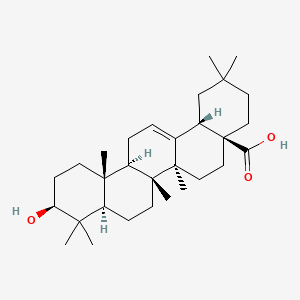 Compound
- Category
- Compound
What Oleanolic acid is, and what it does.
- Does it work
- Suits people who follow early antioxidant research and want an olive-derived triterpene in a daily routine. Human outcome data hasn't been gathered yet.
- How much to take
- No daily amount is on record. Start with the serving on the pack and take it with a meal containing fat, since it barely dissolves in water.
- Time to feel it
- No time course has been measured in people. Nrf2 signalling is a gene expression change, so it would read in laboratory measures rather than in sensation.
- The first dose
- Nothing you'd sense on day one. This is a lipid-soluble compound whose activity is measured as antioxidant enzyme expression, not as a same-day feeling.
- With regular use
- Weeks of daily use haven't been tracked in people. The preclinical picture is of antioxidant enzyme expression rising, a laboratory readout rather than a felt change.
- How well tolerated
- Human tolerability data is limited and dosing has not been characterised. Check with your prescriber if you take medicines or are pregnant or breastfeeding.
- How it feels
- Most people report no sensation. It's background biochemistry, and what it is studied for is measured in tissue and blood rather than felt.
- The overlooked benefit
- It rarely travels alone. Ursolic acid, its near twin, comes along in most plant extracts, so a label naming one is usually delivering both.
The proof, claim by claim.
What these words mean
These words describe the research, not the molecule's worth. Research strength is how much work stands behind one claim, and it is never a product score.
- Nrf2 driven antioxidant enzyme expressionAnimal study
- markers of healthy glucose metabolismAnimal study
3 more claims
- everyday liver function markersAnimal study
- improved oral absorption from lipid and phospholipid delivery systemsNarrative review
- antioxidant activity in cell systemsIn vitro study
Why these belong in the same formula, 14 pairings
Why these belong in the same formula. Each row says what the basis is, from settled biochemistry through to a trial that measured the pair.
Oleanolic and ursolic acid differ only in the position of one methyl group and are almost always extracted together from apple peel, olive leaf, rosemary and holy basil. Separating them industrially is difficult and often not attempted, so a product labelled for one usually contains both. They act on overlapping targets in preclinical models. The co-occurrence is a fact of botany and manufacturing before it is a pharmacological choice.
Poorly water-soluble triterpenes need to be solubilised into mixed micelles before they can reach the enterocyte. A medium-chain triglyceride vehicle promotes micelle formation and keeps the compound dissolved through the small intestine. Lipid-based delivery is the standard formulation answer to this class of solubility problem. Improved dissolution is a pharmaceutical property, not by itself a clinical benefit.
Complexing a lipophilic compound with a phospholipid produces a dispersible form that wets and disperses far better in gut fluid than the raw crystalline powder. The same approach is used commercially for other poorly soluble botanicals. It addresses dissolution, which is the main barrier here. Whether the resulting exposure translates into any measured effect is a separate question.
Olive material is both a natural source of the compound and a lipid matrix that carries it. The triterpene sits in the waxy skin fraction, which is why pomace and unrefined oils carry more than highly refined ones. Consuming it in an oil matrix supplies the fat needed for micellar uptake at the same time. This is dietary chemistry, and the amounts in ordinary olive oil are small compared with a supplement dose.
Rosemary-derived triterpene acid fractions carry oleanolic acid together with the diterpene phenolics that rosemary is better known for. Products described as rosemary triterpene extracts are supplying this compound as part of a mixture. The constituents overlap in their antioxidant chemistry. Preclinical animal work on the fraction exists, and it should not be read across to people.
Triterpenoids of this class are among the better characterised Nrf2 pathway activators in cell and animal models, and the downstream response includes higher endogenous glutathione synthesis capacity. Supplying cysteine substrate alongside a pathway activator is the mechanistic argument for pairing them. The evidence for the Nrf2 effect is preclinical. Raised enzyme expression in a cell model is a marker, not a demonstrated outcome in a person.
An enzyme induced without adequate substrate cannot increase product. Cysteine availability is the limiting factor in glutathione synthesis in most tissues. Pairing a substrate donor with a reported pathway inducer is mechanistically coherent. The inducer half of that argument rests on cell and animal data, so this belongs on the page rather than on a product claim.
The two appear together in liver-focused formulas because their preclinical literatures overlap. Silymarin is the better studied of the pair in people. There is no combination trial. The rationale is mechanistic convergence in animal and cell work, and it should be read that way.
Animal work describes each as influencing glucose handling through partly different routes. Stacking two agents that both move blood sugar in the same direction is worth flagging for anyone already managing high blood sugar with medication, because the effects may add. That caution stands whether or not the benefit does. No human study of the pairing exists.
The formulation problem is identical for both, which is why they end up in the same lipid or phospholipid delivery systems. Their reported pathway effects converge in cell work. Whether the combination adds anything beyond either alone has not been tested. Two compounds sharing a solubility problem is a manufacturing similarity, not a synergy.
Extensive first-pass glucuronidation is the main reason oral oleanolic acid reaches such low plasma levels. Inhibiting that conjugation would be expected to raise exposure. The same inhibition applies to any medication cleared by the same route, which is the reason to flag rather than simply recommend it. This has not been measured for oleanolic acid specifically.
Compounds that depend on micellar solubilisation compete for and share the same uptake pathway. In an oil formulation, a lipid-phase antioxidant also slows oxidative degradation of the product on the shelf. That second role is a formulation function rather than a physiological one. Both are straightforward consequences of putting a lipophilic compound in an oil.
Micellar capacity is finite, and lipophilic compounds taken together in quantity compete for incorporation. Plant sterols are well documented to interfere with the micellar uptake of other lipids, cholesterol most notably. Co-dosing a sterol at high level with a triterpene may reduce uptake of one or both. The direction is predictable from the mechanism, the magnitude has not been measured here.
Glucuronidation capacity in the gut wall and liver is saturable. Two heavily glucuronidated plant compounds taken together compete for that capacity, which raises the free fraction of both relative to either taken alone. Whether that is useful or unwanted depends on what else the person is taking. It is a real pharmacokinetic interaction rather than a claimed benefit.
Nothing specific on file for Oleanolic acid. Match the label to the daily amount above, and tell your doctor what you take.
Not medical advice. Show the label to your pharmacist.What Oleanolic acid actually does.
Oleanolic acid is a plant compound built on a specific multi-ring structure, with ursolic acid as its close chemical cousin, differing only in where one methyl group sits.
3 more mechanisms
It's very fat-loving and barely dissolves in water, so getting it to dissolve, not crossing membranes, is the main bottleneck for oral absorption, which is why fat-based delivery systems dominate the formulation research on it.
Two spots on the molecule are common attachment points for a liver conjugation enzyme, and that heavy first-pass processing is the main reason blood levels after taking it by mouth are low and short-lived.
This compound shows up widely across plants, concentrated in waxy surface tissue such as olive leaf and fruit skin, apple peel, rosemary, holy basil and clove, usually alongside ursolic acid.
Where Oleanolic acid comes from.
Oleanolic acid is a waxy compound plants make to waterproof their leaves and fruit skin. Most of what is sold comes from olive leaves and the leftovers of olive oil pressing, or from apple peel. It barely dissolves in water and the liver clears it fast, so getting a useful amount into the bloodstream from a plain capsule is genuinely hard, and most of the formulation work in this space is about that problem. Almost every study behind the interest in it was run in cells or animals, not people. It also travels with a near-identical twin called ursolic acid, and most products contain both whether the label says so or not.
What this route gives you
Made from a plant. What ends up in the capsule tracks the harvest, so batch testing and a stated marker matter more here than with a made molecule.
5 steps on record
Commercial supply comes mainly from olive processing residues, particularly leaf and pomace left after oil pressing, and from apple peel from juice and cider production. Rosemary and holy basil are secondary sources. The compound sits in the waxy surface layer, so peel and leaf carry far more than flesh.
Milled plant material is extracted with ethanol or another organic solvent that dissolves the waxy cuticular fraction. Supercritical carbon dioxide is also used, which avoids residual solvent but recovers a different constituent balance.
The crude triterpene fraction is enriched by crystallisation. Separating oleanolic acid from ursolic acid is the difficult step, because the two isomers have nearly identical physical properties, and many commercial materials do not fully separate them.
Purity is determined by HPLC against a reference standard. A well-specified material declares both the oleanolic acid figure and the ursolic acid content rather than reporting total triterpene acids.
Supplied as crystalline free acid, as a salt, complexed with phospholipid, or loaded into a lipid delivery system depending on the intended format.
Getting Oleanolic acid from food.
The whole-food sources on file. A supplement closes the gap, it does not replace dinner.
A gram-for-gram figure (how much of each you would eat to match a dose) will appear here once it is sourced and reviewed. This page will not print a number it cannot cite.
The forms it comes in.
2 more forms
The essence, in one line each.
- The authors review proposed oxidative stress and inflammatory signalling mechanisms through which oleanolic acid acts in joint inflammation models.Narrative review. Lai X et al., 2026 (Frontiers in Pharmacology). PMID 42147333 ↗
4 more findings
- A review of oleanolic acid and its semi-synthetic derivatives, covering mechanistic findings, structural modification strategies and delivery approaches used to address its poor bioavailability.Narrative review. Hu X et al., 2026 (Frontiers in Pharmacology). PMID 41847126 ↗
- A review of Oleaceae plant metabolites, naming oleanolic acid among the triterpenes with reported vascular activity in preclinical work.Narrative review. Filipek A et al., 2025 (Frontiers in Pharmacology). PMID 41756115 ↗
- A rosemary-derived triterpene acid fraction containing oleanolic acid was associated with changes in growth and lipid metabolism measures in juvenile fish.Animal study. Wu Z et al., 2026 (Journal of Animal Science and Biotechnology). PMID 41814343 ↗
- Pinto bean feeding was associated with shifts in gut microbiota and metabolite profiles in a rodent colon model, with oleanolic acid appearing among the metabolites discussed.Animal study. Gao T et al., 2026 (Current Research in Food Science). PMID 41939136 ↗
Chosen from the 5 we read for Oleanolic acid.
The studies, linked.
6 sources behind our Oleanolic acid verdict, every one linked to PubMed, the journal or ClinicalTrials.gov.
- Clinical trialBioavailability Assays of Oleanolic Acid, Formulated as Functional Olive Oil, in Healthy Subjects. Pharmacokinetic Analysis and Study of Its Integration in Postprandial Human Triglyceride-Rich LipoproteinsClinicalTrials.gov ↗22 participants, Completed
5 more linked trials
- Clinical trialPrevention With Oleanolic Acid of Insulin Resistance and Metabolic Syndrome in AdolescentsClinicalTrials.gov ↗22 participants, Completed
- Clinical trialEffect of Intraduodenal Perfusion of Bile Acids on the Secretion of Gastrointestinal Satiation Peptides in Healthy Male VolunteersClinicalTrials.gov ↗Phase 1, 12 participants, Completed
- Clinical trialNeuroprotective Effects of Oleanolic Acid and Erythrodiol in Prodromal Alzheimer's DiseaseClinicalTrials.gov ↗120 participants, Not yet recruiting
- Clinical trialOleanolic Acid as Therapeutic Adjuvant for Type 2 Diabetes Mellitus (OLTRAD STUDY)ClinicalTrials.gov ↗Phase 2, 100 participants, Active not recruiting
- Clinical trialEffectiveness of Oleanolic Acid as Intracanal Medicament on Infectious/Inflammatory Contents in Teeth With Apical PeriodontitisClinicalTrials.gov ↗36 participants, Active not recruiting
From clinical trials and PubMed, ranked by study type and citation weight, not cherry-picked.
FDA Disclaimer: These statements have not been evaluated by the Food and Drug Administration. This information is for educational purposes only and is not intended to diagnose, treat, cure, or prevent any disease. Consult your healthcare provider before starting any supplement regimen.