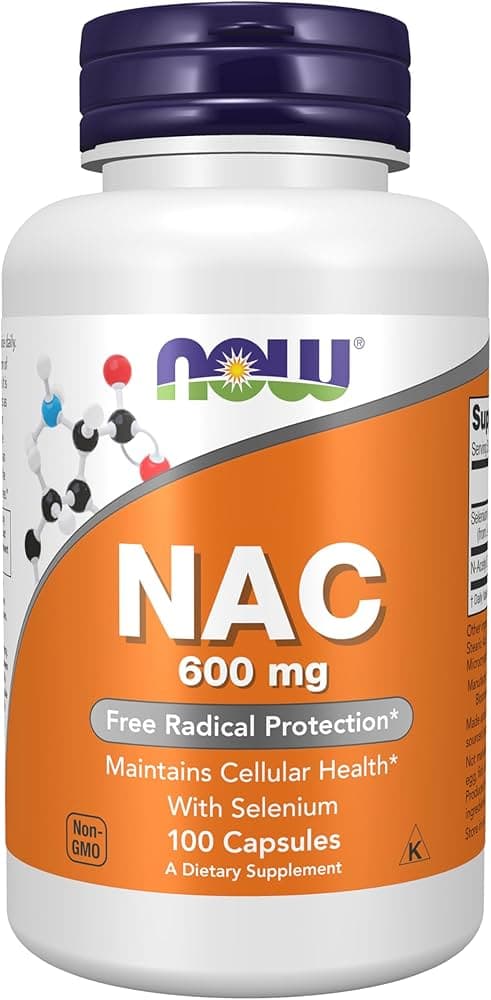
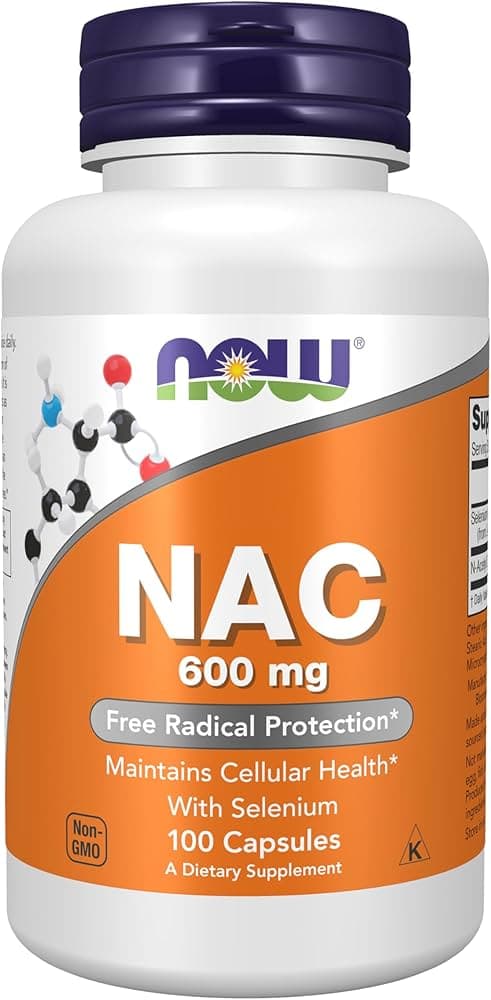
N-Acetyl Cysteine (NAC).
Glutathione precursor. Liver and lung support. Supplies cysteine, the limiting piece your cells need to build glutathione, and its free thiol loosens the disulfide bonds that make mucus thick and sticky.
Reviewed March 2026
- Category
- Amino acid
- Also filed under
- GlutathioneLiverLungs
- Also called
- N Acetyl Cysteine, N Acetylcysteine, Nacetylcysteine, N-Acetyl Cysteine
What N-Acetyl Cysteine (NAC) is, and what it does.
- Does it work
- Excellent. Used in hospitals. Strong research base.
- How much to take
- Start with 600mg to 1,200mg a day, the daily maintenance band, split in two if you sit at the upper end. The 2,400mg used in trials is a research condition.
- Time to feel it
- Mucus can loosen within hours. The glutathione side builds over one to four weeks and shows up on a blood panel rather than as a sensation.
- The first dose
- Usually a quiet day, sometimes with a faint sulfur smell from the capsule. If your chest is congested, mucus can thin out the same afternoon.
- With regular use
- Mucus effects within hours. Mental effects take weeks.
- How well tolerated
- Can thin blood. May deplete zinc with long-term use.
- How it feels
- Clearer breathing. Mental effects for some. Reduced cravings.
- The overlooked benefit
- Cysteine sulfur you don't spend on glutathione heads toward taurine and sulfate, so steady thiol intake also feeds the sulfation side of liver clearance.
600 to 1,200mg a day is where N-Acetyl Cysteine (NAC) works.
Source: Atkuri 2007 + Deepmala 2015 psych review
The proof, claim by claim.
These words describe the research, not the molecule's worth. Research strength is how much work stands behind one claim, and it is never a product score.
Based on 60 human trials.
- Glutathione synthesis supportRandomised trial
- Normal mucus consistency in the airwaysMeta-analysis
- Oxidative stress markersMeta-analysis
- Markers of liver function already in the normal rangeRandomised trial
- Exercise-related oxidative stressRandomised trial
Questions people ask about N-Acetyl Cysteine (NAC).
- When should I take it?
- Timing matters less than consistency. Pick a time that works for you and take it daily.
- Can I take it with other supplements?
- Usually fine. The main thing to watch is not doubling up on the same ingredient from different products. If you're on prescription meds, check with your pharmacist first.
- Any side effects to watch for?
- Most people tolerate it well at recommended doses. GI upset is the most common complaint with any supplement. Start with a lower dose and work up. If something feels off, stop and reassess.
- Who benefits most from this?
- People with a specific, evidence-backed need. Nac has strong research. If your situation matches the studied use case, it's one of the more reliable supplements you can take.
Why these belong in the same formula. Each row says what the basis is, from settled biochemistry through to a trial that measured the pair.
Glutathione is built inside cells from three amino acids: cysteine, glutamate, and glycine. NAC supplies the cysteine that usually limits the rate, while glycine supplies the final amino acid the enzyme needs to complete the tripeptide, so the two feed the same synthesis pathway.
Glutathione peroxidase, the enzyme that spends glutathione to neutralize peroxides, is a selenoprotein that carries selenium at its active site. NAC helps keep glutathione topped up while selenium supplies the mineral the enzyme depends on, so both are needed for the cell's normal peroxide-handling cycle.
Alpha lipoic acid and its reduced form help regenerate spent antioxidants, including glutathione, back to their active state. NAC keeps the glutathione pool supplied while lipoic acid supports its recycling, so the pair reinforces the same cellular redox network.
Vitamin C and glutathione sit in the same antioxidant chain and help return each other to the reduced, active form after quenching a reactive molecule. Because NAC feeds glutathione production, the two work together within the cell's normal redox balancing.
Cysteine is the rate-limiting amino acid for glutathione synthesis, and NAC is a stable delivery form of it. Supplying both loads the pathway at its bottleneck and at its end point.
Glutathione reductase is an FAD enzyme, so riboflavin status sets how fast oxidised glutathione is recycled back to its active thiol form. Cysteine supply without recycling capacity leaves the pool turning over slowly.
Sulfur from cysteine leaves the body through sulfite oxidase, a molybdenum enzyme that converts sulfite to sulfate. Higher sulfur amino acid intake raises the demand on that step.
Both enzymes that build cysteine from homocysteine, cystathionine beta-synthase and cystathionine gamma-lyase, depend on pyridoxal phosphate. B6 status governs how much cysteine the body can make on its own alongside what is supplied.
Betaine remethylates homocysteine back to methionine, while cysteine formation pulls homocysteine down the transsulfuration branch. The two arms draw on one shared substrate pool.
Glutathione is a tripeptide of cysteine, glycine and glutamate, and glutamine is the main circulating source of that glutamate. Supplying cysteine alone can leave the second substrate limiting.
Cysteine is oxidised to cysteine sulfinic acid and then decarboxylated toward hypotaurine and taurine. Cysteine supply is the upstream input to the same sulfur branch taurine sits at the end of.
The free sulfhydryl group on NAC binds divalent metals, including zinc, and can form complexes in the gut lumen that absorb less well. Separating the two doses by a couple of hours is the usual formulation answer.
Thiols bind copper avidly, so a large NAC dose taken with copper can hold it in a less absorbable complex. This is the same chemistry that makes NAC a metal-binding agent.
Tocopherol that has quenched a lipid radical is returned to its active form by ascorbate, which is itself regenerated at the expense of glutathione. Cysteine supply sits at the base of that recycling chain.
Methionine donates its sulfur to homocysteine, which condenses with serine to form cystathionine and then cysteine. N-acetylcysteine short-circuits that route by delivering an acetylated cysteine that intracellular deacetylases hydrolyse directly. When methionine intake is low the transsulfuration route contributes less cysteine, so the two sources are complementary rather than duplicative.
NAC is L-cysteine with an acetyl group on the amino nitrogen, which slows oxidation of the thiol during storage and in the gut. Deacetylation in enterocytes and liver releases free cysteine into the same intracellular pool that dietary cysteine feeds. Supplying both simply raises the same pool by two routes, so dosing is additive rather than mechanistically distinct.
Cystathionine beta-synthase joins homocysteine to serine, and the carbon skeleton of the resulting cysteine comes from serine, not from methionine. Serine availability therefore sets part of the ceiling on endogenous cysteine production. NAC supplies cysteine independently of that step, which is why the two act on the same output through different inputs.
S-adenosylmethionine is the allosteric activator of cystathionine beta-synthase, so its concentration helps decide whether homocysteine is remethylated or committed to cysteine synthesis. NAC enters downstream of that decision point. The pairing is mechanistic rather than a tested combination, and it should be read that way.
5-methyltetrahydrofolate donates the methyl group that converts homocysteine back to methionine, the alternative to sending it down the transsulfuration branch toward cysteine. Folate status therefore shifts how much sulfur reaches the cysteine pool. NAC adds cysteine directly, which is a different lever on the same node.
Methionine synthase needs methylcobalamin to remethylate homocysteine, so B12 status is one determinant of how homocysteine is partitioned. Where remethylation runs slowly, more homocysteine is available to the transsulfuration branch. This is normal metabolic accounting, not a claim that either nutrient changes a clinical endpoint.
Silymarin flavonolignans are described as supporting hepatic antioxidant handling, while NAC supplies the rate-limiting substrate for glutathione synthesis. The overlap is at the level of the same tissue and the same redox pool. No combination trial is cited here, so the pairing rests on mechanism.
Activated charcoal adsorbs small organic molecules non-selectively in the gut lumen and reduces how much of a co-ingested compound stays available for absorption. Oral NAC taken in the same window is subject to that adsorption. Separating the two by several hours is the ordinary way to keep the interaction from mattering.
Ubiquinol works in the lipid phase of membranes while glutathione, which NAC feeds, works in the aqueous cytosol. The two compartments hand reducing equivalents back and forth through intermediates such as ascorbate and alpha-tocopherol. This is a network argument, not a measured combination effect.
Quercetin is described as influencing Nrf2-linked expression of glutathione-synthesising enzymes, and NAC supplies the substrate those enzymes use. Pairing an inducer with a substrate is a coherent formulation idea. The support is laboratory and mechanistic, so read it as early.
Catechins auto-oxidise in neutral aqueous solution and thiols such as NAC can quench the resulting quinones, which changes the mix of species present in a formulation and in the gut. The direction of the net effect depends on concentration and pH. This is chemistry observed in vitro, not a human outcome.
Thiols reduce ferric iron to the ferrous state and can coordinate iron directly, so a large NAC dose taken with an iron supplement changes the redox state and the speciation of the iron in the lumen. The practical consequence for absorption has not been characterised in the sources cited here. Spacing the two is the conservative formulation choice.
NAC in solution is acidic and unpleasant, and bicarbonate is the usual buffer used to raise the pH of effervescent tablets and reconstituted powders. It changes palatability and dissolution, not the amount of cysteine delivered. This is formulation practice rather than a physiological pairing.
Melatonin and its metabolites scavenge oxidants directly and have been reported to influence glutathione-related enzyme expression in animal models. NAC contributes to the same pool from the substrate side. The evidence is preclinical and the pairing should be read as mechanistic.
Nothing specific on file for N-Acetyl Cysteine (NAC). Match the label to the daily amount above, and tell your doctor what you take.
Not medical advice. Show the label to your pharmacist.What N-Acetyl Cysteine (NAC) actually does.
N-acetylcysteine is just L-cysteine wearing an acetyl cap on its amino nitrogen. Inside your cells that cap gets clipped off, and the free cysteine joins the cell's amino acid pool.
How much cysteine you have on hand is what limits glutathione production. Two enzymes build it in two ATP-spending steps, first glutamate-cysteine ligase, then glutathione synthetase.
That free sulfhydryl group snaps disulfide bridges. That's the chemistry behind the way thiol compounds thin out the glycoprotein mesh that makes mucus thick.
Any cysteine sulfur your body doesn't put into protein or glutathione gets oxidised to sulfate and cleared out. One step in that path, sulfite oxidase, needs a molybdenum cofactor to run.
Where N-Acetyl Cysteine (NAC) comes from.
It starts as the amino acid cysteine, made either by fermentation or by breaking down keratin-rich material, then a small acetyl group is chemically attached to make it more stable. The result is crystallised, tested, and packed into capsules or effervescent tablets.
Chemically synthesised. The molecule is identical to the one a plant or an animal makes, and building it deliberately means a known purity, a fixed dose and no crop contaminants. For several nutrients this is the only route that reaches a usable amount.
Sourced either from bacterial fermentation of glucose with an engineered production strain, or from acid hydrolysis of keratin-rich material such as feathers or hair, depending on the supplier.
The amino group of L-cysteine is acetylated, conventionally with acetic anhydride under controlled pH, which protects the amino nitrogen and slows oxidation of the free thiol.
The product is crystallised from aqueous or aqueous-alcoholic solution and washed to remove acetic acid residues and unreacted cysteine.
Batches are assayed for acetylcysteine content, free thiol, and related substances against pharmacopoeial monographs, with optical rotation used to confirm the L-configuration.
The crystalline solid is blended with excipients. Effervescent formats add a bicarbonate and acid pair, and capsules are usually filled with minimal additional processing.
Getting N-Acetyl Cysteine (NAC) from food.
The whole-food sources on file. A supplement closes the gap, it does not replace dinner.
A gram-for-gram figure (how much of each you would eat to match a dose) will appear here once it is sourced and reviewed. This page will not print a number it cannot cite.
The forms it comes in.
The essence, in one line each.
- Pooling 28 controlled trials, NAC lowered the oxidative stress marker malondialdehyde (standardized mean difference about -1.44) and reduced blood homocysteine by roughly 1.45 pg/ml.Meta-analysis. Faghfouri et al., 2020 (European Journal of Pharmacology). PMID 32726657 ↗
- Across five randomised trials in men with below-reference semen measures, NAC raised total sperm motility by about 9.7 percentage points and also improved semen volume, sperm concentration and normal morphology versus control.Meta-analysis. Syarif et al., 2025 (Archivio Italiano di Urologia e Andrologia). PMID 40126496 ↗
- Across 22 studies in 2,515 women with irregular ovulation and raised androgens, NAC was linked to higher progesterone (SMD 0.95) and thicker endometrium (SMD 0.58) than placebo or comparison drugs, with no measurable change in estradiol, SHBG or FSH.Meta-analysis. Viña et al., 2025 (Nutrients). PMID 39861414 ↗
- The authors report clinical and translational findings for N-acetylcysteine across seven neurological indications and describe the evidence as heterogeneous in design and endpoint.Systematic review. Mindreanu et al., 2026 (International Journal of Molecular Sciences). PMID 41977262 ↗
- The authors pooled trials of N-acetylcysteine given around endoscopic pancreatic and biliary procedures and reported the pooled estimate for the primary endpoint with its confidence interval. A pooled null is a failure to detect a difference, not evidence of none.Systematic review. Hormati et al., 2025 (BMC Gastroenterology). PMID 41188701 ↗
- The trial reports changes in endocrine and metabolic laboratory markers and in ovulation induction endpoints with N-acetylcysteine supplementation. The endocrine measures are markers, not clinical outcomes.Randomised trial. Fang et al., 2024 (Journal of Ovarian Research). PMID 39415242 ↗
- Administration of N-acetylcysteine was associated with differences in apoptosis-related gene expression in granulosa cells. Gene expression is a marker and not a fertility outcome.Randomised trial. Heshmati et al., 2026 (Scientific Reports). PMID 41663453 ↗
- Prophylactic N-acetylcysteine was compared against usual care for postoperative endpoints after elective double valve surgery, with the authors reporting the between-group comparisons as measured.Randomised trial. Ram Kiran et al., 2024 (Annals of Cardiac Anaesthesia). PMID 39365130 ↗
- Selenium, N-acetylcysteine, or both were compared on thyroid-related laboratory indices in adults on maintenance haemodialysis. The endpoints are circulating markers.Randomised trial. Shahreki et al., 2022 (Pharmacology). PMID 35691282 ↗
- The trial reports duration and frequency of gastrointestinal symptoms in children given N-acetylcysteine alongside usual care compared with usual care alone.Randomised trial. Heydari et al., 2025 (BMC Pediatrics). PMID 40069676 ↗
- Adding N-acetyl cysteine to standard care was compared against standard care alone for symptom scores in adults with nerve-related lower back discomfort from disc herniation.Randomised trial. Heidari et al., 2023 (Reviews on Recent Clinical Trials). PMID 37779397 ↗
- The review pools clinical reports of N-acetylcysteine in alcohol-use and trauma-related care settings and describes the trials as small and heterogeneous.Systematic review. Ahmed et al., 2026 (BMC Psychiatry). PMID 42115982 ↗
- In a forced swim screening model, N-acetyl cysteine altered behavioural endpoints used to screen antidepressant activity. This is a rodent screening assay and not a human result.Animal study. Memudu et al., 2022 (Basic and Clinical Neuroscience). PMID 37323955 ↗
- Dietary N-acetyl cysteine was associated with differences in productive performance, biochemical indices and antioxidant gene expression in poultry.Animal study. El-Barbary et al., 2026 (Poultry Science). PMID 41935446 ↗
- N-acetyl-L-cysteine modulated PI3K/AKT/mTOR and AMPK/TSC2/mTOR signalling in embryoid body cultures. These are pathway readouts in cells.In vitro study. Simoes et al., 2026 (Brain Sciences). PMID 42192854 ↗
- Adding N-acetyl cysteine to human sperm samples after thawing was associated with differences in motility measures and in uncoupling protein 2 transcript levels. Both are laboratory markers.In vitro study. Dorodian et al., 2026 (Biopreservation and Biobanking). PMID 40566670 ↗
These are the studies our verdict leans on, chosen from the 1,498 we read for N-Acetyl Cysteine (NAC). The full linked list is below.
FDA Disclaimer: These statements have not been evaluated by the Food and Drug Administration. This information is for educational purposes only and is not intended to diagnose, treat, cure, or prevent any disease. Consult your healthcare provider before starting any supplement regimen.