N-acetylgalactosamine.
This sugar is the repeating unit inside chondroitin and dermatan sulfate and the anchor of mucin glycoproteins, so it is structural material for cartilage, skin and mucus.
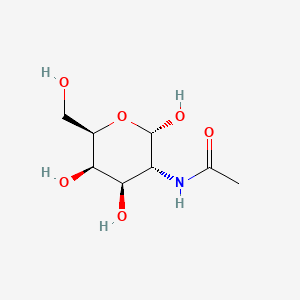 Compound
- Category
- Compound
What N-acetylgalactosamine is, and what it does.
- Does it work
- Most people meet it inside a chondroitin product rather than alone. The free sugar suits the curious, since no human trial on it exists to point at.
- How much to take
- No dose figure is on record, and no human trial has set a daily band for the free sugar. Inside chondroitin it arrives as part of the polymer.
- Time to feel it
- Nobody has measured a time course for the free sugar in people. Chondroitin research reports joint comfort changes across eight to twelve weeks.
- The first dose
- Absorbed and phosphorylated into the same nucleotide sugar pool your cells already use. Day one is biochemistry rather than sensation.
- With regular use
- Over weeks it feeds the pool cells draw on to build glycosaminoglycans and mucins. Whether extra supply changes a human measure has not been tested.
- How well tolerated
- No adverse signal is on record at food-level amounts, and no human study has examined the isolated sugar. Check with your clinician before taking it on its own.
- How it feels
- No subjective effect has been reported and nobody has looked for one. It is structural material, and it shows up in tissue rather than in sensation.
- The overlooked benefit
- It is the sugar that defines blood group A. The same molecule, clustered three at a time, is how liver-directed medicines find hepatocytes.
The proof, claim by claim.
What these words mean
These words describe the research, not the molecule's worth. Research strength is how much work stands behind one claim, and it is never a product score.
- core repeating unit of chondroitin and dermatan sulfateNarrative review
- anchor sugar of mucin-type O-linked glycosylationIn vitro study
3 more claims
- salvage of free GalNAc into the UDP sugar poolIn vitro study
- joint comfort with chondroitin sulfateMeta-analysis
- hepatocyte recognition through the asialoglycoprotein receptorNarrative review
Why these belong in the same formula, 5 pairings
Why these belong in the same formula. Each row says what the basis is, from settled biochemistry through to a trial that measured the pair.
Chondroitin sulfate is built from a repeating disaccharide of glucuronic acid and N-acetylgalactosamine, so GalNAc is a structural subunit of the finished polymer rather than a separate additive. Supplying the free amino sugar and the intact polymer are two different propositions: the polymer is absorbed and handled as a large molecule, the monosaccharide as a small one. Anyone taking both is taking the same building block in two chemically distinct states. That distinction matters more than the shared name on an ingredient panel.
Most Golgi glycosyltransferases, including the polypeptide GalNAc-transferases that start mucin-type O-glycosylation, require a divalent metal in the active site and manganese is the usual one. Without the cofactor the transfer step does not run, whatever the sugar supply looks like. This is an enzymology point about the pathway, not a reason to load manganese, which has a narrow intake range of its own. Read it as mechanistic context rather than a stacking instruction.
Hyaluronan alternates glucuronic acid with N-acetylglucosamine, the epimer partner of GalNAc, and both polymers occupy the same extracellular matrix compartment. The two are frequently formulated together for that reason. What they share is chemistry and location, not a demonstrated combined effect in people. State the overlap and stop there.
Collagen supplies the protein scaffold of connective tissue while glycosaminoglycans built on GalNAc supply the hydrated ground substance around it. Products combine them on that structural logic. The pairing is a formulation convention drawn from tissue anatomy rather than from a trial of the combination. Read it as rationale, not as evidence.
Ascorbate is the reducing cofactor for prolyl and lysyl hydroxylases, which stabilise the collagen triple helix. That is a different arm of connective tissue synthesis from the glycosaminoglycan arm that GalNAc feeds. Combining them covers two independent requirements rather than reinforcing one. The vitamin C half of this is settled biochemistry and needs no citation.
Nothing specific on file for N-acetylgalactosamine. Match the label to the daily amount above, and tell your doctor what you take.
Not medical advice. Show the label to your pharmacist.What N-acetylgalactosamine actually does.
GalNAc is the first sugar attached to certain amino acids when the body builds a whole class of glycoprotein structures, making it the anchor point for that entire process.
3 more mechanisms
The body makes its own usable form of GalNAc through an internal metabolic pathway, so it doesn't have to depend on getting it from food.
GalNAc alternates with another sugar to form the repeating chain structure found in cartilage and skin connective tissue.
Liver cells have a receptor that specifically recognizes GalNAc, which is why drug developers attach clusters of it to certain medicines to direct them to the liver.
Where N-acetylgalactosamine comes from.
A sugar your body builds into cartilage, mucus and the coating on your cells. You make it yourself from other sugars, so there is no dietary requirement. Most people meet it as part of chondroitin rather than on its own, and nobody has run a proper human trial on the free sugar.
What this route gives you
The same molecule is reached more than one way. Which route a given product used is a manufacturing choice, and the finished compound is the same either way.
6 steps on record
Animal cartilage supplies GalNAc as part of chondroitin sulfate. Microbial routes start from glucose or N-acetylglucosamine.
Polymer routes hydrolyse the glycosaminoglycan chain. Biocatalytic routes epimerise N-acetylglucosamine to the galacto configuration.
Protein, lipid and salt are removed by precipitation and filtration before the sugar is recovered.
Ion exchange or size separation removes related sugars, then the product is crystallised to a defined purity.
Identity and purity are confirmed by HPLC against a reference standard, with residual solvent and endotoxin checks on fermentation material.
Sold as a free monosaccharide powder, or supplied indirectly as the polymer subunit inside a joint ingredient.
Getting N-acetylgalactosamine from food.
The whole-food sources on file. A supplement closes the gap, it does not replace dinner.
A gram-for-gram figure (how much of each you would eat to match a dose) will appear here once it is sourced and reviewed. This page will not print a number it cannot cite.
The forms it comes in.
3 more forms
The essence, in one line each.
- Reported that endosomal cholesterol content governs how much internalised small interfering RNA escapes into the cytosol, in a delivery system that uses GalNAc for hepatocyte targeting.In vitro study. Tawfik et al., 2026 (Journal of Pharmacology and Experimental Therapeutics). PMID 41564596 ↗
Chosen from the 2 we read for N-acetylgalactosamine.
The studies, linked.
5 sources behind our N-acetylgalactosamine verdict, every one linked to PubMed, the journal or ClinicalTrials.gov.
- Clinical trialStudy of Recombinant Human N-acetylgalactosamine 4-sulfatase (rhASB) in Patients With MPS VIClinicalTrials.gov ↗Phase 3, 39 participants, Completed
4 more linked trials
- Clinical trialA Multicenter, Multinational Open-Label Extension Study of Recombinant Human N-acetylgalactosamine 4-sulfatase (rhASB) in Patients With Mucopolysaccharidosis VIClinicalTrials.gov ↗Phase 3, 39 participants, Completed
- Clinical trialA Phase 4 Multi-center, Multi-national, Open-label, Randomized, Two Dose Level Study of Naglazyme(TM) (Galsulfase) in Infants With Maroteaux-Lamy Syndrome (MPS VI)ClinicalTrials.gov ↗Phase 4, 4 participants, Completed
- Clinical trialDouble-Blind,2 Dose Group Study of Recombinant Human N-Acetylgalactosamine 4-Sulfatase in Patients With MPS VIClinicalTrials.gov ↗Phase 1, Completed
- Clinical trialOpen-Label Study of Efficacy and Safety of Recombinant Human N-acetylgalactosamine 4-sulfatase in Patients With MPS VIClinicalTrials.gov ↗Phase 2, Completed
From clinical trials and PubMed, ranked by study type and citation weight, not cherry-picked.
FDA Disclaimer: These statements have not been evaluated by the Food and Drug Administration. This information is for educational purposes only and is not intended to diagnose, treat, cure, or prevent any disease. Consult your healthcare provider before starting any supplement regimen.