N-acetylneuraminic acid.
The sialic acid that caps most of your cell surface sugars and carries their negative charge. It is concentrated in brain gangliosides and abundant in human milk.
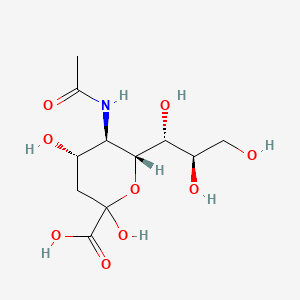 Compound
- Category
- Compound
What N-acetylneuraminic acid is, and what it does.
- Does it work
- Suits people following early-life nutrition and glycobiology closely. Human supplement trials in adults barely exist, so today the case rests on animal and cell work.
- How much to take
- No dose figure is on record and no human intake band has been set. Your body makes its own from a sugar precursor, so diet is a top-up rather than a requirement.
- Time to feel it
- Nobody has measured a time course in people. Animal feeding work reports tissue sialic acid changes across weeks.
- The first dose
- Some free sialic acid is absorbed and enters the nucleotide sugar pool within hours. Day one is biochemistry rather than sensation.
- With regular use
- Weeks of intake raise the sialic acid available for glycan building in animal studies. The matching human work has not been done yet.
- How well tolerated
- No adverse signal is on record from foods like dairy and eggs. Isolated supplementation has not been examined in adults, so check with your clinician first.
- How it feels
- No subjective effect has been reported and nobody has looked for one. This one lives on a laboratory measure rather than in sensation.
- The overlooked benefit
- Humans lost the enzyme that makes the second sialic acid, so any Neu5Gc found in your tissue arrived from red meat and dairy rather than from your own cells.
The proof, claim by claim.
What these words mean
These words describe the research, not the molecule's worth. Research strength is how much work stands behind one claim, and it is never a product score.
- terminal sialylation of cell surface glycansNarrative review
- ganglioside supply in early-life nutritionAnimal study
3 more claims
- learning and memory measures with dietary sialic acidAnimal study
- sialyllactose as a human milk oligosaccharide in infant formulaRandomised trial
- gut bacteria use of sialic acid released from mucinIn vitro study
Why these belong in the same formula, 6 pairings
Why these belong in the same formula. Each row says what the basis is, from settled biochemistry through to a trial that measured the pair.
Infant-associated bifidobacteria carry sialidases and transporters that let them use sialylated milk oligosaccharides as a growth substrate, which is part of why these organisms dominate the breastfed infant gut. Free Neu5Ac and sialyllactose are both potential substrates in that system. Whether adding either shifts an adult microbiome in a useful direction has not been settled. The enzymology is solid, the applied claim is not.
Sialic acid is almost always added onto a terminal galactose residue by a sialyltransferase, so the two sugars occupy neighbouring positions on the same glycan chain. Galactose availability is therefore part of what determines how much sialylation a chain can carry. This is structural biochemistry rather than a supplementation finding. It explains why the two co-occur constantly in the glycobiology literature.
Gangliosides are sialylated glycosphingolipids concentrated in neural membranes, and their lipid tails are enriched in long-chain fatty acids while their headgroups carry Neu5Ac. Infant formula work has combined the two on that structural logic. Sharing a molecule in tissue is not the same as a demonstrated benefit from taking both. The rationale is anatomical rather than clinical.
The carboxyl group of sialic acid is ionised at physiological pH and gives cell surfaces much of their negative charge, which binds calcium and other divalent cations. That charge behaviour is what underlies the mucus and cell-surface properties of sialylated glycans. It is a physical chemistry point about the molecule, not a claim that either ingredient changes the other's absorption in a person. Read it as mechanism.
Galactooligosaccharides and sialylated oligosaccharides are both fermentable substrates that shift bifidobacterial populations, and infant nutrition products routinely combine them to approximate the breadth of human milk oligosaccharides. They are not the same substrate and the organisms that use them overlap only partly. Combining them is a coverage strategy. The evidence for the combination is stronger in infants than in adults.
Ethanol appears alongside sialic acid in the literature mostly as an extraction and precipitation solvent, and the antagonism flag in the co-occurrence index reflects laboratory chemistry rather than an interaction inside a person. It is listed here so the flag is explained rather than silently dropped. There is no basis for presenting alcohol intake as an interaction with dietary sialic acid. This row is bookkeeping.
Nothing specific on file for N-acetylneuraminic acid. Match the label to the daily amount above, and tell your doctor what you take.
Not medical advice. Show the label to your pharmacist.What N-acetylneuraminic acid actually does.
This is the main sialic acid sugar in humans and sits at the very tip of the sugar chains on cell surfaces, which is part of why cells carry a negative charge.
3 more mechanisms
The body builds it from a series of steps starting with a related sugar, ending with an enzyme called NANS that assembles it from two smaller pieces.
Before it gets attached to a sugar chain, it has to be activated in the cell nucleus by a specific enzyme, the only sugar-activating step that happens there.
Humans have a broken version of a gene called CMAH, so we can't turn this sugar into a related one, which is why that other sugar only shows up in our tissue if we eat it.
Where N-acetylneuraminic acid comes from.
The sugar that sits on the outside of your cells and gives them their negative charge. Breast milk is loaded with it, which is where most of the interest comes from. Your body makes its own, and so far the supplement research is almost entirely in rats, pigs and cell dishes. Interesting molecule, thin human evidence.
What this route gives you
The same molecule is reached more than one way. Which route a given product used is a manufacturing choice, and the finished compound is the same either way.
6 steps on record
Fermentation routes start from simple sugars. Extraction routes start from whey, egg yolk, or edible bird's nest.
N-acetylglucosamine is epimerised to N-acetylmannosamine, then condensed with pyruvate by a sialic acid aldolase. Thermostable whole-cell systems now run this at production scale.
Cells and protein are removed by filtration. Extraction routes use mild acid hydrolysis to cleave sialic acid off glycoprotein chains.
The acidic sugar binds anion exchange resin, which separates it cleanly from neutral sugars, and it is then crystallised.
Purity is confirmed by HPLC, with checks for the related sialic acid Neu5Gc when the source is animal-derived.
Sold as the free acid, the sodium salt, or as sialyllactose for infant and gut applications.
Getting N-acetylneuraminic acid from food.
The whole-food sources on file. A supplement closes the gap, it does not replace dinner.
A gram-for-gram figure (how much of each you would eat to match a dose) will appear here once it is sourced and reviewed. This page will not print a number it cannot cite.
The forms it comes in.
3 more forms
The essence, in one line each.
- Reported that dietary N-acetylneuraminic acid supported intestinal barrier and homeostasis measures in an ageing and inflammation model.Animal study. Li et al., 2026 (International Immunopharmacology). PMID 41880677 ↗
5 more findings
- Characterised how a human transporter and pyruvate lyase pathway set the cellular balance of Neu5Ac and non-canonical sialic acids.In vitro study. Huang et al., 2026 (Glycobiology). PMID 42149948 ↗
- Reported shifts in intestinal microbial composition and metabolic activity with Neu5Ac supplementation.Animal study. Zhang et al., 2026 (Veterinary Sciences). PMID 41893712 ↗
- Reported that Neu5Ac supplementation limited the insulin resistance induced by a high fat diet, with transcriptional changes offered as the explanation.Animal study. Yida et al., 2015 (BioMed Research International). PMID 26688813 ↗
- Reported overlapping and distinct vascular effects for Neu5Ac and 3'-sialyllactose supplementation.Animal study. Zhang et al., 2026 (Food and Function). PMID 41395688 ↗
- Reported that dietary mucin acted through an Akkermansia-linked route in which released Neu5Ac was the signalling intermediate.Animal study. You et al., 2026 (Pharmacological Research). PMID 41895417 ↗
Chosen from the 9 we read for N-acetylneuraminic acid.
The studies, linked.
2 sources behind our N-acetylneuraminic acid verdict, every one linked to PubMed, the journal or ClinicalTrials.gov.
1 more linked trial
- Clinical trialPharmacokinetic Study on N-acetylneuraminic Acid in Patients With Distal Myopathy With Rimmed Vacuoles (DMRV) - Hereditary Inclusion Body Myopathy (hIBM)ClinicalTrials.gov ↗Phase 1, 6 participants, Completed
From clinical trials and PubMed, ranked by study type and citation weight, not cherry-picked.
FDA Disclaimer: These statements have not been evaluated by the Food and Drug Administration. This information is for educational purposes only and is not intended to diagnose, treat, cure, or prevent any disease. Consult your healthcare provider before starting any supplement regimen.