Orotic Acid.
Orotic acid is a step your own cells run when building the pyrimidine half of DNA and RNA. In supplements it usually rides along as the partner half of a mineral like magnesium.
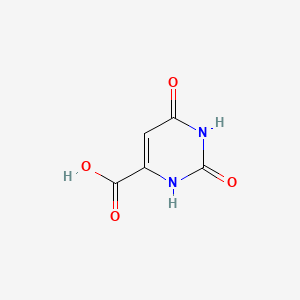 Compound
- Category
- Compound
What Orotic Acid is, and what it does.
- Does it work
- Suits anyone taking a mineral orotate who wants to know what the orotate part is doing. Dairy eaters already get some daily, since milk carries it natively.
- How much to take
- No daily amount is on record for orotic acid on its own. In a mineral orotate the mineral leads, so start with the amount that suits the mineral you are taking.
- Time to feel it
- There is no sensation to time. What a mineral orotate contributes tracks with its mineral, and that shows up on a blood panel over weeks rather than in how you feel.
- The first dose
- Day one passes quietly. The compound joins a pathway your cells already run, so the first day is measured in biochemistry, not in anything you would notice.
- With regular use
- Weeks of daily use keep feeding an intermediate your pyrimidine pathway already uses. Human long-term outcome data on orotic acid by itself is thin.
- How well tolerated
- Milk carries it natively, so dairy eaters take it in daily. High loads have driven liver fat accumulation in rodent models, so keep intakes modest and involve a clinician.
- How it feels
- Nothing subjective. Mineral orotates tend to sit easily on the stomach, so the experience is really the mineral's rather than the orotate's.
- The overlooked benefit
- Orotic acid in urine is a standard laboratory marker of how nitrogen is being handled, which is why a lab can report it even when nobody is supplementing it.
The proof, claim by claim.
What these words mean
These words describe the research, not the molecule's worth. Research strength is how much work stands behind one claim, and it is never a product score.
- intermediate of de novo pyrimidine nucleotide synthesisNarrative review
- mineral carrier in magnesium and zinc orotate formsRandomised trial
2 more claims
- urinary marker of nitrogen metabolismNarrative review
- hepatic triglyceride accumulation at high dietary loadsAnimal study
Why these belong in the same formula, 6 pairings
Why these belong in the same formula. Each row says what the basis is, from settled biochemistry through to a trial that measured the pair.
Magnesium orotate is a defined salt in which orotic acid acts as the anion carrying the magnesium. The orotate is not inert filler, since it enters pyrimidine metabolism once dissociated, but its formulation job is to give magnesium a soluble organic counter-ion. Claims that this salt delivers more magnesium than other organic salts are not settled. The pairing is formulation convention with a metabolically active anion.
Zinc orotate exists as a commercial mineral salt on the same principle as the magnesium form. Orotate provides the anion, zinc the intended active. Comparative absorption against zinc picolinate or zinc gluconate has not been established in a way that supports preferring one over another. State the salt, not a ranking.
When the urea cycle is short of ornithine or arginine, mitochondrial carbamoyl phosphate spills into the cytosol and is diverted into pyrimidine synthesis, and urinary orotic acid rises. Arginine adequacy is one of the things that keeps that overflow closed. This makes orotic acid a marker of urea cycle flux rather than something arginine acts on. It is a marker relationship, not an outcome.
Ornithine is the substrate that condenses with carbamoyl phosphate inside the mitochondrion. Limited ornithine leaves carbamoyl phosphate unused, and the excess is what feeds the orotate route. The connection is upstream substrate availability, and it explains why orotic acid shows up in urea cycle laboratory work. Nothing here says supplemental ornithine changes orotate levels in a healthy person.
The cytosolic first step of de novo pyrimidine synthesis takes its nitrogen from glutamine, and the pathway runs forward from there to orotate. Glutamine availability is therefore upstream of orotate formation in every dividing cell. This is textbook pathway architecture. It does not imply that taking glutamine raises orotate intake or vice versa.
Calcium orotate is another mineral salt using orotate as the counter-ion. As with the magnesium and zinc forms, the orotate portion is metabolically active rather than inert, which is worth knowing when totalling orotate intake across several orotate salts in one stack. Comparative calcium absorption against carbonate or citrate is not settled. The relevant point is dose accounting, not superiority.
Nothing specific on file for Orotic Acid. Match the label to the daily amount above, and tell your doctor what you take.
Not medical advice. Show the label to your pharmacist.What Orotic Acid actually does.
It is a step the body already builds on its own when it makes the building blocks of RNA and DNA.
3 more mechanisms
Two enzyme steps turn it into uridine, which the body then uses to make everything else in the pyrimidine family.
Doctors measure it in urine as a clue about how the body is clearing nitrogen. It is a signal, not a therapy.
Milk already contains it.
Where Orotic Acid comes from.
A compound your body already makes on the way to building DNA and RNA, also present in milk. In supplements it usually shows up as the partner half of a mineral, such as magnesium orotate.
What this route gives you
The same molecule is reached more than one way. Which route a given product used is a manufacturing choice, and the finished compound is the same either way.
4 steps on record
Orotic acid occurs naturally in cow milk and whey, and is also produced industrially from urea and aspartate-type precursors or by microbial fermentation.
Chemical routes build the pyrimidine ring and oxidise dihydroorotate to orotate. Fermentation routes use bacterial strains that accumulate orotate in the broth.
The free acid is precipitated and recrystallised, since it is only sparingly soluble in water.
The purified acid is reacted with magnesium, calcium, zinc or potassium hydroxides or carbonates to give the mineral orotate sold in finished products.
Getting Orotic Acid from food.
The whole-food sources on file. A supplement closes the gap, it does not replace dinner.
A gram-for-gram figure (how much of each you would eat to match a dose) will appear here once it is sourced and reviewed. This page will not print a number it cannot cite.
The forms it comes in.
4 more forms
The essence, in one line each.
- Reports that an edible insect protein source lessened the rise in blood triglycerides produced by feeding orotic acid.Animal study. Ochiai M et al., 2026 (Journal of Oleo Science). PMID 42091562 ↗
4 more findings
- Describes effects of orotic acid on cultured sheep mammary epithelial cells and maps the transcriptional pathways involved.In vitro study. Wang J et al., 2026 (BMC Veterinary Research). PMID 42001153 ↗
- Metabolomic profiling in which orotic acid appears among the metabolites shifted by maternal diet during suckling.Animal study. Pomar CA et al., 2026 (FASEB Journal). PMID 41537760 ↗
- In a cohort study of people with a diagnosed condition where the heart pumps weakly, adding orotic acid to a risk model improved its ability to predict mortality over 2 years.Cohort study, in heart failure (HF) with preserved (HFpEF) or reduced ejection fraction (HFrEF). Wu LH et al., 2026 (Cardiovascular Research). PMID 42035244 ↗
- Orotic acid figures among rumen, plasma and milk metabolites tracking with milk fat synthesis in dairy cattle.Animal study. Zhang H et al., 2026 (Animals). PMID 42071906 ↗
Chosen from the 7 we read for Orotic Acid.
The studies, linked.
2 sources behind our Orotic Acid verdict, every one linked to PubMed, the journal or ClinicalTrials.gov.
- Clinical trialEffects of Orotic Acid Derivatives With or Without Glutathione on AllergicClinicalTrials.gov ↗100 participants, Completed
1 more linked trial
- Clinical trialAn Open-Label, Phase 2 Study to Treat Patients With Renal Allograft and Polyoma BK Viruria to Prevent Polyoma BK Viremia, Polyoma BK Nephropathy and Renal Allograft RejectionClinicalTrials.gov ↗Phase 2, 24 participants, Terminated
From clinical trials and PubMed, ranked by study type and citation weight, not cherry-picked.
Problems people have reported.
Read this carefully. These are 168 voluntary, unverified reactions reported to the FDA (openFDA). The number mostly reflects how popular Orotic Acid is, not how risky it is. A report is not proof Orotic Acid caused anything. It is a signal of what to watch for, nothing more.
3 more reported effects
Source: openFDA adverse-event reports. Voluntary reporting, not an incidence rate.
FDA Disclaimer: These statements have not been evaluated by the Food and Drug Administration. This information is for educational purposes only and is not intended to diagnose, treat, cure, or prevent any disease. Consult your healthcare provider before starting any supplement regimen.