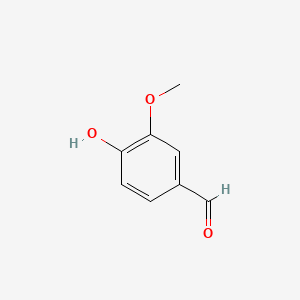
Vanillin.
It's the molecule behind vanilla aroma, and it does two jobs: it carries flavour at tiny concentrations and its phenol group scavenges radicals in the mix.
 Compound
- Category
- Compound
What Vanillin is, and what it does.
- Does it work
- Suits anyone who wants a powder or drink to taste of something without added sugar. Its job is flavour and formulation, and it's rarely taken on its own.
- How much to take
- No supplemental dose figure is on record. It flavours at fractions of a percent, so the amount in a serving is small by design rather than by restraint.
- Time to feel it
- Immediately, as taste and aroma. Nobody has measured a functional effect in people on a timescale, so there is no benefit window to give you.
- The first dose
- You taste it, and that's day one. It's oxidised to vanillic acid and cleared in urine within hours, with nothing to register beyond the flavour.
- With regular use
- Weeks of food-level intake have no measured effect in people. Its antioxidant behaviour is documented in cells and in the product itself rather than in humans.
- How well tolerated
- Well tolerated at flavouring levels and used in food for over a century. The aldehyde group reacts with amines and thiols, so it can interact with other formula ingredients.
- How it feels
- Warm, sweet, familiar. It makes a formula taste better, and that's the honest extent of the subjective experience.
- The overlooked benefit
- It's volatile and lipophilic, so an opened tub loses its vanilla smell over months. That fading aroma is a rough read on how the powder has been stored.
The proof, claim by claim.
What these words mean
These words describe the research, not the molecule's worth. Research strength is how much work stands behind one claim, and it is never a product score.
- radical scavenging activityIn vitro study
- flavour and aroma at low concentrationNarrative review
2 more claims
- conversion to vanillic acid after ingestionNarrative review
- reactivity with thiols and primary aminesIn vitro study
Why these belong in the same formula, 5 pairings
Why these belong in the same formula. Each row says what the basis is, from settled biochemistry through to a trial that measured the pair.
Plants and engineered microbes convert ferulic acid to vanillin through feruloyl-CoA and a hydratase lyase step, and the same route is run industrially in bioconversion tanks. The two compounds sit next to each other on one pathway. Anything that raises ferulic acid supply in a fermentation raises vanillin output. In a person the relationship runs the other way, since ingested vanillin is oxidised to vanillic acid rather than back to ferulic acid.
Vanillin carries a reactive aldehyde group that forms adducts with thiols, glutathione included. At high in vitro concentrations that consumes reduced glutathione rather than sparing it, which is the opposite of the antioxidant framing vanillin sometimes gets. At the microgram amounts present in food flavouring the effect is not meaningful. The direction of the interaction depends entirely on concentration and this should be stated whenever vanillin is described as an antioxidant.
The amino group and thiol of cysteine condense with an aldehyde to give a cyclic adduct, which is why cysteine is used industrially to scavenge aldehydes. In a formulation this quietly removes free vanillin and dulls the aroma. It is a compatibility point for formulators rather than a benefit. The chemistry is standard carbonyl reactivity.
With a water solubility around one gram per hundred millilitres and a marked lipophilic character, vanillin distributes into emulsified fat when one is present. Lecithin emulsions carry it evenly through a formulation and slow its loss to volatilisation. This is why liquid supplements flavoured with vanillin usually include an emulsifier. The point is stability and dispersion, not absorption.
Tocopherol interrupts lipid peroxidation chain propagation in the membrane while guaiacyl phenolics such as vanillin scavenge radicals in the aqueous phase. The two compartments are complementary in principle. Reported vanillin antioxidant effects come from animal and cell work at doses far above dietary flavour exposure. Read the pairing as mechanistic rather than clinical.
Nothing specific on file for Vanillin. Match the label to the daily amount above, and tell your doctor what you take.
Not medical advice. Show the label to your pharmacist.What Vanillin actually does.
Vanillin is an aromatic aldehyde, and it's a phenolic hydroxyl group in its structure that gives it its ability to mop up free radicals.
3 more mechanisms
Once swallowed, vanillin is mostly converted by a liver enzyme into vanillic acid, with a smaller amount going a different route, and these breakdown products get processed further and cleared out in urine.
Vanillin's aldehyde group makes it chemically reactive, it readily bonds with amine and thiol groups, which affects both how well it mixes into formulations and how it behaves in cell studies.
Vanillin is volatile and fat-soluble, which is why you can smell it at tiny amounts and why it fades out of watery, open preparations over time.
Getting Vanillin from food.
The whole-food sources on file. A supplement closes the gap, it does not replace dinner.
A gram-for-gram figure (how much of each you would eat to match a dose) will appear here once it is sourced and reviewed. This page will not print a number it cannot cite.
The forms it comes in.
3 more forms
The essence, in one line each.
- Dietary vanillin reduced markers of hepatic, renal and DNA damage in fish exposed to chronic pymetrozine.Animal study. Rahman ANA et al., 2026 (Veterinary Research Communications). PMID 41569434 ↗
1 more finding
- Vanillin appeared among the phenolic constituents concentrated by ethanol-modified supercritical fluid extraction of carrot seed, alongside antimicrobial and antioxidant activity of the whole extract.In vitro study. Qanash H et al., 2026 (Foods). PMID 42195925 ↗
Chosen from the 2 we read for Vanillin.
The studies, linked.
1 source behind our Vanillin verdict, every one linked to PubMed, the journal or ClinicalTrials.gov.
- Clinical trialClinical Trial for Oral Formula of Vanillin and Wheat Germ Oil for Treatment of Mild and Moderate COVID-19 Viral DiseaseClinicalTrials.gov ↗Phase 2, 120 participants, Unknown
From clinical trials and PubMed, ranked by study type and citation weight, not cherry-picked.
Problems people have reported.
Read this carefully. These are 47 voluntary, unverified reactions reported to the FDA (openFDA). The number mostly reflects how popular Vanillin is, not how risky it is. A report is not proof Vanillin caused anything. It is a signal of what to watch for, nothing more.
3 more reported effects
Source: openFDA adverse-event reports. Voluntary reporting, not an incidence rate.
FDA Disclaimer: These statements have not been evaluated by the Food and Drug Administration. This information is for educational purposes only and is not intended to diagnose, treat, cure, or prevent any disease. Consult your healthcare provider before starting any supplement regimen.