
The people it speaks toFieldwork August 2023
74% of US adults
take dietary supplements, and 55% are regular users, in the Council for Responsible Nutrition's 2023 consumer survey of 3,192 adults.
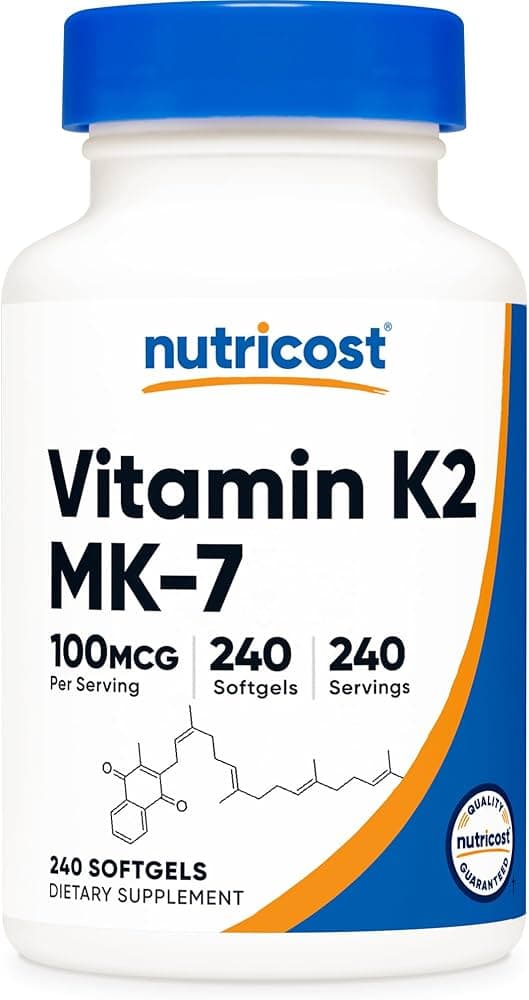
Council for Responsible Nutrition and Ipsos, 2023Vitamin K2 (as menaquinone-7) is the lead active here, studied most for filling everyday nutrient gaps. 13 human studies on Vitamin K2 (as menaquinone-7) back this formula, each one cited. Each serving carries 100 mcg of Vitamin K2 (as menaquinone-7), inside the range the published research used. Who it fits: skews toward women, adults.
 Verified by IngredientMD
The panel on the left is the one we evaluated, line by line.
All 1 actives checked against the clinical evidence: dose, form, and what the research actually shows.
Doses, ratios, and how the ingredients work together. That assessment is the verdict above: "Strong evidence, strong dose".
The verdict is public and identical whether or not a brand pays. A formula that does not clear the bar gets nothing.
Read by the engine against 2.1 million data points from clinical trials, PubMed and more than a hundred vetted sources. No individual reviewer is named or implied.
Cross-checked against 1 documented interactions for these actives.
Public health figures the engine matched to this formula's ingredients. Reported by their source, cited and dated, never written by the brand.
74% of US adults
take dietary supplements, and 55% are regular users, in the Council for Responsible Nutrition's 2023 consumer survey of 3,192 adults.
Council for Responsible Nutrition and Ipsos, 202392% of US supplement users
agree that dietary supplements are essential to maintaining their health, in the Council for Responsible Nutrition's 2023 consumer survey.
Council for Responsible Nutrition and Ipsos, 202312.3% of US adults
met the fruit intake recommendation and 10.0% the vegetable recommendation in 2019, in the Behavioral Risk Factor Surveillance System across 49 states.
CDC, MMWR, 202215% of US adults
aged 20 and over ate no breakfast on the day of their dietary recall, in the 2017 to March 2020 What We Eat in America survey.
USDA Agricultural Research Service, 202460.2% of US adults aged 20 and over
took a dietary supplement in the past 30 days, and 38.7% took two or more, in the 2021 to 2023 National Health and Nutrition Examination Survey.
CDC National Center for Health Statistics, 202659 to 66 days
was the median time it took adults to make a new daily health habit automatic across the studies a 2024 review pooled, with individuals ranging from 4 to 335 days.
Systematic review and meta-analysis, 202461% to 74%
About 61 to 74 percent of adults refilling a long-term medicine on their own stopped within a year, versus 33 to 44 percent on one set pickup day.
Cohort study, 2015Meta-analysis, 2022
Across nine trials in postmenopausal women, vitamin K2 raised lumbar spine bone density by about 2.2 percent and forearm bone density by about 1.6 percent compared with control.
Journal of Bone and Mineral MetabolismMeta-analysis, 2025
Across six mostly observational studies in 2,327 Japanese adults, habitual natto intake linked to much higher blood MK-7 and modestly greater bone density, a food-intake association, not a measured effect.
Front NutrRandomised trial, 2013
In healthy postmenopausal women, three years of 180 micrograms a day of MK-7 slowed bone density loss at the spine and hip, and improved bone strength.
The paperRandomised trial, 2020
In this trial of a low daily MK-7 amount, bone mineral density changed over the study period in the group given it, an imaging measurement, not a clinical event.
Calcified Tissue InternationalMeta-analysis, 2025
In nine trials of 2,570 older women with low bone mass, vitamin K2 changed blood signals tied to bone turnover, not actual bone strength.
Front EndocrinolSystematic review, 2026
The authors report that effects on glycaemic measures differ across groups with differing baseline blood sugar status, so results are not uniform across populations. The outcomes assessed are blood markers.
NutrientsPopulation figures from public health data. Context for the category, not a statement about any individual and not a claim about this product.
Each line below was derived from this formula's own record at the time of verification. Nothing here was written by the brand, and nothing can be added that the evidence does not carry.
Time-to-effect windows the engine read from the trial record. Each is a window a named study measured, cited and dated, never written by the brand.
A double-blind randomised dose-finding trial gave 60 postmenopausal women aged 50 to 69 either 0, 50, 100 or 200 micrograms of menaquinone-7 daily for four weeks on a controlled diet. The ratio of carboxylated to undercarboxylated osteocalcin rose dose dependently, with significant differences from the 0 microgram group at 100 and 200 micrograms. A companion 12-week trial in 120 people aged 20 to 69 confirmed the change at 100 micrograms daily. Both studies were run by authors affiliated with the R and D division of J-Oil Mills. An independent 8-week double-blind trial in 55 healthy prepubertal children found the same direction at 45 micrograms daily. What was measured is a blood marker of vitamin K status, not bone density and not a sensation.
A double-blind randomised trial gave 244 healthy postmenopausal women either placebo or 180 micrograms of menaquinone-7 daily for three years, with bone mineral density measured by DXA at baseline and after each year. Menaquinone-7 decreased the age-related decline in bone mineral content and bone mineral density at the lumbar spine and femoral neck, but not at the total hip. The effect is a slowed decline rather than a gain, and the trial ran three years rather than weeks.
Windows measured in the cited trials. Context for how the active behaves over time, not a statement about any individual and not a claim about this product.
One ingredient, from its own page.
Days for absorption, weeks for the marker. Undercarboxylated osteocalcin falls across roughly four to twelve weeks of daily intake, and that is a status marker rather than an outcome.
How each ingredient usually behaves over time, from its own page on IngredientMD. General timing for the ingredient, not a measurement of this product.
What each form is, and where it fits in a formula. Measured findings carry the study that reported them.
The long-side-chain menaquinone, usually made by bacterial fermentation of the kind that gives natto its K2. The seven-unit tail keeps it circulating far longer than the short-chain MK-4, which is why microgram doses are the convention.
In a 12-week double-blind randomised controlled trial, 71 healthy young and older adults took menaquinone-7 at 240 micrograms daily or placebo. Circulating MK-7 rose with supplementation, while recovery from a bout of muscle-damaging resistance exercise did not differ from placebo on strength, function, soreness or inflammatory markers.
Descriptions of the form itself, read from the cited studies. Not a comparison between products and not a statement about any individual.
It is a softgel, so the active is already dissolved in oil and the shell keeps it away from air and light.
Where two of this brand's products carry actives the literature has read together, the pairing and its basis are below. The evidence word is the corpus row's own confidence, never a score.
D3 absorbs calcium, K2 directs it to bones, Mg activates D3. The complete calcium optimization system.
Put an earned verification on your own product page.
These statements have not been evaluated by the Food and Drug Administration. This product is not intended to diagnose, treat, cure, or prevent any disease. This record is not medical advice. Always consult your healthcare provider before starting any supplement regimen.