14-Hydroxydocosahexaenoic Acid.
It's a signal your body builds from the DHA in fish oil. It sits at the head of the pathway that helps an inflammatory response settle once it has done its job.
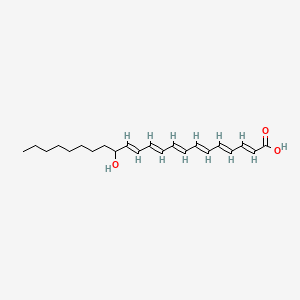 Compound
- Category
- Compound
What 14-Hydroxydocosahexaenoic Acid is, and what it does.
- Does it work
- It suits people already taking DHA who want to know what happens downstream. Your own enzymes make it, so DHA intake is the lever you actually have.
- How much to take
- No daily amount is on record for this metabolite. It isn't dosed on its own, and how much you carry follows your DHA intake and your platelet activity.
- Time to feel it
- Nobody has measured a timeline for it in people. Shifts in DHA intake show up in blood lipid measures over weeks rather than in hours.
- The first dose
- Day one is a laboratory event. Levels track DHA supply and platelet activity, so the change lands in a plasma oxylipin reading.
- With regular use
- Over weeks, steady DHA intake keeps the substrate topped up, so the pathway that makes this metabolite and the maresins has material to work with.
- How well tolerated
- It isn't sold as a stand-alone product, so tolerance is really that of fish oil. Check with your clinician first if you take blood thinning medication.
- How it feels
- No sensation attaches to a single oxylipin. What you experience comes from the fish oil it's made from, and that's a slow, quiet one.
- The overlooked benefit
- Its level rises after exercise and after injury, because platelets carry the enzyme that makes it. It partly reads platelet activity, not just diet.
The proof, claim by claim.
What these words mean
These words describe the research, not the molecule's worth. Research strength is how much work stands behind one claim, and it is never a product score.
- a healthy inflammatory responseNarrative review
- plasma oxylipin response to DHA intakeRandomised trial
3 more claims
- precursor step to maresin mediatorsIn vitro study
- tissue repair signallingAnimal study
- platelet lipoxygenase product formationIn vitro study
Why these belong in the same formula, 8 pairings
Why these belong in the same formula. Each row says what the basis is, from settled biochemistry through to a trial that measured the pair.
12-lipoxygenase adds oxygen at carbon 14 of DHA, producing the hydroperoxide that is then reduced to 14-HDHA. Every molecule of 14-HDHA in the body traces back to a DHA molecule. Tissue DHA supply therefore sets the ceiling on how much of this metabolite can be formed. This is the single most important relationship for the compound.
Marine oil raises membrane DHA over weeks, which raises the substrate available to lipoxygenase. Studies measuring oxylipin panels after omega-3 supplementation consistently show DHA-derived hydroxy metabolites rising alongside the parent fatty acid. What that means for any clinical endpoint is a separate question. The substrate relationship itself is not in doubt.
12-lipoxygenase and 15-lipoxygenase act on EPA, DHA and arachidonic acid alike, so the mix of oxylipins produced tracks the mix of fatty acids present. A high EPA to DHA ratio shifts output toward EPA-derived metabolites and away from DHA-derived ones such as 14-HDHA. This is competition for enzyme access, not interference with absorption. It is why EPA-heavy and DHA-heavy oils produce different oxylipin profiles from the same total dose.
DHA has six double bonds and oxidises readily, both through enzymes and through free radical chain reactions. Tocopherol suppresses the non-enzymatic route, which keeps oxidation channelled through the controlled lipoxygenase pathway rather than producing random oxidation products. Fish oil products routinely add tocopherol for exactly this reason. It protects the oil in the bottle and the fatty acid in the membrane.
Astaxanthin sits in the membrane and quenches singlet oxygen and peroxyl radicals, which reduces uncontrolled oxidation of highly unsaturated fatty acids. Krill oil naturally contains both, which is where the pairing originates. The effect described is on oxidative stability, not on any measured change to oxylipin output in people. Read it as formulation rationale.
Krill oil carries a share of its DHA in phospholipid form rather than as triglyceride, which follows a somewhat different absorption and distribution route. Whichever vehicle delivers it, the DHA that reaches tissue is the substrate pool for this metabolite. No head-to-head study has compared vehicles on 14-HDHA output specifically. The vehicle question is about delivery, not about the downstream chemistry.
Standard marine oil raises circulating and membrane DHA, and the oxylipin panel follows. This is the ordinary route by which someone would raise this metabolite, since 14-HDHA is not itself a common supplement ingredient. Dose and duration matter more than form. Membrane incorporation takes weeks, not days.
A diet high in omega-6 fatty acids raises arachidonic acid in membranes, which competes with DHA for lipoxygenase and cyclooxygenase access. The result is a shift in the balance of oxylipins produced rather than an absolute block. Lowering omega-6 intake and raising omega-3 intake both move that balance in the same direction. The competition happens at the enzyme, not in the gut.
Nothing specific on file for 14-Hydroxydocosahexaenoic Acid. Match the label to the daily amount above, and tell your doctor what you take.
Not medical advice. Show the label to your pharmacist.What 14-Hydroxydocosahexaenoic Acid actually does.
14-HDHA forms when a specific enzyme modifies DHA at one particular carbon. It's a breakdown product of DHA, not a separate fatty acid you'd get on its own.
3 more mechanisms
14-HDHA is an early step toward the maresin family of specialized signaling molecules, which form from the same starting point through further enzyme steps in certain immune cells and platelets.
How much of this metabolite you have depends on both how much DHA is available and how active the converting enzyme is. Raising your DHA intake raises the raw material, but it doesn't by itself determine how much actually gets converted.
Because platelets are rich in the enzyme that makes this compound, platelet activity and platelet count influence how much of it gets produced, which is one reason its levels change after exercise and after injury.
Where 14-Hydroxydocosahexaenoic Acid comes from.
This is not something you buy in a bottle in any normal sense. Your body makes it out of the DHA in fish oil, using an enzyme that platelets carry a lot of. If you want more of it, the practical lever is more DHA, not more of this.
What this route gives you
The same molecule is reached more than one way. Which route a given product used is a manufacturing choice, and the finished compound is the same either way.
4 steps on record
From marine oil, algal oil, or from elongation of dietary alpha-linolenic acid, which in people is inefficient.
The enzyme inserts molecular oxygen at carbon 14, giving 14-hydroperoxy-DHA.
Glutathione peroxidase and related enzymes reduce the hydroperoxide to the stable hydroxy compound, 14-HDHA.
Some proceeds to maresins through additional enzymatic steps. The rest is measured as a circulating oxylipin or is further metabolised and cleared.
Products claiming specialised mediator content rarely state the assay method or the amount per serving, and there is no accepted standard for how these fractions are quantified.
The forms it comes in.
2 more forms
The essence, in one line each.
- In a study of older adults with or without a diagnosed cognitive condition, the high-density lipoprotein (HDL) of men and Hispanic individuals with the condition had lower levels of DHA-derived hydroxy metabolites compared to those without the condition.Cross-sectional study, in older (70+) adults with or without mild cognitive impairment. Kelliher JC et al., 2026 (Journal of Lipid Research). PMID 41831526 ↗
2 more findings
- Oxygenated metabolites of docosahexaenoic acid and arachidonic acid altered contractility in cultured cardiac cells, showing these metabolites act as signalling molecules in their own right.In vitro study. Kawakami H et al., 2026 (Journal of Artificial Organs). PMID 41933083 ↗
- The authors review dietary influences on age-related bone loss and place omega-3-derived specialised mediators among the mechanisms discussed.Narrative review. Döding A et al., 2026 (Journal of Dental Research). PMID 41108172 ↗
Chosen from the 4 we read for 14-Hydroxydocosahexaenoic Acid.
FDA Disclaimer: These statements have not been evaluated by the Food and Drug Administration. This information is for educational purposes only and is not intended to diagnose, treat, cure, or prevent any disease. Consult your healthcare provider before starting any supplement regimen.