27-deoxyactein.
It is one of the molecules a lab measures in black cohosh root to confirm the extract is the real species at a known strength. On a label it describes the black cohosh.
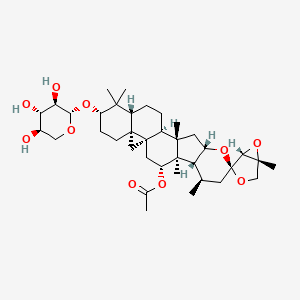 Compound
- Category
- Compound
What 27-deoxyactein is, and what it does.
- Does it work
- It matters most if you want evidence the black cohosh in your product is genuine and standardised. When you see it listed, read it as a quality marker.
- How much to take
- No dose figure is on record for the isolated compound. It is declared as part of the total triterpene glycosides in a standardised extract, commonly 2.5 percent.
- Time to feel it
- There is no timeline of its own here. Any timeline belongs to the black cohosh extract it measures, and nobody has studied the isolated molecule in people.
- The first dose
- Day one is a label fact rather than a sensation. What you took is a standardised extract, and this marker is how its strength was checked.
- With regular use
- Across weeks the value is consistency: each batch carrying the same measured glycoside content as the one before it.
- How well tolerated
- Standardised black cohosh extracts are generally well tolerated over short courses. If you take anything that works through liver metabolism, ask your doctor first.
- How it feels
- A marker compound has no sensation of its own. Where it shows up is on a certificate of analysis rather than in your body.
- The overlooked benefit
- Asian Actaea species carry a different glycoside profile, so this marker is how a lab catches a substituted root before it ever reaches a bottle.
The proof, claim by claim.
What these words mean
These words describe the research, not the molecule's worth. Research strength is how much work stands behind one claim, and it is never a product score.
- Identity and potency standardisation of black cohosh extractsNarrative review
- Detection of species substitution in the black cohosh supply chainNarrative review
1 more claim
- Oestrogen receptor affinity of black cohosh triterpene glycosidesIn vitro study
Why these belong in the same formula, 4 pairings
Why these belong in the same formula. Each row says what the basis is, from settled biochemistry through to a trial that measured the pair.
27-deoxyactein is a triterpene glycoside from the rhizome of Actaea racemosa, and it is one of the compounds used to standardise black cohosh extracts. Nobody takes it in isolation. It arrives as part of a whole extract alongside actein, cimiracemoside and the rest of the glycoside family. Reading it as a marker of extract identity rather than as a standalone ingredient is the accurate framing.
Rare liver injury reports have followed black cohosh use, enough that several regulators require a liver warning on labels even though causality has not been established and adulteration with other Actaea species is a competing explanation. Silymarin is studied for hepatic support. The pairing is a precaution built on mechanism and regulatory caution, not on any trial of the combination.
Isoflavones bind oestrogen receptors directly, particularly the beta subtype. Triterpene glycosides such as 27-deoxyactein do not show meaningful oestrogen receptor binding in the assays that have looked, and the mechanism attributed to black cohosh has moved toward serotonergic and central pathways instead. Combining them stacks two different proposed mechanisms in one product without evidence that either the individual or the combined effect holds.
Black cohosh preparations are sometimes taken in the evening and blended with chamomile in tea and capsule formats. This is formulation habit rather than a documented interaction. Neither compound has been studied against the other.
Nothing specific on file for 27-deoxyactein. Match the label to the daily amount above, and tell your doctor what you take.
Not medical advice. Show the label to your pharmacist.What 27-deoxyactein actually does.
This is a specific plant compound found in the root of black cohosh, first described in the literature under a different name.
3 more mechanisms
It's used along with related compounds as a marker to standardize black cohosh extracts, which are commonly labeled as containing a set percentage of these compounds together.
Compounds of this type generally absorb poorly from the gut and get broken down substantially by gut bacteria before much of anything reaches the bloodstream.
Since this is a marker compound rather than something sold on its own, essentially all the evidence relates to standardized whole extracts, not to this molecule in isolation.
Where 27-deoxyactein comes from.
This is not something you buy on its own. It is one of the specific molecules in black cohosh root that labs measure to prove an extract is the real thing and strong enough. If you see it on a label, it is describing the black cohosh, not naming a separate ingredient.
What this route gives you
Made from a plant. What ends up in the capsule tracks the harvest, so batch testing and a stated marker matter more here than with a made molecule.
5 steps on record
Harvested from eastern North American woodland, historically wild-collected, with cultivation increasing as wild populations came under pressure.
Dried milled rhizome is extracted with ethanol or isopropanol, which pulls the lipophilic triterpene glycoside fraction.
Producing the isolated compound requires preparative chromatography, which is why it exists in analytical quantities rather than as a bulk ingredient.
Commercial extracts are assayed and adjusted to a declared triterpene glycoside percentage, typically 2.5 percent, using 27-deoxyactein and actein as reference points.
Concentrated to a dry powder for tablets and capsules, or held as a liquid extract.
The forms it comes in.
2 more forms
FDA Disclaimer: These statements have not been evaluated by the Food and Drug Administration. This information is for educational purposes only and is not intended to diagnose, treat, cure, or prevent any disease. Consult your healthcare provider before starting any supplement regimen.