Aucubin.
Aucubin is a plant compound from plantain leaf and eucommia bark. Laboratory work links it to the antioxidant gene switches cells use under stress.
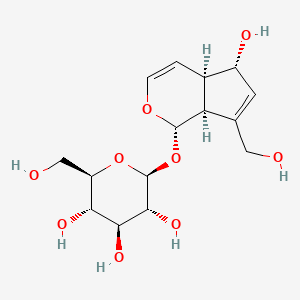 Compound
- Category
- Compound
What Aucubin is, and what it does.
- Does it work
- Suits people drawn to plantain leaf or du zhong preparations who are comfortable with early evidence. Most of what is known comes from cells and animals.
- How much to take
- No settled daily amount is on record for aucubin. Extracts declare a percentage, so start with the maker's serving. Drying and storage decide how much survives.
- Time to feel it
- Nobody has measured a time course in people. Gut bacteria have to cleave the sugar before absorption, so exposure varies from person to person.
- The first dose
- Day one is quiet. No acute sensation has been described for aucubin, and the activity reported so far sits at the level of cell signalling.
- With regular use
- Nobody has run a long-term human study on isolated aucubin. What has been used over weeks are the whole plantain leaf and eucommia bark preparations that carry it.
- How well tolerated
- No human safety dataset exists for isolated aucubin, and no toxicity signal is on record at food-level intakes. Anyone pregnant or on medication should check first.
- How it feels
- No subjective effect is on record. People taking plantain leaf preparations describe them as mild and unremarkable.
- The overlooked benefit
- It is fragile. Aucubin breaks down in acid and with heat, so how the leaf was dried and stored matters more than the percentage on the front of the pack.
The proof, claim by claim.
What these words mean
These words describe the research, not the molecule's worth. Research strength is how much work stands behind one claim, and it is never a product score.
- antioxidant gene signallingAnimal study
- a healthy inflammatory responseAnimal study
2 more claims
- everyday liver supportAnimal study
- gut microbial cleavage required before absorptionIn vitro study
Why these belong in the same formula, 5 pairings
Why these belong in the same formula. Each row says what the basis is, from settled biochemistry through to a trial that measured the pair.
Iridoid glycosides pass the small intestine largely intact and meet bacterial beta-glucosidase in the colon. The released aglycone is the more absorbable species. That makes the resident microbiota a gate on exposure, which is a plausible reason for the person to person variability seen with this class. This is mechanistic reasoning, not a measured co-administration result.
Inulin fermentation favours Bifidobacterium and related genera, several of which carry broad glycoside hydrolase activity. More of that activity in the colon means more deglycosylation of an iridoid glycoside reaching it. The logic is sound and the direct measurement for aucubin specifically has not been done. Read it as mechanistic rather than clinical.
Aucubin has been described as activating Nrf2 driven antioxidant gene expression in animal and cell work, which raises the enzymes that use glutathione. NAC supplies the rate-limiting cysteine for making glutathione itself. One raises demand-side capacity, the other raises substrate. The combination is coherent on paper and has not been tested together in people.
Quercetin glycosides and iridoid glycosides both rely on intestinal and bacterial glucosidase activity, then on phase II conjugation. At high combined intakes those steps can saturate, which is a competition rather than a boost. The direction is worth stating even though the size is unknown. Not a reason to avoid the pair.
Iridoid glycosides with a hemiacetal are known to degrade under acidic conditions, producing reactive dialdehyde intermediates that polymerise. A high ascorbic acid load in a liquid or effervescent format lowers pH and can drive that. In a dry capsule the concern is minimal. This is a formulation point rather than a physiological one.
Nothing specific on file for Aucubin. Match the label to the daily amount above, and tell your doctor what you take.
Not medical advice. Show the label to your pharmacist.What Aucubin actually does.
This is a sugar-attached plant compound, and gut bacteria have to clip off the sugar before the core molecule can be absorbed, so what happens in the gut shapes what actually gets in.
3 more mechanisms
The freed core molecule is chemically reactive, which is why isolated aucubin breaks down in acid and needs to be kept dry and cool.
It's found in several different plants, so any extract standardized on it will carry other related compounds from whichever plant it came from.
Lab studies point to it turning on antioxidant gene pathways and dialing down an inflammation-related signaling pathway, but these are cell-level observations, not measured effects in people.
Where Aucubin comes from.
It is a plant compound found in plantain leaf and eucommia bark. It falls apart quickly once the plant is picked, so how the leaf was dried matters more than almost anything else on the label.
What this route gives you
Made from a plant. What ends up in the capsule tracks the harvest, so batch testing and a stated marker matter more here than with a made molecule.
6 steps on record
Leaves of Plantago major and lanceolata, bark of Eucommia ulmoides, or leaves of Aucuba japonica. The plant chosen sets which co-occurring iridoids come with it.
Fresh tissue carries beta-glucosidase and polyphenol oxidase that degrade aucubin within hours. Fast low-temperature drying preserves the glycoside.
The glycoside is polar and extracts readily into water or dilute alcohol at controlled temperature and near-neutral pH.
Macroporous resin removes pigments and sugars, then preparative chromatography separates aucubin from catalpol and geniposidic acid when an isolate is the goal.
Extract is adjusted with carrier to a declared aucubin percentage.
Packed dry and protected from moisture and acid, since the free aglycone route degrades the molecule.
Getting Aucubin from food.
The whole-food sources on file. A supplement closes the gap, it does not replace dinner.
A gram-for-gram figure (how much of each you would eat to match a dose) will appear here once it is sourced and reviewed. This page will not print a number it cannot cite.
The forms it comes in.
3 more forms
The essence, in one line each.
- In the authors' model, aucubin supplementation reduced markers of testicular oxidative damage and preserved blood-testis barrier proteins, which they attributed to Nrf2 pathway signalling.Animal study. Wei J et al., 2023 (European Journal of Pharmacology). PMID 36460131 ↗
1 more finding
- A scoping review of Eucommia ulmoides constituents that names aucubin among the iridoids associated with bone-related signalling in preclinical work.Narrative review. Wang Y et al., 2025 (Frontiers in Pharmacology). PMID 41646940 ↗
Chosen from the 2 we read for Aucubin.
FDA Disclaimer: These statements have not been evaluated by the Food and Drug Administration. This information is for educational purposes only and is not intended to diagnose, treat, cure, or prevent any disease. Consult your healthcare provider before starting any supplement regimen.