Benzoic acid.
In a formula it's a preservative that keeps acidic liquids from spoiling. In your body it's joined to glycine and passed out in urine as hippuric acid.
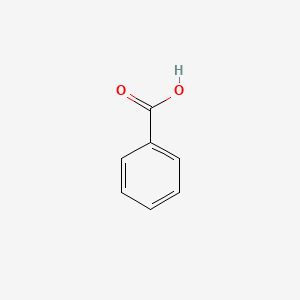 Compound
- Category
- Compound
What Benzoic acid is, and what it does.
- Does it work
- This one matters to label readers rather than dose choosers. It suits liquid, syrup and gummy formats that need microbial protection at low pH.
- How much to take
- No daily amount is on record for it as a supplement in its own right. It appears as a small preservative fraction, not as something you dose.
- Time to feel it
- Clearance is quick: urinary hippuric acid rises within hours of intake. That urinary marker is where intake shows up, rather than in sensation.
- The first dose
- Day one shows up as higher urinary hippuric acid. That's a marker of exposure, not a measure of any effect.
- With regular use
- Steady intake keeps drawing on glycine, since clearing each molecule uses one. A diet with reasonable protein replaces that glycine readily.
- How well tolerated
- Well tolerated at the small amounts used to preserve food and drink. Some people report flushing or itching. Ask a clinician if you react to preservatives.
- How it feels
- Sharply sour and slightly astringent when you can taste it. At preservative levels in a finished product there's no experience attached.
- The overlooked benefit
- It only works as a preservative in acidic products. Above about pH 5 the active undissociated form is essentially gone, so the pH tells you whether it's working.
The proof, claim by claim.
What these words mean
These words describe the research, not the molecule's worth. Research strength is how much work stands behind one claim, and it is never a product score.
- microbial preservation of acidic productsNarrative review
- glycine conjugation to hippuric acidNarrative review
2 more claims
- urinary hippuric acid as a marker of intakeCohort study
- gut microbial conversion of dietary aromatic compoundsNarrative review
Why these belong in the same formula, 9 pairings
Why these belong in the same formula. Each row says what the basis is, from settled biochemistry through to a trial that measured the pair.
In liver mitochondria, benzoate is activated to benzoyl-CoA and then conjugated with glycine by glycine N-acyltransferase, giving hippuric acid that the kidney excretes. Glycine is consumed stoichiometrically in that reaction. Sustained high benzoate intake therefore draws on the glycine pool, which is the basis for the long-standing use of benzoate in nitrogen handling. This is settled biochemistry rather than a supplement pairing.
Ascorbate reduces trace copper or iron ions, which generate hydroxyl radicals that decarboxylate benzoate to benzene. This is a documented beverage chemistry problem that led to reformulation across the soft drink category. It applies to acidic liquid products stored warm and in light, not to a dry powder or capsule. Chelating the trace metals or keeping the two apart in liquid formats is the standard answer.
Trace iron participates in Fenton chemistry that produces hydroxyl radicals, and those radicals attack the benzoate ring. Benzoate also coordinates iron directly as a carboxylate ligand. Both matter in liquid formulations rather than in dry blends. Formulators handle it with chelators and by controlling raw material metal content.
Copper cycles between its two oxidation states faster than iron does in aqueous conditions, which accelerates radical generation when ascorbate is present. Even parts per billion levels in the water supply are enough to matter over a product shelf life. Again this is liquid formulation chemistry, not something happening in the body at intake levels.
Only the uncharged benzoic acid molecule crosses microbial membranes, and its pKa is around 4.2. Above pH 5 the great majority exists as the dissociated benzoate ion, which does not cross. An alkalinising co-ingredient therefore removes most of the preservative function. This is why benzoate preservation is confined to acidic products.
A 2026 poultry study examined benzoic acid together with oregano essential oil and reported changes in intestinal histomorphology, lesion scores and tight junction gene expression. The acid lowers gut pH while the essential oil phenolics act on microbial membranes. That is two different pressures on the same populations. The work is in birds, not people.
A 2026 study combined dietary benzoic acid with cinnamon essential oil and reported effects on growth performance, antioxidant markers and intestinal measures in birds. Cinnamaldehyde and benzoic acid also share a biosynthetic relationship in plants, where cinnamic acid is a precursor to benzoic acid. The combination logic is about gut environment. Poultry results do not carry over to people.
Plants convert phenylalanine to cinnamic acid via phenylalanine ammonia-lyase, then shorten the side chain to give benzoic acid. Gut bacteria carry out related conversions on aromatic amino acids in the human colon. This is why hippuric acid in urine tracks both benzoate intake and gut microbial aromatic metabolism. It is a metabolic map point rather than a supplement combination.
Calcium carbonate neutralises acid and pushes formulation pH upward. Benzoic acid loses its preservative function above roughly pH 5 because it exists almost entirely as the ion. Putting the two in the same aqueous product defeats the preservative. In a dry blend there is no interaction.
Nothing specific on file for Benzoic acid. Match the label to the daily amount above, and tell your doctor what you take.
Not medical advice. Show the label to your pharmacist.What Benzoic acid actually does.
Your body clears benzoic acid by attaching an amino acid to it to form a compound that's excreted in urine, a two-step process that uses up ATP and a coenzyme along the way.
3 more mechanisms
Each molecule of benzoate cleared uses up one molecule of glycine. So taking in a lot of it steadily can draw down your glycine supply, which is actually the basis for using benzoate to help clear excess nitrogen in some medical contexts.
Its antimicrobial action depends on the unionised form of the acid crossing into microbial cells and acidifying them. Since it has a pKa near 4.2, that active form drops off sharply above pH 4.5 and is barely present above pH 5.
Benzoic acid occurs naturally in cranberries, lingonberries, cinnamon, cloves and gum benzoin, and shows up in cultured dairy when bacteria convert another compound into it.
Where Benzoic acid comes from.
Most of it is made industrially from toluene, though it also occurs naturally in cranberries, cinnamon and a tree resin called benzoin. The natural and the manufactured versions are the same molecule, so the route mainly affects cost and labelling rather than what it does.
What this route gives you
The same molecule is reached more than one way. Which route a given product used is a manufacturing choice, and the finished compound is the same either way.
6 steps on record
Industrial supply starts from toluene derived from petroleum. Natural-source material comes from gum benzoin resin, cranberry and lingonberry, or from cinnamon.
Toluene is oxidised with air over a cobalt or manganese catalyst at elevated temperature and pressure, giving crude benzoic acid. This route accounts for essentially all commercial volume.
For natural-source material, the benzoate esters in gum benzoin are hydrolysed to release free benzoic acid.
Crude acid is recrystallised from water or sublimed to remove catalyst residues and partial oxidation products such as benzaldehyde.
Purity is confirmed by titration or HPLC and residual toluene and benzaldehyde are checked against specification.
Sold as the crystalline acid, or neutralised with sodium, potassium or calcium hydroxide and spray-dried to the corresponding benzoate salt.
Getting Benzoic acid from food.
The whole-food sources on file. A supplement closes the gap, it does not replace dinner.
A gram-for-gram figure (how much of each you would eat to match a dose) will appear here once it is sourced and reviewed. This page will not print a number it cannot cite.
The forms it comes in.
4 more forms
The essence, in one line each.
- The authors reported effects of dietary benzoic acid on growth performance measures in the birds studied.Animal study. Józefiak D et al., 2010 (Journal of Animal Physiology and Animal Nutrition). PMID 19138347 ↗
7 more findings
- In protein-deficient diets, benzoic acid supplementation reduced rather than improved growth performance, which the authors linked to the amino acid cost of benzoate conjugation.Animal study. de Azevedo PHA et al., 2025 (Journal of Animal Science). PMID 40843539 ↗
- Dietary benzoic acid altered rumen fermentation parameters and rumen microbial composition in the animals studied.Animal study. Dai H et al., 2024 (Animals). PMID 39409772 ↗
- The authors reported improved nutrient digestibility and altered nitrogen metabolism with dietary benzoic acid.Animal study. Zhang W et al., 2024 (Frontiers in Veterinary Science). PMID 38406631 ↗
- Encapsulated benzoic acid changed gut bacterial composition and metabolic activity compared with the unencapsulated form, indicating that where in the tract the acid is released matters.Animal study. Yousaf MS et al., 2017 (British Poultry Science). PMID 27869509 ↗
- Benzoic acid with oregano essential oil altered intestinal histomorphology, lesion scores and tight junction protein expression in the birds studied.Animal study. Khukhodziinai JS et al., 2026 (Avian Pathology). PMID 42479959 ↗
- Dietary benzoic acid combined with cinnamon essential oil affected growth performance and antioxidant capacity measures in the birds studied.Animal study. Long MH et al., 2026 (Poultry Science). PMID 42114283 ↗
- Dietary lauric and benzoic acids produced immunomodulatory and histopathological changes at the mucosal level in the model used.Animal study. Rabea A et al., 2026 (Research in Veterinary Science). PMID 42349101 ↗
Chosen from the 8 we read for Benzoic acid.
The studies, linked.
3 sources behind our Benzoic acid verdict, every one linked to PubMed, the journal or ClinicalTrials.gov.
- Clinical trialRandomized Study Comparing the Efficacy and Tolerance of a Lipophilic Hydroxy Acid Derivative of Salicylic Acid and 5% Benzoyl Peroxide in the Treatment of Facial Acne VulgarisClinicalTrials.gov ↗80 participants, Completed
2 more linked trials
- Clinical trialBenzoic Acid in Beverages: Establishing a Link Between Urinary Metabolites, Metabolic Dysregulation and Weight Loss FailureClinicalTrials.gov ↗20 participants, Completed
- Clinical trialA Study to Evaluate the Pharmacokinetics of Benzoic Acid and Hippuric Acid After Topical Administration of GSK2585823 in Japanese Subjects With Acne VulgarisClinicalTrials.gov ↗Phase 1, 12 participants, Completed
From clinical trials and PubMed, ranked by study type and citation weight, not cherry-picked.
Problems people have reported.
Read this carefully. These are 375 voluntary, unverified reactions reported to the FDA (openFDA). The number mostly reflects how popular Benzoic acid is, not how risky it is. A report is not proof Benzoic acid caused anything. It is a signal of what to watch for, nothing more.
3 more reported effects
Source: openFDA adverse-event reports. Voluntary reporting, not an incidence rate.
FDA Disclaimer: These statements have not been evaluated by the Food and Drug Administration. This information is for educational purposes only and is not intended to diagnose, treat, cure, or prevent any disease. Consult your healthcare provider before starting any supplement regimen.