Borneol.
Borneol is an aromatic terpene from tree resin. On skin it gives a cooling feel, and in traditional formulas it's added in tiny amounts to accompany other ingredients.
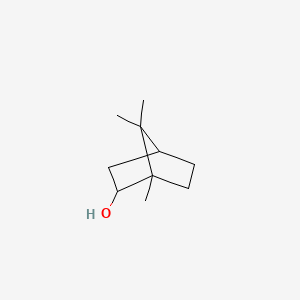 Compound
- Category
- Compound
What Borneol is, and what it does.
- Does it work
- It suits people using traditional herbal formulas or a cooling topical balm, where it sits as a minor component rather than the main event.
- How much to take
- No daily amount is on record for borneol, and it's normally used in very small quantities inside a formula rather than taken on its own.
- Time to feel it
- On skin the cooling sensation arrives within a minute or two. Taken by mouth, nobody has measured a timeline in people.
- The first dose
- Day one is a faint camphor smell and, on skin, a cool tingle. Internally, nothing has been measured in humans to point to yet.
- With regular use
- Nobody has measured what weeks of daily borneol do in people. Each exposure is short lived, since it's conjugated and cleared through the kidneys.
- How well tolerated
- In the small amounts typical of traditional formulas it's generally well tolerated. Check with your doctor if you're pregnant or taking prescription medicines.
- How it feels
- Sharp, camphor-like and cooling. On skin that's obvious. Swallowed, most people notice the aroma more than any sensation.
- The overlooked benefit
- Its cooling effect and its smell come from the same molecule that turns into camphor when oxidised, which is why a sealed, cool container matters.
The proof, claim by claim.
What these words mean
These words describe the research, not the molecule's worth. Research strength is how much work stands behind one claim, and it is never a product score.
- carrier role alongside other formula constituentsAnimal study
- GABA-A receptor modulationIn vitro study
2 more claims
- cooling sensation on skinNarrative review
- glucuronide conjugation and renal clearanceAnimal study
Why these belong in the same formula, 8 pairings
Why these belong in the same formula. Each row says what the basis is, from settled biochemistry through to a trial that measured the pair.
Berberine has notoriously low oral availability, held back by efflux and rapid first-pass handling. Borneol has been shown in animal and cell work to loosen tight junctions and raise the apparent permeability of co-dosed compounds. The classical role of borneol in formulas is exactly this, as a guiding agent added in small amounts to carry other constituents. Human pharmacokinetic confirmation of the pair is lacking, so read it as mechanistic.
Animal work reports that borneol transiently increases blood-brain barrier permeability, and formulators have used it alongside neuroactive botanicals for that reason. Nothing has measured ginkgo terpene lactone brain exposure in people with and without borneol. The pairing is a formulation tradition supported by non-human permeability data, not a demonstrated human effect.
Curcumin's problem is solubility and rapid conjugation rather than membrane crossing alone, so a permeation enhancer only addresses part of it. Borneol has been included in experimental nasal and oral delivery systems for exactly this class of molecule. Evidence sits at the formulation-science level.
Menthol is the archetypal TRPM8 agonist and borneol acts on overlapping thermosensitive channels, which is why both read as cooling on skin and mucosa. Combined topically the sensory effect stacks, and so does the irritation potential on broken skin or mucous membranes. This is a sensory and formulation interaction. It says nothing about a systemic effect.
Bornyl esters and borneol itself potentiate GABA-A currents in cell work, and valerenic acid does the same at a different site on the receptor. Combining them in a night-time formula stacks two weak modulators at one receptor complex. Neither has strong human data at supplement doses, and the caution is more about layering sedating agents than about any expected benefit.
Melatonin shifts timing rather than sedating directly, but the practical experience of combining it with a GABA-active terpene is more grogginess than either alone in some people. The interaction is behavioural and unmeasured. Flagged so that anyone layering an evening stack counts both.
Borneol is absorbed quickly and conjugated to borneol glucuronide before renal excretion. Quercetin is heavily glucuronidated on the same enzyme family. High co-doses can in principle slow each other's clearance. This is inferred from shared metabolic route rather than measured for this pair, so the confidence stays low.
Borneol dissolves readily in oils and alcohols and barely at all in water, so any oral or topical preparation needs a lipid or alcoholic vehicle to get it into solution and keep it there. Carrier oils also slow evaporative loss from topical preparations. This is formulation chemistry.
Nothing specific on file for Borneol. Match the label to the daily amount above, and tell your doctor what you take.
Not medical advice. Show the label to your pharmacist.What Borneol actually does.
Borneol is a two-ring plant compound related to camphor, and it exists as multiple distinct forms with different natural sources.
3 more mechanisms
Borneol can be oxidized into camphor and camphor reduced back into borneol, and that back-and-forth is the basis of the main way it's made synthetically, which is why synthetic material comes as a mix of forms rather than one pure isomer.
It's volatile, forms crystals at room temperature, evaporates readily, and dissolves in alcohol and oils rather than water, and those traits shape how it's stored and formulated.
After absorption it gets processed by the liver and cleared through the kidneys, which is why its presence in the body is short-lived after a dose taken by mouth.
Where Borneol comes from.
A waxy, camphor-smelling crystal that comes from tree resin or is made from turpentine. It is used in tiny amounts, traditionally as a guiding agent said to carry other ingredients along (that role rests on animal and cell work, not human data), or to give a cooling feel on skin.
What this route gives you
The same molecule is reached more than one way. Which route a given product used is a manufacturing choice, and the finished compound is the same either way.
5 steps on record
Three separate starting points: Dryobalanops aromatica resin for d-borneol, Blumea balsamifera leaves for l-borneol, and alpha-pinene from pine turpentine or camphor for the synthetic route.
Natural routes distil and then crystallise. The synthetic route hydrates alpha-pinene or reduces camphor, and both give borneol together with isoborneol.
The crystalline solid is purified by repeated crystallisation and by sublimation, which also removes residual camphor.
Gas chromatography sets total borneol content, the borneol to isoborneol ratio and residual camphor. Optical rotation distinguishes d from l material, which is what separates the natural grades from synthetic.
Sold as crystals or flakes for compounding, or already dissolved in an oil or alcohol base for topical and aromatic products.
Getting Borneol from food.
The whole-food sources on file. A supplement closes the gap, it does not replace dinner.
A gram-for-gram figure (how much of each you would eat to match a dose) will appear here once it is sourced and reviewed. This page will not print a number it cannot cite.
The forms it comes in.
4 more forms
The essence, in one line each.
- The authors set out the botany and phytochemistry of Camphora officinarum and place borneol among the terpenoid constituents of the camphor tree alongside camphor and related monoterpenes.Narrative review. Shah K et al., 2026 (Plants). PMID 42197601 ↗
2 more findings
- A microencapsulated essential oil blend that included borneol-type terpene constituents was associated with changes in performance and fatty acid profile in the animals studied.Animal study. Safari H et al., 2026 (Translational Animal Science). PMID 41799845 ↗
- The paper surveys traditional Chinese herbs used in olfactory training and names borneol among the aromatic constituents involved.Narrative review. Zhang W et al., 2026 (Chinese Medicine). PMID 42231450 ↗
Chosen from the 3 we read for Borneol.
The studies, linked.
5 sources behind our Borneol verdict, every one linked to PubMed, the journal or ClinicalTrials.gov.
- Clinical trialPhase III Clinical Trial of Y-2 Sublingual Tablet in the Treatment of Acute Ischemic Stroke - a Multicenter, Randomized, Double-blind, Parallel, Placebo-controlled Phase III Clinical TrialClinicalTrials.gov ↗Phase 3, 914 participants, Completed
4 more linked trials
- Clinical trialEffect of Acupoint Application With Herbal Medicine in Patients With Stable Angina Pectoris: Randomized, Controlled,Double Blind Clinical StudyClinicalTrials.gov ↗Early phase 1, 200 participants, Completed
- Clinical trialNasal Irrigation With Chinese Herbal Medicine as an Adjunctive Treatment in Allergic Rhinitis: Phase 2 Randomized, Double-blinded, Placebo-controlled TrialClinicalTrials.gov ↗Phase 2, 38 participants, Completed
- Clinical trialA Randomized, Double-blind, Placebo-controlled, Multicenter Clinical Study of Edaravone Dexborneol Sublingual Tablets for the Prevention of Post-Stroke EpilepsyClinicalTrials.gov ↗Phase 3, 160 participants, Not yet recruiting
- Clinical trialSublingual Y-2(Edaravone And Borneol) Tablet For Acute Ischemic And Hemorrhagic Patients-the SALVAGE TrialClinicalTrials.gov ↗Phase 1, 24 participants, Unknown
From clinical trials and PubMed, ranked by study type and citation weight, not cherry-picked.
Problems people have reported.
Read this carefully. These are 12,548 voluntary, unverified reactions reported to the FDA (openFDA). The number mostly reflects how popular Borneol is, not how risky it is. A report is not proof Borneol caused anything. It is a signal of what to watch for, nothing more.
3 more reported effects
Source: openFDA adverse-event reports. Voluntary reporting, not an incidence rate.
FDA Disclaimer: These statements have not been evaluated by the Food and Drug Administration. This information is for educational purposes only and is not intended to diagnose, treat, cure, or prevent any disease. Consult your healthcare provider before starting any supplement regimen.