Calcium alpha-ketoisocaproate.
It's leucine with the nitrogen taken off, so it delivers the leucine carbon skeleton without adding to urea load. It sits in muscle-support and ketoanalogue formulas.
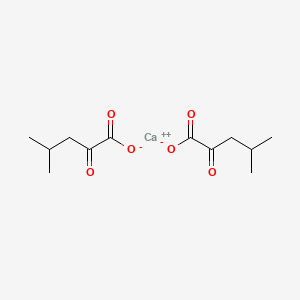 Compound
- Category
- Compound
What Calcium alpha-ketoisocaproate is, and what it does.
- Does it work
- Suits people building a leucine-adjacent stack, and people on nitrogen-restricted eating plans under supervision. If you're hitting your protein target daily, food is already supplying leucine.
- How much to take
- No dose figure is on record. With a single record at Europe PMC there's no maintenance band to lead with, so the amount is one to set with a clinician.
- Time to feel it
- Nobody has measured a time to effect for this compound on its own.
- The first dose
- Day one is quiet. The keto acid joins branched-chain metabolism alongside the leucine already circulating.
- With regular use
- No long-term picture has been published for it as a standalone. What's known is where it sits in leucine metabolism, not what weeks of it do.
- How well tolerated
- Human data at supplement amounts is thin. The calcium salt adds to your daily calcium intake. Speak to a clinician if you have kidney concerns or are pregnant.
- How it feels
- No subjective reports have been published. Calcium salts of keto acids are typically bland to slightly sour in water.
- The overlooked benefit
- Its metabolism runs on B vitamins: the transaminase step needs B6 and the committed oxidation step needs thiamine, riboflavin and niacin. That's why B vitamins sit next to it.
500 to 1,000mg a day is where Calcium alpha-ketoisocaproate works.
Source: NIH ODS + USPSTF 2018 + WHI calcium trial
The proof, claim by claim.
What these words mean
These words describe the research, not the molecule's worth. Research strength is how much work stands behind one claim, and it is never a product score.
- delivery of the leucine carbon skeleton without amino nitrogenNarrative review
- nitrogen-sparing nutrition in restricted dietsNarrative review
2 more claims
- conversion to hydroxymethylbutyrate through a cytosolic dioxygenaseNarrative review
- muscle protein supportAnimal study
Why these belong in the same formula, 15 pairings
Why these belong in the same formula. Each row says what the basis is, from settled biochemistry through to a trial that measured the pair.
Alpha-ketoisocaproate is the keto acid of leucine, and branched-chain aminotransferase moves between the two in both directions. Supplying the keto acid with an amino group donor available regenerates leucine without adding nitrogen. The same is true in the other direction: leucine given in excess is deaminated to this keto acid.
Branched-chain aminotransferase is a pyridoxal-5-phosphate dependent enzyme, so the interconversion of this keto acid and leucine cannot run without adequate B6. This is a hard biochemical dependency, not a modest additive effect. It says nothing about whether extra B6 improves anything in someone already replete.
Pyridoxal-5-phosphate is the coenzyme form that transaminases actually use, so it enters the pathway without the conversion step that pyridoxine requires. The dependency is the same one described for B6 generally. Choosing between the two forms is a delivery question, and both feed the same reaction.
Onward oxidation of alpha-ketoisocaproate runs through the branched-chain alpha-keto acid dehydrogenase complex, whose first component needs thiamine pyrophosphate. Without thiamine, branched-chain keto acids accumulate rather than being oxidised. This is textbook, and it is why thiamine status matters wherever branched-chain load is raised.
The dihydrolipoyl dehydrogenase component of the branched-chain keto acid dehydrogenase complex carries FAD, which is built from riboflavin. The complex is a riboflavin-dependent machine in the same way pyruvate dehydrogenase is. The relationship is structural, so it holds regardless of dose.
The same dehydrogenase complex reduces NAD to NADH at its final step, so niacin-derived NAD is consumed by branched-chain keto acid oxidation. Cellular NAD supply is shared with many other pathways, which makes this less of a bottleneck than thiamine. It belongs in the mechanism map rather than in a dosing recommendation.
Further down the leucine catabolic route, 3-methylcrotonyl-CoA carboxylase is a biotin-dependent enzyme. Poor biotin status shows up as a specific pattern of leucine-pathway intermediates. That makes biotin a genuine part of the pathway rather than a general-purpose addition.
A minor cytosolic route converts alpha-ketoisocaproate to HMB via a dioxygenase, so the keto acid sits directly upstream of HMB. Only a small fraction of leucine flux takes that turn in humans. Taking both supplies the precursor and the product of the same short step.
Transamination of this keto acid back to leucine needs an amino group donor, supplied through the glutamate and glutamine pool. Where that pool is low, the keto acid is oxidised rather than converted. The pairing is about which direction the transaminase runs.
Valine, leucine and isoleucine share the same aminotransferase, the same dehydrogenase complex and the same LAT1 transporter at the cell membrane. Loading one branched-chain skeleton heavily shifts the handling of the other two. That competition is the reason branched-chain products are usually blended rather than given singly.
Whey is naturally high in leucine, so a whey dose already loads the same pathway this keto acid feeds. Stacking the two is additive rather than complementary. Where whey intake is already substantial, the marginal contribution of the keto acid is small.
The calcium in the salt competes with non-heme iron for uptake when the two arrive together. This has nothing to do with the keto acid and everything to do with the counter-ion. Separating the doses by a couple of hours resolves it.
Calcium taken in a single sizeable dose reduces zinc uptake in the same meal. Again, the interaction belongs to the salt rather than the active. It matters more for people relying on a marginal zinc intake.
A calcium salt of an organic acid contributes elemental calcium that most labels do not put on the front. Added to a dedicated calcium supplement, the day's total climbs without anyone intending it. Count both when tallying intake.
Calcium and magnesium share absorptive and renal handling, and a large calcium load shifts magnesium balance modestly. The effect is small at supplemental calcium doses of this size. Note it for people taking several calcium-salt products at once.
Nothing specific on file for Calcium alpha-ketoisocaproate. Match the label to the daily amount above, and tell your doctor what you take.
Not medical advice. Show the label to your pharmacist.What Calcium alpha-ketoisocaproate actually does.
Alpha-ketoisocaproate is the related keto acid form of leucine. An enzyme can convert between the two, so this keto acid delivers leucine's carbon skeleton without the nitrogen.
3 more mechanisms
The enzyme that converts between the two needs vitamin B6 as a helper, same as other similar enzymes.
Fully breaking down this keto acid needs a whole enzyme complex that requires several B vitamins plus other cofactors, and this is the slowest, rate-limiting step in breaking down these amino acids.
A small side pathway turns this compound into a related molecule using a specific enzyme, and only a small share of leucine takes this route in the body.
Where Calcium alpha-ketoisocaproate comes from.
It is leucine with the nitrogen taken off, made in a factory and stuck to calcium so it stays a dry powder instead of a sticky mess.
What this route gives you
Chemically synthesised. The molecule is identical to the one a plant or an animal makes, and building it deliberately means a known purity, a fixed dose and no crop contaminants. For several nutrients this is the only route that reaches a usable amount.
6 steps on record
Chemical routes start from a branched aldehyde and a cyanide or oxalate synthon. Enzymatic routes start from leucine itself
The keto acid is built by cyanohydrin or oxalate condensation and hydrolysis, or generated from leucine by an amino acid oxidase or transaminase
The crude acid is purified by extraction and repeated crystallisation to strip residual precursors
Titrated with calcium hydroxide or calcium carbonate to the salt, then dried under controlled humidity
Content confirmed by HPLC against a keto acid reference, with checks on residual solvent, moisture and calcium content
Milled and blended into capsules, tablets or ketoanalogue formulations
The forms it comes in.
3 more forms
FDA Disclaimer: These statements have not been evaluated by the Food and Drug Administration. This information is for educational purposes only and is not intended to diagnose, treat, cure, or prevent any disease. Consult your healthcare provider before starting any supplement regimen.