Calcium hydroxymethylbutyrate.
A leucine metabolite that leans on the breakdown side of muscle protein turnover, so it's used to help hold on to the muscle you already have.
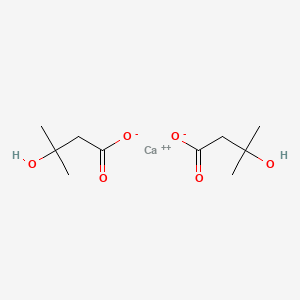 Compound
- Category
- Compound
What Calcium hydroxymethylbutyrate is, and what it does.
- Does it work
- Suits people eating in a deficit, returning after a training break, or working to keep muscle later in life. Trained lifters already eating plenty of protein see a smaller effect.
- How much to take
- No dose figure is on record here. Daily maintenance is the pattern it fits, split across the day with meals, and steadiness matters more than any single serving.
- Time to feel it
- The change shows up on a body composition reading over several weeks, rather than in how a session feels that afternoon.
- The first dose
- Nothing to sense on day one. The calcium salt is absorbed more slowly than the free acid, so plasma levels rise gently rather than spiking.
- With regular use
- Across weeks of daily use alongside training and enough protein, the measured outcome is lean mass retained. That's a marker on a scan, not a feeling.
- How well tolerated
- Well tolerated in trials running several weeks. It clears through the kidneys, so check with a clinician if kidney function is a concern, and count the calcium it adds.
- How it feels
- No sensation to speak of. It's chalky in water, and the result lands in a body composition measurement rather than in how you feel.
- The overlooked benefit
- The calcium salt and the free acid aren't interchangeable on timing. The free acid peaks earlier and higher, the salt arrives more slowly, so the dosing pattern differs between them.
500 to 1,000mg a day is where Calcium hydroxymethylbutyrate works.
Source: NIH ODS + USPSTF 2018 + WHI calcium trial
The proof, claim by claim.
What these words mean
These words describe the research, not the molecule's worth. Research strength is how much work stands behind one claim, and it is never a product score.
- lean mass retention alongside resistance trainingMeta-analysis
- muscle maintenance in older adultsMeta-analysis
4 more claims
- attenuation of muscle protein breakdown signallingRandomised trial
- recovery markers after resistance exerciseRandomised trial
- cholesterol synthesis within muscle cells supporting membrane integrityAnimal study
- renal clearance shaping exposureNarrative review
Why these belong in the same formula, 11 pairings
Why these belong in the same formula. Each row says what the basis is, from settled biochemistry through to a trial that measured the pair.
HMB is a leucine metabolite, formed from leucine by way of alpha-ketoisocaproate, so the two occupy the same pathway at different points. Only a small fraction of leucine flux turns into HMB, which is the argument for supplying the metabolite directly. Taken together they load the same route rather than two independent ones.
Alpha-ketoisocaproate is the immediate precursor, converted to HMB by a cytosolic dioxygenase. Supplying both gives the substrate and the product of one enzymatic step. It also doubles the calcium load, since both are usually sold as calcium salts.
Whey is leucine-rich, so a whey dose already delivers the precursor from which a little HMB is made endogenously. Adding the metabolite bypasses the conversion bottleneck. The pairing is common in practice, and the effects are not independent of one another.
Vitamin D status and muscle function are linked through vitamin D receptor signalling in muscle tissue, and the two are combined in most products aimed at age-related muscle loss. Trials have generally tested the combination rather than isolating either component. That makes the pairing conventional and the attribution unclear.
Creatine acts on phosphocreatine availability during short intense effort while HMB is discussed in terms of protein turnover. The mechanisms do not overlap, which is the usual argument for stacking them. Whether the combined effect exceeds either alone remains inconsistent across the literature.
Slow-digesting casein raises amino acid availability across a long window, which is the rationale for pairing it with HMB overnight. The reasoning is about timing rather than a shared enzyme step. No trial has isolated this specific combination.
The step that turns leucine into alpha-ketoisocaproate, the precursor of HMB, is a pyridoxal-5-phosphate dependent transamination. B6 status therefore governs endogenous HMB production, though not the handling of an HMB dose already supplied. The relevance is upstream of the ingredient, which is worth stating plainly.
A meaningful calcium dose taken alongside zinc reduces zinc uptake in that meal. Again this tracks the counter-ion rather than the active moiety. It matters most at the larger daily amounts of the calcium salt used in typical protocols.
A full daily protocol of calcium HMB carries a non-trivial amount of elemental calcium that rarely appears on the front of a label. Stacked with a dedicated calcium supplement, the daily total rises unintentionally. Count both.
Both appear in clinical nutrition formulas aimed at preserving lean tissue, usually alongside arginine as well. The published work tests the blend rather than the parts. Read any combined claim as belonging to the formula, not to either ingredient.
Collagen peptides supply glycine, proline and hydroxyproline for connective tissue, while HMB is discussed in terms of contractile protein turnover. They target different tissue compartments and do not compete. The pairing is a formulation rationale without direct combined evidence.
Nothing specific on file for Calcium hydroxymethylbutyrate. Match the label to the daily amount above, and tell your doctor what you take.
Not medical advice. Show the label to your pharmacist.What Calcium hydroxymethylbutyrate actually does.
HMB is a byproduct of how the body handles leucine, made through a couple of enzyme steps, though only a small share of leucine actually goes this route.
3 more mechanisms
The calcium salt form includes elemental calcium alongside the active part, so taking a full daily amount adds a measurable amount of calcium to your intake.
The proposed action is on protein turnover, either slowing breakdown signals or supporting building signals, and it's still debated which side matters more, since the two haven't been cleanly separated in human studies.
HMB can be turned into a building block for cholesterol inside muscle cells, one proposed way it might support membrane integrity in stressed tissue.
Where Calcium hydroxymethylbutyrate comes from.
Your body makes a trickle of this from leucine. The supplement is not made that way at all: it is built in a chemical plant from simple starting materials, then stuck to calcium so it stays a dry powder.
What this route gives you
Chemically synthesised. The molecule is identical to the one a plant or an animal makes, and building it deliberately means a known purity, a fixed dose and no crop contaminants. For several nutrients this is the only route that reaches a usable amount.
6 steps on record
Commercial routes start from simple ketone feedstocks rather than from leucine, despite HMB being a leucine metabolite in the body
Controlled oxidation, historically with hypochlorite or permanganate chemistry, builds the beta-hydroxy acid skeleton
The crude acid is extracted and recrystallised to strip oxidant residues and process by-products
Titrated with calcium hydroxide and crystallised as the monohydrate, which is what makes it a handleable dry powder
Content by HPLC, with checks on residual solvent, heavy metals from the oxidant step, moisture and calcium content
Milled calcium salt for capsules and powders, or the free acid delivered as a gel
Getting Calcium hydroxymethylbutyrate from food.
The whole-food sources on file. A supplement closes the gap, it does not replace dinner.
A gram-for-gram figure (how much of each you would eat to match a dose) will appear here once it is sourced and reviewed. This page will not print a number it cannot cite.
The forms it comes in.
2 more forms
The essence, in one line each.
- The authors review the rationale and available data for using hydroxymethylbutyrate together with branched-chain amino acids against muscle loss in people with reduced kidney function.Narrative review. Marrone G et al., 2026 (Nutrients). PMID 41683304 ↗
Chosen from the 1 we read for Calcium hydroxymethylbutyrate.
FDA Disclaimer: These statements have not been evaluated by the Food and Drug Administration. This information is for educational purposes only and is not intended to diagnose, treat, cure, or prevent any disease. Consult your healthcare provider before starting any supplement regimen.