Creatinol-O-Phosphate.
A synthetic buffering compound taken before hard training, aimed at helping muscle keep producing energy as acidity climbs during repeated all-out efforts.
 Compound
- Category
- Compound
What Creatinol-O-Phosphate is, and what it does.
- Does it work
- It suits athletes doing repeated high-intensity work who already have the basics covered. Human performance data in trained people is thin, so set expectations accordingly.
- How much to take
- No daily amount is on record, so we won't invent one. It is used as a pre-training ingredient rather than something built up in the body over time.
- Time to feel it
- Buffering is an acute effect, so whatever it does happens in the session it is taken before rather than after weeks of loading.
- The first dose
- Nothing dramatic on day one. Any effect would register as one or two extra reps at the end of a hard set rather than as a sensation you can point to.
- With regular use
- It doesn't load into muscle the way creatine does, so weeks of daily use aren't expected to build a store. Nobody has measured long-term use in trained athletes.
- How well tolerated
- Older cardiology research used it without notable tolerance problems, though modern human data is limited. Check with a clinician if you take heart medication.
- How it feels
- No buzz to report. It sits in the background of a pre-workout formula, and any effect reads as slightly better output late in a hard set.
- The overlooked benefit
- Despite the name it is not a creatine precursor and never becomes phosphocreatine, so it doesn't overlap with creatine and can sit alongside it in the same formula.
The proof, claim by claim.
What these words mean
These words describe the research, not the molecule's worth. Research strength is how much work stands behind one claim, and it is never a product score.
- Anaerobic performance across repeated high-intensity effortsRandomised trial
- Intracellular buffering as intramuscular pH fallsNarrative review
1 more claim
- Sustaining glycolytic flux under acid loadIn vitro study
Why these belong in the same formula, 10 pairings
Why these belong in the same formula. Each row says what the basis is, from settled biochemistry through to a trial that measured the pair.
Creatine works by expanding the phosphocreatine pool that regenerates ATP in the first seconds of effort. Creatinol-O-phosphate is not a creatine precursor and does not feed that pool, despite the similar name. Its described role is sustaining anaerobic glycolysis under falling intracellular pH. Because the two act at different points, they are complementary rather than interchangeable, and one does not substitute for the other.
Carnosine is the main intracellular buffer in skeletal muscle and beta-alanine availability limits how much of it is made. Creatinol-O-phosphate is described as sustaining glycolytic flux when intracellular pH falls. Both are aimed at the same limiting factor in repeated high-intensity work, by different means. The combination has not been tested in controlled human work.
Sodium bicarbonate raises blood buffering capacity, which steepens the gradient for proton export from working muscle. That is a different compartment from the intracellular route creatinol-O-phosphate is described as acting on. Buffering inside and outside the cell are complementary rather than duplicative. Bicarbonate brings its own gastrointestinal cost at effective doses.
Taurine is one of the most abundant free amino acids in skeletal muscle and participates in osmotic regulation and calcium handling at the sarcoplasmic reticulum. It occupies a different part of the contraction cycle than a glycolytic buffering agent. Both appear together in pre-workout formulas on that basis. The pairing is formulation rationale, not measured combination data.
Caffeine antagonises adenosine receptors and lowers perceived exertion, which is a central mechanism. Creatinol-O-phosphate is described peripherally, in muscle metabolism. Combining a central and a peripheral route is the standard construction of a pre-workout formula. Caffeine also raises heart rate and blood pressure acutely, which should be counted separately.
Citrulline bypasses first-pass metabolism to raise plasma arginine, which feeds nitric oxide synthesis and vasodilation. Better perfusion and better intracellular buffering are separate limiting factors in sustained effort. That makes the pairing non-redundant on mechanism. Nothing has been measured for the combination itself.
ATP is functionally Mg-ATP in cells, and every phosphotransfer reaction in muscle energetics requires magnesium as a cofactor. That includes the glycolytic kinases and creatine kinase. This is textbook biochemistry rather than a specific interaction with creatinol-O-phosphate. It is background sufficiency, not a stacking effect.
Repeated maximal effort depletes the total adenine nucleotide pool, and rebuilding it goes through the pentose phosphate pathway where ribose-5-phosphate supply is slow. Supplemental ribose is proposed to shorten that. It addresses nucleotide replacement rather than pH, so it does not overlap with a buffering agent. Human performance data for ribose is mixed.
HMB is a leucine metabolite associated with attenuated protein breakdown rather than acute performance. A buffering or glycolytic agent addresses what happens within the session. The two occupy different timescales in the same training context. Neither the combination nor the additivity has been measured.
Sustained muscle contraction depends on the sodium and potassium gradients across the sarcolemma, which are maintained by the sodium-potassium ATPase. Losing electrolytes through sweat degrades that independently of anything happening to intracellular pH. Both matter for repeated high-intensity work. This is established physiology rather than a specific pairing effect.
Nothing specific on file for Creatinol-O-Phosphate. Match the label to the daily amount above, and tell your doctor what you take.
Not medical advice. Show the label to your pharmacist.What Creatinol-O-Phosphate actually does.
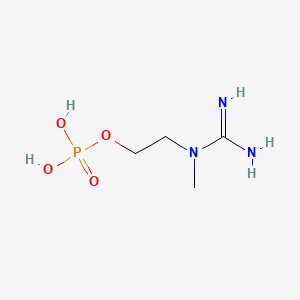
This is a synthetic compound that shares a chemical group with creatine but has a different overall structure.
3 more mechanisms
Despite the similar name, this compound doesn't turn into creatine or phosphocreatine in the body, so it doesn't add to that energy reserve and isn't a creatine building block.
As lactic acid builds up during exercise, it slows down a key enzyme in the sugar-burning pathway, and that's the well-established brake that buffering compounds like this one are meant to address.
It carries a phosphate group in its structure, which matters for a product's acidity and total phosphate content, but that doesn't mean it feeds the body's phosphocreatine energy system.
Where Creatinol-O-Phosphate comes from.
This one is made in a lab from scratch. There is no plant, animal or food that contains it. It is built in two chemical steps, and the finished powder soaks up moisture from the air, so it needs a well-sealed container.
What this route gives you
Chemically synthesised. The molecule is identical to the one a plant or an animal makes, and building it deliberately means a known purity, a fixed dose and no crop contaminants. For several nutrients this is the only route that reaches a usable amount.
6 steps on record
Both are ordinary industrial chemical feedstocks. There is no botanical, animal or fermentation source for this molecule, and it does not occur in food.
Cyanamide is condensed with N-methylethanolamine to form the guanidine, giving creatinol, which carries the free hydroxyl group.
The hydroxyl is esterified with a phosphorylating agent to give the O-phosphate. This is the step that distinguishes creatinol-O-phosphate from creatinol.
The product is crystallised and, where a salt form is made, neutralised with sodium to improve handling and solution pH.
HPLC assay confirms the phosphate ester content and quantifies unphosphorylated creatinol, which is the main process-related impurity.
Blended into a drink powder or encapsulated. The material is hygroscopic, so moisture control in packaging matters.
The forms it comes in.
2 more forms
FDA Disclaimer: These statements have not been evaluated by the Food and Drug Administration. This information is for educational purposes only and is not intended to diagnose, treat, cure, or prevent any disease. Consult your healthcare provider before starting any supplement regimen.