Hydrastine.
Hydrastine is one of the two marker alkaloids in goldenseal root. On a label it is the number that shows the root is genuine goldenseal and not a look-alike plant.
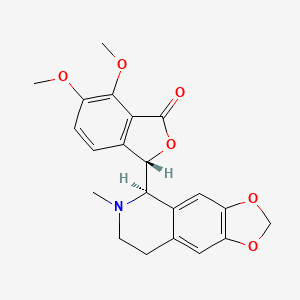 Compound
- Category
- Compound
What Hydrastine is, and what it does.
- Does it work
- Useful to anyone buying goldenseal who wants the label to prove identity. If you take prescription medicine, speak to your prescriber before using goldenseal at all.
- How much to take
- No daily amount is on record for hydrastine on its own. It arrives as a stated percentage of a goldenseal product, so start with that product's own label.
- Time to feel it
- Nobody has measured a time course for hydrastine alone in people. Its work as a goldenseal marker shows up in identity testing rather than in a sensation.
- The first dose
- Bitterness is the noticeable part of a first dose. The alkaloid itself acts on liver and gut enzyme activity, which is measured in blood rather than felt.
- With regular use
- Over weeks the goldenseal alkaloids keep slowing certain liver and gut enzymes, so anything else you take by those routes clears more slowly. Review it with a prescriber.
- How well tolerated
- Goldenseal alkaloids inhibit CYP3A4 and CYP2D6, which changes how many medicines clear. Not for use in pregnancy. Check with your prescriber first.
- How it feels
- Intensely bitter and drying in the mouth from the root's tannins. Beyond that, people report no distinct sensation from the alkaloid fraction.
- The overlooked benefit
- Berberine turns up in several other plants, but hydrastine does not. A stated hydrastine percentage is the clearest sign the root in the bottle is real goldenseal.
The proof, claim by claim.
What these words mean
These words describe the research, not the molecule's worth. Research strength is how much work stands behind one claim, and it is never a product score.
- identity marker for authentic goldenseal rootNarrative review
- inhibition of drug-metabolising enzymesRandomised trial
2 more claims
- smooth muscle activity described in early pharmacologyAnimal study
- antimicrobial activity in cultureIn vitro study
Why these belong in the same formula, 6 pairings
Why these belong in the same formula. Each row says what the basis is, from settled biochemistry through to a trial that measured the pair.
Both are isoquinoline alkaloids from the same root, and goldenseal extracts are conventionally standardised to both. They are chemically distinct: berberine is a quaternary protoberberine with a permanent positive charge, hydrastine is a phthalideisoquinoline that is not permanently charged. This difference drives quite different absorption behaviour. Data generated on berberine does not transfer to hydrastine, and the two should not be discussed interchangeably.
Practically no product sells isolated hydrastine. What is on the market is goldenseal root standardised to a stated hydrastine and berberine percentage. This matters because everything documented about goldenseal, including its interaction profile, was generated on the whole extract, not on hydrastine alone. Attribution to the single alkaloid is usually unwarranted.
Goldenseal is one of the better-documented botanical inhibitors of cytochrome P450 enzymes, notably CYP3A4 and CYP2D6, which together handle a large share of orally administered medicines. Silymarin has its own, generally weaker, effects on the same system. Combining two agents that both act on drug metabolism raises the chance of altering the handling of anything else taken alongside. Anyone on prescription medication should raise this with their prescriber rather than working it out from a label.
Grapefruit furanocoumarins irreversibly inactivate intestinal CYP3A4, and goldenseal alkaloids inhibit the same enzyme. Because the effects run in the same direction on a shared target, combining them compounds the effect on first-pass metabolism. The consequence is higher systemic exposure to co-administered CYP3A4 substrates. This is the single most practically important thing to know about goldenseal-type alkaloids.
Piperine is added to formulations precisely because it slows first-pass metabolism and raises systemic exposure to co-ingested compounds. Goldenseal alkaloids do the same thing through overlapping targets. Stacking two metabolic inhibitors in one product amplifies the effect on anything else in the gut at the same time, including prescription medicines. This is a flag rather than a benefit.
Hydrastine biosynthesis in the plant proceeds from tyrosine through dopamine and 4-hydroxyphenylacetaldehyde to norcoclaurine, and the decarboxylation steps require pyridoxal-5-phosphate. This is plant biochemistry and describes how the compound is made, not anything about what it does in a person taking it. It is included because it explains the alkaloid's structural family.
Nothing specific on file for Hydrastine. Match the label to the daily amount above, and tell your doctor what you take.
Not medical advice. Show the label to your pharmacist.What Hydrastine actually does.
Hydrastine is one of the two main active compounds in goldenseal root, the other being berberine.
3 more mechanisms
Berberine carries a permanent electrical charge that limits how easily it crosses cell membranes, while hydrastine doesn't carry that same permanent charge, so the two compounds are absorbed differently.
Goldenseal is one of the better-studied plants for blocking liver enzymes that clear a large share of prescription medications, which makes drug interactions a real practical concern here.
Commercial goldenseal is standardized by its combined hydrastine and berberine content, and a product with no such figure on the label isn't a well-defined material. Substitution with cheaper look-alike plants containing berberine has also been documented.
Where Hydrastine comes from.
Hydrastine is one of two main alkaloids in goldenseal root. You will almost never see it sold on its own. It shows up as a number on a goldenseal label next to berberine. That number does real work, because berberine turns up in several cheaper plants while hydrastine is specific to goldenseal, so its presence is how you tell the real thing from a substitute. The important practical point: goldenseal alkaloids slow down the liver and gut enzymes that process a large share of prescription medicines. If you take anything prescribed, talk to whoever prescribed it before adding this.
What this route gives you
Made from a plant. What ends up in the capsule tracks the harvest, so batch testing and a stated marker matter more here than with a made molecule.
6 steps on record
A woodland understorey perennial native to eastern North America. Wild populations were heavily depleted by collection and the species sits on CITES Appendix II, so legitimate material increasingly comes from forest cultivation.
Rhizomes are lifted, washed and dried at controlled temperature. Alkaloid content depends on root age, typically requiring three to five years of growth.
Ethanol-water extraction pulls the isoquinoline alkaloid fraction. Acidified solvent improves alkaloid recovery by favouring the salt form.
Acid-base partitioning or resin chromatography separates the alkaloid fraction from plant ballast. Concentrating hydrastine and berberine also concentrates the enzyme-inhibitory activity.
HPLC quantification of both hydrastine and berberine. Berberine alone is not sufficient to confirm goldenseal, because cheaper Coptis and Oregon grape material also carries berberine but no hydrastine. Hydrastine presence is the authenticity marker.
Delivered as root powder, standardised dry extract in capsules, or hydroalcoholic tincture.
The forms it comes in.
3 more forms
The essence, in one line each.
- Demonstrated an ex vivo method for screening botanical-drug interactions, with botanical constituents assessed for effects on drug-metabolising activity.In vitro study. Wang X et al., 2015 (Journal of Ethnopharmacology). PMID 25623616 ↗
Chosen from the 1 we read for Hydrastine.
FDA Disclaimer: These statements have not been evaluated by the Food and Drug Administration. This information is for educational purposes only and is not intended to diagnose, treat, cure, or prevent any disease. Consult your healthcare provider before starting any supplement regimen.