Leucodelphinidin.
A colourless plant flavonoid sitting midway between flavonoid building blocks and either purple pigments or astringent tannins. In practice you meet it inside plant extracts.
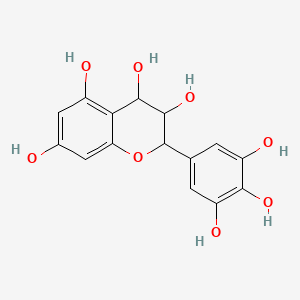 Compound
- Category
- Compound
What Leucodelphinidin is, and what it does.
- Does it work
- It's of interest to formulators and plant chemists. Where it appears on a label, what you are buying is the extract around it, so read what that extract is standardised to.
- How much to take
- No daily amount is on record, and it isn't sold as a standalone serving. Start with the serving stated for the extract that carries it, taken with food.
- Time to feel it
- No human time course has been measured for this compound. Its downstream relatives, the prodelphinidin tannins, are what most extract research follows instead.
- The first dose
- Day one is whatever the extract tastes of, usually astringent. Nothing has been measured in people on a single-dose timescale for this compound.
- With regular use
- Weeks of a polyphenol-rich extract feed the gut bacteria that convert these compounds to small phenolic acids. That conversion is the part research can actually follow.
- How well tolerated
- It's an ordinary constituent of everyday plant foods at the levels food supplies. As with other tannin-forming polyphenols, keep a large dose away from an iron serving.
- How it feels
- Astringent in the mouth when the extract is tannin-rich. No subjective effect has been described for the isolated compound itself.
- The overlooked benefit
- It's unstable in heat and acid, turning into coloured anthocyanidins, which is why you rarely see it isolated and why extracts are characterised by what it becomes.
The proof, claim by claim.
What these words mean
These words describe the research, not the molecule's worth. Research strength is how much work stands behind one claim, and it is never a product score.
- Branch point role in flavonoid biosynthesis between pigments and tanninsNarrative review
- Radical scavenging in chemical assay systemsIn vitro study
2 more claims
- Microbial conversion to small phenolic acids and valerolactones after intakeNarrative review
- Effects reported in animal models of the isolated compoundAnimal study
Why these belong in the same formula, 9 pairings
Why these belong in the same formula. Each row says what the basis is, from settled biochemistry through to a trial that measured the pair.
Flavan-3,4-diols such as leucodelphinidin carry the catechol and pyrogallol hydroxyl patterns that donate hydrogen atoms to radicals, leaving a phenoxyl radical behind. Ascorbate can reduce that radical back to the parent phenol, which is standard antioxidant network chemistry rather than anything specific to this compound. Note this is measured chemistry, not a demonstrated effect in people. No human study of the pair exists.
The B-ring of leucodelphinidin carries a pyrogallol arrangement of three adjacent hydroxyl groups, which binds ferric iron tightly. This is the same chemistry that makes tannin-rich foods reduce non-heme iron absorption when eaten with a meal. Anyone relying on plant-source iron should space it away from tannin-rich material. This is a genuine antagonism, and it is the most practically relevant interaction for this compound class.
Divalent zinc is chelated by ortho-dihydroxy and trihydroxy phenolic arrangements, though less avidly than iron. In practice this means tannin-rich plant material taken with a zinc supplement can reduce zinc uptake. Separating the two by a couple of hours removes the issue.
Flavan-3,4-diols and the proanthocyanidins they build into associate strongly with proteins, particularly proline-rich ones, through hydrogen bonding and hydrophobic stacking. That binding is what produces astringency in the mouth and it also complexes protein in a beverage. Formulators combining tannin-rich extracts with protein see haze and sediment for this reason.
Leucodelphinidin is the flavan-3,4-diol that leads to delphinidin on one branch and to gallocatechin and prodelphinidin oligomers on another. Grape seed and grape skin extracts contain those downstream oligomers rather than the leucoanthocyanidin itself. Anyone looking for what leucodelphinidin becomes in a real product is looking at proanthocyanidin content.
Tocopherol works in the lipid phase and polyphenols work at the aqueous interface, so the two occupy different compartments of the same oxidation network. Flavonoid species can contribute to regenerating the tocopheroxyl radical under laboratory conditions. This is chemistry established in model systems, and translating it to a person is a further step nobody has taken for this specific compound.
Pyrogallol-type phenolics chelate cupric copper, which can block copper-driven oxidation. But the same phenolics can also reduce copper, and reduced copper drives Fenton-type radical production. So the direction of the effect depends on concentration and on the ratio of the two, which is why polyphenols show pro-oxidant behaviour in some laboratory conditions. The relationship is genuinely two-directional.
Proanthocyanidins and their precursors bind amylase, lipase and proteases non-specifically, reducing their activity. That is one reason high-tannin plant material lowers the digestibility of a meal. It is an antagonism worth flagging for anyone taking enzyme supplements alongside a tannin-rich extract.
Higher-molecular-weight flavan-3-ol oligomers are poorly absorbed in the small intestine and arrive in the colon largely intact, where bacteria cleave them to smaller phenolic acids and valerolactones. Those microbial metabolites, not the parent compounds, account for much of what is measurable in blood after a polyphenol-rich meal. So the gut community substantially determines what a person actually gets from this class.
Nothing specific on file for Leucodelphinidin. Match the label to the daily amount above, and tell your doctor what you take.
Not medical advice. Show the label to your pharmacist.What Leucodelphinidin actually does.
Leucodelphinidin is a plant flavonoid precursor whose particular ring structure, with three adjacent hydroxyl groups, is what sets it apart from its close relative, leucocyanidin, which has only two.
3 more mechanisms
In plants, this compound sits at a real fork in the road, one enzyme pushes it toward becoming the blue-purple pigment delphinidin, while another pushes it toward becoming a tannin precursor instead. Which path wins determines whether a plant tissue ends up colored or tannic.
This class of compounds is chemically unstable at low pH and under heat, converting into colored pigments, which is why it's rarely isolated as its own ingredient, plant material containing it usually gets characterized by what it converts into instead.
Polyphenols like this aren't absorbed intact. What actually shows up in your blood after intake is mostly smaller compounds made by colon bacteria and then modified by the liver, not the original molecule itself.
Where Leucodelphinidin comes from.
A plant compound that sits halfway along the route from colourless building blocks to either the purple pigments or the astringent tannins. Because it is a halfway point rather than an end product, you never really buy it on its own.
What this route gives you
Made from a plant. What ends up in the capsule tracks the harvest, so batch testing and a stated marker matter more here than with a made molecule.
5 steps on record
Formed in plants through the flavonoid pathway, occurring in tissues that also accumulate proanthocyanidins and anthocyanins. It is a biosynthetic intermediate rather than a stored end product, so it accumulates only transiently.
Dihydromyricetin is reduced by dihydroflavonol 4-reductase to give leucodelphinidin, which then branches either to delphinidin via anthocyanidin synthase or to gallocatechin via leucoanthocyanidin reductase.
Polyphenol extraction from plant material captures the leucoanthocyanidin fraction alongside catechins and oligomers. Acid or heat during processing converts leucoanthocyanidins toward coloured anthocyanidins.
Standardisation is to total polyphenols or to proanthocyanidin content, not to leucodelphinidin, because the individual compound is not stable enough to specify reliably.
Supplied as a polyphenol extract in which leucodelphinidin is one identified constituent among many.
Products naming leucodelphinidin among their constituents almost never quantify it, and the assay they do report is usually total polyphenols or proanthocyanidins.
Getting Leucodelphinidin from food.
The whole-food sources on file. A supplement closes the gap, it does not replace dinner.
A gram-for-gram figure (how much of each you would eat to match a dose) will appear here once it is sourced and reviewed. This page will not print a number it cannot cite.
The forms it comes in.
2 more forms
The essence, in one line each.
- Phytochemical screening of Combretum indicum by UPLC-QTOF/ESI-MS combined with computational pharmacology characterised constituents and predicted antioxidant-related activity.In vitro study. Forid MS et al., 2021 (Molecules). PMID 34361788 ↗
1 more finding
- A network pharmacology analysis with cell-based validation reported anti-inflammatory and anti-apoptotic activity for the plant preparation studied.In vitro study. Zheng Y et al., 2025 (Current Issues in Molecular Biology). PMID 40699713 ↗
Chosen from the 2 we read for Leucodelphinidin.
FDA Disclaimer: These statements have not been evaluated by the Food and Drug Administration. This information is for educational purposes only and is not intended to diagnose, treat, cure, or prevent any disease. Consult your healthcare provider before starting any supplement regimen.