Magnesium hydroxide.
A magnesium salt that reacts with stomach acid, which buffers the acid and frees magnesium. Whatever isn't absorbed holds water in the bowel and softens stool.
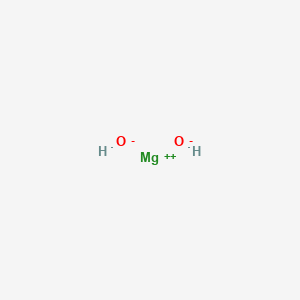 Compound
- Category
- Compound
What Magnesium hydroxide is, and what it does.
- Does it work
- Suits people who want a magnesium-dense salt and don't mind a looser stool. If you'd rather have magnesium without the bowel effect, an organic salt behaves differently.
- How much to take
- No daily amount is on record here. Start with the label serving, taken with water, since how much magnesium becomes available depends on your own acid output.
- Time to feel it
- The bowel effect usually shows up within six to twelve hours. Acid buffering is much faster, within minutes of the tablet dissolving.
- The first dose
- Day one often brings a softer, earlier bowel movement. The magnesium side works quietly, showing up over weeks rather than hours.
- With regular use
- Used daily over weeks it keeps contributing elemental magnesium to cellular stores. Regular loosening is the signal to lower the amount or split it.
- How well tolerated
- Loose stools are the usual limit. Reduced kidney function means magnesium accumulates, so that needs medical oversight. Space it away from iron and from antibiotics.
- How it feels
- Mostly you notice the bowel: softer, earlier, sometimes urgent. Used as an antacid, the easing of stomach burning is quick and obvious.
- The overlooked benefit
- By weight it is one of the more magnesium-dense salts, at roughly forty percent elemental magnesium, so a small tablet carries more mineral than a same-sized chelate.
200 to 400mg a day is where Magnesium hydroxide works.
Source: NIH Office of Dietary Supplements + Rosanoff 2012 meta-analysis
The proof, claim by claim.
What these words mean
These words describe the research, not the molecule's worth. Research strength is how much work stands behind one claim, and it is never a product score.
- bowel regularity through an osmotic effectMeta-analysis
- gastric acid bufferingRandomised trial
2 more claims
- elemental magnesium delivery per unit weightNarrative review
- magnesium status when acid output is adequateNarrative review
Why these belong in the same formula, 12 pairings
Why these belong in the same formula. Each row says what the basis is, from settled biochemistry through to a trial that measured the pair.
The hepatic 25-hydroxylase and renal 1-alpha-hydroxylase steps that convert vitamin D to its active form are magnesium-dependent, as is the vitamin D binding protein's handling of the metabolites. Low magnesium status therefore blunts the response to a vitamin D dose. This is settled biochemistry and applies to any magnesium salt that raises status, including this one.
Calcium and magnesium compete for the same paracellular and transcellular routes across the intestine, so a large single dose of one blunts uptake of the other taken at the same moment. Separating them across the day sidesteps most of it. At usual dietary intakes the competition is minor. It matters at supplement-sized boluses.
Magnesium hydroxide neutralises stomach acid, and non-heme iron needs an acidic stomach to stay soluble before it reaches the duodenum. Taking an iron supplement alongside an antacid dose of magnesium hydroxide lowers the fraction absorbed. Two to four hours of separation is the standard workaround.
Ferrous sulfate depends on an acidic gastric environment to stay in the absorbable ferrous state. Raising gastric pH pushes it toward insoluble ferric hydroxide species. This is the most clinically relevant negative pairing for anyone using magnesium hydroxide as an antacid while also correcting low iron status.
Zinc shares transport routes with magnesium and calcium at the enterocyte, and its solubility also drops as gastric pH rises. A large magnesium hydroxide dose taken with zinc reduces zinc uptake on both counts. Dose separation is the practical answer.
Food-bound B12 has to be freed by gastric acid and pepsin before intrinsic factor can bind it. Sustained acid neutralisation reduces that release, which is why long-running antacid use is linked with lower B12 status. Crystalline B12 in a supplement is not protein-bound, so it is far less affected.
Betaine hydrochloride is taken to lower gastric pH and magnesium hydroxide is taken to raise it. Taken together they neutralise each other and both doses are wasted. Anyone using both is working against themselves and should pick one purpose per meal.
The two are combined in antacid tablets because their gastrointestinal side effects run opposite ways: magnesium salts loosen stools and calcium carbonate tightens them. The pairing balances that while both contribute acid neutralisation. This is a formulation convention with a long history.
Magnesium hydroxide works osmotically by holding water in the lumen. Psyllium holds water in a gel matrix. Used together the stool-softening effect stacks and adequate fluid intake becomes more important. Worth knowing before someone doubles up without meaning to.
Magnesium depletion opens ROMK channels in the distal nephron and drives renal potassium loss, which is why low potassium that will not correct often will not until magnesium status is restored. Any salt that raises magnesium status is relevant here. This is standard clinical physiology.
A randomised trial paired L-carnitine with magnesium hydroxide in adults with elevated liver fat and reported improvements in liver-related blood markers versus control. Those are markers, not clinical outcomes, and the design cannot separate which of the two components did the work. It is the only combination trial of this specific salt worth naming.
Both raise gastric pH, bicarbonate quickly and briefly, magnesium hydroxide more slowly and for longer. Combining them stacks the pH effect and, with it, every pH-dependent absorption issue listed above. Bicarbonate also adds a sodium load that matters for some people.
Nothing specific on file for Magnesium hydroxide. Match the label to the daily amount above, and tell your doctor what you take.
Not medical advice. Show the label to your pharmacist.What Magnesium hydroxide actually does.
Magnesium hydroxide barely dissolves in plain water, it mostly dissolves by reacting with stomach acid, so how much stomach acid someone has largely determines how much magnesium becomes available to absorb.
3 more mechanisms
Whatever isn't absorbed stays in the gut as an osmotically active salt that draws water into the bowel and increases stool water content, which is the basis for its use as an osmotic laxative and why bigger doses loosen stools.
By weight, magnesium hydroxide is one of the more magnesium-dense salts, at roughly forty percent elemental magnesium, so a tablet of a given weight delivers more actual magnesium than an organic chelate of the same weight.
Magnesium is a required cofactor for hundreds of enzymes, including every ATP-using kinase, since the actual substrate those enzymes use is magnesium bound to ATP, not free ATP.
Where Magnesium hydroxide comes from.
Most of it comes out of seawater. Lime is added, magnesium falls out as a white solid, and that solid is washed and dried. Grades made for medicines are tested for purity. Industrial grades of the same chemical are not.
What this route gives you
From a mineral source, then refined and usually bound to a carrier so the body can take it up.
5 steps on record
Most commercial supply starts from magnesium-rich seawater and subterranean brines. Some routes start from mined magnesite or dolomite.
Adding lime or dolime raises pH and precipitates magnesium hydroxide out of the brine, leaving calcium salts in solution. Ore routes calcine and hydrate instead.
The precipitate is repeatedly washed to remove chloride, sulfate and calcium residues, then filtered and dewatered.
Pharmacopoeial grades are assayed for magnesium hydroxide content and screened for lead, arsenic, cadmium and residual carbonate.
Milled to a defined particle size and either suspended in water, filled into capsules or compressed with binders.
The forms it comes in.
4 more forms
The essence, in one line each.
- In a meta-analysis of studies in adults with a diagnosed blood pressure condition, magnesium supplementation was associated with a small reduction in diastolic blood pressure of about 1.6 mmHg, but had no detectable effect on systolic blood pressure or pulse rate.Systematic review, in hypertensive patients. Amer SA et al., 2025 (BMC Complementary Medicine and Therapies). PMID 40045266 ↗
8 more findings
- In older adults with a diagnosed blood-sugar condition and arterial calcification, magnesium supplementation for 6 months did not produce a detectable reduction in serum calciprotein crystallisation or arterial stiffness.Randomised trial, in older individuals with type 2 diabetes with peripheral medial arterial calcification. Meer R et al., 2026 (The American Journal of Clinical Nutrition). PMID 41903889 ↗
- In pooled trials of 496 adults with a diagnosed kidney condition, magnesium had mixed effects on measures of vascular calcification, leading the authors to conclude that more research is needed.Meta-analysis, in patients with chronic kidney disease (CKD). Zhan Y et al., 2023 (Renal Failure). PMID 36856310 ↗
- In a man in his late 50s with a diagnosed genetic condition causing low magnesium, oral magnesium supplements were not enough to maintain stable blood levels, and he required intravenous or subcutaneous magnesium.Case report, in a man in his late 50s with adult-onset familial hypomagnesaemia with secondary hypocalcaemia (homg1). Bogaert EG et al., 2026 (BMJ Case Reports). PMID 41667208 ↗
- A clinical overview of magnesium's role across enzyme systems, noting that serum magnesium is a poor indicator of total body stores.Narrative review. Schwalfenberg GK et al., 2017 (Scientifica). PMID 29093983 ↗
- A practical review of magnesium status in oncology care, covering causes of depletion and the difficulty of assessing stores from a blood draw.Narrative review. Sambataro D et al., 2025 (Nutrients). PMID 41515237 ↗
- Review of hydration protocols in which magnesium-containing regimens were among the approaches examined for kidney protection during platinum chemotherapy.Systematic review. Li J et al., 2024 (Clinical and Experimental Nephrology). PMID 37530867 ↗
- A review of raising dialysate magnesium concentration and its reported cardiovascular associations, noting the evidence is largely observational.Narrative review. Tannar B et al., 2026 (Canadian Journal of Kidney Health and Disease). PMID 42293164 ↗
- Magnesium hydroxide combined with alginate formed hybrid nanoparticles with characterised physicochemical behaviour, showing how the material behaves as a formulation component.In vitro study. Silva Filho JC et al., 2026 (ACS Omega). PMID 42146166 ↗
Chosen from the 10 we read for Magnesium hydroxide.
The studies, linked.
3 sources behind our Magnesium hydroxide verdict, every one linked to PubMed, the journal or ClinicalTrials.gov.
- Clinical trialA Phase II, Randomized, Double-blind, Placebo-controlled, Parallel Group Proof-of-Concept Trial to Assess Relief of Meal Induced Heartburn by a Combination of Lansoprazole 15 mg and Antacid Versus Lansoprazole 15 mg and Antacid (Calcium Carbonate and Magnesium Hydroxide) AloneClinicalTrials.gov ↗Phase 2, 120 participants, Completed
2 more linked trials
- Clinical trialAn Open-Label, 3-Period, Fixed-Sequence, Study to Examine the Effect of Aluminum Hydroxide/Magnesium Hydroxide/Simethicone and Omeprazole on the Single-Dose Pharmacokinetics of Tebipenem Pivoxil Hydrobromide (TBPM-PI-HBr) in Healthy Adult SubjectsClinicalTrials.gov ↗Phase 1, 20 participants, Completed
- Clinical trialEffects of 12-week Magnesium Supplementation on Peri-menopause Symptoms, Cognition, Sleep and Psychological Wellbeing - a Randomised, Placebo-controlled TrialClinicalTrials.gov ↗58 participants, Active not recruiting
From clinical trials and PubMed, ranked by study type and citation weight, not cherry-picked.
Problems people have reported.
Read this carefully. These are 61,557 voluntary, unverified reactions reported to the FDA (openFDA). The number mostly reflects how popular Magnesium hydroxide is, not how risky it is. A report is not proof Magnesium hydroxide caused anything. It is a signal of what to watch for, nothing more.
3 more reported effects
Source: openFDA adverse-event reports. Voluntary reporting, not an incidence rate.
FDA Disclaimer: These statements have not been evaluated by the Food and Drug Administration. This information is for educational purposes only and is not intended to diagnose, treat, cure, or prevent any disease. Consult your healthcare provider before starting any supplement regimen.