N-phenylacetyl-L-prolylglycine ethyl ester.
A synthetic peptide-type compound from the pyrrolidone nootropic family, studied for memory and attention. It is registered as a prescription medicine in Russia.
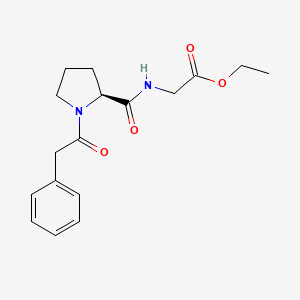 Compound
- Category
- Compound
What N-phenylacetyl-L-Prolylglycine ethyl ester is, and what it does.
- Does it work
- This suits people following the pyrrolidone nootropic literature. It has no dietary ingredient status in the United States, the United Kingdom or the European Union.
- How much to take
- No daily amount is on record, so we won't put a number on it. As a registered prescription medicine in Russia, its dosing sits with a prescriber.
- Time to feel it
- No reliable timeline is published for a supplemental amount. The Russian clinical work followed cognitive measures over weeks rather than after a single dose.
- The first dose
- Day one has no documented pattern outside a prescribing setting. First-day descriptions circulating online are user report rather than measured data.
- With regular use
- Weeks of use have only been characterised in the Russian prescription literature, which tracked cognitive test scores rather than how people said they felt.
- How well tolerated
- Tolerability outside prescription supervision hasn't been characterised, and it holds prescription medicine status in Russia. Talk to a clinician before considering it.
- How it feels
- Users report a mild lift in mental clarity, sometimes headache or irritability. That is self-report rather than measured, so hold it loosely.
- The overlooked benefit
- What you swallow isn't what acts. Esterases strip the ethyl ester, and cycloprolylglycine, a cyclic dipeptide that occurs in brain tissue, is the proposed active species.
The proof, claim by claim.
What these words mean
These words describe the research, not the molecule's worth. Research strength is how much work stands behind one claim, and it is never a product score.
- Memory and attention measuresRandomised trial
- Cognitive performance in adultsNarrative review
1 more claim
- Learning behaviour in rodentsAnimal study
Why these belong in the same formula, 6 pairings
Why these belong in the same formula. Each row says what the basis is, from settled biochemistry through to a trial that measured the pair.
Alpha-GPC is paired with racetam-family compounds on the reasoning that cholinergic supply should keep up with any cholinergic demand the other compound creates. That reasoning comes from user practice and from the older piracetam literature rather than from any study of this dipeptide. No trial has tested the combination. It is convention, and it should be labelled as convention.
Citicoline is the other standard cholinergic partner in this category, chosen for the same reason as alpha-GPC and differing mainly in that it also supplies cytidine. Products combine it with racetam-family compounds as a matter of habit. There is no combination data involving this specific dipeptide. Read it as formulation practice.
Theanine is added to nootropic stacks to take the edge off subjective overstimulation, a use inherited from the caffeine and theanine pairing. Whether that transfers to this compound has not been tested. Anyone reporting irritability from a stack is describing an outcome that has not been characterised in a trial. This row exists because the pairing is common, not because it is supported.
Caffeine appears in the same stacks by default rather than through any shared pathway with this dipeptide. Stacking two agents that each affect subjective alertness makes any adverse response harder to attribute to one of them. That attribution problem is the practical reason to name the pairing. It is co-use, not synergy.
The molecule is a phenylacetyl-prolyl-glycine ethyl ester, so glycine is one of the amino acids released when esterases and peptidases break it down. That makes glycine a metabolite rather than a partner. Naming it clarifies the structure for anyone reading the chemical name. It is not a reason to combine the two.
Proline is the second residue in the dipeptide backbone and appears in the cyclic prolylglycine fragment produced on hydrolysis. As with glycine, this is chemistry of the molecule rather than a stacking recommendation. Both amino acids are abundant in ordinary protein intake. The relationship is descriptive.
Nothing specific on file for N-phenylacetyl-L-Prolylglycine ethyl ester. Match the label to the daily amount above, and tell your doctor what you take.
Not medical advice. Show the label to your pharmacist.What N-phenylacetyl-L-Prolylglycine ethyl ester actually does.
This is a fully synthetic compound, designed as a peptide version of the pyrrolidone class of cognitive drugs, and it was never isolated from anything natural.
3 more mechanisms
After you absorb it, general enzymes in the body cleave off part of the molecule, so what you swallow is a prodrug, not the form that actually circulates.
Small peptides like this get broken down by enzymes in the gut and liver, which is why other routes, like under the tongue or through the nose, are discussed for this chemical class.
This is a synthetic drug developed and registered as a prescription medicine in Russia, and it doesn't have dietary ingredient status in the US, UK or EU.
The forms it comes in.
1 more form
FDA Disclaimer: These statements have not been evaluated by the Food and Drug Administration. This information is for educational purposes only and is not intended to diagnose, treat, cure, or prevent any disease. Consult your healthcare provider before starting any supplement regimen.